Back in the early 1990s when I was a poor graduate student, I used to stay home on Saturday nights and watch my little black-and-white TV. I couldn’t afford cable, of course, but thankfully there was always PBS, so I watched a lot of documentaries and episodes of Great Performances. On one such night, I saw a filmed performance of Peter Brook’s stage play The Mahabharata. The play is, of course, a dramatic adaptation of the great Hindu epic, the tale of a feud between two groups of royal cousins, the Pāṇḍava princes and their arch-nemeses, the Kauravas. As epic tales are wont to do, the feud escalates into a civil war so catastrophic that even the gods are pulled into the conflict (in the same way that the Greek gods Mars, Apollo, and Venus involve themselves in the The Illiad).
Being a filmed staged play, Brook’s TV version is low on special effects (this was before CGI) but packed with minimalistic, highly-stylized interpretations of sweeping battles, multi-armed demons, and flying chariots. Somehow, it all works, and I found myself obsessed with both the film and the story. A few years later I would finally read a popular translation of The Bhagavad Gita, which is really just one portion of the much larger Mahabharata.
In this latest episode of Read a Classic Novel…Together!, Margaret and Ash discuss the first half of George Eliot’s 1872 classic Middlemarch. We discover that Eliot was not even a man (her real name was Mary Ann Evans) and that she was probably everyone’s favorite, super-smart aunt of the 19th Century. Also, we agree that the characters of Fred and Rosamund are not-so-great people (especially Fred, who is a real jerk). Bonus: Margaret looks up the word “pillulous” in her big-damn dictionary and reveals its actual meaning. (Hint: if “The Matrix” had been made in the 1870s, Neo would have taken the red pillulous.)
Ah, how the tide turns. Back in the 1990s, The Dave Matthews Band bestrode the music world like a colossus. With their incredibly inventive and fresh jazz-rock stylings and bewitching lyrics by frontman Mathews, they were one of the most popular bands in the world, and deservedly.
Now, for reasons I can’t quite understand, they are considered passé, even ridiculous. The Nickelback of the soft-rock world. Oh, well. I have a feeling that DMB’s popularity will enjoy a resurgence soon. Here’s my attempt to get the ball rolling with “The Last Stop,” one of the darkest and most menacing songs I’ve ever heard.
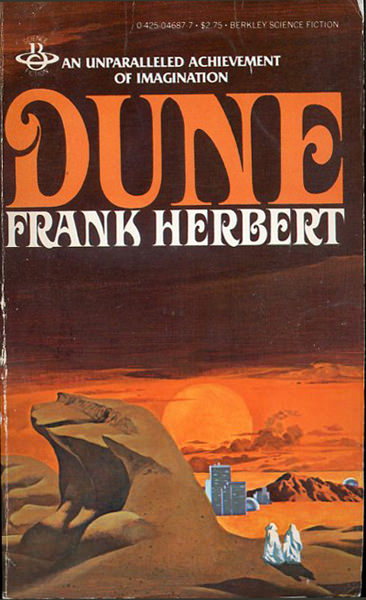
Frank Herbert’s Dune is arguably the most successful science fiction book ever published, kicking off a series that (thanks to his son and other writers) continues to this day. Actually more a work of epic science fantasy than hard sci-fi, it was amazingly inventive and original, and it surely would have been a huge hit regardless of how it was packaged. However, I personally believe that its success was greatly increased by the brilliant marketing work done by Berkley Books in the 1970s. Specifically, their brilliant use of a font called Davison Art Nouveau that, with its swirly, vaguely Arabian vibe, perfectly captures the spirit of the books. The font was also used on all the sequels, creating a visual unity for Berkley’s Dune brand.
Even more striking, to me, was the sublime cover art by the legendary Vincent Di Fate. This is the edition of Dune that I read in high school, which means I’ve been looking at for four decades, and I never once suspected that it was done by Di Fate. Di Fate was, after all, a sci-fi artist primarily known for his space opera-style covers. He was already famous for these back in the 1970s, so much so that I my parents gave me a book of his cover art for Christmas one year. (Yeah, I was that nerd.) But his cover for Dune seems totally atypical for him.
Nonetheless, it’s a great cover. Putting a dune on the cover of Dune might seem like a no-brainer, but Di Fate’s choice here really gives the reader a sense of the book’s setting—the mysterious, pitiless desert planet of Arrakis. And if there was ever a novel where the setting becomes a character in and of itself, it’s Arrakis. The ghostly white figures depicted are obviously Fremen, the fierce native people of the story (never mind the fact that the Fremen in the book where black still-suits and not white robes). The fact that they seem to be crossing out of the desert and into the town is significant, too, because so much of novel involves the intersection of wilderness and civilization (the desert people being more “civilized,” in some ways, than those of the town).
I love David Bentley Hart. He’s not only a great writer and philosopher, he’s a wonderful speaker and explainer of big, complicated ideas (actually, the biggest and most complicated ideas imaginable). He also has a scathing wit and a talent for skewering stupid ideas masquerading as wisdom.
I’ve read a lot of Hart’s work, and watched many of his interviews on Youtube (there are a ton of them). My favorite is posted above, and I encourage everyone to check it out. However, if you’re new to DBH’s work, you might find yourself frantically looking up a lot of terms that frequently come up. (I still do.) So, in order to ease the transition, here is a handy cheat-list of some of the more important ones:
Ontology – The philosophical study of being itself, especially in the questions of why is there something rather than nothing and does God exist.
Dualism – The idea that human beings are composed of two fundamental, separate things: mind and matter. This concept is most closely associated with René Descartes (i.e., Cartesian Dualism) and his famous statement, “cogito, ergo sum” (“I think, therefore I am”). Dualism is usually contracted with monism, the notion that all aspects of human life are reducible to one fundamental thing (typically, the physical laws of nature).
Materialism (a.k.a. Reductionism, Physicalism) – The notion that all aspects of human life, including consciousness, can ultimately be explained by scientific laws. That is, the fundamental forces of nature (gravity, electromagnetism, the strong force), genetics, Darwinian evolution, etc.
Apophatic – The idea that, because God (if He exists) is ineffable and beyond human comprension, we can only talk about Him in terms of what He is not rather than in terms of what He is (i.e., Cataphatic theology). For example, we can say that God is neither male nor female (despite the fact that most people use a male pronoun). But we can’t really say what His nature is.
Contingent – The concept of contingency refers to the fact everything in the physical universe exists as a result of something that came before it (including, ultimately, the Big Bang). THis becomes important in the so-called Ontological Arguments for the existence of God.
Thomist – The adjective used to describe ideas that derive from those of St. Thomas of Aquinas. (It’s pronounced TOME-ist.)
Qualia – Qualia is a fancy word used by philosophers–especially those concerned with the so-called Hard Problem of Consciousness–to describe feelings. That is, what it’s like to be conscious and experience things as a living being, and how is this possible.
Panpsychism – the ancient idea that all things–even those things we usually call inanimate–might have some kind of consciousness.
Apokatastasis – A Greek work referring to the restoration of all creation to a divine state. In some Christian philosophical schools of thought, it also refers to the eventual salvation of all souls (even those in hell, including the Devil). Hart has written extensively on this subject in his book That All Shall Be Saved.
I recently found myself in the so-called “green room” of a TV studio in Biloxi, Mississippi, waiting to be interviewed about a book-reading I was doing that week. The interview was to air live on a local current events show, and another guest waiting for his spot was a musician for a band called The Molly Ringwalds. He was friendly and very smart, and we began to chat (I did so to relieve my nervousness; he was just being nice).
In the course of conversation, he explained that The Molly Ringwalds (as I should have guessed, but didn’t) is an 1980s tribute band that covers all kinds of hits from that by-gone era, which I also love. I asked him if they did any songs by The Smiths, and he said they did.
“Which one?” I asked.
“‘How Soon is Now?’ What else?”
What else, indeed. “How Soon is Now?” is not only The Smiths’ greatest song, it’s one of the greatest rock songs ever. It’s also one of the most complicated. From its famous guitar overture, warbling and full of dark menace, to its anguished lyrics by the brilliant Morrisey, “How Soon is Now?” is both a dance song and a dirge. It’s also a cry of rebellion against conformity, prejudice, and alienation.
Since it first hit the clubs in 1985, the song has been taken up as an anthem by the LGBTQ community, and rightly so. But I think it resonates equally well with any introvert, outcast, or general freak who just, well…needs to be loved.
I had a really good chat with Ms. Karen Abernathy on WLOX’s Four O’Clock Show out of Biloxi. It was a blast. Many thanks to her and the whole WLOX team!
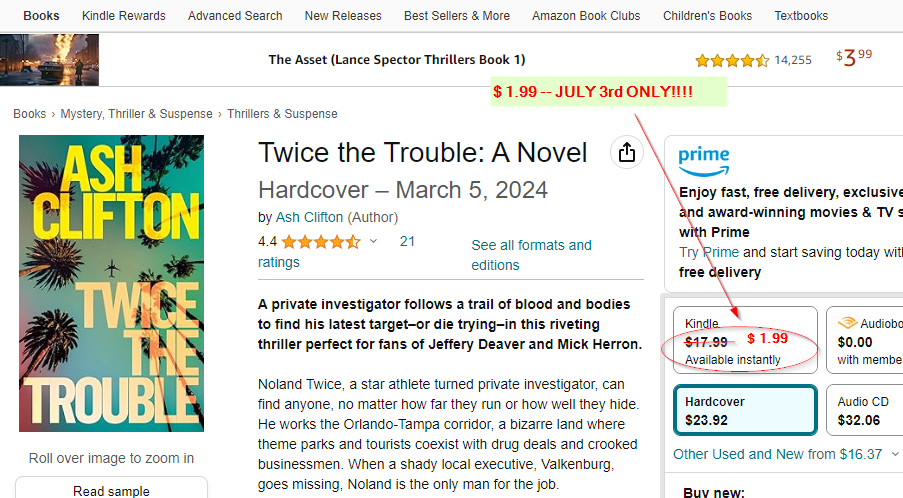
Heads Up!!! For today only, Twice the Trouble will be on sale for $1.99 on Amazon Kindle!!! Yes, you read that correctly. $1.99!!! Not even 2 bucks! Cheap!!! Buy it for your ma! Buy it for your pa! Buy it for your Significant Other! Buy it for your ex! Buy it for your Significant Other’s ex! Just buy the damn thing! Buy buy buy!
I’ve been meaning to post this for a while (sorry, I’m a flake). Marshal Zeringue has (another) really cool web site called The Page 69 Test, where he invites writers to turn to page 69 of their latest book and write about it. It’s actually a lot of fun! Here is my entry (for which I am grateful to Mr. Zeringue for inviting me to write).
The 1990s gave us two great, new genres in popular music. The first was Grunge, and the second was Big Beat. I’ve written a lot about the first but hardly anything on the second, even though it represented some of my favorite electronic bands like The Prodigy and The Chemical Brothers.
So, as a small acknowledgement of this fact, I’m doing this week’s Friday Night Rock-Out on Fatboy Slim. Specifically, his remix of “Brimful of Asha” by Cornershop. I’ll admit that I’ve never heard the original release, but the remix is pure genius.