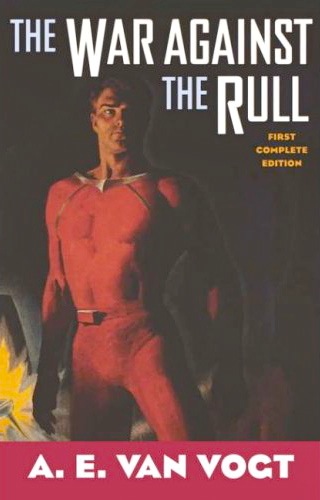
Classic Sci-Fi Book Cover: “The War Against the Rull”

This entry in my on-going Classic Sci-Fi Book Covers series is both old and new. That is, it’s a modern touch-up of the cover from the October 1949 edition of Astounding Science Fiction painted by Hubert Rogers. That issue included a work by A.E. van Vogt, but not the one we are interested in here. This modern version is from a 1999 edition of van Vogt’s classic sci-fi novel, The War Against the Rull, which I distinctly remember devouring in two days when I was in eighth-grade.

I like this cover a lot. It’s not just a classic. It’s an archetype. Specifically, the archetype of the heroic (America) scientist, a buff intellectual and polymath whose ilk could be found in countless works of Isaac Asimov, Robert Heinlein, Roger Zelazny, and on an on. In The War Against the Rull, the man is Dr. Trevor Jamieson, a brilliant scientist who is also a fierce warrior and survival-expert. He’s stranded on an alien planet with a huge, six-legged, intelligent creature called an ezwal who wants to kill him. But when both Jamieson and the ezwal encounter a mutual enemy—a race of aggressive, centipede-like aliens called the Rull—they decide to work together to survive.

It’s a great story, like so many from the sci-fi’s Golden Age. I’ve written before about why sci-fi novels from that era are so much more enjoyable (to me, at least) than most of those written in the last ten years or so. I think it has to do with the gritty humanity of such stories. Yeah, Jamieson is essentially a comic-book character (think Doctor Quest and Race Bannon rolled into one), but van Vogt does a great job of making you believe he’s in real trouble. The ezwal, too—he’s a compelling character in his own right. You get involved in the desperate nature of their situation, and you keep reading to see how they will get out of it.

Anyway, check it out if you can…
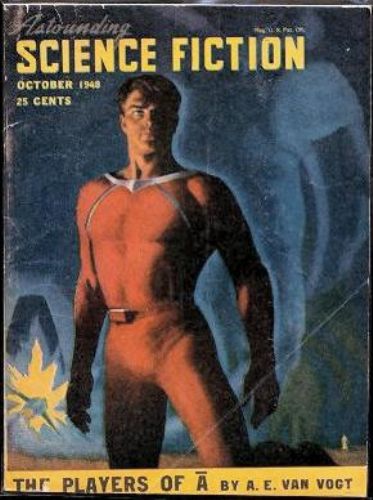
Original Cover from Astounding
Cover from the 1970 edition that I read as a kid (by artist John Schoenherr)
Another version of the Scientist Hero Archetype (by artist James Bama)

Classic Sci-Fi Book Cover: “This Immortal”

My privious entry in this continuing “Classic Sci-Fi Book Covers” series was also devoted to Roger Zelazny, so please forgive me for double-dipping into the Zelazny well. But I couldn’t resist talking about one of Zelazny’s other great novels, …And Call Me Conrad—published in 1966 as This Immortal. Most people have never heard of it, but it’s an interesting book for several reasons.

For one, it was Zelazny’s first novel, and it has many of his signature obsessions (e.g, ancient mythology mixed with science fiction; a wise-cracking anti-hero who is also an Übermensch; epic fight scenes; etc.). For another, it actually won a Hugo Award, tying in 1966 with a slightly better-known book…Frank Herbert’s Dune. And finally, it’s just a hell of an entertaining adventure tale.

I chose this cover (by fantasy artist Rowena Morrill) because it really captures the sense of the book’s main character, Conrad Nomikos, a world-weary man-of-mystery who might be immortal. (The text suggests that he is at least a century old, and hints that he might be several thousand years older still.) He works as director of a government agency tasked with protecting and preserving the surviving relics of a destroyed earth. A nuclear war referred to by the characters as “The Three Days” has occurred many decades before, leaving most of the planet uninhabitable. The survivors, which include a wide variety of mutants both human and animal, live mainly on islands like Greece, Conrad’s home.

And that’s not even the main subject this wild, wild little book. Conrad is assigned the duty of escorting a group of VIP tourists—including Cort Myshtigo, an alien from the Vega star system whose race has purchased earth as a kind of vast museum—as they tour the planets once great sites (now ruins). Conrad soon realizes that another of the tourists, an Egyptian assassin named Hassan with whom Conrad has befriended in the past, is secretly on a mission to kill the Vegan. Hassan, it seems, has been hired for this task by an obscure, underground political group who want to reclaim earth for humanity. So, Conrad finds himself not only being a tour-guide but also an unpaid protector of Myshtigo—who he hates.

It’s a crazy book, and the cover conveys this craziness well. Though the edition is from 1980, the cover really feels like a 1970s cover, with its vaguely photorealistic painting of a ruggedly handsome dude with great hair (think Roger Staubach in his prime). I also like how Morrill works in the other tropes of the book—its setting among Greek ruins, as well as the presence of some mythological creatures in the background (which, the reader eventually learns, are actually just animals that have been mutated by radioactive fall-out).

It’s a very dated cover, but still a really cool one. Classic, one might say…

What I’m Reading: “Night. Sleep. Death. The Stars”

Ever since I read her famous short story “Where Are You Going? Where Have You Been?” in college, I have loved Joyce Carol Oates. I continued to read her short stories through the 1980s and 90s, and my admiration only grew. She seemed to combine the style and critical eye of other great practitioners of modern realist fiction (think John Updike, Phillip Roth, John Cheever) with her own particularly empathic sensibility. 

Empathic, yes, and also brutal. Oates writes about working class people in dire straights, including physical danger. Her female protagonists, especially, often face the threat of violence and even death (several of Oates’s stories involve rapists and serial killers). But even in these heightened situations, the primary threat is the internal, psychological one. For Oates, the real adversary is the self—that is, ourselves, with all of our passions and desires and resentments and jealousies. 

And fear, of course. Fear is the greatest enemy in Oates’s imagined world, and overcoming fear, in all of its manifestations, is the greatest achievement of any Oates character. And so it makes perfect sense that the opening scene of her epic novel, Night. Sleep. Death. The Stars, would present the reader with a man engaged in an act of actual heroism. John Earle “Whitey” McClaren is the patriarch of an big family in Hammond, New York. His five children, all grown, are pillars of the community, and Whitey himself was once mayor of the Hammond. But when he spots two police officers brutalizing an Indian man on the side of the road, he pulls over and intervenes. The cops turn their fury on him, and he is brutally beaten. Whitey ends up in a coma, with his family gathering around him in the hospital. I don’t think I’m spoiling much when I state that White doesn’t survive his ordeal. And his death, in turn, impacts all the members of his family, from his devoted wife, Jessalyn, to his five adult children. 

But instead of writing just another book about the grieving process—a so-called aftermath novel—Oates describes a series of titanic transformations that take place in each individual over the following two years. Flannery O’Connor once wrote that fiction is about the mystery of personality, and Oates seems to confirm this in the way she reveals how Whitey’s loss “breaks” the each of his children’s personalities. Like crystals, they all fracture along unique and unpredictable fault lines, and that’s the genius of Oates’s novels. Some of the children find themselves growing spiritually and sexually (with lots of missteps and false starts), while others spiral down into paranoia and bitterness. Jessalyn, Whitey’s widow, works her way through survivor’s guilt to find new love with a Hispanic liberal photographer who is as different from Whitey as a man could be (at least on the surface; spiritually, they are similar, as Jessalyn soon realizes). 

One common shortcoming of big, third-person novels with many view-point characters is that some of those characters blur together. But Oates renders each of these people so vividly and convincingly that, by the end of the book, they feel as real to us as…well…someone in our own family. This is, I think, the highest achievement of fiction—to make us feel what it’s like to be another human being. 

And (oh yeah) the book is funny as hell. 

Check it out….