
Synchronicity for Bookworms: Sherlock Holmes and George Eliot

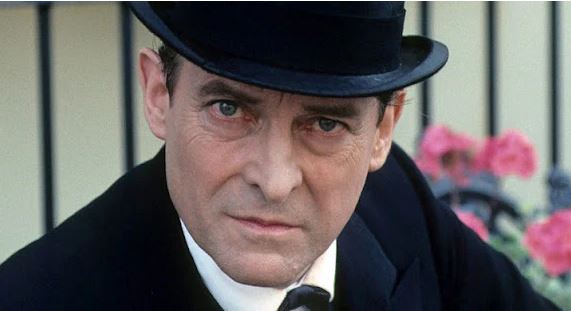
Jeremy Brett as Sherlock Holmes

It’s time for another entry in my ongoing series Synchronicity for Bookworms. In this episode, I will describe the incredibly tenuous and yet undeniable connection I found between the great stage and film actor Jeremy Brett and George Eliot’s classic Victorian novel Middlemarch

As you might recall, I recently did a blog post on Arthur Conan Doyle’s classic mystery novel, The Hound of the Baskervilles. In that post, I mentioned that my favorite actor to ever play the role of Sherlock Holmes was Jeremy Brett. While I was writing the post, I browsed various Internet pages pertaining to Brett. Brett was primarily a brilliant and prolific stage actor, appearing in everything from Shakespearean Tragedy (check out his performance as Macbeth on YouTube) to comic theater. 

Rex Harrison

On one page, I found a photo of Brett standing in front of a billboard advertising a play in which he was appearing. As I looked closer at the image, I saw that Rex Harrison was also in the play. (As I later discovered, the production was a revival of Frederick Lonsdale’s “Aren’t We All?” that ran on Broadway in 1985.) This revelation made me smile because I am also a fan of Rex Harrison, ever since I read a biography of him a decade ago.

Naturally, I immediately went to the Wikipedia page for Rex Harrison and browsed through his biography. This included his great filmography. One of the more famous films he starred in was Blithe Spirit, a supernatural comedy based on a play by Noël Coward. I clicked on the link to the Wikipedia page for Blythe Spirit (the play) and discovered that Coward took the title from a poem by the great British romantic poet Percy Bysshe Shelley

Naturally, I then clicked on the link to Shelly’s Wikipedia page and browse through his biography. Reaching the bottom of the page, I saw to my amazement that George Eliott had based the character of Will Ladislaw from her great novel Middlemarch on Shelley. 

Percy Bysshe Shelley

And there you have it, a cosmic filament connecting two of my recent topics—Sherlock Holmes and George Eliot. When my eyes settled on this last reference to Middlemarch, a little spark of amazement ran down my spine. That’s the sensation one gets when stumbling upon the sublime, hiding in the common-place.

Note that this was not some Six Degrees of Seven Bacon thing. That is, I was not looking for any connection. In fact, Middlemarch wasn’t on my mind at all when I started Googling Jeremy Brett. And yet, there the connection was.

I don’t know if it means anything or not. But it made my day.

Great Mystery Novels: “The Hound of the Baskervilles”

*** SPOILERS BELOW ***

It feels a little silly, writing SPOILERS BELOW considering I am discussing a novel that came out 123 years ago. Is it possible that any reader of this blog—or, for that matter, any book nerd over the age of thirty—is not already familiar with the plot of The Hound of the Baskervilles? Even those who haven’t read the book have probably seen the movie in one of its many incarnations over the decades. I first saw the Basil Rathbone version from 1939 (which is free on Youtube) when I was about ten years old. This was about the same time my mom gave me a faux-leather bound edition of the complete Sherlock Holmes collection, which I read and re-read many, many times. And the work I re-read the most was The Hound of the Baskervilles (henceforth, HOTB).

Which might lead one to ask: Why would anybody re-read a mystery? After all, the whole point of a mystery is to figure whodunnit, right?

For the average mystery, this is largely true. But the great mysteries—like great books of any kind—operate on many levels and hold different kinds of appeal. For me, the very best mystery novels are character-driven, with a vivid setting and a lot of drama that stands above mere plot mechanics. HOTB  is such a novel.

Continue reading “Great Mystery Novels: “The Hound of the Baskervilles””

Sherlock Holmes was a Fixer

ScandalBohemia

With all the innumerable recent scandals that have erupted over the last decade or so, I find myself wondering when, exactly, did the term “fixer” enter the national lexicon?

Recently, Donald Trump’s personal lawyer, Michael Cohen, was referred to as a “fixer” by the national press. Similarly, the popular TV show Ray Donovan is about a “fixer”. As far as I can tell, the term “fixer” denotes any ostensibly legitimate person—usually a lawyer but sometimes a private investigator—who can be called upon to act a kind of bridge between the underworld and the legitimate world. His mission is (usually) to stifle some impending scandal or P.R. disaster. (In Cohen’s case, it was arranging the payment of hush-money to women who had had affairs with Donald Trump.)

Of course, there is nothing new about this concept of a “fixer”; only the name is new. In fact, any student of classic literature will recognize that on at least one occasion the great fictional detective Sherlock Holmes played exactly the same role as Michael Cohen (albeit with a just a bit more intelligence and wit).

Continue reading “Sherlock Holmes was a Fixer”