
Last year, I wrote a post about a fine non-fiction book called Paperbacks from Hell: The Twisted History of ‘70s and ‘80s Horror Fiction. I enjoyed the book primarily for the way the author, Grady Hendrix, mixes his obvious love of old, pulpy horror novels with an enormous amount of mockery and snark. Basically, he makes fun of the trends that ran through horror fiction back in the day, as well their emphasis on over-the-top gore and hilariously silly plots.
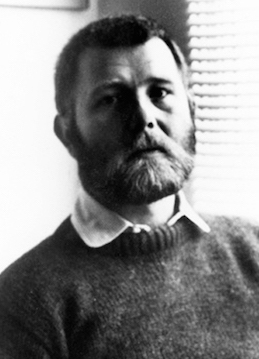
As I read the book, though, I noticed Hendrix mention one writer whom he does not mock: Michael McDowell. Rather, Hendrix uncharacteristically bestows a bit of praise on this particular novelist, which made me curious as to why I had never heard of the dude.
As it turns out, most people haven’t heard of McDowell, even though he was a very respected paperback fiction writer (Stephen King called him one of the best) as well as a successful screenwriter (he wrote the screenplays for Beetlejuice and The Nightmare before Christmas, as well as a lot of TV shows). I, especially, should have heard of McDowell considering he was, like me, a Southern writer—from the Gulf Coast of Alabama, not far from where I spent my summers in Pass Christian, Mississippi. He was also a writer who tried to blend a literary sensibility with an appreciation of genre narrative, which is an achievement which I admire.
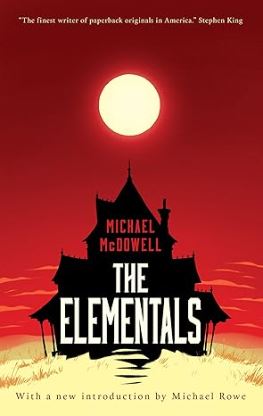
McDowell died in 1999, a latter casualty of the AIDS epidemic in America, just a few years before reliable HIV treatments came into common use. In the years since, his reputation seems to have grown, steadily if slowly, to the point where he is now considered a forgotten master. I was surprised to find an e-book edition of his most famous novel, The Elementals, on my local library’s Overdrive site, and I immediately checked it out and tore into it.
It’s definitely worth the read. Set in Alabama, it tells the story of a two wealthy, intermarried families: the Savages, with matriarch Marian and her adult son, Dauphin; and the McCrays, with matriarch Big Barbara and her adult children, Luker (who has a thirteen-year-old daughter, India) and Leigh (who is married to Dauphin Savage). At the start of the book, Marian has just died and the rest of the blended family is attending her funeral:
In the middle of a desolate Wednesday afternoon in the last sweltering days of May, a handful of mourners were gathered in the church dedicated to St. Jude Thaddeus in Mobile, Alabama. The air conditioning in the small sanctuary sometimes covered the noise of traffic at the intersection outside, but occasionally it did not, and the strident honking of an automobile horn would sound above the organ music like a mutilated stop. The space was dim, damply cool, and stank of refrigerated flowers. Two dozen enormous and very expensive arrangements had been set in converging lines behind the altar. A massive blanket of silver roses lay draped across the light-blue casket, and there were petals scattered over the white satin interior. In the coffin was the body of a woman no more than fifty-five. Her features were squarish and set; the lines that ran from the corners of her mouth to her jaw were deep-plowed. Marian Savage had not been overtaken happily.
Even for a funeral, it’s a very dreary and ominous affair. Yet it gets worse when, at one pre-arranged moment, Dauphin rises and stabs a ritual knife into his dead mother’s chest. Yeah, it’s that kind of book. The fact that McDowell can pull it off and still maintain a high-level of physical and emotional realism—not to mention vivid, sharp writing, as in the passage above—is a testament to his mastery.
The book gets even weirder after the funeral, when the family retreats to their ancestral vacation spot, a tiny barrier island called Beldame, taking with them their Black maid, the long-suffering (and very smart) Odessa. We soon learn that there are three houses on Beldame, yet the family occupies only two of them, leaving the third abandoned. (You can probably guess the reason why, but it has something to do with the house’s intermittent habit of…well…eating people.)
As the sand-dunes slowly encroach and bury it, the empty house attracts the curiosity of the young and intrepid India McCray, who ventures inside and sees something impossible yet real. And terrifying.
Of course, The Elementals isn’t just a generic ghost story, nor a generic Southern Gothic novel. The characters are vividly drawn, sympathetic, and believable. Their conversation is fraught with age-old tensions and resentments, yet it’s often very funny in a Curb Your Enthusiasm kind of way. And the characters of India and Odessa are especially well-realized. Linked by their intelligence and, as McDowell implies, some kind of psychic power reminiscent of The Shining, each comes off as a kind of hero in their battle against the evil hiding (rather obviously) in House #3.
The Elementals is a literary horror novel, meaning that it bridges the gap between genre story-telling and development of realistic characters. The book really comes to life (forgive the pun) in the chapters about India as well as of the adult male characters, Luker and Dauphin, both of whom struggle—in true Southern fashion—with the dark legacy of the past and especially surround their own family. Self-indulgent, smothering matriarchs like the recently deceased Marian are, in particular, a source of psychological revulsion. Indeed, they are central to the main theme of the novel, which I will not spoil here.
There is also a good amount of subtle criticism about the racial divide that existed at the time (and now) in the deep south. Odessa, the Black maid, is the only character who does any real work in the book, busy doing the cooking and cleaning for the affluent Whites, just as she has done (we are told) for thirty years. And, of course, Odessa is not only smarter than most of the family members (except, perhaps, for India) she is the only one who knows what the hell is going on in House #3, using her power of second-sight as well as (it is implied) a familial knowledge of voodoo.
Yes, as many reviewers on Reddit have observed, Odessa is an instance of the Magical Negro Trope, of the sort that genre writers, both Southern and not, have abused for a century. This trope is, of course, a literary stereotype, and like any stereotype it can be harmful if taken too far and left unexamined. But if Odessa is a Magical Negro, she is a very world-weary and snarky example, with both courage and brains. I simply loved her character. Sue me.
In fact, I loved the whole book, which feels a bit like a mash-up of Tennessee Williams and Stephen King. Check it out. It deserves some attention. Better late than never.

 Ash Clifton, Writer