Sometimes you just have to go back to basics. And what could be more basic than the definitive punk-rock song of all time?
Some things you might not know about the Sex Pistols: 1.) Their original name was The Pistols. Their favorite venue was a club called Sex. The rest is history. 2.) They only had one studio album. 3.) They broke up on stage in San Francisco on their one and only U.S. tour. 4.) John Lydon was given his nickname, Johnny Rotten, for his bad teeth (allegedly).
Also, Billy Idol uses the opening lines of “Anarchy in the U.K.” as the opening lines for his excellent memoir Dancing with Myself. Who am I to argue with Billy Idol?
I learned many things from reading the excellent nonfiction book Would You Baptize an Extraterrestrial? For instance, I learned that the Vatican has its own astronomical observatory, which is run, in part, by the authors, Guy Consolmagno and Paul Mueller. Both men are also Jesuits. (The current Pope, Francis, is also a Jesuit—that’s another thing I learned).
Now, I was raised Catholic, and I thought a knew a thing or two about the religion. But not only did I learn from this book that the Vatican has its own observatory, but that it has had one for hundreds of years. In fact, I was so taken by this discovery that I Googled “Vatican observatory” and, to my amazement, found that the Vatican also runs an observatory in Tucson, Arizona.
Talk about synchronicity! When I was twenty-two years old, I went off to attend grad school at the University of Arizona, in Tucson, and I distinctly remember the first night I spent there. I impressed by the size of the city—much larger than my little hometown of Gainesville, Florida—but also by how beautiful the desert sky was. Even in the downtown area, the stars were clearly visible. This was no accident; the city, I was told, purposely kept the streets relatively dark, in deference to the many astronomical observatories that surround the valley, which could not function if too much light pollution bled from the metro area.
Apparently, the Vatican’s observatory is one of them.
If you’re old enough to remember the early 1980s, you probably know that there was a time when Sting was more than just a meme, and The Police were the greatest rock band in the world. When I say greatest, I mean by almost any measurable component—records sold, concerts sold out, number of MTV plays in any given week, number of magazine articles written about them, etc.—they were at number one. (The only artists who could really give them a run for their money were Michael Jackson and Madonna, and I don’t count either of them as rock artists, though I love them both, especially Madonna.)
Heck, I’m old enough to remember when The Police, themselves, weren’t a rock band, either. They were more of a punk, reggae-adjacent garage band. And that period was, imho, their peak. Yes, “Every Breath You Take” is a classic—arguable the most successful rock song of the 20th Century—but it came out on what was, in some ways, The Police’s least interesting album, Synchronicity. Their very best songs, I think, come from earlier albums, including this one about a guy who, well, can’t stand losing…you.
On those rare occasions when I choose to read a big, fat, thick-as-a-brick book about a famous person, I usually pick one about a politician. David McCullough’s Truman is a great example. I tend to gravitate toward books about political figures because, in the course of reading about their lives, you also get a free history lesson. That is, the story of Harry Truman is also the story of World War II, the atomic bomb, Korea, the founding of Israel, and the Berlin Wall.
Biographies of artists are more problematic, for me. I just finished reading de Kooning: An American Master, by Mark Stevens and Annalyn Swan. It chronicles the long life of the great painter—a life barely contained within the span of the Twentieth Century—in which de Kooning lived to be the celebrated, Grand Old Man of modern American art. He became, in fact, the only American artist whose figure and reputation approached those of Picasso.
Have I no shame? Not a shred! Therefore, I am letting everyone know that the Kindle edition of my Edgar-nominated novel, Twice the Trouble, is currently on-sale for two Ameros! If you like mystery fiction, or want to support this blog, please buy a copy.
I am very honored (not to mention shocked, amazed, and overwhelmed) to have received an Edgar Award nomination for Best First Novel by an American Author. Many thanks to the Mystery Writers of America, Crooked Lane Books, and my outstanding agent, Cindy Bullard of Birch Literary.
I am also humbled to be in such fine company. The other five nominees have written some truly great books.
It has been a week since David Lynch passed away, and many great tributes have already been written about him. I’m tempted to say that I needed a week to process his passing and figure out what I wanted to say about him, but the truth is I was just too damned busy to write anything. In fact, I knew instantly what I wanted to say—simply, that Lynch was a very important person in my life, and in the lives of many of my friends.
I was a college English major in 1986 when Blue Velvet came out, and it hit me and my circle of arty friends like an atomic blast. I already knew of Lynch’s work (I was one of the few kids to see The Elephant Man, and in an actual movie theater, no less), and I knew that he was a director of enormous visual and thematic power. But even I was unprepared for Blue Velvet. On the one hand, it’s a murder mystery, an homage to the noir films of the 1950s in which an unsuspecting suburban kid discovers a hidden world of violence, evil, and, (of course) depraved sexuality. On the other hand, it’s a surrealist vision of the inner world of a modern young man (and, probably, many young women). I was roughly the same age as the main character, Jeffrey Beaumont, in 1986, and so the film had special resonance. I felt like the landscape of my own imagination was a strange blend of the beautiful and the grotesque—often in the same image. And that’s exactly what the film captures, somehow.
There is a great documentary on Netflix about the legendary record producer Clive Davis. One of the more interesting moments in the film is when Davis describes some of the fine artists he didn’t sign to his label, either because someone else beat him to punch or because he thought the artist in question just didn’t fit in with his catalog.
One example he gives of the latter is John Mellencamp, who, despite being saddled with the dumb, management-invented stage-name of John Cougar, hit the airwaves like a thunderbolt in the early 1980s. Mellencamp, Davis lamented, seemed too similar to another of Davis’s great artists, Bruce Springsteen, in that they both played soaring, electrified dirges about working class America (i.e., so-called “Heartland Rock,” even though Springsteen is famously from New Jersey). So, to his later regret, Davis passed.
Too bad for him. Mellencamp sold a bazillion records over the years, while gradually ditching the John Couger moniker and returning to his own, real name. As he did so, I gradually came to like him more and more. His early hits like “Jack and Diane” didn’t speak to me, perhaps because I was in high school at the time (just like Jack and Diane), and while the song was a paeon to lost youth and spirit, I was miserable in high school. (Later, I would realize that I probably would have liked high school a lot better if I had gone to Mellencamp’s, nestled somewhere in small-town America, full of cool, down-to-earth, nice kids instead of the jocks and preppies I was used to. And, yes, I eventually fell in love with and married a girl named Diane.)
But my opinion of Mellencamp’s music changed when his “Authority Song” came out. Not only is it one of the most danceable songs of the 80’s, it’s also one of rock music’s most defiant and rebellious rejections of… well…authority.
I’ve liked Mellencamp ever since. In fact, I think he’s a bit of genius.
(…or, Everything That’s Wrong with Deadpool & Wolverine)
Well, I finally got around to watching Marvel’s latest blockbuster, Deadpool & Wolverine. This was the first Marvel movie I’d watched in a while, and now I remember why. Holy smoke, what a crappy film! As I watched it—doggedly, hoping it would get better, resisting the urge to switch it off—I began to realize that this film is not only bad, it is profoundly bad. That is, bad in a way that’s worth talking about.
Normally, being a nominal “artist” myself, I don’t lay into other people’s work just because I don’t like it. Why bother? But this movie triggered me in such a way that I have to rant about it for a while. Specifically, it pissed me off because it breaks the single most important rule of genre fiction (which applies equally to genre film): Keep it Real.
Wait a moment, you say. Realistic genre fiction? Realistic fantasy fiction? Sounds like an oxymoron, right? Actually, no. For while every Marvel movie, like every James Bond movie and every action movie and every horror movie and even every science fiction movie, is, in a sense a fantasy, the good ones display a kind of realism that’s critical, and vastly more important than any sense of day-to-day realism in the story itself. This is psychological realism. And psychological realism has its root in physiologicalrealism—the realism of the human body.
When most people think of the archetypal techno-thriller writer, they probably think of Tom Clancy. He didn’t invent the genre, but with the publication of his 1984 mega-hit The Hunt for Red October, he took it to a whole new level of mainstream popularity. Henceforth, the pop lit shelves in bookstores and airport gift shops across the countries would be filled with works by Clancy and an army of his imitators.
And why not? The techno-thriller novel combines aspects of several other genres, including “caper” fiction (a group of determined men taking on a seeming impossible mission), science fiction (the “techno” part is often so cutting-edge that it is more like sci-fi), mysteries (there is always a hidden bad guy in the mix), and, of course, thrillers (duh).
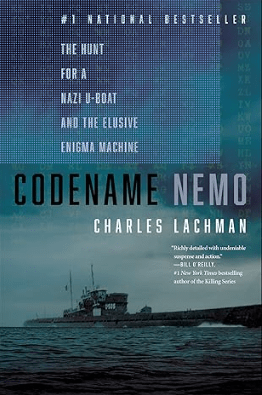
I kept thinking of The Hunt for Red October as I read an excellent history book recently, Codename Nemo: The Hunt for a Nazi U-Boat and the Elusive Enigma Machine by Charles Lachman. It recounts the fantastical story of a visionary naval captain, Daniel Gallery, who comes up with a hare-brained plan to capture a German U-boat. He developed the idea while stationed at a naval base in Iceland, seeing the damage that U-boats could wreak. He also learned how to sink them.






 Ash Clifton, Writer