As a long-time, struggling, nominal “artist,” I am aesthetically opposed to the idea of a supergroup. The very notion sounds like a BS, 1990s-era, dot-com bubble businessplan: 1.) Pick great musicians from two or more already famous and successful rock groups, 2.) put them in a studio with all the booze and/or drugs they want, and 3.) profit!
But I have to admit that my snobbery is unjustified, if not downright hypocritcal. There are a lot of “supergroups” whose music I love. Derek and the Dominos. Crosby, Stills, Nash and Young. The Traveling Wilburys. Hell, even friggin Toto was pretty good. (“I’ve felt the rains down in AAAAAFRI-CUH!!!”)
Them Crooked Vultures is one of the more recent (and also one of the best) rock supergroups. Representing at least two generations of great rock music, it boasts Dave Grohl on drums, Josh Homme on lead guitar and vocals, and John Paul Jones on bass. I find myself especially sentimental about Jones being in the band. Not only is he an older guy who proves that he still has the licks, but he’s one of the most under-appreciated musicians in the history of rock. When people say they love Led Zepplin, what they’s often, really saying is that they love John Paul Jones (and John Bonham, of course, rounding out one of the greatest rythym sections ever).
Below is a great live version of “Dead End Friends” in which you can see that, yes, Jones still knows how to rock. And Grohl and Homme haven’t forgotten, either.
If I were to make a list of the most influential science fiction novels of all time, William Gibson’s Neuromancer would surely be on it. How often does a book create a whole genre—almost single-handedly? I say “almost” because there were other cultural touchstones of the cyberpunk genre, primarily Ridley Scott’s landmark film Blade Runner. But Neuromancer was the primary literary component of the movement, with its landscape of towering, high-tech super-cities where the rich live high (in every sense of the word), and the poor live very, very low.
Expanding on his ground-breaking short story, “Johnny Mnemonic,” Gibson created a dark near-future in which giant “mega-corporations,” many of them Japanese, have taken control of all aspects of life, and the richest people have almost become a different species. Average people either work as wage-slaves to the corporations, and the closest thing to a counterculture is a teeming underclass of rebel hackers who make their existence by spying on (and stealing from) the corporate oligarchy.
These underground, anti-heroes are the punks of cyberpunk, and they are what made it so compelling as a genre. In a world where technology and corporate greed have dehumanized everyone, the punks beat the system at its own game. They do so by humanizing it, using their courage, individuality, and creativity to win in the one place where everyone is still equal—in the virtual world of cyberspace.
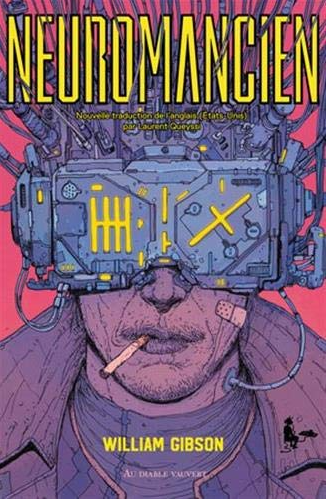
That’s why I like this cover so much. Strangely, though Neuromancer was published forty years ago, there has never been a cover that really captured the vibe and essence of the book. Until this one. It’s a very obscure cover belonging to a Brazilian edition of the novel and created by Spanish artist Josan Gonzalez. I like it because it feels like a 1980s comic strip—specifically, the work of French artist Moebius from the magazine Métal hurlant back in the 1980s (truly, the golden age of cyberpunk). The character portrayed is, presumably, that of Case, the hacker-hero of the novel. With a cigarette dangling from his mouth and a welter of wires rising from his VR goggles (from his “brain,” essentially), he personifies the spirit of cyberpunk: a rebellious unflappability combined with human creativity and technical skill.
Author’s Note: Michael Mann’s first feature film, Thief, is on-sale for dirt-cheap on Prime Video at the moment. So, I thought I’d re-post a short essay I wrote about it on my old blog some years ago. Enjoy!
When my son and I went to New York City over the summer, we stayed in Queens, just a few blocks from the Museum of the Moving Image. We spent most of our time in Manhattan, doing the tourist thing, and I never got around to the seeing the Museum. I regret this, and not only because it’s supposed to be a really cool place.
As fate would have it, I later found out that the film being screened at the Museum that week was Michael Mann’s first feature, Thief. It’s a fabulously entertaining crime thriller starring James Caan (a Bronx native) in one of the best performances of his long career. Caan plays Frank (we never learn his last name), a Chicago businessman by day and a high-end burglar by night. Like many heroes in Mann’s films, Frank is guy with a score to settle; he spent much of his youth in jail on trumped-up charges, and now stealing is his way of making for lost time.
Ever since Kurt Cobain’s tragic suicide in 1994, Courtney Love has gotten a lot of hate from the bros. I don’t know why. I always liked her and her music. If Kurt Cobain was my generation’s Jim Morrison, then she was our Patti Smith.
I say “was” because Love hasn’t released much music recently. I hope that changes. I’m particularly fond of this song, “Malibu”.
I was going to make a new Christmas Sci-Fi List to go with the first one that I wrote some years ago. But…well…I flaked out. So, here is a belated list of some of my favorite science fiction novels. And why not? New Year’s Day is a time to think about the future, right? RIGHT?
Anyway, here’s the list…
Trouble on Triton
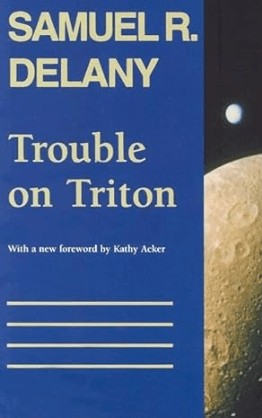
Samuel R. Delany’s Trouble on Triton (published as Triton in the U.S.) is one of the finest written, poorly known works of literary sci-fi in publishing history. Perhaps this is due to the fact that it’s a short work—really a novella—with a post-modern, elliptical plot, not to mention some gender-bending content that was way ahead of its time. Set in a dome-style space colony on the farthest moon in the solar system, it tells the story of Bron, an ordinary schlemiel who’s in love with a mysterious, beautiful performance-artist. What really makes this book fascinating is its depiction of a high-tech, post-scarcity society that anticipated Iain Banks’s Culture novels by decades.
The Peripheral
William Gibson pretty much invented cyberpunk, so it’s fitting that he should write one of the best twists on that genre to come along in years. The Peripheral begins in what appears to be standard Gibson territory. Set in an economically devastated near-future, the story centers on Flynn, a young woman who makes her living as a remote contractor who works in the virtual reality of cyberspace. She thinks she is testing on a prototype for a video game set in a much farther distant, higher-tech future. But when she witnesses a murder in this other, virtual world, she realizes that it’s not virtual at all, but an actual, alternate future earth to which she is connected through a mysterious Chinese server.
The rest of the novel involves her getting to know her future-based boss, Wilf, and helping him solve the murder mystery. Wilf, in return, gives Flynn money and technology to help her and her friends change their timeline, hoping to avoid the environmental catastrophe—a.k.a. “The Jackpot”—that has denuded the planet in Wilf’s. (He explains that their timelines are now independent of each other, so she won’t be messing with his present.) It’s one of Gibson’s best, tightest books with a page-turner plot and some brilliant twists.
The Man in the High Castle
Speaking of alternate timelines, have you ever felt like you were stuck in the wrong one? And it’s not a good one? This is the experience of all the characters in The Man in the High Castle. Set in the 1960s, the book imagines an alternate earth where the Axis powers won World War II. Nazi Germany controls the American east coast, Japan the west coast, and the midwest serves as a vast DMZ between the two. Like most of Dick’s novels, the novel involves several interlocking narratives concerning characters from all classes, high and low, each of whom struggles to be a good person in an insane world.
The Girl with All the Gifts
In the last twenty years, there have been so many zombie apocalypse novels, movies, tv shows, and video games that one would expect it to be completely…well, dead. Played out. Void of new ideas.
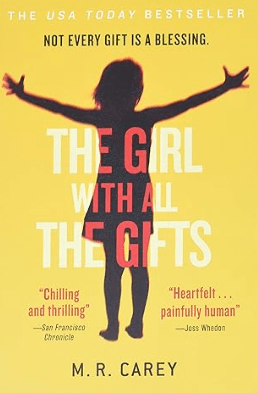
That’s what I thought when I picked up The Girl with All the Gifts. You can imagine my surprise when I found it to be one of the best written, engrossing, and often thrilling novels I’ve ever read. Its great strength lies in its central twist on the zombie story: the hero (actually heroine) is, herself, a zombie.Sort of. Ten year-old Melanie is infected with the fungus that turns people into zombies, but despite an almost irresistible hunger for human flesh, she retains her human intellect and sensibility. A prisoner in a military-run research station tasked with studying zombie children, Melanie has super-human strength, a genius I.Q., and a love of Greek mythology. She also loves her “teacher” (actually, a sympathetic scientist), Miss Justineau.
When the research station is overrun by zombies, Melanie becomes the savior of her former captors as they make their way across the English countryside, trying to get back to human-controlled territory. The great irony of the novel is that most of the evil Melanie confronts on her journey comes from humans, not zombies. (Or maybe that’s not so ironic, after all.)
The Wave
Known primarily for his mystery novels, Walter Mosley is just a damned good writer, period. The Wave is a rip-snorting, old-school sci-fi novel with a modern sensibility. It’s about a working-class stiff named Errol who comes home one night to find that his father has paid him a visit. No big deal, except for the fact that his father has been dead for years.
The explanation lies is an sentient extremophile that lives so deep in the earth’s crust it has never been discovered…until now. Intelligent and deadly, it can take the shape of any biological form (including poor Errol’s dead father), accessing the target’s memories and consciousness in the process. Errol soon finds himself on the run from scientists who want to study the entity and military men who want to kill it. Good stuff from one of the best.
(…or, Why I Leave My Christmas Lights Up Till January 5th)
I’m a big fan of the Brother Cadfael novels by Edith Pargeter. Brother Cadfael is a medieval monk who has two areas of expertise: botany (plant-based medicine) and solving crimes. Ever since I began reading the Cadfael series about twenty years ago, I’ve been fascinated by the richness and detail of Catholic dogma. Like all monks, Brother Cadfael observes the canonical hours that strictly divide the entire day into a schedule of prayer sessions (for which he is always late). And I also became interested in the various holy days that he and his fellow monks observe.
Perhaps that’s the reason I refuse to consider Christmas over on December 26. Rather, I prefer to stick to the original church concept of Christmastide, which begins on Christmas Day and extends all the way to Twelfth Night on January 5 (better known as Three Kings Day in the Latin community).
Twelfth Night is, of course, marks the Day of the Epiphany when the Christ-child was perceived by the wise men as a divine being. The wise men are, themselves, a subject of fascination for me. Their story—which is barely mentioned in the bible—has become embellished over the centuries by various Catholic fanboys. According to current tradition, there were three of them, and they were in fact kings from various parts of the orient: Balthasar of Arabia, Melchior of Persia, and Caspar of India. In some versions, their various ages are given as 20, 40, and 60, representing the three phases of a person’s life (youth, middle-age, and old-age).
So, if you’re still hung over from Christmas Day (I’m speaking metaphorically, although I did have a bit of whiskey in my eggnog), take heart. Christmas might be over, but Christmastide goes on and on. As it should. Those medievals had a much better sense of how to celebrate, from which we, as harried, stressed-out, modern Westerners have much to learn.
And whether you’re a Christian or a lapsed-Christian or just a secular person who respects the Christ figure and observes the holiday solely from a sense of tradition, why not extend the holiday a bit, even past New Year’s Day? Leave your Christmas lights up. Give another present or two to your loved ones. Have another feast.
1.) Alternate Realities One of the great things about living in a university town is that you get to hear some great lectures by famous people—for free. Back in the 80s, I attended a lecture on the subject of evolution by the late, great Stephen Jay Gould. He talked about how incredibly subtle mutations in the gene pool can, over time, create titanic changes in the history of earth. He called this the Phenomenon of Contingency. To illustrate his point, he mentioned two movies that deal primarily with the subject of an individual’s impact on the course of history—the way small choices can resonate through the future. The movies he sited were It’s a Wonderful Life and Back To The Future. He might have mentioned a dozen or so works of modern science fiction, or the Hindu concept of the Net of Jewels. Or all of Buddhism, for that matter. But he was right on the money with It’s a Wonderful Life. The movie is about keeping your eye on the Cosmic View, rather on selfish or ego-centric desires. George has forgotten how much good he had done in Bedford Falls because the effects of his actions have been blurred by time. Clarence the Angel reveals (or re-reveals) it to him.
I’ve been seeing a lot of on-line ads for the new Nosferatu movie directed by Dave Eggers. It looks like a pretty good movie, although, judging by the trailers, it seems to be emphasizing the horror (e.g., slasher) elements of the classic Nosferatu/Dracula story over the erotic angle (which most film adaptations have veered toward).
Or does it? Looking at the poster, the hook line poster reads “Succumb to the Darkness.” It’s a seductive line, which doesn’t quite seem to go with the image portrayed—that of a beautiful young woman in a nightgown lying on her back with her mouth open, while a skeletal, monstrously taloned hand reaches for her face.
Erotic? Not really. Gross? Yeah, kinda. This thematic confusion between the film’s trailer and its poster reflects, I think, the difficulty in adapting the Dracula story to the screen. (Yes, I know that Nosferatu is not the same as Dracula, but close enough.) The difficulty is made worse in our present time, the 21st Century, when porn is only a few clicks away and the idea of truly transgressive sexual activity is more and more difficult to imagine.
Somebody shared an old post on Facebook today regarding my interview with David Gwyn back in March on his Thriller101 podcast. It got me thinking about how much I enjoyed that particular talk, and what great questions David asks.
E.L. Doctorow once said that Edgar Allen Poe was the best bad writer in American history. I would suggest that Journey was the best bad band in rock history. Blessed with a classic rock pairing of a great singer and a great lead guitarist—Steve Perry and Neil Schon, respectively—Journey was a hit-machine all through the 1980s. In a sea of turgid, flat corporate rock, Journey’s unusual combination of Perry’s crooning lyrics and Schon’s clean-yet-virtuosic guitar licks was a winner. It stood out a mile on F.M. radio. Also, the band had a great work ethic. They played out-of-the-way venues in the midwest and the deep south that many other bands shunned, which won the band the eternal devotion of countless rural and working-class kids, to whom Journey’s sentimental and often maudlin songs appealed.
It was this sentimental and overblown quality that made Journey a bit of a drag. There was something cloying and yet self-aggrandizing about much of their work. Every other song sounded like an “anthem.” One was always tempted to flick a lighter and wave it in the air whenever one of them came on the radio.
Still, when Journey was on its game and at its most pure, they could create a really great, down-and-dirty rock song. My favorite of theirs—the only one that truly feels like a rock song, to me—is their unapologetic ode to sex, “Any Way You Want It”.






 Ash Clifton, Writer