What I’m Reading: “Rod: The Autobiography”

Rod_ TheAutobiography2

One of the many things I learned from Rod Stewart’s memoir, Rod: The Autobiography, is that the technical process of recording a studio album is very strange.  For instance, the lead singer usually records his vocal track in a soundproofed room, by himself, wearing headphones so that he can listen to the band’s instrumental track.

It seems a very sterile and artificial process–not at all what one pictures when imagining a rock singer at work.  And so I was impressed to learn that Stewart has always rejected this technique, insisting on recording all tracks directly with his band:

When we were recording, I liked to be in the sound room with the band, walking around with a microphone  in hand, so that I could look them in the eye, interact with them, perform with them, basically.  I think it slightly startled the engineer, who was more used to having the singer isolated behind screens, or in an entirely separate vocal booth.  I remember hearing how Frank Sinatra had once been parked by an engineer behind a screen in a recording studio and he had made them take it down.  In order to sing, he needed to feel the sound of the orchestra hit him in the chest.  I guess this was my own version of that.

It’s interesting that Stewart draws a comparison between himself and Sinatra.  As I learned from James Kaplan’s fine bio of Sinatra, the great crooner himself exerted tremendous effort when preparing for one his recordings.  He was known to read the song lyrics aloud to himself, almost like prose.  He felt he had to discover the emotional truth of the lyric before he could sing it, and if that truth was not forthcoming, he would nix the song.

Continue reading “What I’m Reading: “Rod: The Autobiography””

Classic Sci-Fi Book Cover: “Lord of Light”

I’ve read a lot of trippy science books in my time, but Roger Zelazny’s Lord of Light is probably the trippiest. The only one that sort of comes close is Frank Herbert’s Dune, which makes a lot of sense considering both were written in the 1960s by two extremely smart and talented writers. (One of Zelazny’s other books, This Immortal, actually shared the Hugo Award with Dune in 1967.)

In fact, there’s not really a name for what Lord of Light is. Technically, it’s science fiction fantasy (a sub-genre I’ve written about before). That is, it looks and feels like a fantasy novel (as does Dune) until you realize that the plot has a sci-fi underpinning. Lord of Light is set on an alien world in which the population is stuck in a pre-industrial state, ruled over by gods of the Hindu pantheon. These gods interact with mortal humans on a daily basis, using magical powers and objects to control their destiny. Throughout the novel, however, Zelazny drops carefully crafted clues that the “gods” are actually the crew of a starship called The Star of India, which crash-landed on the planet centuries before.

These faux-deities use high-technology to set themselves up as gods, complete with a kind of immortality (they can transfer their consciousness to new, young bodies when the old ones wear out). They rule over the common people (who are revealed to be the descendants of the passengers of the ship) with an iron fist, doling out justice and retrobution from a floating, anti-gravity city (“heaven”). This reign is, ostensibly, for the people’s own good (tyrants always say this, right?). But when one of the last democratically-minded crew members, Sam, takes on the role of Siddhartha, he poses a threat to the status quo, which has kept humanity stagnant for generations.

This 1987 edition from Avon was the one I read in college, and I still own it. Its cover was done by an English illustrator named Tim White. I really like it because it captures that essential trippiness. At first, it looks like a pop-religion book, depicting figures dressed like Hindu gods. But what’s with the blue electric bolts? Or the floating city? And why is one of the Hindu “goddesses” blonde?

Ahhh, it’s really a sci-fi novel.

Yes, it is.

Books on Art: “de Kooning – An American Master”

deKooning

On those rare occasions when I choose to read a big, fat, thick-as-a-brick book about a famous person, I usually pick one about a politician. David McCullough’s Truman is a great example. I tend to gravitate toward books about political figures because, in the course of reading about their lives, you also get a free history lesson. That is, the story of Harry Truman is also the story of World War II, the atomic bomb, Korea, the founding of Israel, and the Berlin Wall.

Biographies of artists are more problematic, for me.  I just finished reading de Kooning: An American Master, by Mark Stevens and Annalyn Swan. It chronicles the long life of the great painter—a life barely contained within the span of the Twentieth Century—in which de Kooning lived to be the celebrated, Grand Old Man of modern American art. He became, in fact, the only American artist whose figure and reputation approached those of Picasso.

Continue reading “Books on Art: “de Kooning – An American Master””

R.I.P. David Lynch

Photo by Alan Light, CC BY 2.0

It has been a week since David Lynch passed away, and many great tributes have already been written about him. I’m tempted to say that I needed a week to process his passing and figure out what I wanted to say about him, but the truth is I was just too damned busy to write anything. In fact, I knew instantly what I wanted to say—simply, that Lynch was a very important person in my life, and in the lives of many of my friends.

I was a college English major in 1986 when Blue Velvet came out, and it hit me and my circle of arty friends like an atomic blast. I already knew of Lynch’s work (I was one of the few kids to see The Elephant Man, and in an actual movie theater, no less), and I knew that he was a director of enormous visual and thematic power. But even I was unprepared for Blue Velvet. On the one hand, it’s a murder mystery, an homage to the noir films of the 1950s in which an unsuspecting suburban kid discovers a hidden world of violence, evil, and, (of course) depraved sexuality. On the other hand, it’s a surrealist vision of the inner world of a modern young man (and, probably, many young women). I was roughly the same age as the main character, Jeffrey Beaumont, in 1986, and so the film had special resonance. I felt like the landscape of my own imagination was a strange blend of the beautiful and the grotesque—often in the same image. And that’s exactly what the film captures, somehow.

Continue reading “R.I.P. David Lynch”

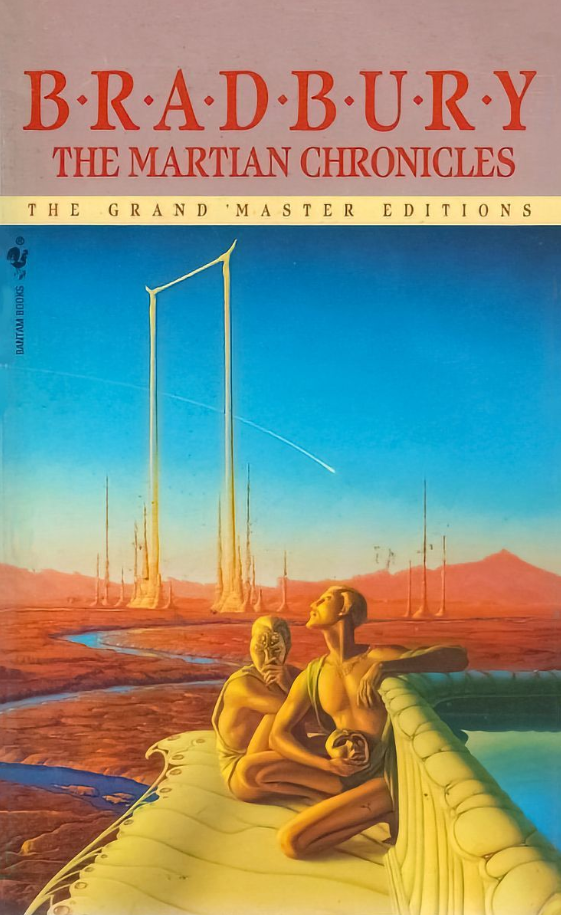
Classic Sci-Fi Book Cover: “The Martian Chronicles” – Michael Whelan

When I was a public school kid back in the 1980s, I used to spend hours at the bookstore, mostly looking at science fiction books. It wasn’t just the stories themselves that interested me, but the cover art. Back then, before the internet gave one an endless supply of great sci-fi concept art of any kind, the only way to get one’s imagination going was to head to the bookstore.

So, it’s probably inevitable that I would regard that time as a golden age of sci-fi cover art. And I do. When I look at sci-fi books today, there is usually no cover art to speak of, but just an exercise in graphic design. The title goes in this font 38 point; the author’s name goes in this font at 28 point; etc.; with some blurry, abstract notion of an alien planet or a futuristic city. Back in the pre-digital days, sci-fi cover art consisted mainly of actual paintings, made by actual painters.

One of the best actual painters was (and is) Michael Whelan. His work has that perfect blend of realism, action, and whimsy that I always looked for in a good sci-fi cover. For five decades, he created some of the best covers ever made, and they earned him a place in the Science Fiction Hall of Fame.

One of my favorites is the one above, his cover for the 1990 Bantam/Spectra edition of Ray Bradbury’s The Martian Chronicles. If you haven’t read it (and you should), it’s an allegory about the loss of ancient wisdom, the horrors of capitalism, and even the conquest of the American West. Haunting the work are the ghosts of the Martians themselves, who once-great civilization is helpless in the face of the invading Earth-men, with their guns and disease and endless greed. I love this cover because it gives you a sense of that lost majesty, but it also makes you curious about the story.

In other words, it kindles the imagination.

R.I.P. James Earl Jones

Let’s face it, 99% of the people alive today who knew anything at all about James Earl Jones knew about him from Star Wars. He was, after all, the voice of Darth Vader, the most commanding villain in all cinema.

My first memory of Jones, however, was from the early 1970s, when I was a little kid. I was watching a made-for-TV movie about the Barney and Betty Hill UFO incident. Jones played Barney, and the scene where he recalls, under hipnosis, his encounter with a UFO struck me, even a kid, as unbelievably powerful and even scary. (If you can find this movie on Youtube, you should check it out.)

It’s important for us all to remember how truly great an actor Jones was. He wasn’t just a voice–he was a master of the entire art. One of my lit. professors in college recalled seeing Jones as Othello on Broadway in a now-legendary production with Christopher Plummer as Iago, and how absolutely mesmerizing Jones was.

In keeping with that memory, I am posting a brief, command performance that Jones did of a scene from Othello about ten years ago.

Godspeed, Mr. Jones….!!!

Classic Sci-Fi Book Cover: “The Left Hand of Darkness”

Ursula K. Le Guin was one of our finest science fiction writers, and The Left Hand of Darkness is probably her best book. Not only did it anticipate by half-a-century the seismic cultural shifts that are currently roiling Western society regarding issues of gender-identity and sexual orientation, it’s also just a damned good sci-fi story.

Set in the far future, it takes place on Gethen, a wintery planet with a post-industrial civilization. Genly Ai is an Earth-man who is sent to Gethen on a diplomatic mission, hoping to convince the locals to join the Ekumen (basically, Le Guin’s version of the United Federation of Planets). Genly’s efforts are frustrated by long-standing, internecine conflicts between the Gethenians themselves, and also by his own difficulty in relating to the local people. People on Gethen are, it seems, are androgenous—serially androgenous, actually, existing as one sex for a part of the month and as females for the other. (As Le Guin beautifully describes, they subtly change their outer physiognomy, depending on which gender they are currently occupying, appearing to be “men” some of the time and “women” at others.)

Even now, it’s a pretty far-out concept, but it was totally mind-blowing in 1969 when the novel came out. Trust me, though—it’s a very exciting book. Genly soon finds himself caught between warring nations and is arrested as a potential spy. He is rescued by Estraven, the former prime minister of one of the countries, who helps Genly escape. They set off on a life-and-death adventure, sledding across the frozen wilderness of Gethen and trying to get to safety. In the process, Genly is forced to come to terms with his own deep-rooted conceptions of sexuality, while Estraven faces the prospect of Gethen being just one small planet in a vast, strange galaxy.

Le Guin is often described as a literary science fiction writer, and it’s true. Her prose and descriptive eye were top-notch, and she was able to weave Big Ideas (Feminism, Taoism, etc.) into her fiction without it feeling like a Humanities 101 lecture. The edition I read had this great cover by veteran illustrator Alex Ebel, which might seem a bit cheesy today but was striking and evocative at the time. I love the way it captures one of the major visual motifs of the novel, that of linked-opposites (light and dark, male and female, good and evil, progressive and reactionary). It’s a great, surreal representation of a great novel.

Brief Encounters with Infinity

Autumn Rhythm (Number 30)
Jackson Pollock, Autumn Rhythm (Number 30)

Back in the dot.com boom of the 1990s, I was lucky enough to work for an IT company based in New York City. I was a remote worker, writing software eight hours a day in my spare bedroom in Gainesville, Florida. It was a win-win situation. I got to work from home, and my bosses got a good developer for country-boy wages (and I was still in the same time zone).

Occasionally they would fly me to the city for a meeting and I would spend my evenings wandering the streets of Manhattan, which is surely the most beautiful and bewitching cities of the earth. My favorite spot is the Met. Like a lot of introverts, I love museums, and the Met is the greatest of them all. I mean, how many museums have their own Egyptian Temple?  Indoors?

Once I spent an entire weekend roaming its halls, barely scratching the surface of its vast collections. I tend to gravitate toward the Modern period from the early- and mid-twentieth century. From guys like Matisse and Picasso all the way to Hopper and O’Keefe.

From a historical perspective, my interest stopped after that.  I never much got the whole Post-Modern thing—Abstract Expressionism and all that.  It seemed too theoretical. A joke that high-brow art critics had played on the rest of us, as Tom Wolfe wrote so wittily in The Painted Word.

Continue reading “Brief Encounters with Infinity”

The Enchanting Labyrinths of Vortex Fiction

Of all the categories of genre fiction that I’ve consumed over my lifetime, fantasy has probably best the least represented. Sure, I love The Lord of the Rings, and The Narnia Chronicles, and the works of Ray Bradbury that I consider to be dark fantasy (see Something Wicked this Way Comes). But I don’t keep up with many modern fantasy writers nor read many contemporary fantasy novels.

So, you can imagine my surprise when I took a chance on Susanna Clarke’s Piranesi, a fantasy novel that made quite a splash when it came out in 2020, and I enjoyed the hell out of it. It’s a fascinating story of a man trapped in a labyrinth that he calls The House, and which is composed of endless Greco-Roman halls lined with innumerable statues and vestibules. There is a sky above and ocean tides below, which often flood the lower levels. The man is called Piranesi by the only other person (i.e., “the Other”) in The House, an older man who seems able to leave somehow, only to return with key supplies like vitamins and batteries, which he shares with Piranesi.

It’s a fascinating book, and unexpectedly suspenseful, too, especially when Piranesi begins having flashbacks of who he is and how he came to be in the House. This happens about the same time as the sudden appearance of mysterious, written messages that are scattered throughout the House. They seem to have been left by another, recent intruder (one who seems interested in helping Piranesi escape).

For me, at least half of the appeal of Piranesi lies in this whodunnit factor. Like the protagonist himself, I was caught up in the mystery of how he came to be there, who he is, and how he might get out. But the other half lay in the dizzying, intricate nature of the setting—the endless labyrinth that Piranesi inhabits. Such dreamlike settings are more common in literature than one might think, and their appeal is very much like that of a vivid, fabulously detailed diorama, of the sort that all children love to gaze into (and imagine themselves inside).

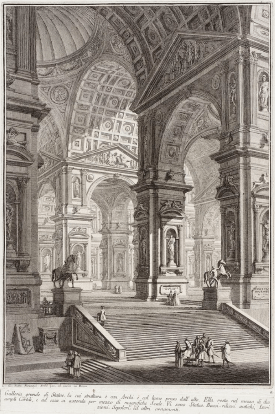
Capriccio Illustration by Giovanni Piranesi

 I don’t know what it is, exactly, about mazes, labyrinths, and castles that evokes the power of imagination, But I think it has to do with their endless novelty, the promise of infinite rooms and corridors that we, like children, would love to explore. More to the point, such structures also symbolize the power of imagination—especially the child-like imagination that each of us still harbors. That’s why there is such a grand tradition of castles and mazes in fantasy literature and mythology, from the Minotaur’s labyrinth to the vast, rambling ruins of the Gormenghast trilogy.

Clarke herself acknowledges this tradition in her main character, Piranesi, who is named after Giovanni Battista Piranesi, the 18th Century illustrator who was famous for his drawings of impossibly grand and complicated imaginary buildings. His most famous works are a series of etchings titled Carceri d’invenzione (Imaginary Prisons), and these are, themselves, part of a much older tradition of so-called capricci, drawings that depict architectural fantasy.

Continue reading “The Enchanting Labyrinths of Vortex Fiction”

Today I Learned a Word: “Mithraic”

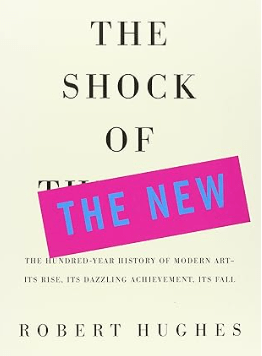
Back in the 1980s, I took a Humanities class during my freshman year of college. The professor was really good, and she supplemented her lectures by showing up a few episodes of Robert Hughes‘s BBC series Shock of the New, which covered the history of Modern Art as seen through Hughes’s own discerning, sardonic lens. 

I remember being struck by how witty and intelligent Hughes seemed as he talked about numerous examples of iconic modern art and architecture. He did exactly what a good critic is supposed to do: open your eyes to meaning and resonance in art that you might have missed, and connections you never would have thought of.

I liked the series so much that I’ve watched it a couple of times since on YouTube, and I recently bought the book that Hughes wrote to accompany it. Hughes really was one the smartest and most interesting art critics of his generation, and he could really write. Take this passage, for instance, about Pablo Picasso’s most famous and disturbing work, Guernica,

Seen detached from its social context, if such a way of seeing were either possible or desirable (in Picasso’s view it would not have been, but there are still formalists who disagree), it is a general meditation on suffering, and its symbols are archaic, not historical: the gored and speared horse (the Spanish Republic), the bull (Franco) louring over the bereaved, shrieking woman, the paraphernalia of pre-modernist images like the broken sword, the surviving flower, and the dove. Apart from the late Cubist style, the only specifically modern elements in Guernica are the Mithraic eye of the electric light, and the suggestion that the horse’s body is made of parallel lines of newsprint, like the newspaper in Picasso’s collages a quarter-century earlier. [emphasis mine]

As I read this passage, I thought to myself: wow. Then I thought to myself: Mithraic? WTF is that? So, naturally, I googled it and discovered that Mithraism was a religious cult in 4th Century C.E. Rome that directly opposed Christianity and was popular with Roman soldiers. I don’t know exactly what sense Hughes was employing the word, but I think he was getting at the idolatrous aspect of Fascism—literally, an ideology opposed to Christ and Christian values—as manifested in the mid-Twentieth Century love of technology and machines. Reading Hughes’s moving and trenchant prose, I was reminded of how Picasso, eighty-seven years before Christopher Nolan’s Oppenheimer, Picasso painted the most powerful and grotesque indictment of war, and especially high-tech war, ever conceived. (Sadly, it is as relevant now as it was in 1937.)

If you have a chance, you should watch Shock of the New, or any of Hughes’s other series if you can find them. If nothing else, you’ll probably be smitten by his fascinating and highly idiosyncratic rhetorical style, with his strange (theoretically Australian) accent and tendency to punch words harder than Mike Tyson. My wife and I still joke lovingly about the way he pronounced various famous artists: i.e., Pehblo Pehkesso.

He was a treasure, and I miss him. 

“Guernica” by Pablo Picasso