

Classic Sci-Fi Book Cover: “Damnation Alley”

For this latest entry in my Classic Sci-Fi Book Covers series, I’ve chosen a fairly recent (2004) edition of Roger Zelazny’s Damnation Alley. The book is a great, sci-fi action yarn about a post-WWIII America in which most of the heartland is scarred by nuclear radiation. Gale-force winds above 500 feet prevent any kind of air travel between the coasts, where the few remaining cities struggle to survive. When an epidemic breaks-out in Boston, officials in Southern California offer a tough criminal, Hell Tanner, a pardon if he will lead a convoy through Damnation Alley, a cross-continental route that bypasses the worst radiation spots. The rest of the story is a kind of post-apocalyptic Iditarod, complete with bandits, micro-hurricanes, and grotesque mutants (both human and animal), all of which Tanner must survive in order to deliver a vaccine.

If you grew up in the 1970s, you might remember the really cheesy (but fun) B-movie that was adapted from it (starring George Peppard, no less!). But even if you’re younger than that, the outlaw-turned-hero plot might seem familiar, mainly because it’s been ripped-off so many times in movies, from Mad Max: The Road Warrior to Escape from New York to Pitch Black

Speaking of movies, Zelazny himself was probably inspired by numerous Westerns from the 1950s and 60s that used the same story. (I’m thinking of The Magnificent Seven, 3:10 to Yuma, and even The Searchers). All such tales focus on a criminal whose ruthlessness and brutality cause him to be ostracized from civilization under normal circumstances, but whose strength and cunning become indispensable in a crisis. 

The idea, of course, goes back further still. Greek and Hindu epics like The Iliad and The Mahabarahta are full of instances of big, nasty warriors who must face a seemingly insurmountable gauntlet of enemies (warriors, monsters, demi-gods, etc.) and defeat them all to achieve some seemingly unattainable boon. In the process, the hero delivers his people from danger and (usually) achieves some kind of moral rehabilitation, if only after his death. 

But there are a couple of key differences between modern tales like Damnation Alley and The Illiad. In ancient literature, the warrior’s violent tendencies are not a minus; they’re a plus. Paleolithic civilizations valued and glorified violent aggression even more than we do, probably because they faced real, existential threats much more often. Also, in ancient myths, it’s usually the hero himself who, seeking glory, embarks on the challenge of his own free-will. In stories like Damnation Alley, the hero (really more of an anti-hero) is compelled by others to take part in the saga. In the end, he might fight some deeper, non-selfish part of himself—or not. It all depends on the worldview of the author.

I really like this cover (by renowned comic book artist Dennis Callero) because it highlights the book’s anti-hero—Hell Tanner—in all his badass glory. He looks like a Hell’s Angel because, according to the story, he is a Hell’s Angel (back before the world got nuked). Now, instead of a Harley, he rides a tank-like vehicle called a Landmaster, bristling with weaponry, which is shown in the background. I also like the greenish glow (of radiation, presumably) coming from the edge of the picture. 

Most of all, I admire how the cover, which was probably done using some kind of digital tool, still looks like an oil painting from old days of 1960s and 70s sci-fi illustration. It’s realistic, but not photo-realistic. It looks like…art.
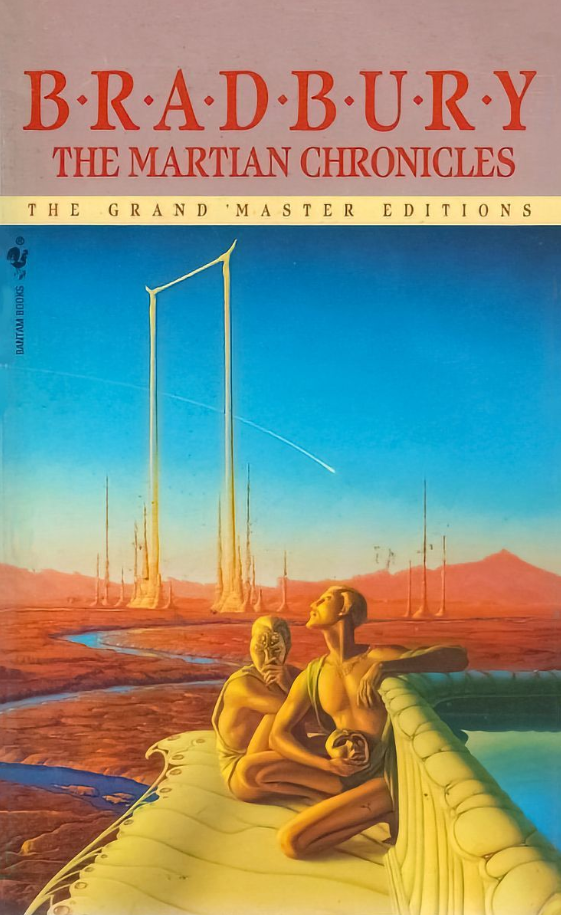
Classic Sci-Fi Book Cover: “The Martian Chronicles” – Michael Whelan

When I was a public school kid back in the 1980s, I used to spend hours at the bookstore, mostly looking at science fiction books. It wasn’t just the stories themselves that interested me, but the cover art. Back then, before the internet gave one an endless supply of great sci-fi concept art of any kind, the only way to get one’s imagination going was to head to the bookstore.

So, it’s probably inevitable that I would regard that time as a golden age of sci-fi cover art. And I do. When I look at sci-fi books today, there is usually no cover art to speak of, but just an exercise in graphic design. The title goes in this font 38 point; the author’s name goes in this font at 28 point; etc.; with some blurry, abstract notion of an alien planet or a futuristic city. Back in the pre-digital days, sci-fi cover art consisted mainly of actual paintings, made by actual painters.

One of the best actual painters was (and is) Michael Whelan. His work has that perfect blend of realism, action, and whimsy that I always looked for in a good sci-fi cover. For five decades, he created some of the best covers ever made, and they earned him a place in the Science Fiction Hall of Fame.

One of my favorites is the one above, his cover for the 1990 Bantam/Spectra edition of Ray Bradbury’s The Martian Chronicles. If you haven’t read it (and you should), it’s an allegory about the loss of ancient wisdom, the horrors of capitalism, and even the conquest of the American West. Haunting the work are the ghosts of the Martians themselves, who once-great civilization is helpless in the face of the invading Earth-men, with their guns and disease and endless greed. I love this cover because it gives you a sense of that lost majesty, but it also makes you curious about the story.

In other words, it kindles the imagination.

Classic Sci-Fi Book Cover: “The Left Hand of Darkness”

Ursula K. Le Guin was one of our finest science fiction writers, and The Left Hand of Darkness is probably her best book. Not only did it anticipate by half-a-century the seismic cultural shifts that are currently roiling Western society regarding issues of gender-identity and sexual orientation, it’s also just a damned good sci-fi story.

Set in the far future, it takes place on Gethen, a wintery planet with a post-industrial civilization. Genly Ai is an Earth-man who is sent to Gethen on a diplomatic mission, hoping to convince the locals to join the Ekumen (basically, Le Guin’s version of the United Federation of Planets). Genly’s efforts are frustrated by long-standing, internecine conflicts between the Gethenians themselves, and also by his own difficulty in relating to the local people. People on Gethen are, it seems, are androgenous—serially androgenous, actually, existing as one sex for a part of the month and as females for the other. (As Le Guin beautifully describes, they subtly change their outer physiognomy, depending on which gender they are currently occupying, appearing to be “men” some of the time and “women” at others.)

Even now, it’s a pretty far-out concept, but it was totally mind-blowing in 1969 when the novel came out. Trust me, though—it’s a very exciting book. Genly soon finds himself caught between warring nations and is arrested as a potential spy. He is rescued by Estraven, the former prime minister of one of the countries, who helps Genly escape. They set off on a life-and-death adventure, sledding across the frozen wilderness of Gethen and trying to get to safety. In the process, Genly is forced to come to terms with his own deep-rooted conceptions of sexuality, while Estraven faces the prospect of Gethen being just one small planet in a vast, strange galaxy.

Le Guin is often described as a literary science fiction writer, and it’s true. Her prose and descriptive eye were top-notch, and she was able to weave Big Ideas (Feminism, Taoism, etc.) into her fiction without it feeling like a Humanities 101 lecture. The edition I read had this great cover by veteran illustrator Alex Ebel, which might seem a bit cheesy today but was striking and evocative at the time. I love the way it captures one of the major visual motifs of the novel, that of linked-opposites (light and dark, male and female, good and evil, progressive and reactionary). It’s a great, surreal representation of a great novel.