Author’s Note: I’m told that Project Hail Mary is doing boffo b.o. in the American cinema currently. It looks like a really good movie, and I look forward to seeing it. It’s also based on an Andy Weir book, and I am a big fan of the film adaptation of his first book, The Martian. It’s not only a great movie, it’s culturally signficant.
So, it seemed like a good time to do a shameless rerun repost my thoughts on The Martian and on the new Hollywood archetype that, I think, it helped foster.
Enjoy…
One of my favorite movies of the last twenty years is Ridley Scott’s The Martian. It’s a science-fiction/adventure movie about an astronaut (Matt Damon) who becomes stranded on Mars after his comrades leave him for dead. Marooned on a barren, hostile world, he has to use his brains and ingenuity to survive until his friends come back to rescue him. By the end of the movie, he has survived dust storms, explosions, freezing temperatures, and starvation.
How does he overcome all these challenges?
Science.
The story is familiar, of course. It has many antecedents, including with the original stranded-on-an-island novel, Robinson Crusoe, and also (more directly) to a great B-movie Robinson Crusoe on Mars. In that classic 1964 cheese-fest, the hero survives by finding a Martian cave full of air where plants still grow, water still flows, and there’s a steady source of light (which is never explained). He even befriends an alien who is also trapped on the planet.
Last year, I wrote a post about a fine non-fiction book called Paperbacks from Hell: The Twisted History of ‘70s and ‘80s Horror Fiction. I enjoyed the book primarily for the way the author, Grady Hendrix, mixes his obvious love of old, pulpy horror novels with an enormous amount of mockery and snark. Basically, he makes fun of the trends that ran through horror fiction back in the day, as well their emphasis on over-the-top gore and hilariously silly plots.
As I read the book, though, I noticed Hendrix mention one writer whom he does not mock: Michael McDowell. Rather, Hendrix uncharacteristically bestows a bit of praise on this particular novelist, which made me curious as to why I had never heard of the dude.
As it turns out, most people haven’t heard of McDowell, even though he was a very respected paperback fiction writer (Stephen King called him one of the best) as well as a successful screenwriter (he wrote the screenplays for Beetlejuice and The Nightmare before Christmas, as well as a lot of TV shows). I, especially, should have heard of McDowell considering he was, like me, a Southern writer—from the Gulf Coast of Alabama, not far from where I spent my summers in Pass Christian, Mississippi. He was also a writer who tried to blend a literary sensibility with an appreciation of genre narrative, which is an achievement which I admire.
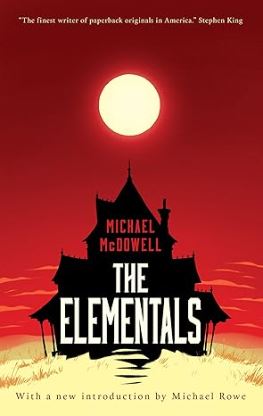
McDowell died in 1999, a latter casualty of the AIDS epidemic in America, just a few years before reliable HIV treatments came into common use. In the years since, his reputation seems to have grown, steadily if slowly, to the point where he is now considered a forgotten master. I was surprised to find an e-book edition of his most famous novel, The Elementals, on my local library’s Overdrive site, and I immediately checked it out and tore into it.
It’s definitely worth the read. Set in Alabama, it tells the story of a two wealthy, intermarried families: the Savages, with matriarch Marian and her adult son, Dauphin; and the McCrays, with matriarch Big Barbara and her adult children, Luker (who has a thirteen-year-old daughter, India) and Leigh (who is married to Dauphin Savage). At the start of the book, Marian has just died and the rest of the blended family is attending her funeral:
In the middle of a desolate Wednesday afternoon in the last sweltering days of May, a handful of mourners were gathered in the church dedicated to St. Jude Thaddeus in Mobile, Alabama. The air conditioning in the small sanctuary sometimes covered the noise of traffic at the intersection outside, but occasionally it did not, and the strident honking of an automobile horn would sound above the organ music like a mutilated stop. The space was dim, damply cool, and stank of refrigerated flowers. Two dozen enormous and very expensive arrangements had been set in converging lines behind the altar. A massive blanket of silver roses lay draped across the light-blue casket, and there were petals scattered over the white satin interior. In the coffin was the body of a woman no more than fifty-five. Her features were squarish and set; the lines that ran from the corners of her mouth to her jaw were deep-plowed. Marian Savage had not been overtaken happily.
Even for a funeral, it’s a very dreary and ominous affair. Yet it gets worse when, at one pre-arranged moment, Dauphin rises and stabs a ritual knife into his dead mother’s chest. Yeah, it’s that kind of book. The fact that McDowell can pull it off and still maintain a high-level of physical and emotional realism—not to mention vivid, sharp writing, as in the passage above—is a testament to his mastery.
The book gets even weirder after the funeral, when the family retreats to their ancestral vacation spot, a tiny barrier island called Beldame, taking with them their Black maid, the long-suffering (and very smart) Odessa. We soon learn that there are three houses on Beldame, yet the family occupies only two of them, leaving the third abandoned. (You can probably guess the reason why, but it has something to do with the house’s intermittent habit of…well…eating people.)
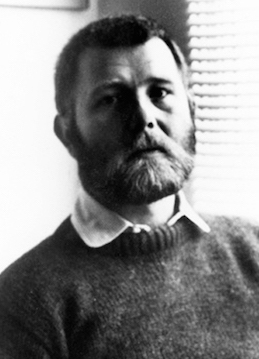
Michael McDowell
As the sand-dunes slowly encroach and bury it, the empty house attracts the curiosity of the young and intrepid India McCray, who ventures inside and sees something impossible yet real. And terrifying.
Of course, The Elementals isn’t just a generic ghost story, nor a generic Southern Gothic novel. The characters are vividly drawn, sympathetic, and believable. Their conversation is fraught with age-old tensions and resentments, yet it’s often very funny in a Curb Your Enthusiasm kind of way. And the characters of India and Odessa are especially well-realized. Linked by their intelligence and, as McDowell implies, some kind of psychic power reminiscent of The Shining, each comes off as a kind of hero in their battle against the evil hiding (rather obviously) in House #3.
The Elementals is a literary horror novel, meaning that it bridges the gap between genre story-telling and development of realistic characters. The book really comes to life (forgive the pun) in the chapters about India as well as of the adult male characters, Luker and Dauphin, both of whom struggle—in true Southern fashion—with the dark legacy of the past and especially surround their own family. Self-indulgent, smothering matriarchs like the recently deceased Marian are, in particular, a source of psychological revulsion. Indeed, they are central to the main theme of the novel, which I will not spoil here.
There is also a good amount of subtle criticism about the racial divide that existed at the time (and now) in the deep south. Odessa, the Black maid, is the only character who does any real work in the book, busy doing the cooking and cleaning for the affluent Whites, just as she has done (we are told) for thirty years. And, of course, Odessa is not only smarter than most of the family members (except, perhaps, for India) she is the only one who knows what the hell is going on in House #3, using her power of second-sight as well as (it is implied) a familial knowledge of voodoo.
Yes, as many reviewers on Reddit have observed, Odessa is an instance of the Magical Negro Trope, of the sort that genre writers, both Southern and not, have abused for a century. This trope is, of course, a literary stereotype, and like any stereotype it can be harmful if taken too far and left unexamined. But if Odessa is a Magical Negro, she is a very world-weary and snarky example, with both courage and brains. I simply loved her character. Sue me.
In fact, I loved the whole book, which feels a bit like a mash-up of Tennessee Williams and Stephen King. Check it out. It deserves some attention. Better late than never.
Author’s Note: This morning, I read that the 2026 Oscars Ceremony, which was held last night, omitted the great character actor Tom Noonan from its In Memoriam segment. I can’t throw stones at the Oscars. When Noonan passed away a few weeks ago, I didn’t say anything about it, either, in part because I had just posted a tribute to the great Robert Duval, who died about the same time. Also, I simply didn’t know enough about Noonan to do a proper post. He only had a few notable film roles, but they were all doozies.
His best was as the serial killer Dollarhyde in Michael Mann’s Manhunter. I am reposting this essay about the film as a kind of (admittedly lame) tribute.
*** SPOILERS BELOW ***
As any old movie buff knows (and many younger ones, too), crime thrillers in 1980s almost constituted their own sub-genre. That is, they had their own special vibe. Slick. Stylish. Erotic. Typically, they boasted good-looking actors with great 80s hair, wearing garish 80s clothes and doing dangerous things. These were exotic and entertaining films, usually set in one of two environments: a dark city landscape (i.e. L.A.) or a gorgeous, sun-drenched beach (i.e. Miami).
And then there was the soundtrack. Synth-heavy, but punctuated with propulsive rock songs from the era—usually something from Genesis or Phil Collins. Take 1984’s Against All Odds, for example, starring Jeff Bridges and Rachel Ward. Collins wrote and sang the theme song for that one, garnering him an Oscar nom. (And, yes, that movie was set against a dark L.A. landscape and a gorgeous beach.)
But my absolute favorite 1980s crime thriller, by far, is a movie almost no one remembers: Michael Mann’s 1986 serial killer flick Manhunter. I saw it when it first came out in 1986, and then saw it again, quickly, before it vanished from the cineplexes forever. In the forty years since, the film has gotten almost no respect, except from a few cinephiles like me. (Quinten Tarantino is a famous booster; he put Manhunter on his list of favorite 1980s films.)
I’ve often wondered why Manhunter is so underappreciated. It probably has something to do with its lame title, which the studio forced Mann for reasons too stupid to discuss here. The original working title was, of course, Red Dragon, taken from the source novel by Thomas Harris. I often think that if the studio had stuck with that title, the film would have been a hit. Another reason is that the brilliant soundtrack, which mostly samples great songs from the era but includes great original music from The Reds, was soon deemed as “dated”. (It has actually come back into fashion thanks to the rise of the Synthwave aesthetic.)
Recently I was chatting with a friend of mine, and at some point in the course of the conversation I told her about one of my favorite thriller novels of the last twenty years. It was Winter’s Bone by Daniel Woodrell, who sadly passed away in November. I described the plot to my friend, explaining how it’s about a 16-year-old girl, Ree Dolly, who lives in the Ozark mountains, raising her two little brothers. When her meth-dealing father goes missing, Ree faces the prospect of the bank foreclosing on the family mortgage, which would leave them all homeless (in addition to crushingly poor). To prevent this, Ree goes alone on a quest to find her father—or, at least, to find his body (she suspects he’s dead) so that she can get the money from his life insurance policy. This quest leads her into the mountain-shack domain of the local drug lord.
As I told all this to my friend, her expression became doubtful.
“Sounds dark,” she said.
I was taken aback, momentarily, and not just because my enthusiasm for Woodrell’s book failed to penetrate her skepticism. I was taken aback because I did not, in fact, have a good reply to her complaint. Yes, Winter’s Boneis a dark novel. Very dark. About as dark as you can get in a realistic, literary work. However, my enjoyment of the book is not dark. In fact, I remember the light-hearted, almost giddy thrill I felt while reading it—feverishly, tearing through it in a couple of days. It was the sensation that Vladimir Nabokov called a “kindling of the spine,” which one gets when reading a truly fine book.
What I found myself unable to communicate to my friend is the simple fact that I loved Winter’s Bone, even though its subject matter sounds like the stuff of an awful, depressing PBS documentary. How is this possible? Why do people like me sometimes read, and love, “dark” novels. More to the point, why do we read “heavy” novels in general—novels about tough subjects, adult circumstances, and big, real-life, consequential choices?
Why don’t we only read fun, predictable, pop-novels of the sort that dominate the best seller lists (not to mention the top 100 slots on GoodReads)?
I often think of something the late, great film critic Roger Ebert once said: “Happy movies don’t make you happy, and sad movies don’t make you sad. Good movies make you happy, and bad movies make you sad.”
Daniel Woodrell – MPR News
Such a simple statement, and yet so profound! It applies equally well to novels. Good novels make you happy, and bad novels make you sad (or, at least, bored). Ultimately, though, Ebert’s aphorism is insufficient to answer my friend’s reaction. What does “good” mean in a movie, or a novel? For that matter, what does “happy” mean? Neither word seems easily definable, in this circumstance.
Happiness, in the grand sense, is not the sensation one gets from a book like Winter’s Bone. As thrilling and, yes, entertaining as it is, it does not induce true happiness. Rather, what it grants the reader is a sense of being transported—of movement, into the mind and world of the main character. That is, for each one- or two-hours session of reading the book, one becomes Ree Dolly. Take this opening paragraph:
Ree Dolly stood at break of day on her cold front steps and smelled coming flurries and saw meat. Meat hung from trees across the creek. The carcasses hung pale of flesh with a fatty gleam from low limbs of saplings in the side yards. Three halt haggard houses formed a kneeling rank on the far creekside and each had two or more skinned torsos dangling by rope from sagged limbs, venison left to the weather for two nights and three days so the early blossoming of decay might round the flavor, sweeten that meat to the bone.
What most people misunderstand about books like Winter’s Bone is that they are not merely well written. Yes, good writing is a necessary—but not sufficient—quality of a successful literary novel. What is also required, though, is this shift in psychic awareness. In the paragraph above, we feel Ree’s sense of life—her desperation, her determination to survive in the most severe physical circumstances. We, as readers, are right there with her, standing on the snow, freezing our butts off, wondering how we’re going to survive the winter.
In a later passage, we also get a sense of Ree’s love and compassion for her two little brothers:
Sonny and Harold were eighteen months apart in age. They nearly always went about shoulder to shoulder, running side by side and turning this way or veering that way at the same sudden instant, without a word, moving about in a spooky, instinctive tandem, like scampering quotation marks. Sonny, the older boy, was ten, seed from a brute, strong, hostile, and direct. His hair was the color of a fallen oak leaf, his fists made hard young knots, and he’d become a scrapper at school. Harold trailed Sonny and tried to do as he did, but lacked the same sort of punishing spirit and muscle and often came home in need of fixing, bruised or sprained or humiliated.
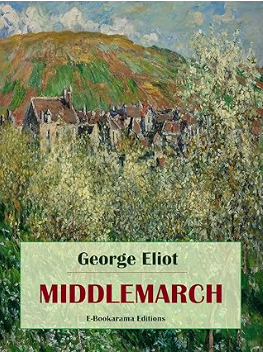
The great novelist Martin Amis once related Vladimir Nabokov’s belief that the reader should not identify with the character in a novel; rather, they should identify with the author. But I’ve never believed it. Yes, a good book does impart the wisdom of the author (this especially true in a masterpiece like George Eliot’s Middlemarch), as well as the benefit of their wit and depth of feeling. But that’s not the main reason people read novels. Rather, it is identification with the protagonist. And it’s not just that we identify with the main character; we must sympathize with them. We must participate in their struggle.
Even a rat-bastard character like Nabokov’s own Humbert Humbert—the most famous pedophile in literary history—could not keep our attention as readers if we did not, on some level, see ourselves in him. We must like him, if only a little. Feel sorry for him, even. Yes, he commits dreadful acts, but he does so, we sense, in a mistaken pursuit of happiness (that, what he believes is happiness, as he equates it to his sexual possession for Delores Haze). He is, in other words, a very wicked man but not a truly evil one.
Ree Dolly, of course, is neither wicked nor evil. She is, in fact, a completely valiant and admirable character. But that’s not the point. The relative morality or immorality of the main character is almost irrelevant. The only real requirement of a successful novel is that, through the art and skill and sympathy of the author, we are able to pierce the membrane of our own egos and enter that of the character. And, in doing so, we inevitably reflect upon our own, personal, real-life struggles. To paraphrase something I once heard Harry Crews say, it is a psychological truism that, in thinking about and judging a character in a novel, we inevitably come to think about and judge ourselves.
Right about now, you might be thinking of the Ancient Greek concept of carthasis, which refers to that paradoxical feeling of renewal one gets after watching a great, tragic play like Oedipus Rex or Othello. It is the sense of having participated in the plight of the tragic hero and come out the other side, as if reborn. And this idea certainly applies to literary novels. But what I am talking about is even deeper, more elemental, than catharsis. Rather, it has something to do with what Joseph Campbell described as “the rapture of being alive.” The rapture can, and in some ways must, transcend what we normally think of as decency or even morality. It goes deeper. It gets as who—and what—we really are, as beings that exist on both a physical and a spiritual plane.
So, I guess the title of this essay is a trick question. I don’t know why we read heavy, challenging novels. I don’t know why we enjoy them, and even need them. And I doubt anyone else really knows, either.
For some reason, I read a lot of science fiction during the holidays. Maybe this is because I loved science fiction as a kid, and I had more time to read it during the Christmas break. At any rate, this year I decided to post a list of great literary science fiction novels.
I’m not qualified to give a meaningful explanation of the difference between popular and literary fiction. My old professor, Jonathan Penner has already done that in his fine essay “Literary Fiction Versus Popular Fiction” (which I cannot find on the Internets, alas). But suffice to say that popular fiction is defined by a formula. As Penner states, “Every work of literary fiction seeks to be like none other; every work of genre fiction seeks to be like many others. Genre fiction works for effects on which the reader knows he or she may rely. Literary fiction always tries to see the world freshly.”
The novels I list below certainly fall into the category of popular fiction. They all make use of the common tropes of science fiction stories: space travel, robots, aliens, and the end-of-the-world. So why do I call them literary? Because each one of them, while remaining on a generic level, is centered around a vivid and successfully realized characters. Also, each is written with a emphatic artfulness and grace.
So here’s the list:
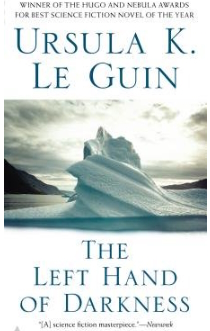
The Left Hand of Darkness Strangely enough, I first got interested in Ursula K. Le Guin’s classic novel when I read a review of it by John Updike. It’s about a human envoy who is sent to a distant alien planet called Gethen. Gethen is remarkable not only for its isolation, but also because the locals, although descended from homo sapiens thousands of years of previously, are all hermaphrodites. Specifically, they function as men for certain part of their lives, and as women for the other. It sounds a bit hokey now (the plot was even ripped-off on an episode of Star Trek), but it’s a fine little novel, with some genuinely compelling drama. (It actually develops into a kind of wilderness adventure story when the main character gets entangled in the political intrigue of the Gethen government.)
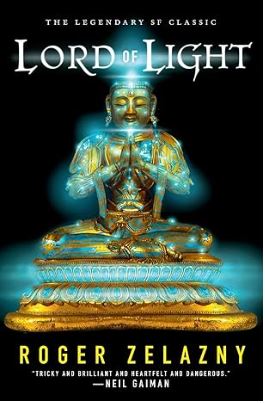
Lord of Light Roger Zelazny was a hell of a good writer who is best known for his Chronicles of Amber series of fantasy novels. But my favorite is Lord of Light, which is the first novel I ever read that seems, at first, to be one genre (religious fantasy), but then reveals itself—convincingly—to be another (science fiction). Zelazny sets the story on an unnamed, earth-like planet where the gods of the Hindu pantheon (Brahma, Vishnu, Shiva, etc.) are real and very much alive. These dieties use their Godly powers to rule over a pre-literate culture of peasants (controlling them in ways that are often less-than-divine).
The story centers on Sam—who closely resembles Gautama Buddha but with a Marlowesque twist—who is trying to unseat the vain and profligate Gods from their position of power. Sam, we soon learn, is one of the original crew members of a starship called The Star of India, which crash-landed on the planet eons previously. Apparently, Sam and the other surviving officers used their technology to set themselves up as “gods” to rule over the other castaways, and eventually came to believe their own propaganda. It’s a far-out idea, which Zelazny delivers in a surprisingly subtle, vivid novel that is part epic, part spoof.
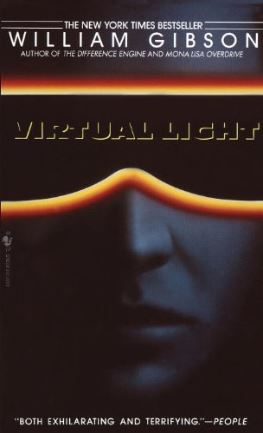
Virtual Light I think William Gibson is one of the best writers of his generation, literary or otherwise. He invented the term cyberpunk, and its attending genre, of which Virtual Light is my favorite example. It’s about a young bike messenger, Chevette, who spends her day cycling through the teeming, corporate-ruled streets of a future San Francisco. In a plot twist that is almost Dickensian in its lyricism, Chevette accidentally comes into possession of a very unusual pair of computerized sunglasses, which a villainous corporate hit-man is very anxious to get back. Gibson is a genius at mixing high-tech plots with low-tech heroes, and Chevette soon has to take refuge in an underground, DIY society based on the remnants of the Oakland Bay Bridge.
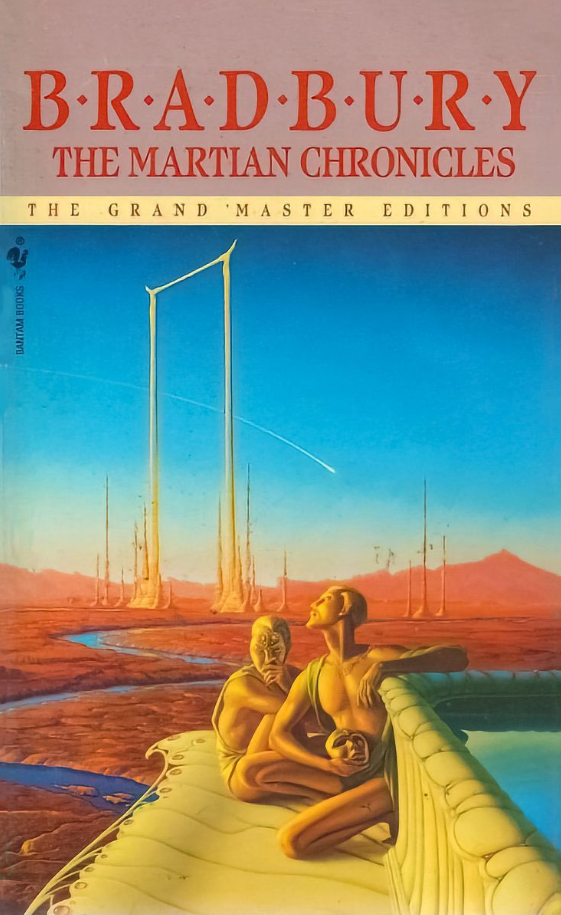
The Martian Chronicles Okay, it’s a stretch to put this one on the list, not because it isn’t literary, but because it really isn’t science fiction. It’s actually a collection of interlocking fables, all of which are based on Mars during the early phases of its colonization. Unfortunately, the planet is already occupied by an ancient race of Martians. If you substitute Illinois for Mars and the Sioux for the Martians, you get an idea of the feel of this novel, which Bradbury himself said was inspired by Sherwood Anderson’s classic collection, Winesburg, Ohio. Many of the stories are genuinely beautiful and haunting.
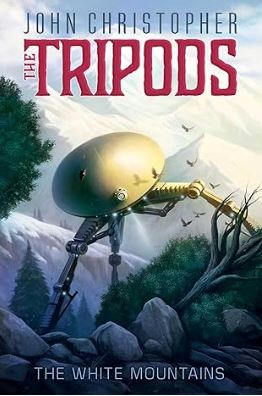
The Tripods If you didn’t read Samuel Youd’s trilogy when you were a kid, you should do so now, especially if you have a kid of your own. Earth has been conquered by aliens, and what remains of humanity exists in a servile, pre-industrial society. Young Will and his cousin Fritz escape their village and go on a quest for the fabled “White Mountains” where a human resistance is forming.
A Clockwork Orange The movie has outshone the book for most of my lifetime. But the book is actually better, written in the inimitable voice of Alex, a fourteen-year-old sociopath who is just trying to have a good time in an Orwellian England of the near future.
God Emperor of Dune The original Dune is a really cool adventure story. I always thought of it as Lawrence of Arabia in the 30th Century. But I think Herbert’s fourth novel in the series, God Emperor of Dune, is the best, from both a narrative and stylistic point-of-view. It focuses on just a couple of characters (as opposed to dozens) and it presents Leto Atreides (son of Paul) as genuinely sympathetic character.
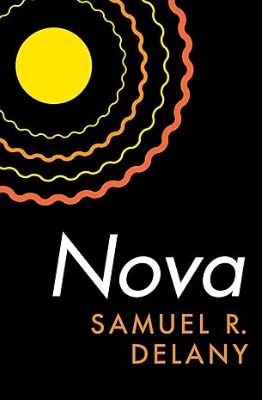
Nova Samuel R. Delany could never decide whether he was a physicist or a mythologist or an literary fiction writer. Why limit yourself? Nova, the story of a mad space-captain seeking to fly through the center of an exploding star, is Delany’s tightest and most interesting novel.
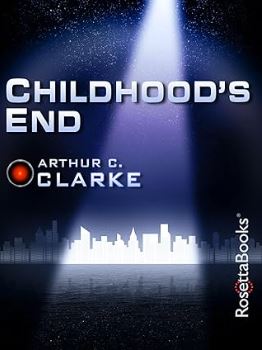
Childhood’s End I hesitate to put this one on the list. I loved it as a kid, as I loved all of Arthur C. Clarke’s books. As a writer, he was very, very limited. But in Childhood’s End, he really outdid himself. It’s the first novel I ever read that broached the concept of a technological Singularity.
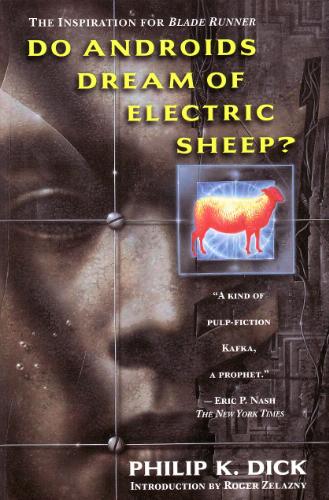
Do Androids Dream of Electric Sheep I can’t help but think that, in some alternate universe much like those he described in his novels, Phillip K. Dick is alive and well and living as a respected and beloved literary fiction writer. In this universe, however, he wrote mesmerizing, almost hallucinogenic sci-fi novels about good and evil, the definition of “reality”, and what it means to human. His best book, Do Androids Dream of Electric Sheep, is a haunting classic.
Author’s Note: This post first appeared some years ago on my old blog, Bakhtin’s Cigarettes.
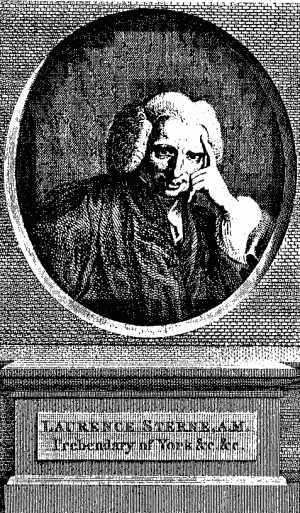
As part of the work for the Read a Classic Novel…Together channel, I’ve been reading a very old classic indeed, The Life and Opinions of Tristram Shandy, Gentleman (almost always abbreviated to just Tristram Shandy). Published by Laurence Sterne in 1767, it’s a very funny, sly book—kind of like Curb Your Enthusiasm, but in the 18th Century—and I found myself imagining George Washington reading it (and laughing his ass off) while holed up in some winter bunker during the dark days of the American Revolutionary War.
The story is told by Shandy himself, a very smart but self-absorbed and neurotic man (again, a lot like Larry David) who tells his life story in wry, sardonic, and occasionally schizophrenic prose. At one point in his rambling narrative, he mentions the “seven planets” in the heavens, which surprised me. Sure, I knew that even the ancient Romans knew about the inner planets, as well as Jupiter and Saturn. But the fact that the unfathomably distant Uranus was known in the 18th Century struck me as remarkable.
As it turns out, I was wrong. Uranus was not discovered until 1781, over a decade after Sterne wrote his novel (but still much earlier than I thought). Which means that there is no way that either Sterne, the writer, nor Shandy, the character, could have known about the actual seventh planet.
So, what, exactly, is Shandy alluding to in the “seven planets” bit? It seems that he was referring to the astrological planets in their classical (and very unscientific) sense, i.e., the Moon, Mercury, Venus, the Sun, Mars, Jupiter, and Saturn. This context makes sense, in retrospect, because Shandy is obsessed with astrology and its supposed effect on a person’s character. (Yes, he’s a bit of a kook.)
Lawrence Sterne
By the time I sorted all this out, however, it was too late; I was already deep down the Wikipedia rabbit-hole. I looked up the history of the outermost planet (not to be confused with the dwarf planets like Pluto and Ceres), Neptune. Neptune was discovered by French astronomer Urbain Le Verrier in 1846. Not only was it the first planet to be discovered entirely by telescope, it was also the first one whose existence was surmised before it was actually observed. That is, Verrier and fellow astronomer John Couch Adams had noticed irregularities in Uranus’s orbit, which, they suspected, might be caused by a seventh, hitherto unseen planet. They then deduced the probable location of this hypothetical planet and hunted it down.
And that’s not all! I also learned that Neptune was actually discovered before it was discovered. As historians found later, Neptune was seen at least three times before, by Galileo Galilei in 1613, Jérôme Lalande in 1795, and John Herschel in 1830. Each of these men recorded seeing something in that spot, but none of them realized it was a planet and not just a weird “fixed” star.
Apparently, this sort of thing happens with some frequency in the world of science, to the point that it actually has a name: precovery. In a precovery, someone finds all the information they might need to make a real (and potentially career-making) discovery, but they never put the pieces together. (Or, at least, they never publish a paper about it.)
I think there might be a profound lesson here about the difference between data and knowledge, observation and understanding.
It’s also a lesson about publishing what you’ve got, ASAP. Before some other doofus steals your thunder.
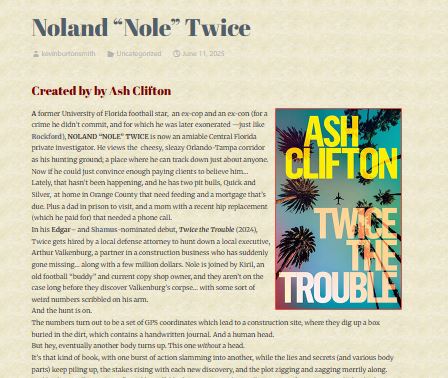
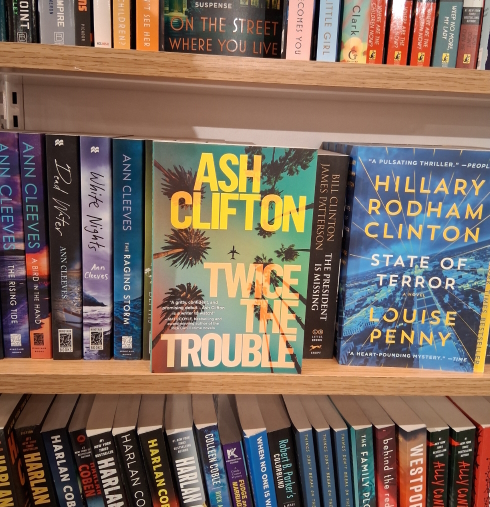
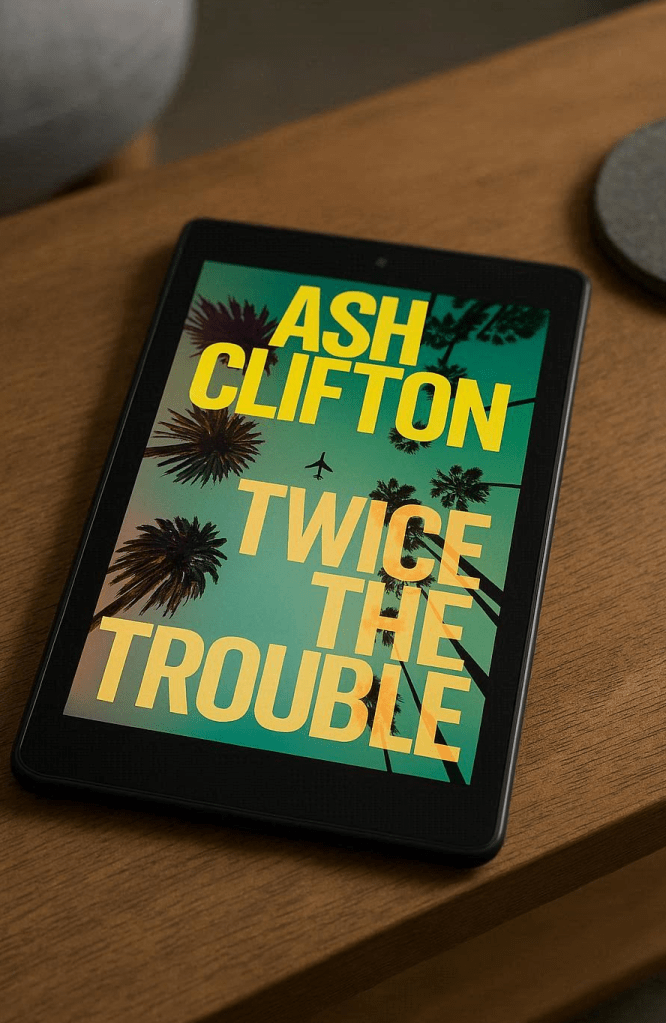
Just a heads-up…. My Edgar-nominated and Shamus-winning novel, Twice the Trouble, is a Kindle Deal all this month. You can get the ebook for just $1.99. That’s less than half the price of a Starbucks’ latte (and it will last a lot longer)!
I know, I know. This cover is a bit out-there. Not every sci-fi book cover, after all, has a spaceship hovering in a night sky over a plus-size female model in a metal bikini, go-go boots, and mail headdress. (But I kind of wish they did.)
Even so, this cover for Babel-17 by Samuel R. Delany is a bonafide classic by the great Spanish illustrator Vicente Segrelles, who has created a ton of great covers throughout his long and brilliant career. It was done for a series of Delany’s novels that were re-released by Bantam in the 1980s, all of which had great, subtle, off-beat covers.
Now, I’ve read a lot of snark about this cover on various chat-boards. Younger guys, especially, find it hilariously bad (and perhaps a lot of girls, too). I think this is because the woman depicted is not the usual, skinny, spandex-clad sci-fi babe. Personally, that’s one reason I like her. I think she’s mysterious, regal, and (yes) sexy.
More importantly, she captures the essence of the novel’s main character, Rydra Wong, who is not only the captain of a spaceship but also a master linguist. When government operatives seek her help in cracking an enemy, alien code called Babel-17, she discovers that it is not just a code—it’s an entire language. She promptly sets-off on a space-adventure to decipher the language, a quest that leads her into a war zone on the edge of the galaxy.
One of the things I love about Babel-17 is the way Delany, even way back in 1966, managed to push a message of tolerance and multi-culturalism. Wong’s spaceship is crewed by a rag-tag group of mercenaries, some of whom are not only transsexual but transhuman, opting for synthetically altered bodies that make them resemble wild animals or fairy tale creatures, and so on. Moreover, Wong’s desire to find the source of Babel-17—and, thus, better understand the aliens who are attacking humanity—suggests a deeper response to the usual fear and xenophobia that was so endemic in America at the time (and is again now, alas).
Babel-17 a classic sci-novel with a classic cover. Check it out…








 Ash Clifton, Writer