Perfect Films: “Manhunter”

*** SPOILERS BELOW ***

As any old movie buff knows (and many younger ones, too), crime thrillers in 1980s almost constituted their own sub-genre. That is, they had their own special vibe. Slick. Stylish. Erotic. Typically, they boasted good-looking actors with great 80s hair, wearing garish 80s clothes and doing dangerous things. These were exotic and entertaining films, usually set in one of two environments: a dark city landscape (i.e. L.A.) or a gorgeous, sun-drenched beach (i.e. Miami). 

And then there was the soundtrack. Synth-heavy, but punctuated with propulsive rock songs from the era—usually something from Genesis or Phil Collins. Take 1984’s Against All Odds, for example, starring Jeff Bridges and Rachel Ward. Collins wrote and sang the theme song for that one, garnering him an Oscar nom. (And, yes, that movie was set against a dark L.A. landscape and a gorgeous beach.)

But my absolute favorite 1980s crime thriller, by far, is a movie almost no one remembers: Michael Mann’s 1986 serial killer flick Manhunter. I saw it when it first came out in 1986, and then saw it again, quickly, before it vanished from the cineplexes forever. In the forty years since, the film has gotten almost no respect, except from a few cinephiles like me. (Quinten Tarantino is a famous booster; he put Manhunter on his list of favorite 1980s films.) 

I’ve often wondered why Manhunter is so underappreciated. It probably has something to do with its lame title, which the studio forced Mann for reasons too stupid to discuss here. The original working title was, of course, Red Dragon, taken from the source novel by Thomas Harris. I often think that if the studio had stuck with that title, the film would have been a hit. Another reason is that the brilliant soundtrack, which mostly samples great songs from the era but includes great original music from The Reds, was soon deemed as “dated”. (It has actually come back into fashion thanks to the rise of the Synthwave aesthetic.) 

Continue reading “Perfect Films: “Manhunter””

Heading to Orlando…

I’m heading off to O-Town tomorrow (yes, the setting for Twice the Trouble) to hold an author talk at the Barnes & Noble on Colonial. If you’re in the area, please come! Danni and Michelle, the hosts of the excellent Book Club After Dark podcast will be presiding.

(This is a ticketed event, so please click here to get your ticket.)

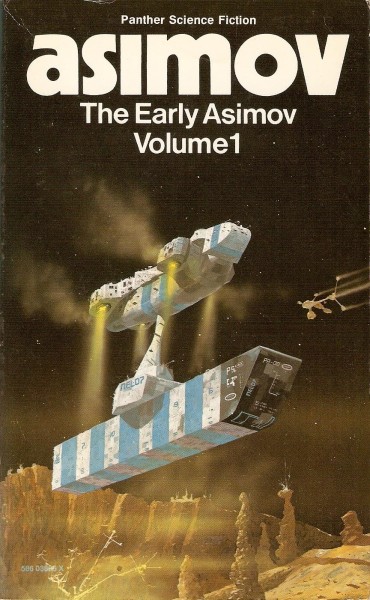
Classic Sci-Fi Book Cover: “The Early Asimov – Volume 1”

Ever since I started this series, I’ve been meaning to write a post about Chris Foss. For a sci-fi nerd growing up in the 1970s and ’80s, it was impossible not to see and be familiar with Foss’s artwork. After all, he illustrated more than 1,000 book covers during his long and celebrated career. His style is so distinct and memorable that one can recognize it on a bookshelf (or a computer screen) from twenty yards away. 

I remember seeing some of his sci-fi book covers back in the 1970s and being struck by their originality and vividness. He specialized in images depicting spaceships or futuristic craft, which he rendered with a strange, industrial-style realism that was new and striking. In particular, his spaceships look like real, constructed things with visible welds and spanners and plates, often painted in bright, almost nautical color schemes. He also likes to depict smoke. Or mist. Or dust. Something to give the otherwise static vacuum of space some drama and sense of motion. 

His work was so good, in fact, that no one seemed to care whether the depicted image had anything to do with the plot of the book itself. Often, it did not. But that didn’t matter. The cover always said two things: science fiction and drama. And that was enough. It was plenty. 

While I was doing a bit of research for this post, I was delighted to learn that Mr. Foss is still alive and still working. You can see more of his artwork on his website, which I encourage everyone to visit.

Book Talk – “The Dispossessed”, Part 1!

In this latest episode of our on-going YouTube series, Read a Classic Novel…Together!, Margaret and I go over the first half of The Dispossessed, Ursula K. Le Guin’s classic literary science fiction novel. We also address other topics such as was Communism doomed from the start, are flashbacks overused in fiction, and do New York City rats constitute their own, separate species?

Check it out!

Yes, the Marvel Movies Are “Real” Cinema

Having once been an art student (well, a creative-writing student; close enough), I know from experience that the quickest way to start an argument among a bunch of art majors is to ask them what the definition of “real” art is. Similarly, the best way to start an argument among a bunch of cinephiles is to ask them what “real” cinema is. 

That is essentially what the great director Martin Scorsese did in 2019 when he suggested that Marvel superhero movies (in their zenith, at the time) were “not cinema”. He stated: 

Honestly, the closest I can think of them, as well made as they are, with actors doing the best they can under the circumstances, is theme parks. It isn’t the cinema of human beings trying to convey emotional, psychological experiences to another human being.

Scorsese thus not only managed to make himself sound like a bit of a snob—not to mention a grumpy old man—but to also start an internet flame-war that continues to this day. Ultimately, the whole affair was a tempest-in-a-teapot. Of course, the Marvel films are “real” cinema. That is, they are fabulously well-crafted motion pictures that, at their best, have an emotional and even a physical impact on their viewers. And—again, at their best—they also make important philosophical and political points. However, they are a different kind of cinema than what Scorsese works in. In other words, what we’re really talking about her is the difference between literary cinema and popular (that is, genre-based) cinema.

This is the same distinction one must make between literary fiction and genre fiction. The purest and simplest definition of genre fiction is that, for the most part, the reader knows what they’re gonna get. A mystery is going to have a murderer and a sleuth. A horror story is going to have a monster and hero/heroine fighting it. A rom-com is going to have two people who should get together romantically but just can’t, for some reason, until the very end. And a superhero movie is going to have, well, a superhero with some kind of superpowers who is fighting some equally superlative evil.

The devil, of course, is in the details. We consume genre cinema for the same reason we consume genre literature—because we want to see how they pull it off. “They” in the case of cinema, being the director and the writer and the actors. How do they change-up the old formula, make it interesting and somehow new? 

That is how genres evolve and adapt to new time periods and new zeitgeists. Daniel Craig’s interpretation of James Bond was different from Sean Connery’s or Roger Moore’s—it was more brutal, more bloodthirsty, and yet somehow more vulnerable, too. Just like us, the American film-viewing public. 

In the same way, Marvel superhero movies are different from superhero movies of the 1970s (think Superman) or the 1980s. The characters are more believable, as well as being more complex and even vulnerable. I am, again, thinking of the very best Marvel movies: the first Ironman starring Robert Downey Jr. and Captain America: The Winter Soldier. This latter film, which came out in 2014 (yes, it’s been that long), is probably the best film of the entire series. And, yes, it is “real” cinema.

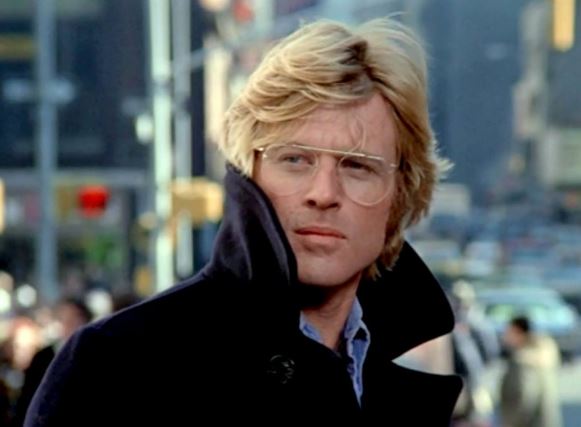
Robert Redford in “Three Days of the Condor”

In fact, as very few people have realized, The Winter Soldier is almost a remake of a 1975 film that most film snobs would agree is “real” cinema: Three Days of the Condor.

The only obvious similarity is that both films feature Robert Redford. In Condor, Redford plays a brilliant but very bookish CIA analyst named Turner who works in a New York City branch office. One day, he comes back from lunch to find everyone in the office dead, murdered by professional assassins. Turner goes on the run. Unsure of who he can trust, he kidnaps an unsuspecting, beautiful woman (Faye Dunnaway) and hides in her apartment. From there, he gradually figures out that the assassins who killed his work-mates were sent by a rogue faction inside the CIA itself. Apparently, Turner’s branch had stumbled upon a secret plot by the faction to invade the Middle East and capture all the oil fields (how very far-fetched, right?). Turner eventually confronts the leader of the faction, as well the head assassin, a Zen-Master-like Frenchman named Joubert (played with brilliant, icy effectiveness by Max von Sydow). 

On the surface, Condor might seem like a very different film from The Winter Soldier. But the closer you look, the more The Winter Soldier seems almost like a remix of the earlier film. That is, it has all the same elements. The good-guy-betrayed-by-his-government figure is Steve Rogers (a.k.a. Captain America) who, like Turner in Condor, discovers a vast conspiracy within U.S. intelligence (S.H.I.E.L.D, in this case, rather than the CIA). Like Turner, Rogers finds himself on the run with a beautiful woman (Natasha Romanoff/Black Widow). He confronts the leader of the conspiracy (played by none other than Robert Redford himself). And of course he confronts the lead assassin, Barnes, who (like Joubert in Condor) turns out to be far more complicated than he appears. 

Even some of the individual scenes in The Winter Soldier are eerily reminiscent of those in Condor. Take the now famous elevator sequence, which is not only the best in the film but one of the best in the entire MCU series. On his way out of the high-tech and vaguely fascistic H.Q. of S.H.I.E.L.D., Rogers steps into an elevator and rides down. As the elevator stops at successive floors, more and more men step on, each menacing but seemingly disinterested. The scene works so well because everyone—that sense of unease we all fell when forced into close proximity with strangers. We begin to wonder: what if some of these people were evil. They could hurt us—maybe even kill us—before we could react. And yet, despite this unease, we do nothing because we have no real evidence of evil intent. We’re playing a social role. And that’s just what Rogers—a good-natured man if ever there was one, willing to give anyone the benefit of the doubt—does. 

Robert Redford in “The Winter Soldier”

I love the moment when Rogers notices sweat streaming down the face of one of the men next to him. He knows—as we, the viewers, know—that this is really, really bad. But there is nothing he can do about it…yet. It’s still in the future. Alfred Hitchcock couldn’t have done it any better. Nor, for that matter, could Sidney Pollack, who has an almost identical scene in Condor, in which the hapless Turner finds himself in an elevator with Joubert, the master assassin. Each man knows that the other man knows who he really is, but neither can take any action…yet. 

Ever since I read Mark Crispin Miller’s landmark essay “Hollywood: The Ad” many years ago, I’ve been fascinated the way in which the tropes and elements of an early “classic” movie can end up rearranged and transformed in a later pop film. Miller gives the example of 2001: A Space Odyssey (1968) and Star Wars (1977). If you look closely, many of the components of the former get transmogrified in the latter. The apes of 2001 become the loyal Wookie Chewbacca. The cold, robotic voice of HAL the computer becomes that of C3PO the droid. The white, sterile interiors of the spaceship Discovery become the stark, sterile halls of the Death Star. And so on and so forth.

Martin Scorsese

That’s just what has happened here, with Condor and The Winter Solider. They’re practically the same movie, but shaken up by time and changing purposes. That is, The Winter Soldier is every inch a pop film, with the full intention of stimulating the audience with all the action and explosions and kung-fu fights that we’ve come to expect from a Hollywood blockbuster. But, on some level, the kernel of Condor is still there. The Winter Soldier is also a story about evil, rapacious men seizing control of government, and also the creeping power of America’s military-industrial complex. It’s also about the dehumanization the soldiers like Rogers and Barnes undergo as pawns in the hands of callous leaders and ruthless institutions.

In short, despite all its roller-coaster-ride thrills and spectacle, The Winter Solider is a “real” movie. 

And, yes, it’s “real” cinema.

Shamus Award Nom

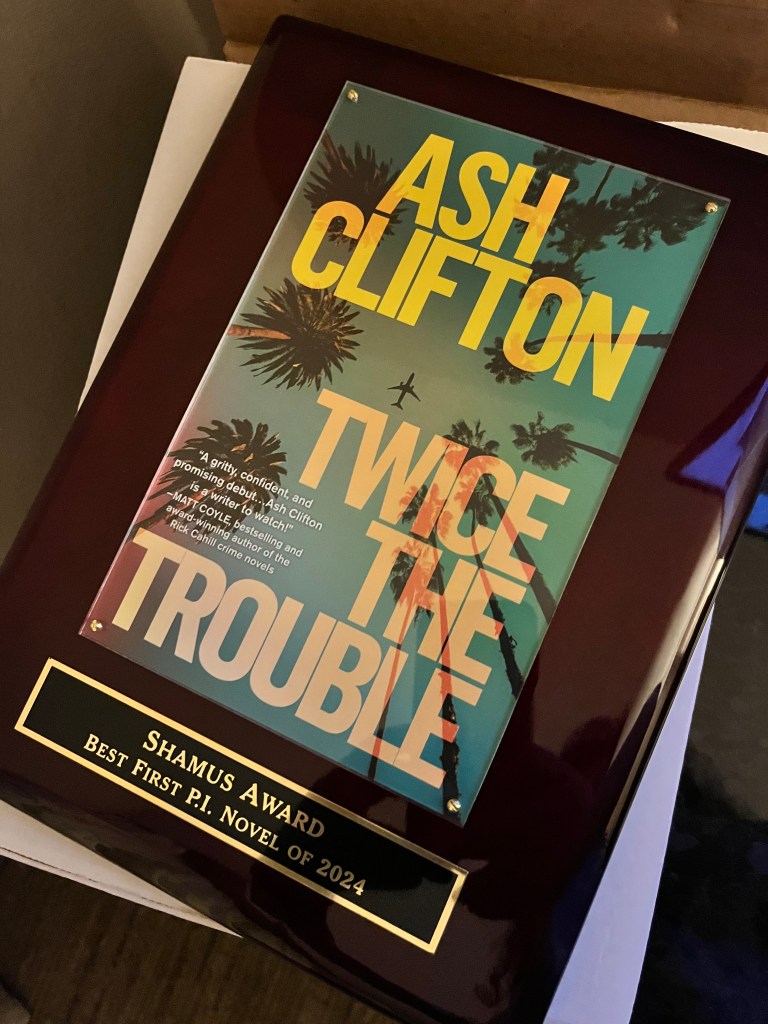
I am very happy to announce that I am a finalist in the Best First P.I. Novel category for this year’s Shamus Awards! Many, many thanks to the good people of The Private Eye Writers of America for this great honor.

Good luck to all the other nominees, especially my friends Alexis Stefanovich-Thomson and Henry Wise. I hope one of us wins. And I really hope it’s me.

Classic Sci-Fi Book Cover: “Something Wicked This Way Comes”

Okay, let’s get this out of the way: Something Wicked this Way Comes is not a science fiction novel. It’s dark fantasy, and, in my opinion, a precursor to many famous books in that genre from the likes of Stephen King, Anne Rice, Erin Morgenstern, and others. 

However, Ray Bradbury’s books were always sold in the science fiction aisle when I was a kid. And I read all his books thinking they were science fiction. (I didn’t read fantasy back then.) So, I’m shoe-horning him into my classic sci-fi book covers thread. 

Having said all that, let me add that this is one of my favorite novels, not to mention Bradbury’s best. It’s the tale of two 13-year-old boys, Will and Jim, who have grown up next door to each other in 1930s Illinois. Will and Jim are almost exactly the same age, with Will being born one minute before midnight on October 30th and Jim being born one minute after midnight on October 31st. Yes, one boy is born a minute before Halloween begins and the other born a minute after. (Guess which one is the “bad” kid?)

It might seem like clunky symbolism, but in Bradbury’s prolix hands, it works. The duality between the introverted, good-natured Will and the adventurous, mischievous Jim—that is, between light and dark sides of our being—is repeated throughout the novel. Both boys are forced to confront their darker impulses when a demonic carnival arrives on the edge of town in the middle of the night. Will and Jim soon discover that the carnival is a vehicle for a bunch of malevolent,  vampire-like beings who want nothing more to lure innocent people onto the midway and tempt them into evil.

The only person who believes the boys when they tell what they’ve seen is Will’s father, an older man who doubts his own strength and courage. Together, they challenge the men who run the carnival, Mr. Cougar and Mr. Dark (another light/dark duality) for the soul of the town.

I really like this cover—created by veteran illustrator David Grove—because it captures the nostalgia, magic, and dark wonder that are the great strengths of the novel. Specifically, it refers to a moment in the story when Mr. Dark wanders through the town looking for Will and Jim. He has the images of the boy tattooed on his palms, and he shows them to passersby to see if anyone recognizes them. It’s an extremely creepy scene in an amazing book. (It’s also the first moment when Will’s father shows his courage and guile in besting Mr. Dark.)

My appreciation for the cover is in no way diminished by the fact that it appears to be a poster tie-in with the film adaptation produced by Disney in 1983, depicting the likenesses of some of the actors (most notably, the great Jonathan Pryce, who performance as Mr. Dark is worth the price of admission all by itself).

Also, not long after Mr. Grove passed away, Tor.com published a tribute to him and his career. You can see it here

Synchronicity for Bookworms: Sherlock Holmes and George Eliot

Jeremy Brett as Sherlock Holmes

It’s time for another entry in my ongoing series Synchronicity for Bookworms. In this episode, I will describe the incredibly tenuous and yet undeniable connection I found between the great stage and film actor Jeremy Brett and George Eliot’s classic Victorian novel Middlemarch

As you might recall, I recently did a blog post on Arthur Conan Doyle’s classic mystery novel, The Hound of the Baskervilles. In that post, I mentioned that my favorite actor to ever play the role of Sherlock Holmes was Jeremy Brett. While I was writing the post, I browsed various Internet pages pertaining to Brett. Brett was primarily a brilliant and prolific stage actor, appearing in everything from Shakespearean Tragedy (check out his performance as Macbeth on YouTube) to comic theater. 

Rex Harrison

On one page, I found a photo of Brett standing in front of a billboard advertising a play in which he was appearing. As I looked closer at the image, I saw that Rex Harrison was also in the play. (As I later discovered, the production was a revival of Frederick Lonsdale’s “Aren’t We All?” that ran on Broadway in 1985.) This revelation made me smile because I am also a fan of Rex Harrison, ever since I read a biography of him a decade ago.

Naturally, I immediately went to the Wikipedia page for Rex Harrison and browsed through his biography. This included his great filmography. One of the more famous films he starred in was Blithe Spirit, a supernatural comedy based on a play by Noël Coward. I clicked on the link to the Wikipedia page for Blythe Spirit (the play) and discovered that Coward took the title from a poem by the great British romantic poet Percy Bysshe Shelley

Naturally, I then clicked on the link to Shelly’s Wikipedia page and browse through his biography. Reaching the bottom of the page, I saw to my amazement that George Eliott had based the character of Will Ladislaw from her great novel Middlemarch on Shelley. 

Percy Bysshe Shelley

And there you have it, a cosmic filament connecting two of my recent topics—Sherlock Holmes and George Eliot. When my eyes settled on this last reference to Middlemarch, a little spark of amazement ran down my spine. That’s the sensation one gets when stumbling upon the sublime, hiding in the common-place.

Note that this was not some Six Degrees of Seven Bacon thing. That is, I was not looking for any connection. In fact, Middlemarch wasn’t on my mind at all when I started Googling Jeremy Brett. And yet, there the connection was.

I don’t know if it means anything or not. But it made my day.

What I’m Reading: Middlemarch

As some dedicated readers of this blog might know, my friend Margaret Luongo and I posted a pair of videos discussing George Eliot’s classic novel Middlemarch to our “Read A Classic Novel…Together!” channel on YouTube. Ever since then, I’ve been meaning to take the time to write a post about it, mainly because it had such a big impact on me. I mean, lots of books have achieved the classic moniker and yet don’t hold up to modern scrutiny. But Middlemarch does. In fact, it’s one of those titanic works of literature that you almost can’t get your head around. It has so many sides and so many aspects, such that it attains a kind of sublime quality. Like Shakespeare’s works, Middlemarch is a different experience for everyone who reads it.

When I say titanic, I mean it literally. Middlemarch is a big book–eight hundred pages in most editions–following the lives of six major and at least a dozen minor characters in the fictional, provincial town called Middlemarch. The story is set in the 1830s, but Eliot wrote the book in the 1870s, when the world had already been vastly changed by the industrial revolution in England. And so, the book has a little bit of a “lost world” feel to it. One can sense that Eliot (whose real name was Mary Ann Evans) is writing about the social and economic environment that is already a thing of the past. However, absolutely nothing about the book feels the least bit sentimental or nostalgic. Quite the contrary. Eliot was a great writer whose blazing intelligence seems to illuminate every page of this very long book. And everything she describes feels as true and relevant today as when she wrote it.

Continue reading “What I’m Reading: Middlemarch”

My Interview on The Writer’s Dossier Podcast

Recently I chatted with my friend Jeff Circle on his excellent “The Writer’s Dossier” podcast. We discussed topics ranging from growing up in Gainesville to 80s music to crime fiction. I had a great time, even though I was slow to grasp the concept of “rapid-fire responses.” Oh, well. I’m getting old.

Check it out…