I’m heading off to O-Town tomorrow (yes, the setting for Twice the Trouble) to hold an author talk at the Barnes & Noble on Colonial. If you’re in the area, please come! Danni and Michelle, the hosts of the excellent Book Club After Dark podcast will be presiding.
(This is a ticketed event, so please click here to get your ticket.)
There is a scene in Steven Soderbergh’s 1999 noir thriller The Limey when the main character, Wilson, a career-criminal and generally scary guy, is questioning a woman in her house about a man named Valentine. Wilson (played with enormous power by Terance Stamp), is looking for the man who killed his daughter, and Valentine is his prime suspect. The woman, naively, offers to give Wilson Valentine’s phone number, at which point Wilson smiles wickedly and says, mostly to himself, “I’ve got his number.”
It’s a great, almost chilling moment. What we, the viewers, know (and the woman doesn’t) is that Wilson has already killed five men to get Valentine’s “number”, every sense of the term. And Stamp’s delivery of this line speaks volumes about Wilson’s character—his steely-eyed determination, his courage, and his constant, barely controlled rage.
It’s a great moment in a great movie, which marked one of several come-backs in Stamp’s long career. His filmography is so great and varied that one must divide not in stages but in ages. First, there was Stamp the movie star, an epically handsome, Angry-Young-Man who got the lead in several fine, gritty films in the 1960s, including William Wyler’s The Collector and Ken Loach’s Poor Cow. But he never really clicked as a leading-man, either in England or in Hollywood, and his next big break didn’t come until 1980’s Superman II, in which he reprised his role as the evil General Zod (a.k.a. the chief of the three baddies whom Superman’s dad banishes to the Phantom Zone in Superman.)
To this day, Stamp is best remembered for this one, silly role, Zod—at least, in America. But film nerds such as myself admired his work in many other small, supporting roles throughout the 80s. My favorite was his scene-stealing cameo in 1987 Wall Street, playing a redoubtable corporate raider who has reformed his ways and stands in opposition to the evil Gordon Gekko.
Then, in the 1990’s, Stamp had his next, and greatest, comeback with his role as transexual woman in The Adventures of Priscilla, Queen of the Desert, which remains one of my favorite films of all time. Stamp was nominated for a BAFTA for that one, and he should have been nominated for an Oscar, too. But no matter. The role is a classic, and it re-introduced him to American audiences.
This led to Stamp’s last leading role in a major motion picture. This was, of course, The Limey, and it is perhaps his greatest performance, in part because he was able to leverage his own, real-life history as 1960s hipster in the role of Wilson, who was a master thief in 1960s England. Indeed, Soderbergh sampled black-and-white footage of Stamp from Ken Loach’s Poor Cow to use in flashbacks of Wilson’s earlier life—a daring artistic choice which, although done with permission from Loach himself, remains controversial to this day. However one might feel about this cinematic cribbing, though, Soderbergh made one hell of a good movie—a genuine classic—in which Stamp finally got a chance to shine in the lead, one last time.
Terance Stamp passed away on Sunday, at the age of 87. Not bad, for such a hell-raiser. I’ll miss him.
As I’ve stated before, one mark of a truly fine mystery novel—for me at least—is if I feel the need to go back and reread it. This isn’t just a matter of me waiting long enough to forget whodunnit (a period of time that grows shorter the older I get), it’s also an indication that something about the novel stuck with me, and made me want to revisit its imagined world.
So, it’s perhaps not surprising that I find myself rereading many of Edith Pargeter’s (writing as Ellis Peters) Brother Cadfael novels. Currently, I’m on The Rose Rent, which is about as fine an episode in the series as any. It has all the components of a truly great mystery novel—namely, a compelling and complicated sleuth; an entrancing and alien setting; original and interesting secondary characters; and a multi-layered plot.
And a voice. Of course, a great narrative voice. Take the opening paragraph of the novel:
By reason of the prolonged cold, which lingered far into April, and had scarcely mellowed when the month of May began, everything came laggard and reluctant that spring of 1142. The birds kept close about the roofs, finding warmer places to roost. The bees slept late, depleted their stores, and had to be fed, but neither was there any early burst of blossom for them to make fruitful. In the gardens there was no point in planting seed that would rot or be eaten in soil too chilly to engender life.
I love the elegance and almost romantic feel to this passage, which is characteristic of all Pargeter’s writing. You feel like you’re in competent hands, which is crucial considering that you’ve been transported to England in the Twelfth Century. (Specifically, to Shrewsbury, the town where Cadfael lives as the resident herbalist of the local Benedictine monastery.) I love the sense of desolation in this opening. We can almost feel the lingering winter, which has gone on too long and threatens the well-being of the town, including the ordinary folk, the monks, and even the nobles. It also suggests the coming tragedy of the murder around which the story will be revolve—that of a young, love-stricken monk who is killed trying to protect the woman with whom he has become infatuated.
Yes, it’s a desolate opening. But with Pargeter, you never really feel hopeless. Sure, it’s the Dark Ages, but her stories are populated with good, strong, shrewd people who always find a way to make the best of things. Take this paragraph, which comes a bit later and introduces Brother Cadfael himself:
Brother Cadfael, preoccupied with his own narrower concerns, continued to survey the vegetable patch outside the wall of his herb-garden, digging an experimental toe into soil grown darker and kinder after a mild morning shower. “By rights,” he said thoughtfully, “carrots should have been in more than a month ago, and the first radishes will be fibrous and shrunken as old leather, but we might get something with more juices in it from now on. Lucky the fruit-blossom held back until the bees began to wake up, but even so it will be a thin crop this year. Everything’s four weeks behind, but the seasons have a way of catching up, somehow. Wareham, you were saying? What of Wareham?”
#
He is speaking, of course, to his best friend, Hugh Berenger, the Sheriff of Shrewsbury. Berenger is a much younger man, but like Cadfael he is world-weary, experienced, and tough. Indeed, many of the best novels in the series depict bad guys who underestimate Berenger, with his mild demeanor and slight build, as weak. He is, in fact, an intelligent man and a cunning fighter. Berenger has just brought news of the most recent battle of the on-going English civil war (the Anarchy) which serves as the backdrop for all the novels. Berenger, we know, has befriended Cadfael in part because they have both been soldiers—in Cadfael’s case, a veteran of the First Crusade, which caused him to live in the Middle East for many years, where he lived with a Muslim widow and fathered a child with her.
A great part of the appeal of these novels is this tension between two sides of Cadfael’s character. He is the very opposite of an oblate—a person who has come into the monastery as a child. Rather, Cadfael has converted later in life, after have seen many terrible and wondrous things and had many worldly experiences. As such, he brings a shrewd, wise perspective to his role as a monk, healer, and protector of the innocent—a shrewdness that is matched by the “hatchet-faced” Abbot Rudolfus, who often conspires with Cadfael to bend the rules in favor of a remorseful miscreant or helpless person.
And, of course, there is just Pargeter’s unerring talent for winning, memorable description. For instance, take this passage, in which a self-serving (and possibly villainous) young character, Vivian, is introduced.
[Vivian] was a very personable young man indeed, tall and athletic, with corn-yellow hair that curled becomingly, and dancing pebble-brown eyes in which a full light found surprising golden glints. He was invariably elegant in his gear and wear, and knew very well how pleasant a picture he made in most women’s eyes. And if he had made no headway yet with the Widow Perle, neither had anyone else, and there was still hope.
The woman on whom Vivian has set his sights is Judith Perle, a young widow who has leased her old house to the monastery for the meager “rent” of a single rose per year, plucked from the bush that grows outside the doorway. Judith is, of course, very rich woman, and must of the plot revolves around a murder who is intent of separating her from that wealth—even if this means killing her in the process.
The Rose Rent is a great mystery novel. Check it out…
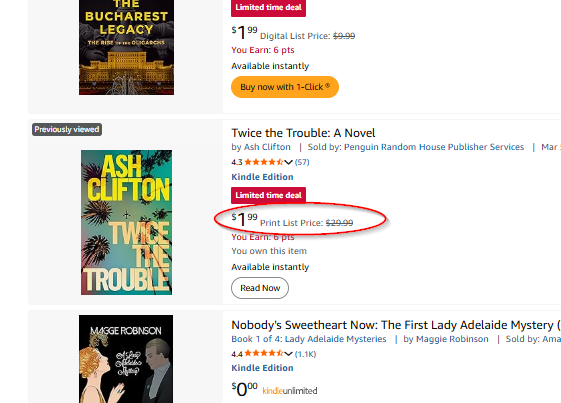
What can two bucks buy you in today’s economy? A copy of my book, that’s what! For the entire month of August, the Kindle edition of Twice the Trouble is on sale for just two bucks. That’s right. Just two Ameros!
You should buy it! Right now! Don’t give me that “I don’t even have a Kindle” crap! Just buy the damned book. Buy buy buy!
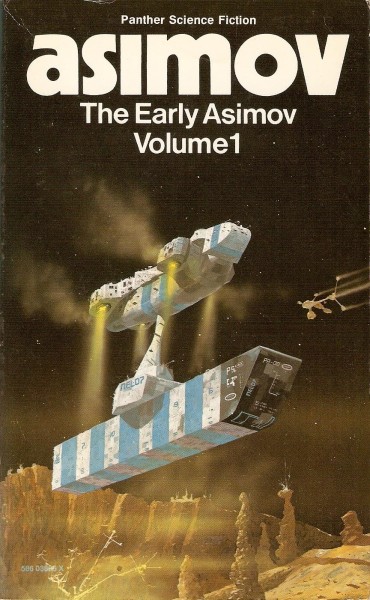
Ever since I started this series, I’ve been meaning to write a post about Chris Foss. For a sci-fi nerd growing up in the 1970s and ’80s, it was impossible not to see and be familiar with Foss’s artwork. After all, he illustrated more than 1,000 book covers during his long and celebrated career. His style is so distinct and memorable that one can recognize it on a bookshelf (or a computer screen) from twenty yards away.
I remember seeing some of his sci-fi book covers back in the 1970s and being struck by their originality and vividness. He specialized in images depicting spaceships or futuristic craft, which he rendered with a strange, industrial-style realism that was new and striking. In particular, his spaceships look like real, constructed things with visible welds and spanners and plates, often painted in bright, almost nautical color schemes. He also likes to depict smoke. Or mist. Or dust. Something to give the otherwise static vacuum of space some drama and sense of motion.
His work was so good, in fact, that no one seemed to care whether the depicted image had anything to do with the plot of the book itself. Often, it did not. But that didn’t matter. The cover always said two things: science fiction and drama. And that was enough. It was plenty.
While I was doing a bit of research for this post, I was delighted to learn that Mr. Foss is still alive and still working. You can see more of his artwork on his website, which I encourage everyone to visit.
What’s worse than a shameless plug? A rerun of a shameless plug!
I’ve been laid up with back problems all week and haven’t been doing much, so I thought I would repost this oldie. I had a lot of fun writing this essay. Many thanks to the good people at CrimeReads for giving me the opportunity.
When I was a kid, my parents bought me a book called A Pictorial History of Science Fiction by David Kyle, which covers the history of science fiction illustration from Jules Verne all the way through the 1970s. (The book was printed in 1976.) I still have it. I remember being especially enthralled by covers from pulp magazines in the 1930s like Astounding Science Fiction and Amazing Stories. Many of these covers were devoted to some artist’s vision of The City of The Future—usually some towering, high-tech, hive-like metropolis.
It makes sense that sci-fi nerds of the 1930s would imagine a vertical, urban future. At the time, the most sophisticated places on earth were the great western cities of Europe and America. Paris. Berlin. And especially New York—Manhattan—with its great skyscrapers reaching ever higher. The obvious extrapolation of this trend was that someday everyone would be living in some vast, super-tall version of New York or Los Angeles, with buildings hundreds of stories high and millions of people living in close proximity. Ramps and walkways would connect these towers in the sky, allowing residents to hardly ever venture down to street-level. Airplanes, blimps, and elevated high-speed trains would speed residents from one end of the city to the next.
For most of these sci-fi artists and writers, this was going to be a good thing. A utopian vision, in fact. Future cities would be paradises of high technology, dense but egalitarian. Robots would do all the dirty work, and everyone would be rich. For others, though, the City of the Future would be a capitalist hell, with the decadent rich living high above the exploited poor. These upper-classes would hoard resources and technology, either out of fear or greed or sheer meanness. It is this dystopian vision that informs works like Fritz Lang’s Metropolis, as well as every instance of the cyberpunk genre from William Gibson’s Virtual Light to Ridley Scott’s Blade Runner.
Despite this dark side, however, the vision of an artificial, high-tech utopia has long existed in sci-fi, and it still does today. But the vision itself has changed. Relocated. These days, the City of Future is almost invariably depicted as being in outer space—”off-world,” in the lingo of movies like Blade Runner—either on a nearby planet or the moon or on a station floating in space.
Space stations, in particular, have captured the imagination of science fiction fans for the past four decades, ever since Princeton physicist Gerard K. O’Neill published The High Frontier: Human Colonies in Outer Space. In that landmark book, O’Neill explained the advantages of living on a space colony as opposed to a land-based colony like Mars or the moon. These include the fact that one could spin the colony to produce the same gravitational pull as Earth, thus avoiding any physiological problems the colonies might suffer from living on a smaller world. Unlimited solar power is another plus, as is the fact that, living outside the gravity well of a planet or moon, travel between colonies would be vastly cheaper. Trade would thrive, fueled by a steady flow of cheap, raw materials from the asteroid belt and various moons throughout the solar system.
Artist’s Depiction of Stanford Torus Interior, c. 1970s
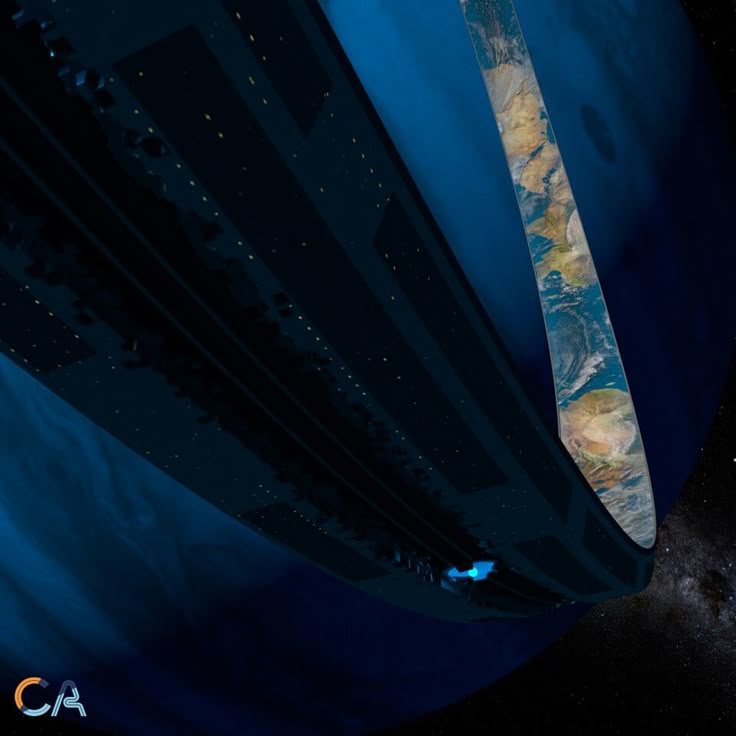
O’Neill was the first, legit scientist to take the idea of people living in outer space seriously, and he was able to back up his ideas with hard data, including actual blueprints for working stations. Namely, he invented the O’Neill Cylinder, a tube-shaped world the size of a city with its residents living on the inner surface. Other designs were created by a diverse group of like-minded theorists. Of these, the most compelling is the Stanford torus (named for the university where the plan was cooked up). Instead of a tube, it’s a giant wheel. For whatever reason, it’s this ring-like design that has dominated most sci-fi stories of recent decades. Larry Niven’s Ringworld is basically a humongous Stanford torus (large enough to encircle a star). And the design is also represented in the wheel-worlds of the Halo videogame franchise and the fabulous Orbitals of Iain Banks’s The Culture novels.
As was the case with the high-rise super-cities that were imagined of the 1920s, the space-colony vision isn’t always utopian. In the 2013 film Elysium, for example, the titular space station is an exclusive haven for the ultra-rich, desperate to escape an Earth ravaged by global warming and end-stage capitalism. Perhaps this is why many people become uneasy when billionaire tech-bros like Jeff Bezos openly embrace the idea of building giant colonies in space. They seem to be confirming the dystopian side of the space colony coin.
I have very little in common with Jeff Bezos. But, like him, I must confess to be completely captivated by the idea of colonies in space. They are not only fun to imagine, but I believe that they probably do represent the best possible, long-term vision for the future of humanity. I don’t know if they will happen, but I hope they do.
Recent Artistic Depiction of Stanford Torus
Why do I harbor this hope? Lots of reasons. For one, space colonies offer our best chance of surviving as a species into the far future. Even if we somehow avoid the worst consequences of global-warming, there will always be some other looming disaster that threatens to exterminate life on Earth, from planet-killer asteroids to super-volcanoes to the next pandemic. With space colonies, there would soon be more people living in space than earth—perhaps trillions of people within a few centuries—thus making us a lot harder to wipe out.
For another, the quality of life on space colonies would probably be much, much higher for the average citizen than it is likely to ever be on Earth. This is due to the advantages I listed above, like abundant solar power and cheap resources for asteroids. And overpopulation would never be a problem—at least, not for long. Whenever a colony got too crowded, any citizens who craved more elbow-room would simply build a new space colony and move into it.
Of course, many people will never be disavowed of the idea that space colonies represent nothing more than a “Plan-B” for the ultra-rich. That is, after all the rich people trash the earth with their greed and unfettered capitalism, space colonies give them the ultimate chance for escape from the consequences of their actions.
This is, I think, a real possibility for why space colonies might eventually be built. But it’s not the only possibility, nor even the most likely. Rather, my guess is that space colonies will be built for the positive reasons that I mentioned—abundance, room, and quality of life. Indeed, one could imagine an era—in the three or four-hundred perhaps—when so many people choose to emigrate to space that Earth could become a giant Hawaii. That is, an ecological and historical preserve, with less than a billion people on the entire planet. People who are born on space colonies might endeavor to make a pilgrimage down to Earth at least once in their lives, the way many Irish-Americans eventually take a vacation in “the Old Country” of Ireland.
One thing Bezos and I vehemently disagree on (one of many things, actually) is the time-table for when space colonies will eventually be built. It won’t happen any time soon–not in Bezo’s lifetime (unless he has a store of some immortality drug stashed somewhere), nor in mine, nor in the next generation. But I think it will happen.
Artistic Depiction of a Roofless Bishop Ring
Which leads to the question: Will space colonies really be utopias? That depends on your definition of utopia. If a citizen of mediaeval Europe were to be magically transported to a modern, western city, they would probably perceive it as a utopia. I mean, running water? Toilets? Central heating? All the food you can eat? How much more utopian can you get? Such a person would probably dismiss any argument we might make to the contrary—that people in the 21st Century have as many problems as those in the 13th. Bullshit, they would probably say. And they’d be right. For, while modern western civilization isn’t perfect (and it seems to be getting less perfect by the day, alas), it’s still pretty freakin cool. Yes, we still have evil and stupidity and greed. And all of those human failings will find their way onto space stations.
But still, we will be making progress. It’s a worthwhile vision, and exactly the kind of dream that good sci-fi can deliver.
Having once been an art student (well, a creative-writing student; close enough), I know from experience that the quickest way to start an argument among a bunch of art majors is to ask them what the definition of “real” art is. Similarly, the best way to start an argument among a bunch of cinephiles is to ask them what “real” cinema is.
That is essentially what the great director Martin Scorsese did in 2019 when he suggested that Marvel superhero movies (in their zenith, at the time) were “not cinema”. He stated:
Honestly, the closest I can think of them, as well made as they are, with actors doing the best they can under the circumstances, is theme parks. It isn’t the cinema of human beings trying to convey emotional, psychological experiences to another human being.
Scorsese thus not only managed to make himself sound like a bit of a snob—not to mention a grumpy old man—but to also start an internet flame-war that continues to this day.
Ultimately, though, the whole affair was a tempest-in-a-teapot. Of course the Marvel films are “real” cinema. That is, they are fabulously well-crafted motion pictures that, at their best, have an emotional and even a physical impact on their viewers. They also (again, at their best) make important philosophical and political points.
However, they are a different kind of cinema than what Scorsese works in. In other words, what we’re really talking about her is the difference between literary cinema and popular (that is, genre-based) cinema.
This is the same distinction one must make between literary fiction and genre fiction. The purest and simplest definition of genre fiction is that, for the most part, the reader knows what they’re gonna get. A mystery is going to have a murderer and a sleuth. A horror story is going to have a monster and hero/heroine fighting it. A rom-com is going to have two people who should get together romantically but just can’t, for some reason, until the very end. And a superhero movie is going to have, well, a superhero with some kind of superpowers who is fighting some equally superlative evil.
The devil, of course, is in the details. We consume genre cinema for the same reason we consume genre literature—because we want to see how they pull it off. “They” in the case of cinema, being the director and the writer and the actors. How do they change-up the old formula, make it interesting and somehow new?
That is how genres evolve and adapt to new time periods and new zeitgeists. Daniel Craig’s interpretation of James Bond was different from Sean Connery’s or Roger Moore’s—it was more brutal, more bloodthirsty, and yet somehow more vulnerable, too. Just like us, the American film-viewing public.
In the same way, Marvel superhero movies are different from superhero movies of the 1970s (think Superman) or the 1980s. The characters are more believable, as well as being more complex and even vulnerable. I am, again, thinking of the very best Marvel movies: the first Ironman starring Robert Downey Jr. and Captain America: The Winter Soldier. This latter film, which came out in 2014 (yes, it’s been that long), is probably the best film of the entire series. And, yes, it is “real” cinema.
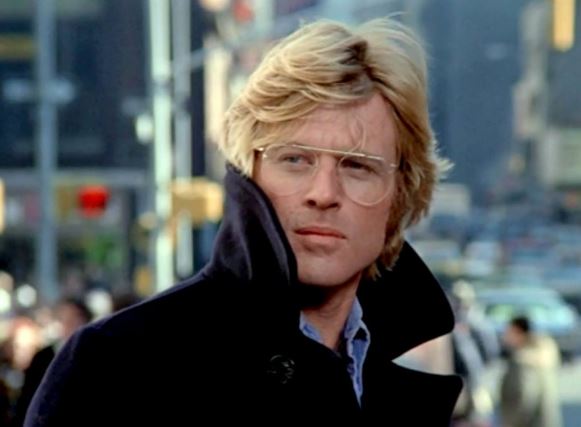
Robert Redford in “Three Days of the Condor”
In fact, as very few people have realized, The Winter Soldier is almost a remake of a 1975 film that most film snobs would agree is “real” cinema: Three Days of the Condor.
The only obvious similarity is that both films feature Robert Redford. In Condor, Redford plays a brilliant but very bookish CIA analyst named Turner who works in a New York City branch office. One day, he comes back from lunch to find everyone in the office dead, murdered by professional assassins. Turner goes on the run. Unsure of who he can trust, he kidnaps an unsuspecting, beautiful woman (Faye Dunnaway) and hides in her apartment. From there, he gradually figures out that the assassins who killed his work-mates were sent by a rogue faction inside the CIA itself. Apparently, Turner’s branch had stumbled upon a secret plot by the faction to invade the Middle East and capture all the oil fields (how very far-fetched, right?). Turner eventually confronts the leader of the faction, as well the head assassin, a Zen-Master-like Frenchman named Joubert (played with brilliant, icy effectiveness by Max von Sydow).
On the surface, Condor might seem like a very different film from The Winter Soldier. But the closer you look, the more The Winter Soldier seems almost like a remix of the earlier film. That is, it has all the same elements. The good-guy-betrayed-by-his-government figure is Steve Rogers (a.k.a. Captain America) who, like Turner in Condor, discovers a vast conspiracy within U.S. intelligence (S.H.I.E.L.D, in this case, rather than the CIA). Like Turner, Rogers finds himself on the run with a beautiful woman (Natasha Romanoff/Black Widow). He confronts the leader of the conspiracy (played by none other than Robert Redford himself). And of course he confronts the lead assassin, Barnes, who (like Joubert in Condor) turns out to be far more complicated than he appears.
Even some of the individual scenes in The Winter Soldier are eerily reminiscent of those in Condor. Take the now famous elevator sequence, which is not only the best in the film but one of the best in the entire MCU series. On his way out of the high-tech and vaguely fascistic H.Q. of S.H.I.E.L.D., Rogers steps into an elevator and rides down. As the elevator stops at successive floors, more and more men step on, each menacing but seemingly disinterested. The scene works so well because everyone can relate to it, to that sense of unease we all fell when forced into close proximity with strangers. We begin to wonder: what if some of these people were evil. They could hurt us—maybe even kill us—before we could react. And yet, despite this unease, we do nothing because we have no real evidence of evil intent. We’re playing a social role. And that’s just what Rogers—a good-natured man if ever there was one, willing to give anyone the benefit of the doubt—does.
Robert Redford in “The Winter Soldier”
I love the moment when Rogers notices sweat streaming down the face of one of the men next to him. He knows—as we, the viewers, know—that this is really, really bad. But there is nothing he can do about it…yet. It’s still in the future. Alfred Hitchcock couldn’t have done it any better. Nor, for that matter, could Sidney Pollack, who has an almost identical scene in Condor, in which the hapless Turner finds himself in an elevator with Joubert, the master assassin. Each man knows that the other man knows who he really is, but neither can take any action…yet.
Ever since I read Mark Crispin Miller’s landmark essay “Hollywood: The Ad” many years ago, I’ve been fascinated the way in which the tropes and elements of an early “classic” movie can end up rearranged and transformed in a later pop film. Miller gives the example of 2001: A Space Odyssey (1968) and Star Wars (1977). If you look closely, many of the components of the former get transmogrified in the latter. The apes of 2001 become the loyal Wookie Chewbacca. The cold, robotic voice of HAL the computer becomes that of C3PO the droid. The white, sterile interiors of the spaceship Discovery become the stark, sterile halls of the Death Star. And so on and so forth.
Martin Scorsese
That’s just what has happened here, with Condor and The Winter Solider. They’re practically the same movie, but shaken up by time and changing purposes. That is, The Winter Soldier is every inch a pop film, with the full intention of stimulating the audience with all the action and explosions and kung-fu fights that we’ve come to expect from a Hollywood blockbuster. But, on some level, the kernel of Condor is still there. The Winter Soldier is also a story about evil, rapacious men seizing control of government, and also the creeping power of America’s military-industrial complex. It’s also about the dehumanization the soldiers like Rogers and Barnes undergo as pawns in the hands of callous leaders and ruthless institutions.
In short, despite all its roller-coaster-ride thrills and spectacle, The Winter Solider is a “real” movie.
I am very happy to announce that I am a finalist in the Best First P.I. Novel category for this year’s Shamus Awards! Many, many thanks to the good people of The Private Eye Writers of America for this great honor.
Good luck to all the other nominees, especially my friends Alexis Stefanovich-Thomson and Henry Wise. I hope one of us wins. And I really hope it’s me.
Okay, let’s get this out of the way: Something Wicked this Way Comes is not a science fiction novel. It’s dark fantasy, and, in my opinion, a precursor to many famous books in that genre from the likes of Stephen King, Anne Rice, Erin Morgenstern, and others.
However, Ray Bradbury’s books were always sold in the science fiction aisle when I was a kid. And I read all his books thinking they were science fiction. (I didn’t read fantasy back then.) So, I’m shoe-horning him into my classic sci-fi book covers thread.
Having said all that, let me add that this is one of my favorite novels, not to mention Bradbury’s best. It’s the tale of two 13-year-old boys, Will and Jim, who have grown up next door to each other in 1930s Illinois. Will and Jim are almost exactly the same age, with Will being born one minute before midnight on October 30th and Jim being born one minute after midnight on October 31st. Yes, one boy is born a minute before Halloween begins and the other born a minute after. (Guess which one is the “bad” kid?)
It might seem like clunky symbolism, but in Bradbury’s prolix hands, it works. The duality between the introverted, good-natured Will and the adventurous, mischievous Jim—that is, between light and dark sides of our being—is repeated throughout the novel. Both boys are forced to confront their darker impulses when a demonic carnival arrives on the edge of town in the middle of the night. Will and Jim soon discover that the carnival is a vehicle for a bunch of malevolent, vampire-like beings who want nothing more to lure innocent people onto the midway and tempt them into evil.
The only person who believes the boys when they tell what they’ve seen is Will’s father, an older man who doubts his own strength and courage. Together, they challenge the men who run the carnival, Mr. Cougar and Mr. Dark (another light/dark duality) for the soul of the town.
I really like this cover—created by veteran illustrator David Grove—because it captures the nostalgia, magic, and dark wonder that are the great strengths of the novel. Specifically, it refers to a moment in the story when Mr. Dark wanders through the town looking for Will and Jim. He has the images of the boy tattooed on his palms, and he shows them to passersby to see if anyone recognizes them. It’s an extremely creepy scene in an amazing book. (It’s also the first moment when Will’s father shows his courage and guile in besting Mr. Dark.)
My appreciation for the cover is in no way diminished by the fact that it appears to be a poster tie-in with the film adaptation produced by Disney in 1983, depicting the likenesses of some of the actors (most notably, the great Jonathan Pryce, who performance as Mr. Dark is worth the price of admission all by itself).
Also, not long after Mr. Grove passed away, Tor.com published a tribute to him and his career. You can see it here…










 Ash Clifton, Writer