What I’m Reading: Would You Baptize an Extraterrestrial?

WouldYouBaptizeAnET

I learned many things from reading the excellent nonfiction book Would You Baptize an Extraterrestrial? For instance, I learned that the Vatican has its own astronomical observatory, which is run, in part, by the authors, Guy Consolmagno and Paul Mueller. Both men are also Jesuits. (The current Pope, Francis, is also a Jesuit—that’s another thing I learned).

Now, I was raised Catholic, and I thought a knew a thing or two about the religion. But not only did I learn from this book that the Vatican has its own observatory, but that it  has had one for hundreds of years. In fact, I was so taken by this discovery that I Googled “Vatican observatory” and, to my amazement, found that the Vatican also runs an observatory in Tucson, Arizona.

Talk about synchronicity! When I was twenty-two years old, I went off to attend grad school at the University of Arizona, in Tucson, and I distinctly remember the first night I spent there. I impressed by the size of the city—much larger than my little hometown of Gainesville, Florida—but also by how beautiful the desert sky was. Even in the downtown area, the stars were clearly visible. This was no accident; the city, I was told, purposely kept the streets relatively dark, in deference to the many astronomical observatories that surround the valley, which could not function if too much light pollution bled from the metro area.

Apparently, the Vatican’s observatory is one of them.

Continue reading “What I’m Reading: Would You Baptize an Extraterrestrial?”

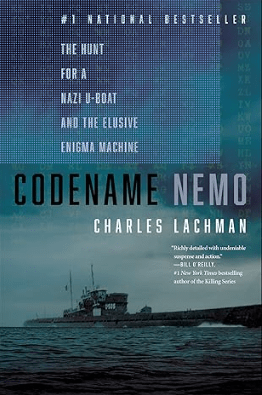
What I’m Reading: “Codename Nemo”

( *** Spoilers Below ***)

When most people think of the archetypal techno-thriller writer, they probably think of Tom Clancy. He didn’t invent the genre, but with the publication of his 1984 mega-hit The Hunt for Red October, he took it to a whole new level of mainstream popularity. Henceforth, the pop lit shelves in bookstores and airport gift shops across the countries would be filled with works by Clancy and an army of his imitators.

And why not? The techno-thriller novel combines aspects of several other genres, including “caper” fiction (a group of determined men taking on a seeming impossible mission), science fiction (the “techno” part is often so cutting-edge that it is more like sci-fi), mysteries (there is always a hidden bad guy in the mix), and, of course, thrillers (duh).

I kept thinking of The Hunt for Red October as I read an excellent history book recently, Codename Nemo: The Hunt for a Nazi U-Boat and the Elusive Enigma Machine by Charles Lachman. It recounts the fantastical story of a visionary naval captain, Daniel Gallery, who comes up with a hare-brained plan to capture a German U-boat. He developed the idea while stationed at a naval base in Iceland, seeing the damage that U-boats could wreak. He also learned how to sink them.

Continue reading “What I’m Reading: “Codename Nemo””

Friday Night Rock-Out: “Turn to Stone”

If you were to ask a music lover to name the most iconic pop band of the 1970s, their answer would probably be The Bee Gees. And they’d be right–mostly. For about three years, The Bee Gees bestrode the world like a collosus, leading the musical and cultural era that was disco.

But, for my money, it was the Electric Light Orchestra that most defined 70s pop. The creation of musical genius Jeff Lynne, E.L.O. was hit machine that cranked out gold records with regularity. Their songs were all over the radio here Gainesville, and their records were coveted.

And expensive. I remember looking at Out of Blue in the record store and was shocked to see that it was priced at $14.99. (This was back when ten bucks would get you a decent dinner in a real restaurant.)

My favorite E.L.O. song is, of course, “Turn to Stone”, which is the perfect fusion of pop and rock. Cinemaphiles will note that it was this song that P.T. Anderson ended his great film Boogie Nights with.

Rock-on…

Brief Encounters with Infinity

Autumn Rhythm (Number 30)
Jackson Pollock, Autumn Rhythm (Number 30)

Back in the dot.com boom of the 1990s, I was lucky enough to work for an IT company based in New York City. I was a remote worker, writing software eight hours a day in my spare bedroom in Gainesville, Florida. It was a win-win situation. I got to work from home, and my bosses got a good developer for country-boy wages (and I was still in the same time zone).

Occasionally they would fly me to the city for a meeting and I would spend my evenings wandering the streets of Manhattan, which is surely the most beautiful and bewitching cities of the earth. My favorite spot is the Met. Like a lot of introverts, I love museums, and the Met is the greatest of them all. I mean, how many museums have their own Egyptian Temple?  Indoors?

Once I spent an entire weekend roaming its halls, barely scratching the surface of its vast collections. I tend to gravitate toward the Modern period from the early- and mid-twentieth century. From guys like Matisse and Picasso all the way to Hopper and O’Keefe.

From a historical perspective, my interest stopped after that.  I never much got the whole Post-Modern thing—Abstract Expressionism and all that.  It seemed too theoretical. A joke that high-brow art critics had played on the rest of us, as Tom Wolfe wrote so wittily in The Painted Word.

Continue reading “Brief Encounters with Infinity”

Today I Learned a Word: “Googie”

FloridaShoppingCenter

I was born in the 1960s, which means I am among the first generation to grow up with color TV. This also means I am also among the first Americans who are able to see their past in color. Or, at least, the urban landscape of our past. Maybe that’s why I love old TV shows like The Rockford Files—shows with a lot of exterior shots of working class cities and suburbs from back then. Once in a while, Rockford will race through Los Angeles and there, flashing by in the background, a McDonald’s from 1976 will appear. Or maybe a Woolworth’s or a Wash King.  (Yes, I do realize that most people have never heard of Woolworth’s or Wash King.)

These were the places I would visit with my parents when I was a kid, and it’s kind of neat to see them again, if only on a TV screen. Seeing them today, forty years later, I am often struck by how different the architecture was back then, especially the fast-food joints and coffee shops, many of which were getting on even when Rockford was in his prime. These vintage buildings from the 50s and 60s often had weird, playful curves and tilted walls, all of it stitched together at crazy angles. I remember one restaurant in particular that my mom used to take me to every weekend. It had plastic booths nestled under a rocket-red awning with trippy lights hanging down. It looked like something straight out of The Jetsons.

Continue reading “Today I Learned a Word: “Googie””

What I’m Reading: “The Big Goodbye: Chinatown and the Last Years of Hollywood”

BigGoodbye

Anyone who follows this blog knows that my two primary obsessions are movies and history. So, you can imagine my excitement whenever I encounter that rare intersection of these two interests: a well-written film history book. And, still further within this category, there is the vaunted production-of-a-classic-movie book, which is a special favorite.

The supreme example of this sub-sub-sub-genre is Mark Harris’s Pictures at a Revolution, which recounts the making of not one film but four, all of which marked the changing nature of Hollywood—and America—at a specific moment in time, 1967. But if Harris’s book is the touchstone of this subject,  then Sam Wasson’s The Big Goodbye: Chinatown and the Last Years of Hollywood is a very close second. Put simply, I enjoyed the hell out of it.

Where Harris’s book describes the making of four movies, Wasson’s reveals the making of four men, the principal creators of Chinatown. These were the producer (Robert Evans), the screenwriter (Robert Towne), the director (Roman Polanski), and the star (Jack Nicholson).

Continue reading “What I’m Reading: “The Big Goodbye: Chinatown and the Last Years of Hollywood””

“I’m Probably Wrong About Everything” Podcast Interview

Many thanks to Gerry Fialka for interviewing me on his great podcast. I have no idea why he thought of me, but I’m glad he did. It was fun.

Yes, my lighting sucks. I’m working on it. Check it out anyway, pls…

A Book-Nerd’s Reaction to “Oppenheimer”

Fifteen years ago I read Mark Harris’s excellent non-fiction book Pictures at a Revolution: Five Movies and the Birth of New Hollywood. It recounts five movies that came out in 1968, a kind of annus mirabilis of American film, a pivot point in both cinema and culture when Hollywood reinvented itself for the better. 

I was reminded of Mr. Harris’s book last night as I sat in a crowded IMAX theater watching Christopher Nolan’s vaunted new film, Oppenheimer. It is, of course, a terrific movie on almost every level: technically, visually, dramatically, and, yes, historically. Moreover, it marks the second very good movie I’ve seen in the last month (Wes Anderson’s Asteroid City was the other), and both films struck me as indications of turning-point in American movies, similar to the one Harris describes so beautifully. Both Asteroid City and Oppenheimer are gorgeous, inventive, and lyrica films—a dark, nostalgic kind of lyricism in the former, and a dark, horrific kind in the latter. Coming just a few years after the movie industry was declared dead during the COVID pandemic, this new wave of excellent films (I’m guessing Greta Gerwig’s Barbie will continue it) makes me hopeful that a new revolution is afoot.

Regarding Oppenheimer, I sat next to my son, Connor, who is also a film and history buff, and we were both mesmerized by the power of the film, but even more so by its cleverness. For a film based on a non-fiction source (Kai Bird’s fine biography of Oppenheimer, American Prometheus), Oppenheimer the movie feels like a fiction film. Unrelentingly tense and dramatic, it is almost free of exposition. Noland trusts the viewer to figure out what is going on in each scene, whether or not you’re familiar with the actual history.

I am, actually, familiar with it. I read Kai Bird’s book years ago and loved it. So, at one moment in the film when Oppenheimer reads from a sanskrit book and intones the words: “I am become death, the destroyer of worlds,” I knew that he is reading from the Hindu epic The Bhagavad Gita, and that these are the same words that would come to mind later as he witnesses the first nuclear test in the New Mexico desert. Part of Nolan’s genius, however, is to reframe this quote into a dramatic (um…actually erotic) scene, in which the character is having sweaty sex with his lover (the tormented Jean Tatlow, played with intelligence and verve by Florence Pugh). This is history done right. If you’re going to insert a famous quote by a famous man in a famous moment in history, you’re better off sneaking it into a steamy sex scene.

I don’t mean to brag—oh, who am I kidding; I totally mean to brag—but not only have I read Kai Bird’s book, I’ve read The Bhagavad Gita, too. And while I only read an English translation (unlike Oppenheimer), I gleaned enough meaning from it to know that it’s a story about a man who finds himself caught between duty and humanity, action and paralysis. Which strikes me as the central theme of Oppenheimer, too, both the man and the movie. Like Arjuna, the super-warrior hero of the Bhagavad Gita, who doesn’t want to go into battle against his friends, Oppenheimer was naturally reluctant to use his talents to create a bomb. But, from a moral and existential point-of-view, he finds himself trapped in a cosmic dilemma. As he explains to a friend at one point in the film, giving the Allies an atomic weapon would be dangerous, but giving the Nazis one would be apocalyptic. 

But did he make the right choice? The question becomes even thornier when focused on the specific issue of how the bomb was first used, against Japan, an enemy that never had an atomic weapons program of its own and which was pretty much on the ropes by 1945. Personally, I have always found the question of whether or not America was right to drop the bomb on Japan to be mildly ridiculous. If we were fighting a war today in which hundreds of thousands of our soldiers had been killed fighting an implacable enemy, and if someone then told us, “We’ve got a bomb that will insert a colony of mutant spiders into country X, and those spiders will eat the face off everyone there, soldiers included,” I’d probably say, “Drop the friggin spiders.” This was essentially the decision Oppenheimer himself reached when advocating for the use of the bomb on Japan (an event he eventually celebrated, as is shown in the film’s most chilling scene).

But the best thing about Nolan’s film is that it never descends to this level of after-the-fact, arm-chair quarterbacking. Indeed, through Oppenheimer’s own hallucinations and fever dreams about a potential World War III, it makes clear that the decisions made in 1945—like the cosmic forces they unleashed—surpass ordinary human judgment, if not human understanding. Was Oppenheimer right to lobby for dropping the bomb? God knows. Perhaps not even Him.

Whatever Happened to Open-Form Films?

All the President's Men

Author’s Note: a slightly different version of this post first ran on my old blog, Bahktin’s Cigarettes.

It’s hard to believe, but the 40th Anniversary of the Watergate break-in is fast approaching, on June 17.  The day will be commemorated by Chapman University and many others.  It will not be the most uplifting of anniversaries, surely.  I would much rather commemorate August 9, 1974, the anniversary of Richard Nixon’s resignation, brought about by the heroic reporting of Carl Bernstein and Bob Woodward.

I have already commemorated the event in my own, couch-potato way:  I re-watched All The President’s Men on Netflix.  It’s still a great movie—smart, tense, dramatic, and well-acted.  Alan Pakula loaded the cast with great American actors:  Dustin Hoffman, Robert Redford, Jason Robards, Jack Warden, Hal Holbrook, etc.  And he manages to tell a vast, complicated story with the breathless pacing of a crime drama (which, of course, it is).  As I was watching it, I was struck by something that I hadn’t thought of before.

What ever happened to open-form films?

Open-form (sometimes called open-frame) refers to a style of filmmaking where the camera is placed at a medium distance from the action, creating a sense of realism and narrative objectivity.  The action is not limited to the visible frame.  Much as in real life, important things are happening off-screen.  What we are looking at in any given moment is not, necessarily, the whole story.

McCabe & Mrs. Miller

Many of my favorite movies from the 1970s are open form, including 2001: A Space OdysseyButch Cassidy and the Sundance Kid, and (of course) All the President’s Men.  But the master was Robert Altman.  Watching one his movies like M.A.S.H. or McCabe & Mrs. Miller (one the greatest films ever made), you get the feeling that you are an invisible guest, somehow  transported into the action.  Characters come and go in and out of the frame.  They talk over each other, and external forces (weather, sound, bullets) often intrude from the outside world.

Another, less obvious effect of open-form is that it makes a movie feel more like a documentary.  This is, in part, because most documentaries are shot in the medium distance, with stationary cameras.  The films of Michael Moore are a classic example.

However, as far as I can tell, open-form has pretty much been abandoned by fiction film directors.  The only recent examples I could think of are portions of Steven Soderbergh’s Traffic and Paul Thomas Anderson’s Boogie Nights.  Both are very fine films, but they are the exceptions, aberrations in a modern film aesthetic that is dominated by closed form, immersive narration.  Specifically, it is dominated by film expressionism.

Remember that famous, virtuoso tracking shot in Goodfellas, when the camera follows Henry and Karen through the nightclub?  This is the epitome of closed-form filmmaking.  Scorsese reduces the distance between us and the main character to essentially zero as Henry leads us through his princely world of sensual delights.  It’s a great movie, and a great moment.  But the style itself has come to dominate movies so completely that they have almost become a dead art form, at least in the U.S.  When practiced by less masterful directors than Martin Scorsese (and, let’s face it, who isn’t less masterful than Scorsese?), closed-form can become meretricious, slick, and boring.

So why has open-form disappeared in favor of closed-form?  The simple explanation is that closed-form is a more intuitive mode of narration, much like first-person point-of-view in short stories and novels.  Open-form is more like third-person omniscient.  It’s more challenging, both intellectually and visually.

The more insidious explanation is that closed-form expressionism allows the filmmaker to manipulate the viewer more directly.  And manipulation is something we Americans know a lot about.

In his landmark essay, Hollywood: The Ad, Mark Crispin Miller wrote about how motion pictures have adapted many of the film techniques of TV commercials—fast-editing, propulsive music, slow motion—in order to keep the viewer bathed in stimulus.   Not only are commercial products carefully featured in motion pictures (with characters slurping coke-a-colas and nibbling Doritos), the movies themselves have become commercials.  As Norman Mailer might have put it, they have become advertisements for themselves.

When did the transition take place?  Sometime in the 1980s, with the advent of MTV.  The horror classic Alien, directed by Ridley Scott in 1979, is an open-form movie—realistic, gritty, and provoking.  The sequel, Aliens, directed by James Cameron in 1985, is a hyped-up, kinetic, closed-form movie—exciting, entertaining, and ultimately disposable.

Of course, there’s nothing wrong with entertainment.  And there’s nothing inherently better about open-form versus closed-form filmmaking.  But it does give one pause that we expect so little from our movies these days.  Are we so used to being told what to feel, and how to think, in every moment of our waking lives?

Which leads me back to my original topic:  Watergate.  The reporting of Woodward and Bernstein marked a triumph of intellectual freedom in this country.  And so does the movie made about them, All the President’s Men.  Is anyone making movies like this today?

Why the Ancient Romans had Good Teeth but Bad Breath

One of my favorite sites on the internet is openculture.com. As the name implies, it’s a curated collection of the best permanently free culture on the web, from free college courses, movies, images, audiobooks, and history lessons. 

Here’s a recent post that I found weirdly fascinating. It’s about how the ancient Romans had fewer cavities and dental problems than we might expect. What was their secret? (Hint: it has to do with less sugar.) I think I liked it because it ran contrary to the tendency most modern books and movies have when it comes to dramatizing the past. Usually, it’s portrayed as unremittingly violent and brutal, or (even worse) nostalgically sweet and winsome. 

My guess is that most people in the past lived lives that, while not exactly happy or carefree, were not that different from our own. (And, no, I wouldn’t like to trade places with them.)

Why the Ancient Romans Had Better Teeth Than Modern Europeans