R.I.P. David Lynch

Photo by Alan Light, CC BY 2.0

It has been a week since David Lynch passed away, and many great tributes have already been written about him. I’m tempted to say that I needed a week to process his passing and figure out what I wanted to say about him, but the truth is I was just too damned busy to write anything. In fact, I knew instantly what I wanted to say—simply, that Lynch was a very important person in my life, and in the lives of many of my friends.

I was a college English major in 1986 when Blue Velvet came out, and it hit me and my circle of arty friends like an atomic blast. I already knew of Lynch’s work (I was one of the few kids to see The Elephant Man, and in an actual movie theater, no less), and I knew that he was a director of enormous visual and thematic power. But even I was unprepared for Blue Velvet. On the one hand, it’s a murder mystery, an homage to the noir films of the 1950s in which an unsuspecting suburban kid discovers a hidden world of violence, evil, and, (of course) depraved sexuality. On the other hand, it’s a surrealist vision of the inner world of a modern young man (and, probably, many young women). I was roughly the same age as the main character, Jeffrey Beaumont, in 1986, and so the film had special resonance. I felt like the landscape of my own imagination was a strange blend of the beautiful and the grotesque—often in the same image. And that’s exactly what the film captures, somehow.

Continue reading “R.I.P. David Lynch”

R.I.P. Earl Holliman

Earl Holliman in his 1970s glory

Last month, I reran an old post about how much I love the classic sci-fi film Forbidden Planet. Then, just over a week later in a striking and somewhat sad example of synchroncity, the last suriving cast member of that film, Earl Holliman, passed away at the age of 94.

Holliman’s brief performance as the boozing, womanizing cook in Forbidden Planet was a highlight of the movie. This is not surprising; Holliman was one of the best character actors of his generation, performing in countless movies and TV shows. These ran the gamut from Westerns, cop dramas, thrillers, and (of course) science fiction.

Physically, Holliman had the kind of rugged, Southern-style good looks that were a requirement for tough-guy roles back in the day. Actually, he looked a bit like another great TV actor, James Garner (not to mention my dad). The picture above shows him in all his 1970s-era glory.

Forbes Magazine has a nice tribute article about him here.

R.I.P. Teri Garr

There is a great tradition in American comedy of very smart women playing very dumb women (usually, dumb blonds). It goes back to at least the 1930s with the duo of George Burns and Gracie Allen, and probably much further than that.

So, it’s not terribly surprising that the brilliant actress Teri Garr was best known for playing a stereotypical “dumb blond”. Specifically, she played Inga, Dr. Frankenstein’s (that’s FRAH-ken-steen‘s) lab assistant in Mel Brooks’s classic Young Frankenstein. The film is one of the funniest ever made, and Garr’s performance is one of the funniest things in it. It’s a masterpiece of physical humor, timing, and delivery, not to mention a great, fake German accent.

The doc falls in love with her by the end of the film, and the same can be said for many of the viewers. It’s safe to say that the film wouldn’t have been half as good without her.

Godspeed, Ms. Garr…!!!

R.I.P. James Earl Jones

Let’s face it, 99% of the people alive today who knew anything at all about James Earl Jones knew about him from Star Wars. He was, after all, the voice of Darth Vader, the most commanding villain in all cinema.

My first memory of Jones, however, was from the early 1970s, when I was a little kid. I was watching a made-for-TV movie about the Barney and Betty Hill UFO incident. Jones played Barney, and the scene where he recalls, under hipnosis, his encounter with a UFO struck me, even a kid, as unbelievably powerful and even scary. (If you can find this movie on Youtube, you should check it out.)

It’s important for us all to remember how truly great an actor Jones was. He wasn’t just a voice–he was a master of the entire art. One of my lit. professors in college recalled seeing Jones as Othello on Broadway in a now-legendary production with Christopher Plummer as Iago, and how absolutely mesmerizing Jones was.

In keeping with that memory, I am posting a brief, command performance that Jones did of a scene from Othello about ten years ago.

Godspeed, Mr. Jones….!!!

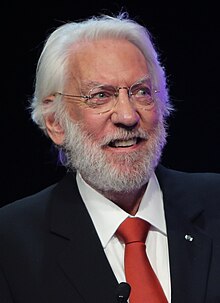
R.I.P. Donald Sutherland

I really enjoyed The Hunger Games movies when they came out. Not only were they great examples of dystopian science fiction, but they served as a refresher course in the nature of fascism. The main baddie in the films was, of course, President Snow, played with great menace and understatement by the great Donald Sutherland. 

I am very grateful to the producers of The Hunger Games for introducing Sutherland to a new generation of film lovers, especially at a time when his career was in a bit of a lull. Sutherland was one of my favorite actors when I was growing up, best known for career-making roles like Hawkeye Pierce in M.A.S.H., Oddball in Kelly’s Heroes, and the titular role in Klute. One of the great ironies of film history is that Sutherland should now be so closely associated with the role of President Snow—literally a right-wing fascist dictator—when his early, defining performances were usually as lovable, left-of-center antiheroes (Hawkeye Pierce especially). 

Sutherland was one of the few movie stars from the 70s and 80s to have curly, hippie-hair, and his entire persona seemed to be that of a counter-cultural smart guy. The Alpha-Hippie that all Beta-Hippies aspired to be. I say he was a smart-guy, and it’s true—never did an actor so effortlessly exude intelligence, even without dialog, as Sutherland did. But while he was so obviously a smart-guy, he was never a smart-ass. Even the irreverent Hawkeye Pierce—perhaps the most famous prankster in cinema history—reserved his mocking for when he needed it to retain his sanity, and focused it on those who most deserved it.

One of the best ways to understand Sutherland as an artist is to imagine his stylistic opposite, Nicholas Cage. Like Sutherland, Cage is a brilliant actor, and a very smart guy, but while Cage is famous for his artistic daring, often taking his performances to frenetic heights that would seem ridiculous for other, lesser actors, Sutherland was known for his almost impenetrable reserve. He always seemed to be holding something back, in a good way. He kept the viewer guessing about what was really going on behind those crystalline blue eyes. 

Perhaps my favorite Sutherland role when I was growing up was as a world-weary health inspector in Philip Kaufman’s 1978 sci-fi horror masterpiece The Invasion of the Body Snatchers. In this film, Sutherland almost drips existential cool, even when faced with an invasion of alien pod-people (read: communists, right-wing conformists, or your boogey-men of choice) who want to eliminate humanity.

Check it out.

R.I.P. Alan Arkin

The great actor and comic genius Alan Arkin has left us. I loved him ever since I saw 1979’s The In-Laws, which is surely one of the best comedies of the 20th Century. Arkin plays Sheldon Kornpett, a straight-laced Manhattan dentist who finds himself caught up in an adventure with his soon to be in-law, a rogue CIA agent. At one point when Sheldon faces imminent death, he laments that he has only ever made love to four women, “two of them my wife.” Classic.

Having loved his work in my youth, I was thrilled to see a new generation of film viewers introduced to Arkin through his movies like Little Miss Sunshine and Argo. The latter film, in particular, seems to encapsulate the essence of Arkin’s on-screen persona. Playing world-weary film producer Lester Siegel, he exudes an aura of what I think of as Sardonic Unflappability, a comical spirit of defiance that I emulated as a kid and which helped me keep my sanity. 

Like many of my heroes, Arkin’s life had a great second act. I hope his blessings continue into the next life, too.

R.I.P. Treat Williams

The fine character actor Treat Williams died in a motorcycle accident earlier this week. I say “character actor” because, despite his charm, intelligence, and vaguely Scottish good-looks, Williams never quite achieved leading-man status in Hollywood. His best movie, imho, was Sidney Lumet’s Prince of the City, a wrenching drama about the corrupting influence of drug money on police officers. Everyone should check it out.

I don’t know why Williams didn’t get the lead in more films. Perhaps it had something to do with his physiognomy (he resembled Colin Farrell, another actor who never really clicked in Hollywood). Whatever the reason, Williams had a long, brilliant career in films, TV, and on-stage. 

Growing up in the 1970s and 80s, I saw him in a lot of stuff, and he was always great. His perseverance should inspire future generations of actors and artists who don’t quite fit the standard commercial mold but have talent out the yin-yang. Success is the best revenge.

Godspeed, Mr. Williams…

R.I.P. Martin Amis

Of all the novels I have read in my life, only two ever disturbed me on a deep, lasting level. One was The Constant Gardener by John le Carré. The other was Money by Martin Amis.

Money is, by any reasonable definition, a brilliant novel. Full of symbolism and thematic complexity, Money is a phantasmagoric mediation on the evils of modern capitalism, whose only purpose is to make every living human being into a customer. And the very best customers, Amis reminds us, are addicts. They simply can’t stop.

The novel’s protagonist, a low-budget film director named John Self (ahem), certainly can’t stop. Addicted to sex, booze, fast-food, and pornography, he spends his days and night rambling around 1980s London, ostensibly in preparing to shoot a low-budget film with an egomaniac has-been movie star and a young, nymphomaniac actress, amongst other tragic-comic types. The movie is being funded by a shady character named Fielding Goodney, who might just be the devil himself. 

Money is a triumph of style and imagery (although—be warned—much of that imagery is very, very gross). Self is a kind of stand-in for the entirety of modern Western civilization, and the novel might have been irredeemably bleak if not for Amis’s ferocious sense of humor, which he surely inherited from his equally brilliant father, the novelist Kingley Amis. 

Martin Amis was a very fine writer, and the world will be a lot less interesting without him.