Ever since the first publicly available AI SaaS offerings (that’s Software-as-a-Service for all you non-geeks) like ChatGTP hit the market, the media ecosystem has been in love with the subject of AI as a major disruptive force. Disruptive, that is, in the creative industries hitherto regarded as safe from any kind of automation: illustration, film-making, acting, and writing. Story after story has run about how AI-generated art, screenplays, journalistic articles, etc. might soon replace the work of human content creators.
Within this maelstrom, a smaller, subset of articles has begun circulating related to whether AI will ever achieve consciousness. (Some experts believe it already has.) And, within this subset, there is a sub-subset devoted to what I call AI alarmism. That is, the idea that AI, if left to its own devices, might soon overthrow—and perhaps even exterminate—humanity itself, ala the “evil AI” tropes of the Terminator films, the Matrix films, the Tron films, et cetera, et cetera.
Such visions of an AI apocalypse are not new. Hal, the murderous supercomputer in Stanley Kubrick’s 2001: A Space Odyssey, is perhaps the most famous example of an AI gone bad. And a cool but largely forgotten movie from the 1970s called Colossus: The Forbin Project lays out exactly how a psychotic AI (in this case, one entrusted with the care and maintenance of the American nuclear arsenal, just like SkyNet) could take over the world by force.
Recently I was enjoying a long-distance phone chat with an old friend of mine, and the conversation turned, as it inevitably does, to the weather. She lives in Ohio, I live in Florida, and yet our answers to our respective inquiries about “How’s the weather where you are” were identical: Hot AF.
Fortunately, scientists like David Keith have been telling us for years that we are not helpless in the battle against climate change. If worse comes to worst, for a few billion dollars we could deploy specialized aircraft to release particles of sulfur (or some more exotic material) into the upper atmosphere, thus reflecting enough sunlight back into space to cool the planet very quickly. Of course, as professor David warns, we have a poor grasp of what possible, global side-effects such a radical course of action might have (although one one wonders if these side-effects could be any worse than a Canada-sized wildfire or a continent-wide heat-wave in India). It is precisely because of these unknown side-effects, he explains, that we need to start thinking about the problem now, with a clear head.
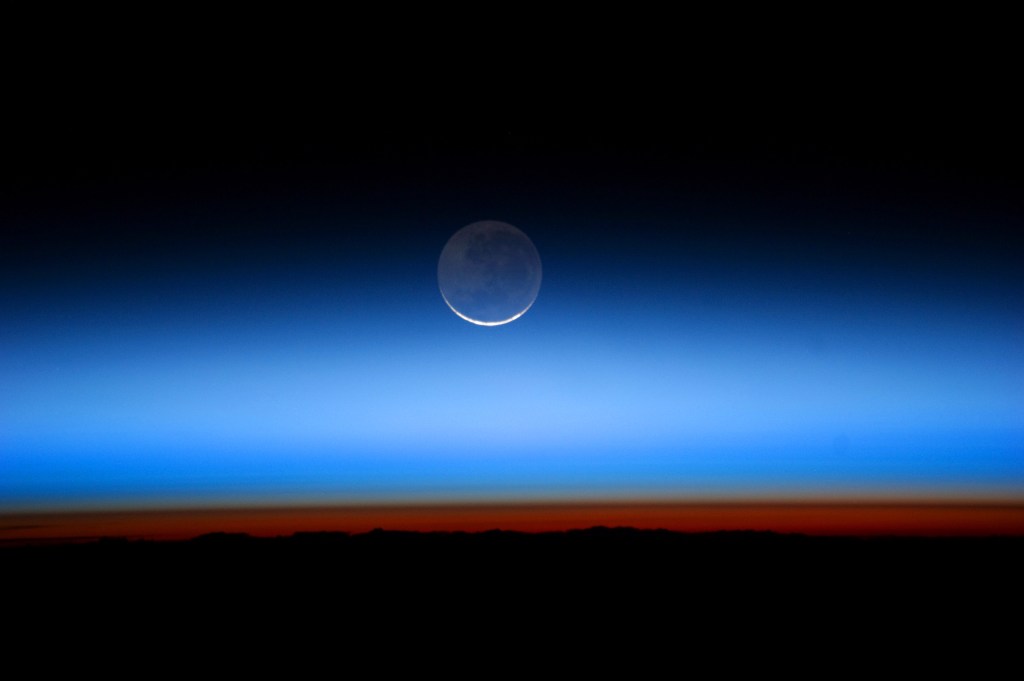
Along these lines, one of the strangest—and yet most encouraging—options to the “solar dimming” set of possible mitigation strategies is the idea that we might blast moondust into outer space. Yeah. For real. This dust, if aimed properly, would linger in one of the Lagrange points between the earth and the sun and, for a time, reduce solar radiation falling on the earth’s surface. The effect would be short-lived due to solar wind blowing the dust away into interplanetary space, but this is a good thing in that the technique would thus be throttleable. We could blast as much as or little dust as needed to cool the planet without plunging it inadvertently into a new ice age. (Have you seen that movie SnowPiercer?) Also, unlike the sulfur-in-the-sky option, the lunar dust wouldn’t contribute to air pollution or acid rain here on earth.
Obviously, the notion that we might somehow shoot lunar dust into space on a routine, industrial scale seems like science fiction. But is it? The space agencies of many nations such as the U.S., China, and Japan have planned future missions to the moon. One can imagine a gradual infrastructure of settlements, supplies, and equipment gathering on the moon over time, much as one formed in the American West in the 19th Century. One could presumably build some kind of mass-driver or rail-gun that could shoot the dust into space, and power it with solar energy. (Extra power could be stored during the two-week long lunar “day” to keep the gun shooting during the “night”).
How much would such a setup cost? Billions? Trillions? On the other hand, how much would it cost to rescue two-hundred million people from Europe if the Atlantic thermohaline circulation is disrupted, as some scientists predict it will? Or to build sea-walls around New York and Miami and San Diego and every other major coastal city? Or to feed South America if the crops there dry up during the next heat wave?
It’s time to think outside-the-box, people.
If worse comes to worst, we shouldn’t rule out going back to the moon. And building a huge cannon there. Or anything else we have to do to cool off the planet.
Here is the original article on SingularityHub where I learned about this idea:
An Aperiodic Monotile has been discovered. Hooray!
When I was in my twenties, I read Roger Penrose’s The Emperor’s New Mind and was blown away by it. That is, in the 5% or so that I could understand, I was blown away. Never have I read a science book that, paradoxically, filled me with hope and optimism. And awe.
The book is probably more timely today than ever. With all the hype about AI and machine learning, people are starting to freak out about humanity’s place in the future.
Penrose’s main thesis, after all, is that human consciousness is not machine-like. Citing the work of brilliant people such as Kurt Gödel, Alan Turing, and himself, Penrose lays out an extremely compelling argument as to why computers—no, not even quantum computers—will ever really think, no less achieve actual consciousness. This conclusion enraged an army of science fiction fanboys and others who believe that the “the brain is a machine made of meat”.
In building his argument, Penrose refers to examples of discoveries scientists and mathematicians have made that could not (in his opinion) have been discovered by any algorithmic process. One of these examples is his own rather brilliant work in the area of aperiodic tilings.
Aperiodic tilings are something that even a STEM idiot like myself can understand. Anyone who has ever looked down at an intricately tiled parquet floor and wondered about the pattern can relate to this. Most floor patterns—even very complicated ones—will reveal themselves as repetitive if viewed from a sufficient height. But some patterns never repeat, even if you view them from the second floor or the fifteenth or Alpha Centauri. This aperiodicity can only be demonstrated, of course, via mathematical proof, which is often maddeningly complex in and of itself. Mathematicians are constantly seeking out new collections of tile shapes (which, paradoxically, are usually simple enough to cut out of a piece of construction paper with kiddie scissors) that yield these aperiodic tiles.
In the 1970s, Penrose himself discovered an aperiodic tiling that used only two shapes—a “kite” and a “dart”. This was a record at the time since other aperiodic tilings had been discovered but they made use of more shapes.
Knowing this, I read with some amusement that a new aperiodic tiling had recently been revealed that uses only one shape. A funky shape, surely, but still just one, thus making it an aperiodic monotile. The only wrinkle was that the shape had to be “flipped” at certain points for the tiling to work.
Then, a few months later, lo and behold, another aperiodic monotile was discovered, and this one required no flipping. The dudes who found it were David Smith, Joseph Samuel Myers, Craig Kaplan and Chaim Goodman-Strauss of the University of Yorkshire.
Truly, this discovery has no impact whatsoever on my daily life, or yours I would bet. And yet it’s still really cool. This mathematical artifact has been hidden there for all eternity, and just now, in 2023, some nerds discover it.
That’s why I still have faith in humanity. The nerds. They will save us.
Author’s Note: hat-tip to the good people at openculture.com for bringing this news to my attention, and for posting the video that I have linked above.
If there’s one kind of story I’m a sucker for, it’s the has-been-makes-a-comeback. You know the formula: a once-great hero (i.e. athlete/cop/musician/artist) is down on his luck. They’re disrespected, lonely, and all but forgotten. But then, with the help of a much younger and optimistic (or older and wiser) companion, the hero gets a burst of inspiration. They discover that they still have vast, untapped powers, and through great discipline, courage, and sacrifice, they focus those powers on a new challenge. Then, at the climax of the tale, they face that challenge and triumph.
I have, of course, just described every single Rocky movie (yes, even Rocky II) as well as 10% of all the Hollywood movies ever made. My favorite cinematic example is a little movie from 2005 called The World’s Fastest Indian, starring Anthony Hopkins. But I tend to like any variation of the formula, even the most banal and overused variety.