

Well, over a week has passed since Halloween, and I’m still working through the classic horror and sci-fi movies that I rewatch every year around this time. One of my favorites (heck, one of everybody’s favorites, as far as I can tell, assuming that everybody is a nerd of a certain age) is Roger Wise’s 1951 classic The Day the Earth Stood Still (henceforth, TDTESS). Here are ten things I love about it….
1.) The Opening
This movie doesn’t dick around. It opens with the frantic calls of radar operators across the globe tracking an ultra-fast UAP as it enters the earth’s atmosphere. Word leaks out to press, generating a world-wide media frenzy—the “media,” in this case, being radio. Wise cast several then-famous, real-life radio broadcasters to play themselves, and I simply love hearing their great, precise modulated voices as they simultaneously try to inform the public without causing panic. It’s hard to believe there was ever such a time when journalists were so revered and appreciated, with good reason.
2.) The Music
From the title sequence onward, the film makes great use of Bernard Herrmann’s brilliant score. Hermann notably employed electronic instruments, including a kind of stone-age synthesizer called a theremin. It’s the theremin that gives the score that haunting, weird quality that has since become synonymous with atomic-era sci-fi movies.
Speaking of atomic-era stuff, this leads me to my next item…
3.) Analog technology
I don’t know why, but I am fascinated by how the movie gives the viewer a glimpse—almost a cross-section, really—of the analog technology of the day. We see radio transmitters, of course, but also phone switch boards with dozens of (women) operators frantically switching lines, and people yelling into telephones. And, of course, we have all the accoutrements of World War II, which was still a recent event: tanks, jeeps, motorcycles, rifles (yes, rifles). There is something soothing about all this old-fashioned stuff, especially when it is contrasted with….
4.) Singularity Technology
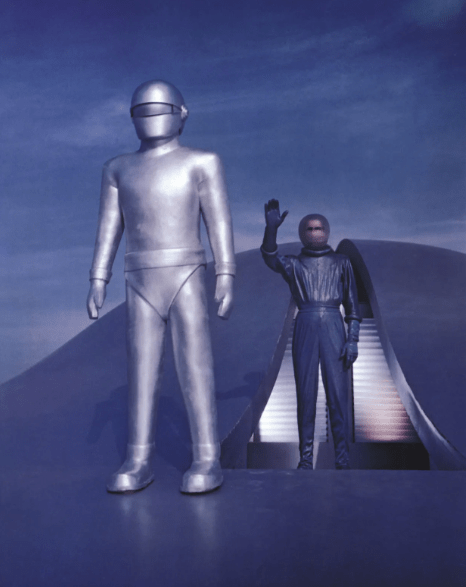
When the UAP finally lands (in Washington D.C., naturally, near the Capitol), we see that it represents a kind of futuristic tech that is the diametrical opposite of the local analog, atomic-era tech. The ship is all smooth silver metal until a seam appears, and the seam opens smoothly to allow a ramp to extend. A door forms in the same way, and the alien pilot Klaatu (Michael Renne) emerges, dressed in a silver suit and a helmet that, one assumes, is made of the same silver metal. All of this seems magical, even now, and also presages the later sci-fi tropes of nanotechnology, lasers, force-fields, atomic energy, computers, etc. etc.
Of course, Klaatu’s most impressive piece of tech is….

5.) Gort
Why is Gort so damned cool? Because he’s terrifying. As a giant, lumbering robot, he evokes the golem myth of implacable, supernatural force that has no emotions and no fear. And, with his single, death-ray emitting eye, he also reminds us of another mythic archetype—the cyclops. And in the way he suggests enormous power, barely held in check, he anticipates The Terminator films of three decades later.
6.) Michael Rennie
As with most classic, once-in-a-lifetime performances, Michael Rennie’s portrayal of Klaatu is so good that it’s now impossible to imagine anyone else doing it. With his smiling, gentle, athletic demeanor, he projects a firm but benevolent presence. He genuinely wants to help humanity escape its seemingly inevitable fate (i.e., being destroyed, either at its own hand or that of Gort). Also, he seems genuinely curious and likeable, especially in…
7.) Klaatu’s Interactions with Danny
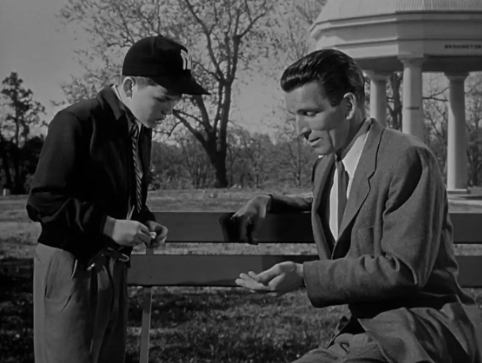
I love the scenes where Klaatu and Danny, the little boy whose boarding house Klaatu finds himself in, go on a site-seeing tour of Washington D.C. They are the emotional core of the movie. After all, in our world, Klaatu is very much like a little boy himself. His sense of wonder is almost as strong as Danny’s.
8.) Patricia Neal
Instead of casting some bombshell scream-queen in the role of Helen, Danny’s mother, Wise chose the formidable and mesmerizing Patrica Neal. She was a great actress who would later hold her own against Paul Newman in 1963’s Hud. As Helen, she exudes an intelligence and moral strength that not only saves Klaatu from capture and death; she saves the entire planet.
9.) How Much you Don’t See
I could write an entire post on the paradox of old thriller movies whose lack of CGI effects (TDTESS was made thirty-three years before Jurassic Park), was actually an advantage. The film is actually made stronger by how much Wise doesn’t show on-screen. That is, we don’t see how Klaatu stops all electrical stuff from working on the titular day. We don’t see Gort walking across D.C. on his way to liberate Klaatu’s body from its jail cell. You know, stuff that would be easy to render in the CGI era (and which would also be rather boring). After all, the ultimate special effect is the human imagination, which happily fills in the blanks better than any whiz-bang effect.
My favorite example of this in the film is when Danny secretly follows Klaatu to his spaceship one night. He watches as Klaatu uses a flashlight to wake-up Gort, who then knocks-out the two G.I. ‘s guarding the ship. The genius of this scene is that we don’t actually see Gort do this. We just see him lumber over to the two dudes. Then, at the last moment, the camera switches back to Danny’s horrified face as he watches the moment of (rather mild) violence. Then, the camera switches back to Gort as he stands over the crumpled, unconscious bodies of the soldiers on the ground. Brilliant.
10.) Multiculturalism
It’s important to remember that TDTESS is a cold-war era movie, produced at the very height of the Red Scare and its attendant paranoia and xenophobia. It also came out just a few years before the start of the American Civil Rights movie. So, I am always amazed, and even a bit moved, by how progressive Wise’s vision is. In the opening scenes, we see people from other countries—France, India, China, and even Russia—depicted in a sympathetic light, human light. At least once in the film, Wise goes out of his way to show some genuine, actual Black people in the crowd watching Klaatu’s spaceship land. (This might seem trivial, now, but it was momentous decision back then.) And, of course, the climax of the movie comes with a miniature U.N. assembly, arranged by Professor Barnhardt (wonderfully played by the great Sam Jaffe, incidentally), full of people of all ethnicities and cultures. The message is clear—it’s only by cooperation and friendship that humanity can survive. And it’s a message that is just as relevant now as it was back then, perhaps even more so.
See also this cool post from another blogger (from whom I stole one of the screenshots above)…


 Ash Clifton, Writer