Back in the early 1990s when I was a poor graduate student, I used to stay home on Saturday nights and watch my little black-and-white TV. I couldn’t afford cable, of course, but thankfully there was always PBS, so I watched a lot of documentaries and episodes of Great Performances. On one such night, I saw a filmed performance of Peter Brook’s stage play The Mahabharata. The play is, of course, a dramatic adaptation of the great Hindu epic, the tale of a feud between two groups of royal cousins, the Pāṇḍava princes and their arch-nemeses, the Kauravas. As epic tales are wont to do, the feud escalates into a civil war so catastrophic that even the gods are pulled into the conflict (in the same way that the Greek gods Mars, Apollo, and Venus involve themselves in the The Illiad).
Being a filmed staged play, Brook’s TV version is low on special effects (this was before CGI) but packed with minimalistic, highly-stylized interpretations of sweeping battles, multi-armed demons, and flying chariots. Somehow, it all works, and I found myself obsessed with both the film and the story. A few years later I would finally read a popular translation of The Bhagavad Gita, which is really just one portion of the much larger Mahabharata.
The great B-Movie director Roger Corman has died. As a kind of tribute, I’m reposting an essay I wrote some years ago on my old blog. Enjoy!
Ever since I turned forty, I find myself going to see fewer and fewer movies. It’s only natural, I suppose. The less time you have left, the less time you want to spend in a darkened theater, lost in flights of fancy. And so, what little I know of recent film releases comes to me second-hand, either through friends or online reviews or through the film trailers that I see when I do occasionally go to a movie. Even from this limited perspective, I can glean a few obvious facts about movies these days: 1.) they are all rated PG-13 and 2.) they are all about the end-of-the-world and 3.) they all rely heavily on digital effects.
These three qualities go together, of course, for reasons that are based more in economics than anything else. The digital effects are required to attract a modern audience raised on video games and violent TV. And because these CGI effects tend to be horrifically expensive, the movies must be rated PG-13 in order to gather as large are a customer base as possible. Finally, the reliance on end-of-the-world plots come naturally, mainly because the plot-lines that justify these breathtaking explosions, airships, monsters, and laser guns usually involve some kind Biblical-style, science-fiction-themed catastrophe.
Fifteen years ago I read Mark Harris’s excellent non-fiction book Pictures at a Revolution: Five Movies and the Birth of New Hollywood. It recounts five movies that came out in 1968, a kind of annus mirabilis of American film, a pivot point in both cinema and culture when Hollywood reinvented itself for the better.
I was reminded of Mr. Harris’s book last night as I sat in a crowded IMAX theater watching Christopher Nolan’s vaunted new film, Oppenheimer. It is, of course, a terrific movie on almost every level: technically, visually, dramatically, and, yes, historically. Moreover, it marks the second very good movie I’ve seen in the last month (Wes Anderson’s Asteroid City was the other), and both films struck me as indications of turning-point in American movies, similar to the one Harris describes so beautifully. Both Asteroid City and Oppenheimer are gorgeous, inventive, and lyrica films—a dark, nostalgic kind of lyricism in the former, and a dark, horrific kind in the latter. Coming just a few years after the movie industry was declared dead during the COVID pandemic, this new wave of excellent films (I’m guessing Greta Gerwig’s Barbie will continue it) makes me hopeful that a new revolution is afoot.
Regarding Oppenheimer, I sat next to my son, Connor, who is also a film and history buff, and we were both mesmerized by the power of the film, but even more so by its cleverness. For a film based on a non-fiction source (Kai Bird’s fine biography of Oppenheimer, American Prometheus), Oppenheimer the movie feels like a fiction film. Unrelentingly tense and dramatic, it is almost free of exposition. Noland trusts the viewer to figure out what is going on in each scene, whether or not you’re familiar with the actual history.
I am, actually, familiar with it. I read Kai Bird’s book years ago and loved it. So, at one moment in the film when Oppenheimer reads from a sanskrit book and intones the words: “I am become death, the destroyer of worlds,” I knew that he is reading from the Hindu epic The Bhagavad Gita, and that these are the same words that would come to mind later as he witnesses the first nuclear test in the New Mexico desert. Part of Nolan’s genius, however, is to reframe this quote into a dramatic (um…actually erotic) scene, in which the character is having sweaty sex with his lover (the tormented Jean Tatlow, played with intelligence and verve by Florence Pugh). This is history done right. If you’re going to insert a famous quote by a famous man in a famous moment in history, you’re better off sneaking it into a steamy sex scene.
I don’t mean to brag—oh, who am I kidding; I totally mean to brag—but not only have I read Kai Bird’s book, I’ve read The Bhagavad Gita, too. And while I only read an English translation (unlike Oppenheimer), I gleaned enough meaning from it to know that it’s a story about a man who finds himself caught between duty and humanity, action and paralysis. Which strikes me as the central theme of Oppenheimer, too, both the man and the movie. Like Arjuna, the super-warrior hero of the Bhagavad Gita, who doesn’t want to go into battle against his friends, Oppenheimer was naturally reluctant to use his talents to create a bomb. But, from a moral and existential point-of-view, he finds himself trapped in a cosmic dilemma. As he explains to a friend at one point in the film, giving the Allies an atomic weapon would be dangerous, but giving the Nazis one would be apocalyptic.
But did he make the right choice? The question becomes even thornier when focused on the specific issue of how the bomb was first used, against Japan, an enemy that never had an atomic weapons program of its own and which was pretty much on the ropes by 1945. Personally, I have always found the question of whether or not America was right to drop the bomb on Japan to be mildly ridiculous. If we were fighting a war today in which hundreds of thousands of our soldiers had been killed fighting an implacable enemy, and if someone then told us, “We’ve got a bomb that will insert a colony of mutant spiders into country X, and those spiders will eat the face off everyone there, soldiers included,” I’d probably say, “Drop the friggin spiders.” This was essentially the decision Oppenheimer himself reached when advocating for the use of the bomb on Japan (an event he eventually celebrated, as is shown in the film’s most chilling scene).
But the best thing about Nolan’s film is that it never descends to this level of after-the-fact, arm-chair quarterbacking. Indeed, through Oppenheimer’s own hallucinations and fever dreams about a potential World War III, it makes clear that the decisions made in 1945—like the cosmic forces they unleashed—surpass ordinary human judgment, if not human understanding. Was Oppenheimer right to lobby for dropping the bomb? God knows. Perhaps not even Him.
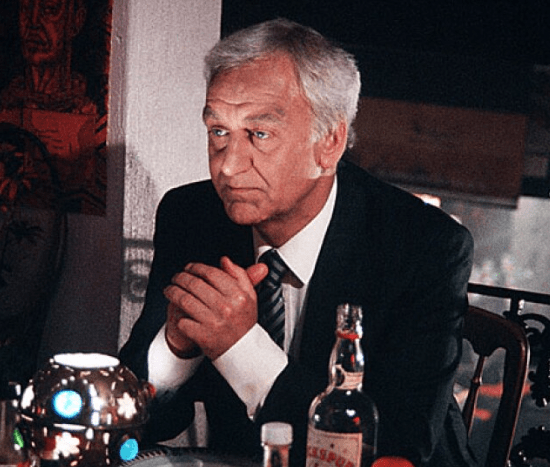
I recently got a BritBox subscription, and I’ve been nerding-out. Mainly, I’m rewatching the original Inspector Morse series that aired on Mystery! back in the 80s and 90s. I’ve loved the show since I first saw it back in college. Morse is a genuinely interesting and conflicted character, and John Thaw played him brilliantly.
Morse is smart and righteous, but also very funny. Emphasis on funny. I remember the first episode I ever saw, back when I was in college, when I was channel surfing one late night. My dad happened to be awake at the same time, and we watched an episode titled The Wolvercote Tongue, in which the world-weary Morse tries to solve the mysterious murder of an American tourist. There is one especially good, laugh-out-loud moment, and both my father and I cracked up. It’s one of my fondest memories. Ever since that moment, I was hooked.
I also love the show’s setting of Oxford (the town and the university). I keep hoping to go there someday. I’m sure they’ve got the murder-rate down by now.
I’m only ten years late to the party, but I’ve just started watching the BBC series Shetland. Based on the mystery novels by Ann Cleeves (which I guess I’ll have to read now), the stories are smart, suspenseful, and engrossing. The acting is also first-rate. But what really makes the show stand out is its setting—the barren, brooding, rugged landscape of the Shetland Islands, which, as I learned from Wikipedia, is the UK’s northernmost territory.
Like a lot of American Southerners who’ve spent their lives in hot places, I’ve always longed to move to a cooler land. As a kid, I loved watching British TV mysteries, partly because the atmosphere looked so soothing in the rainy cities and wind-swept towns where such shows are often filmed.
Yeah, I know—try telling a Brit that they should be grateful for their weather. But I was envious. Being one of those bookish, introverted people who has too much stimulation going on inside the brain, I always felt like I would be happier in a region where there isn’t so much stimulation outside. Where the sun isn’t so strong, the heat so oppressive.