What I’m Reading: “Night. Sleep. Death. The Stars”

Ever since I read her famous short story “Where Are You Going? Where Have You Been?” in college, I have loved Joyce Carol Oates. I continued to read her short stories through the 1980s and 90s, and my admiration only grew. She seemed to combine the style and critical eye of other great practitioners of modern realist fiction (think John Updike, Phillip Roth, John Cheever) with her own particularly empathic sensibility. 

Empathic, yes, and also brutal. Oates writes about working class people in dire straights, including physical danger. Her female protagonists, especially, often face the threat of violence and even death (several of Oates’s stories involve rapists and serial killers). But even in these heightened situations, the primary threat is the internal, psychological one. For Oates, the real adversary is the self—that is, ourselves, with all of our passions and desires and resentments and jealousies. 

And fear, of course. Fear is the greatest enemy in Oates’s imagined world, and overcoming fear, in all of its manifestations, is the greatest achievement of any Oates character. And so it makes perfect sense that the opening scene of her epic novel, Night. Sleep. Death. The Stars, would present the reader with a man engaged in an act of actual heroism. John Earle “Whitey” McClaren is the patriarch of an big family in Hammond, New York. His five children, all grown, are pillars of the community, and Whitey himself was once mayor of the Hammond. But when he spots two police officers brutalizing an Indian man on the side of the road, he pulls over and intervenes. The cops turn their fury on him, and he is brutally beaten. Whitey ends up in a coma, with his family gathering around him in the hospital. I don’t think I’m spoiling much when I state that White doesn’t survive his ordeal. And his death, in turn, impacts all the members of his family, from his devoted wife, Jessalyn, to his five adult children. 

But instead of writing just another book about the grieving process—a so-called aftermath novel—Oates describes a series of titanic transformations that take place in each individual over the following two years. Flannery O’Connor once wrote that fiction is about the mystery of personality, and Oates seems to confirm this in the way she reveals how Whitey’s loss “breaks” the each of his children’s personalities. Like crystals, they all fracture along unique and unpredictable fault lines, and that’s the genius of Oates’s novels. Some of the children find themselves growing spiritually and sexually (with lots of missteps and false starts), while others spiral down into paranoia and bitterness. Jessalyn, Whitey’s widow, works her way through survivor’s guilt to find new love with a Hispanic liberal photographer who is as different from Whitey as a man could be (at least on the surface; spiritually, they are similar, as Jessalyn soon realizes). 

One common shortcoming of big, third-person novels with many view-point characters is that some of those characters blur together. But Oates renders each of these people so vividly and convincingly that, by the end of the book, they feel as real to us as…well…someone in our own family. This is, I think, the highest achievement of fiction—to make us feel what it’s like to be another human being. 

And (oh yeah) the book is funny as hell. 

Check it out….

Ten Great Books on Writing

I am a perpetual student of the writing craft and, as such, I am an avid consumer of books about writing. Here is a list of my favorites, from great to greatest…

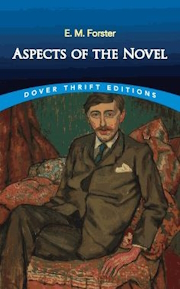
10. Aspects of the Novel Kindle Edition — E. M. Forster

Forster is one of my all-time favorite novelists, a capital-G Great Writer who penned classics like Howard’s End and A Passage to India. So, he could write with some authority on both the broad and fine points of novel-writing. It’s also a very practical book. Best of all, it’s in the public domain, so you can get it for free/cheap.

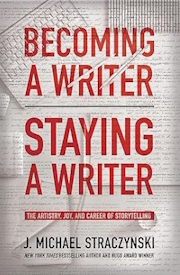
9. Becoming a Writer, Staying a Writer

J. Michael Straczynski is best known as the creator of the classic sci-fi TV show Babylon Five. But he’s also had a long, successful career in screenwriting and producing. He takes his title from a quote by his friend, the late Harlan Ellison: “The trick is not becoming a writer. The trick is staying a writer.” Indeed. Straczynski has good, strategic advice for writers at every level, from novice to published (and wanting to stay published).

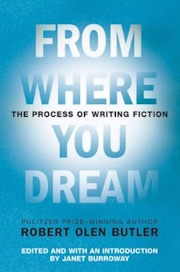
8. From Where You Dream – Robert Olen Butler

This is not a book on craft, but rather a high-level meditation on how to channel inspiration into the art of writing, and how writing itself can almost be a form of spiritual practice. Butler makes a strong case that this practice is what really separates “hack” writers from true artists.

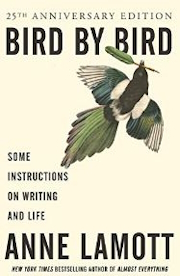
7. Bird by Bird – Anne Lamott

An extremely witty and inspirational book about starting a novel, keeping momentum, and fighting off self-doubt. The title comes from an anecdote that Lamott tells about her father instructing her brother on how to write a big term-paper on local bird-life. 

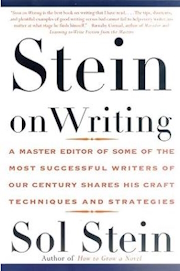
6. Stein on Writing – Sol Stein

This is one of my favorite books on the practical matter of writing fiction that doesn’t suck. From description, to pacing, to style and character motivation, Stein covers it all. His section on titles alone is worth the cost of the book.

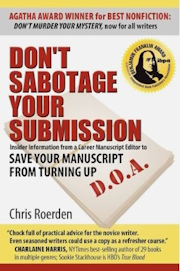
5. Don’t Sabotage Your Submission: Save Your Manuscript from Turning Up D.O.A. – Chris Roerden

This is the absolutely best craft manual that I’ve ever found. No joke—reading it changed the way I write. What this book teaches you is the fiction-writing equivalent of not picking your nose in public. Avoid tons of stupid, stupid shit (that I have done and many others have done) in your fiction—the kinds of things that make an agent or a publisher sock your manuscript straight into the circular file. If you can find this book, new or used, it’s worth the money.

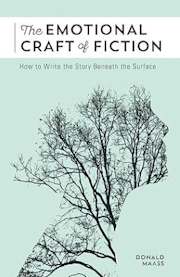
4. The Emotional Craft of Fiction: How to Write the Story Beneath the Surface – Donald Maass

Maass is the only author on this list who is also a successful literary agent. The Emotional Craft of Fiction is a great book about how to make the reader feel something—which, to me, is the highest (and perhaps the only important) goal of fiction. How do you do it? Well, obviously, by making your characters feeling something—that is, complex, believable, and yet somehow ineffable emotions.

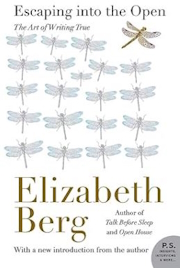
3. Escaping into the Open: The Art of Writing True – Elizabeth Berg

This has recently become one of my favorite books on the writing life. One great quote:

I believe that fiction feeds on itself, grows like a pregnancy. The more you write, the more there is to draw from; the more you say, the more there is to say. The deeper you go into your imagination, the richer that reservoir becomes. You do not run out of material by using all that’s in you; rather, when you take everything that is available one day, it only makes room for new things to appear the next.

2. Big Magic – Elizabeth Gilbert

Gilbert is one of the best writers of her generation, so it makes perfect sense that she would write one of the best books ever on the creative process. While not limited to the literary arts specifically, Big Magic is a meditation on how any kind of creative art is a kind of inexplicable, real magic. It has to be nurtured, defended, shared, and—above all—respected.

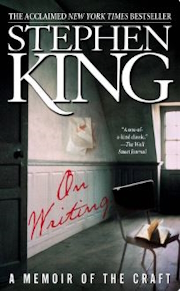
1. On Writing – Stephen King

As one might expect, this is my favorite of all the books on this list, and the one I find myself re-reading. Stephen King is a master, and his is the most entertaining and trenchant book on this list. Part is devoted to practical matters like plot, description, dialog, etc., while the rest is a very compelling memoir.

What I’m Reading: “A Childhood: The Biography of a Place”

Years ago, my son Connor and I went on a hiking trip with my dad. At some point along the trail, we stopped to rest, and he told us about something from his past that he’d never talked about before. Namely, that in high school, he once had a part-time job delivering ice. Not those bags of ice people today buy at the grocery store before a party, but blocks of ice that people would put in their ice-box, the precursor to the modern refrigerator.

Of course, his story was not a total surprise. I knew that my grandfather—Connor’s great-grandfather—had owned an ice factory in rural Mississippi, where my father’s family is from. And my father had been in high school in the late 1950s, when much of that part of the country was still lagging several decades behind in terms of technology. Still, my father’s tales of hauling blocks of ice up tenement stairwells impressed me, as did his description of the blocks themselves, which were notched into thirds. This was done so that poorer people could buy a third or perhaps two-thirds of a whole block. All that was needed was to cleave the block with a small hatchet, which my father had carried with him for this purpose.

I found myself thinking about these stories a lot as I read a memoir by my old professor—the great writer Harry Crews—called A Childhood: The Biography of a Place. Like most good memoirs, the book gives the reader a window into a time and a place that is now long gone. In Crews’s case, it was Bacon County, Georgia in the Great Depression, when poor farmers had a skillset that seems almost fantastic to our modern sensibilities. Take, for instance, this passage, in which Crews describes the technical and highly prized ability to estimate the age (and, thus, the mileage) of a mule:

A mule has a full set of teeth when he’s born. But when he is two years old, he sheds two of the teeth right in the front. A good mule man can tell if he’s shed those two front teeth, in which case he is between two and three years old. A really good man can tell if those teeth have just grown back in or if they’ve been back in the mule’s mouth for several months. The next year, when he’s three, the mule sheds two more teeth, one on each side of the two he shed the year before. From then on the mule sheds two teeth a year until he’s five years old. That’s the last time he sheds.

Reading this passage, I was struck—as I was on that day with my father and my son—by how much the texture of daily life has changed in the past one hundred years. How one human lifetime (Harry Crews’s and also my father’s) could span the era of mule men and ice-delivery boys to my own, in which I make my living programming a computer (an occupation as complicated, surely, as appraising a mule’s age, but not nearly as artful). 

Not all of Crews’s memoir is as comfortingly rustic as the sample above. Crews was never guilty of sentimentality in his writing, and his description of his family and neighbors enduring desperate poverty are as horrifying as any I have ever read. To name just one example, he explains how a problem as mundane as a rotten tooth—a mere annoyance for us today—was an agonizing crisis in rural Georgia, where no dentists were available and no one could afford them even if they were. So, naturally, people were driven by relentless pain to pull their own teeth, as Crews witnessed a hired man do one night:

He had a piece of croker sack about the size of a half dollar in his left hand and a pair of wire pliers in his right. He spat the water out and reached way back in his rotten mouth and put the piece of sack over a tooth. He braced his feet against the well and stuck the pliers in over the sackcloth. He took the pliers in both hands, and immediately a forked vein leaped in his forehead. The vein in his neck popped big as a pencil. He pulled and twisted and pulled and never made a sound.

It’s this kind of detail that makes one appreciate the mercies of modern life, even as it vaporizes any nostalgia we might harbor for the so-called “good old days” that right-wing politicians are always blathering about. For Crews, the “good old days” were marked by disease, privation, hunger, and lethal violence. They were also marked by unexpected moments of kindness, decency, and courage. People helped each other out in times of need without any thought of recompense; it was simply the way of things.

As Crews writes:

Back in the county there was no charity. People gave things to each other, peas because they couldn’t sell them or use them, same with tomatoes, sweet corn, milk, and sometimes even a piece of meat because it was going to turn rank in the smokehouse before they could eat it. But nothing was made out of giving or receiving. It was never called charity or even a gift. It was just the natural order of things for people whose essential problem, first and last, was survival.

Clearly, hard times bring out both the worst and the best in human nature. But there is an even deeper lesson to draw from Crews’s narrative. Namely, that physical suffering can deepen and intensify the human spirit. I was particularly struck by the chapter in which Crews describes the time he was stricken by polio as a small boy. As he lay in bed, paralyzed, he was kept company by an African-American woman called “Auntie” who regaled him with stories of backwoods monsters and superstitions, which both entranced and terrified him. For instance, she warned him of a bird’s ability to spit in a person’s mouth and take over their body.

“Look in there, youngun,” she said. “Look in there and bleve. A bird mought take you to hell. Mought take you anywheres at all. Me, I been grieved more than some, you up here in the house with them birds. Them spittin like snakes, lookin to hit you all up in your mouf. One hit you—an one gone hit you—that bird own you, own all of you. Now you look in there an bleve.” Her old soft voice got sharp when she demanded that I believe. But she could have saved it; I’d been a righteous believer in the deadly accuracy of bird spit long before we came down the hall. “Bird spit mix all up with your spit, and then your spit is his and he’s you. You listening, chile?”

Crews never comes out and says it, but there is a strong implication that it was the power of Auntie’s imagination, and those of others like her, that fostered a desire in him to be a writer. The same was true of the place itself—Bacon County—whose very harshness gave him an appreciation of the miraculous divinity of all things. “I had already learned—without knowing I’d learned it—that every single thing in the world was full of mystery and awesome power.” What better description could there be of the artistic impulse? The need to capture the sublime and terrifying experience of daily life?

My appreciation of A Childhood is undoubtedly tinged by the fact that I got to know Harry Crews for a while. By the time I became an English major at the University of Florida in the 1980s, Crews was already a legend. He had written a lot of great books, of course, but he was more famous locally as a teacher and all-around character. Everyone seemed to have a Harry Crews story. He got into brawls. He took drugs. There was the time he had once (allegedly) tackled an irate student who had attempted to storm out of his class. He studied karate. He caught and raised hawks. He trained body-builders. He wrote five-hundred words a day, even if it took him three hours of sitting at keyboard, staring.

Harry Crews circa 1990

And he drank. A lot.

As a bright-eyed, wannabe writer, I was enthralled with the idea of Harry Crews. But by the time I finally signed up for his creative writing class—a night class, obviously, since he wrote in the mornings—the old Harry of lore was already in the past. He’d given up drinking (he took Antabuse daily), and he’d mellowed out. But he was still a legend. He produced one fine novel after another, and he made a lot of money writing for big-name magazines like Playboy. One of his most notable fans was Madonna, who would only agree to be the focus of a celebrity study in Playboy if Harry were the journalist. So, Harry flew to Manhattan and spent a few days with the Queen of Pop and her then-husband, Sean Penn (who also became a fan).

And yet, as awed as I was that fall evening when I sat in a classroom with a dozen other nervous students, I still had no idea what Harry Crews looked like. Then, at exactly six-o’clock, a lank man in faded jeans shuffled into the room, slightly stooped and smiling. For whatever reason, he looked at me first, sharp grey eyes fixing on me. He nodded and said, “Hey, guy,” a gentle greeting that I have often used. He then proceeded to teach a class that was ostensibly about the writing craft but more directly about the importance of fine art and the dedication required to create it.

My only regret about reading Crews’s memoir after all these years is that I didn’t do so sooner. It would have given me even more appreciation for the man. After all, most people who have the kind of childhood grow up to be hard, violent individuals. And, indeed, Crews wrote hard, violent novels, filled with men and women for whom brutality is a way of life. But the author himself–once you got to know him–was a bit of a sweetheart. I’ve been told that Harry wasn’t always so sweet, in his youth, but he was when I knew him, and so that’s the Harry I remember: a man who felt that all human beings deserve sympathy, but especially the most underprivileged and marginalized. He also knew of the power of imagination and storytelling to sustain us even in the most desperate of circumstances. As Crews says of his beloved Auntie and her bizarre superstitions, “Fantasy might not be truth as the world counts it, but what was truth when fantasy meant survival?”

P.S. Here’s a review of A Childhood recently published in the New Yorker.

(Author’s Note: this post originally appeared on my old blog, Bakhtin’s Cigarettes.)

WHAT I’M READING: THE DESCENDANTS

(Author’s Note: The recent tragedy in Maui got me thinking about one of my favorite novels of the past twenty years, The Descendants, which is set nearby. I am reposting this essay about it as a kind of semi-tribute.)

Even though I fancy myself a literary fiction writer (even when I’m writing detective or sci-fi novels), I don’t read that much literary fiction. I read a ton when I was young, especially in college, and lately I’ve found it difficult to find novels that don’t seem derivative or poorly imagined or just downright silly. And for those rare books I do find engaging, I often arrive at them in circuitous ways.

Take Kaui Hart Hemmings’ celebrated novel, The Descendants. Like a lot of books I read, it became known to me from a movie adaptation, although, strangely enough, I didn’t actually see the movie. I was on a flight to Europe some years ago, on an older model jet that still had drop-down movie screen, and the in-flight movie was The Descendants. I didn’t pay for the earphones, but even as a silent film it looked interesting, with George Clooney skulking about some lush tropical landscape that I somehow knew was Hawaii. I looked the movie up on Imdb.com and found that it was based on a novel, so I looked that up. It was a debut novel and looked the kind of book I might like: a literary story, told from a single point-of-view, with relatively few characters, a vivid setting, a compressed time-span, and an intriguing premise.

So, I checked it out on Overdrive. And, man, was I lucky I did.

Continue reading “WHAT I’M READING: THE DESCENDANTS”

What I’m Reading: “Saint Jack”

Novice writers sometimes ask about the difference between “literary” fiction and “commercial” fiction, and so-called learned people often answer something like this: “Commercial fiction is about plot; literary fiction is about character.”

But what any real student of literary fiction knows is that all novels—all good novels, at least—have a plot. That is, they have a story with a beginning, a middle, and an end, and some element of that story compels the protagonist (and, thus, the reader) through each phase. A short story without a plot isn’t a short story; it’s a poem. And a novel without a plot is a very long poem, the only real difference being a lack of fixed line-breaks.

No, what people really mean when they talk about literary fiction being “plotless” is that the plot, while discernable, is usually internal in nature. This lies in direct opposition to popular novels. Plots of popular novels are often extrinsic, with threats and goals that are externalized and easy to understand. Plots of literary fiction are intrinsic, private to the hidden thoughts, fears, and desires of the main character. Or, put another way, literary fiction often makes use of a plot that revolves around a symbol—something crucial to the hero for reasons that even they might not understand.

Horror and suspense novels have the most obvious and extrinsic plots: Escape the Monster; Kill the Monster; Get the Girl (or Boy); Live to Tell About It. The degree to which the writer of such fiction can make the internal life of the hero relevant to this plot might define the quality of the work, its “literary merit,” but it is by no mean an essential aspect of the genre itself.

Great horror novelists like Stephen King can blur the line between genre and literary fiction almost to undetectability, as in King’s most famous and widely admired novel, The Shining. While ostensibly a ghost story, King elevates his novel by rendering the psychological make-up of his main character, Jack, in vivid and poignant detail. Early in the book, the reader learns that Jack is a failed writer and recovering alcoholic—conditions that combine to make him uniquely susceptible to the seductions of evil emanating from the villainous hotel. But only later do we learn that Jack is also an adult victim of child abuse, a “key” to his psychic make-up that makes the second half of the novel all the more tragic.

In this way, King confirms what Flannery O’Connor said about fiction: “A story always involves, in a dramatic way, the mystery of personality.” She also said that every novel is, in a sense, a whodunnit, if only the psychological sense. The whodunnit of The Shining is Jack’s abusive, alcoholic father.

Of course, the best literary fiction writers can blur the line, too, from the opposite direction. I’ve written before of my love of Robert Stone’s Dog Soldiers, which won the National Book Award in 1973. The story of two world-weary young men who conspire to smuggle a kilo of pure heroin from Viet Nam back to the States, the novel could easily be mistaken for a crime thriller. It’s only the way Stone is able to make the heroin a symbol for both of the men, especially the tragic main character, Ray Hicks, that allows him to wind a deeply affecting literary novel around the spine of that frantic and violent tale.

I’ve been thinking about all this plot business recently, even since I read a very fine novel called Saint Jack by Paul Theroux. Most people classify Theroux as a travel writer—his book The Great Railway Bizarre is often cited as a masterpiece of travel literature—but I know him primarily as a fiction writer, one of the best of the past fifty years. I had admired his books Kowloon Tong and Hotel Honolulu, but for some reason I never read Saint Jack, one of his earlier novels, despite my having been intrigued by it since I was in high school, when I saw Peter Bogdanovich’s wry and mysterious movie adaption starring Ben Gazarra. Part of my failure to actually read the book probably had to do with its relative obscurity; I could never find a copy even in my favorite used book stores. But one of the great boons of the digital era is that the back-catalogues of countless writers are now available, and Saint Jack somehow popped up in my Kindle recommendations for a whopping two bucks! Woo-hoo!

And, man, was that two bucks well spent! Saint Jack presents the reader with one of the most colorful and endearing low-life characters in the history of literature. American ex-pat Jack Flowers is a part-time shipping supplier and full-time pimp working the streets of Singapore. Middle-aged and mildly alcoholic, Jack’s seedy character is redeemed, somewhat, by the kindness with which he treats his affable young prostitutes (his “girls”) and also the hypocritical men (the “fellers”) who seek their services. At least, Jack hopes he is redeemed, fancying himself as a man of importance, a protector to the feckless, lustful, and greedy souls haunting the streets of the city. Cooling his heels in a hotel lobby as he waits for a girl to finish her session with a “feller,” Jack often indulges in…

[t]hat momentary daydream which flits into every reflective man’s mind and makes him say his name with a tide, Sir or President or His Highness—everyone does it sometimes: the clerk wants a kingship, it’s only natural—this dubbing was a feature of my every waking moment. I wasn’t kidding; even the most rational soul has at least one moment of pleasurable reflection when he hears a small voice addressing him as Your Radiance. I had a litany which began Sir Jack, President Flowers, King John, and so forth. And why stop at king? Saint Jack! It was my yearning, though success is nasty and spoils you, the successful say, and only failures listen, who know nastiness without the winch of money. If the rich were correct, I reasoned, what choice had they made? Really, was disappointment virtue and comfort vice and poverty like the medicine that was good because it stung? The President of the United States, in a sense the king of the world, said he had the loneliest job on earth; where did that leave a feller like me?

Unhappy and adrift, Jack’s only ambition is to somehow strike it rich, though he has no plan for doing so. He once dreamed of opening the classiest whore-house in Singapore, a goal that, we learn, was briefly realized in previous years (with tragic consequences). At the point of the novel’s opening, he seems to have stagnated, both financially and spiritually. Then, a stranger enters his life. Leigh, a British accountant hired by Jack’s boss, is of roughly the same age and disposition as Jack, but his life has taken an opposite path. Completely conventional and straightlaced, Leigh nonetheless takes a liking to Jack, even as he finds himself slightly horrified by the details of the man’s street-wise existence. Jack, for his part, sees Leigh as a kindred spirit, a decent “feller,” albeit one who would never hire one of his “girls”. More importantly, Jack is disturbed by Leigh’s disapproval of him, although he struggles to understand why.

Of course, the reader knows why: Leigh is a symbol. He’s a mirror in which Jack sees himself—or, rather, some better version of himself that might have been. In Leigh, all of Jack’s moral failings are revealed. 

In this way, his appearance serves as the instigating action of the novel, the beginnings of the plot in which Jack will be forced to explore his own life history. A more generic kind of novel might have proceeded with a burgeoning friendship between the two men, Jack and Leigh, in which the former would find enrichment and even escape from his louche existence. But in Theroux’s capable hands, the story takes an unexpected turn when, barely one-third into the novel, Leigh dies suddenly from a heart attack while drinking in Jack’s favorite “club,” surrounded by boozy British ex-Pats (whom Jack loathes even as he craves their approval).

I previously alluded to O’Connor’s theory that every good novel is a kind of whodunnit, and Saint Jack is a wonderful case in point. It falls to Jack to call Leigh’s wife and tell her of the man’s passing, and also to arrange the funeral, which Theroux renders as predictably absurd and yet surprisingly moving. At this point, the story becomes a huge, Mobius-loop of a flashback in which we learn much about Jack’s past, including the reason he finds himself in Singapore (he’s a fugitive fleeing drug charges in the States) as well as his brief and glorious stint as a whore-house proprietor. Jack pours all his artistic and self-aggrandizing impulses into this joint, an opulent mini-resort which he grandly bestows with the name Dunroamin—a moniker which vaguely evokes an English estate as well as being a homophone for Jack’s yearning for permanence, a true home. (He’s “done roamin’”; get it?). He also pours in all his money, and for a time Dunroamin is successful. But its very success contains the seeds of Dunroamin’s destruction, as it soon attracts the ire of the local Triads, whose henchmen kidnap Jack and tattoo his arms with Chinese curses. Upon his release, Jack finds Dunroamin burned to the ground, his hopes for a better future having gone up with it.

As it turns out, Jack’s days as a house-pimp are not entirely over. He gets a visit from an old acquaintance named Schuck, a CIA spook who once ran a government-subsidized “hotel” with Jack providing R&R to battle-crazed Vietnam soldiers. If the operation of this hotel represented an even deeper moral failing for Jack than his previous ones, Schuck soon tempts Jack all the way into the abyss, hiring him to film a troublesome American general trysting with a prostitute. Whether or not Jack will go through with the plan is the climax of the novel (and one which I will not reveal here).

Saint Jack is a classic novel by one of our most underrated literary writers. Check it out…

Author’s Note: this post first ran on my old blog, Bahktin’s Cigarettes.