I am very happy to announce that I am a finalist in the Best First P.I. Novel category for this year’s Shamus Awards! Many, many thanks to the good people of The Private Eye Writers of America for this great honor.
Good luck to all the other nominees, especially my friends Alexis Stefanovich-Thomson and Henry Wise. I hope one of us wins. And I really hope it’s me.
As some dedicated readers of this blog might know, my friend Margaret Luongo and I posted a pair of videos discussing George Eliot’s classic novel Middlemarch to our “Read A Classic Novel…Together!” channel on YouTube. Ever since then, I’ve been meaning to take the time to write a post about it, mainly because it had such a big impact on me. I mean, lots of books have achieved the classic moniker and yet don’t hold up to modern scrutiny. But Middlemarch does. In fact, it’s one of those titanic works of literature that you almost can’t get your head around. It has so many sides and so many aspects, such that it attains a kind of sublime quality. Like Shakespeare’s works, Middlemarch is a different experience for everyone who reads it.
When I say titanic, I mean it literally. Middlemarch is a big book–eight hundred pages in most editions–following the lives of six major and at least a dozen minor characters in the fictional, provincial town called Middlemarch. The story is set in the 1830s, but Eliot wrote the book in the 1870s, when the world had already been vastly changed by the industrial revolution in England. And so, the book has a little bit of a “lost world” feel to it. One can sense that Eliot (whose real name was Mary Ann Evans) is writing about the social and economic environment that is already a thing of the past. However, absolutely nothing about the book feels the least bit sentimental or nostalgic. Quite the contrary. Eliot was a great writer whose blazing intelligence seems to illuminate every page of this very long book. And everything she describes feels as true and relevant today as when she wrote it.
I had a lot of fun being on the “Do You Remember the First Time?” panel at the Edgar Awards Symposium last week. Panel chair Terry Shames did a great job, and I got to meet some hitherto online-only friends like Audrey Lee. I also made some new ones.
I was pretty nervous and I think it shows, but oh, well. Check it out if you’re interested.
If I were to make a list of the most influential science fiction novels of all time, William Gibson’s Neuromancer would surely be on it. How often does a book create a whole genre—almost single-handedly? I say “almost” because there were other cultural touchstones of the cyberpunk genre, primarily Ridley Scott’s landmark film Blade Runner. But Neuromancer was the primary literary component of the movement, with its landscape of towering, high-tech super-cities where the rich live high (in every sense of the word), and the poor live very, very low.
Expanding on his ground-breaking short story, “Johnny Mnemonic,” Gibson created a dark near-future in which giant “mega-corporations,” many of them Japanese, have taken control of all aspects of life, and the richest people have almost become a different species. Average people work as wage-slaves to the corporations, and the closest thing to a counterculture is a teeming underclass of rebel hackers who make their existence by spying on (and stealing from) the corporate oligarchy.
These underground, anti-heroes are the punks of cyberpunk, and they are what made it so compelling as a genre. In a world where technology and corporate greed have dehumanized everyone, the punks beat the system at its own game. They do so by humanizing it, using their courage, individuality, and creativity to win in the one place where everyone is still equal—the virtual world of cyberspace.
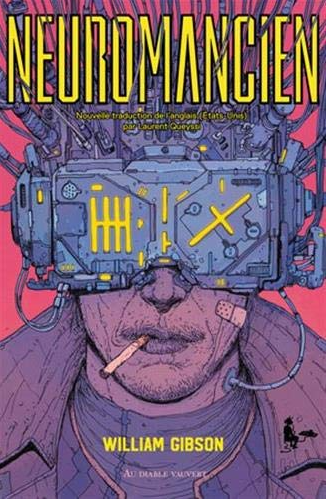
That’s why I like this cover so much. Strangely, though Neuromancer was published forty years ago, there has never been a cover that really captured the vibe and essence of the book. Until this one. It’s a very obscure cover belonging to a Brazilian edition of the novel and created by Spanish artist Josan Gonzalez (a.k.a. Deathburger). I like it because it feels like a 1980s comic book—specifically, the work of French artist Moebius from the magazine Métal hurlant back in the 1980s (truly, the golden age of cyberpunk). The character portrayed is, presumably, that of Case, the hacker-hero of the novel. With a cigarette dangling from his mouth and a welter of wires rising from his VR goggles (from his “brain,” essentially), he personifies the spirit of cyberpunk: a rebellious unflappability combined with human creativity and technical skill.
Somebody shared an old post on Facebook today regarding my interview with David Gwyn back in March on his Thriller101 podcast. It got me thinking about how much I enjoyed that particular talk, and what great questions David asks.
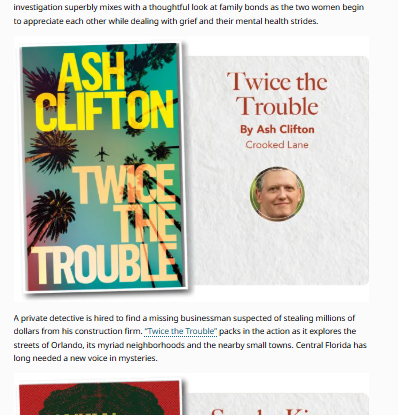
Christmas came early for me this year! Many thanks to Ms. Oline Cogdill and the good folks at the Sun-Sentinel for putting Twice the Trouble on their Best Mystery Fiction Books of 2024 list! I am very honored.
For those of you who might be in the Atlanta area on October 7, please stop by the Flat Shoals library for my book talk. The event is at 6:00 p.m., and I’ll be reading from my mystery novel, Twice the Trouble.
I’ve been meaning to post this for a while (sorry, I’m a flake). Marshal Zeringue has (another) really cool web site called The Page 69 Test, where he invites writers to turn to page 69 of their latest book and write about it. It’s actually a lot of fun! Here is my entry (for which I am grateful to Mr. Zeringue for inviting me to write).