My great friend Margaret Luongo and I just released the premier episode of our new YouTube Channel, Read a Classic Novel…Together. In this series, we tackle classic novels that we’ve been meaning to read forever, and we invite the viewer to read each chunk along with us. (We try not to read ahead, but do anyway sometimes. Sorry.)
For this first episode, we take on Part I of Jean Rhys’s Wide Sargasso Sea. Check it out when you can.
Anyone who follows this blog knows that my two primary obsessions are movies and history. So, you can imagine my excitement whenever I encounter that rare intersection of these two interests: a well-written film history book. And, still further within this category, there is the vaunted production-of-a-classic-movie book, which is a special favorite.
The supreme example of this sub-sub-sub-genre is Mark Harris’s Pictures at a Revolution, which recounts the making of not one film but four, all of which marked the changing nature of Hollywood—and America—at a specific moment in time, 1967. But if Harris’s book is the touchstone of this subject, then Sam Wasson’s The Big Goodbye: Chinatown and the Last Years of Hollywood is a very close second. Put simply, I enjoyed the hell out of it.
Where Harris’s book describes the making of four movies, Wasson’s reveals the making of four men, the principal creators of Chinatown. These were the producer (Robert Evans), the screenwriter (Robert Towne), the director (Roman Polanski), and the star (Jack Nicholson).
Yeah, I know. Picking U2’s “New Year’s Day” as my Friday-Night Rock-Out three days before New Year’s Day is a very, very obvious choice. But the truth is that I still listen to this song all the time. It came out when I in high school, and it marked the first time I really became aware of U2 as a band. The song sounded completely different from anything else on the radio or MTV at the time, with Bono’s soaring, heroic lyrics and The Edge’s dirge-like guitar work. But unlike any other U2 song that I know of, this one is driven primarily by the use of a piano, also played by The Edge. It’s the propulsive piano melody (really more like a drum beat) that makes the song feel otherworldly. Sublime. Classic.
Suffice to say that it still works for me, lo these many years later.
Like millions of others, my family and I have spent part of this year’s Christmas holiday watching some version of Charles Dickens’ A Christmas Carol. Actually, we watched two, starting with Bill Murray’s mad-cap Scroogedand following-up with a much darker made-for-TV film from 1999, starring Patrick Stewart. The production was inspired, in part, by Stewart’s one-man stage performances as the character, and Stuart gives a powerful, tragic interpretation of Scrooge, a man so consumed by his traumatic past that he is unable to experience any emotion other than anger, manifested as a chronic, toxic misanthropy.
A Christmas Carol is, of course, an unabashed Christian parable, perhaps the most influential in history outside the Bible itself. Scrooge is visited by ghosts over three nights (the same number as Christ lays dead in his crypt), until his “resurrection” on Christmas morning, having seen the error of his ways. But the story resonates with people of all faiths, or no faiths, because of its theme of hope. Scrooge is old, but he ain’t dead yet. There’s still time to fix his life. To change. To choose.
I have always thought that the power to choose–the divine gift of free will–lies at the heart of A Christmas Carol, as it does with all great literature. Of course, it’s hard to imagine Scrooge, after seeing the tragedies of his Christmases past, present, and future, to wake up on Christmas and say, “Meh, I’d rather keep being a ruthless businessman. Screw Tiny Tim.” But he could. He might. The ultimate choice given to us is the option to change the nature of our own hearts, our way of thinking.
This matter of free will seems particularly salient this year–this holiday season–because the very concept is under attack. If you Google the term “free will,” you will be presented with a barrage of links with titles like “Is Free Will an Illusion?” and “Is Free Will Compatible with Modern Physics?” Along with the rise of militant atheists like Richard Dawkins, a parallel trend has arisen among theoretical physicists who doubt that free will is even a meaningful concept. After all, if our consciousness is merely an emergent phenomenon of electrical impulses in our brains, and if our brains are, like everything else, determined by the laws of physics, then how is free will even a thing? Every idea we have—every notion—must somehow be predetermined by the notions that came before it, the action and reaction of synapses in our brains.
Our brains, in other words, are like computers. Mere calculators, whose order of operations could be rewound at any moment and replayed again and again and again, with exactly the same results.
Patrick Stewart as Scrooge
Ah, but what about quantum mechanics, you say? The principles that undergird all of quantum theory would seem to imply that human thought, even if you reduce it to electrons in the brain, might be on some level unpredictable, unknowable, and therefore capable of some aspect of free will. Not at all, reply the physicists. The scale at which Heisenberg’s Uncertainty Principle applies—the level of single electrons and other subatomic particles—lies so far below that of the electrochemical reactions in the human brain that their effect must be negligible. That is, a brain with an identical layout of neurons to mine would have exactly the same thoughts, the same personality, as I do. It would be me.
It’s this kind of reasoning that leads people to hate scientists at times, even people like me who normally worship scientists. The arrogance of the so-called “rationalist” argument—which comes primarily from physics, a field that, in the early 1990s, discovered that it could only explain 4% of everything in the universe—seems insufferable. But more to the point, I would argue that the rationalist rejection of free will leads to paradoxes—logical absurdities—not unlike those created by the time-travel thought problems that Einstein postulated over a hundred years ago.
For instance, imagine that one of our free-will denying physicists wins the Nobel Prize. He flies to Stockholm to pick up his award, at which point the King of Sweden says, “Not so fast, bub. You don’t really deserve any praise, because all of your discoveries were the inevitable consequence of the electrical impulses in your brain.”
“But what about all the hard work I put in?” the physicist sputters. “All the late nights in the lab? The leaps of intuition that came to me after countless hours of struggle?”
“Irrelevant,” says His Majesty. “You did all that work because your brain forced you too. Your thirst for knowledge, and also your fear of failure, were both manifestations of mechanicals in your brain. You had absolutely no choice in the matter.”
“Well, in that case,” replies the now angry physicist, “maybe YOU have no choice but to give me the award anyway, regardless.”
“Hmm,” muses the King. “I hadn’t thought of that.”
“So, can I have it?”
“I dunno. Let’s just stand here a minute and see what happens.”
As many critics have pointed out, this kind of materialist thinking inevitably leads to a kind of fatalism of the sort found in some eastern religions. If human beings really have no free will—that is, if we are basically automata in thrall to the physical activity of our brains—then what’s the use of struggle? Why bother trying to improve yourself, to become a productive member of society, or become a better person?
Straw man! scream the physicists. No one is advocating we give up the struggle to lead better lives. That would be the end of civilization. No, we simply mean that this struggle is an illusion, albeit one that we need to exist.
Okay. So, you’re saying that we all have to pretend to have free will in order to keep the trains running? We must maintain the illusion of free will in order to continue the orderly procession of existence? But doesn’t this position, itself, imply a kind of choice? After all, if we have no free will, it really makes no difference whether we maintain the illusion or not.
Doesn’t this very discussion represent a rejection of passivity and the meaningfulness of human will?
My fear is that many young people today will be overexposed to the “rationalism” I describe above, especially when it is put forth by otherwise brilliant people. For those who are already depressed by such assertions that free will is an illusion, I would direct you to the great stories of world history. All the enduring mythologies, from the Greek tragedies to the Arthurian legends to the Hindu Mahabharata, revolve around the choices made by their heroes, their triumphs and failings. As a fiction writer, I would argue that the concept of “story” itself is almost synonymous with choice. A boy is confronted by the wolf. Will the boy run left or right? Will he lead the wolf away from his friends back at the campsite, or will he lead the wolf to them, hoping they can help scare it away (or, more darkly, that it will eat one of his friends instead)?
One can also take hope in the fact that not only can physicists still not explain what 96% of the universe is but they can’t explain what consciousness is. Of course, some would argue that consciousness, itself, is an illusion. But this leads to an entirely new set of paradoxes and absurdities. (As David Bentley Hart once replied, “An illusion in what?”)
Personally, I suspect that consciousness comes to exist around or about the same moment in a specie’s evolution when the individual can choose. That is, consciousness implies a kind of choice. It might be a very elemental, even primal kind of choice—perhaps simply the choice of whether not to swim harder, or fight harder, which I believe even minnows and ants can make—but it’s still a choice, and not merely a matter of pure instinct.
One of my favorite TV shows from my childhood was Patrick McGoohan’s “The Prisoner”, whose every episode begins with the titular character proclaiming “I am not a number! I am a free man!” This assertion, shouted on a beach by the mysterious village in which he has been imprisoned, is followed by the sinister laughter of Number 2, the Orwellian figure who has been tasked with breaking the prisoner’s will. Number 2 is, of course, an awesome and terrifying figure, armed with all the weapons of modern society: technology, bureaucracy, and theory. But he’s still wrong, and he’s ultimately unable to grind the prisoner down.
That’s the hope I cling to, the Christmas message I espouse. Namely, that we’re all able to choose to resist the fatalism of rational materialism. That we can all, eventually, escape the village and be better human beings.
Anyway, that’s my Christmas Eve rant.
(Author’s Note: this is an updated version of a post that originally appeared on my old blog, Bakhtin’s Cigarettes.)
Ever since I read her famous short story “Where Are You Going? Where Have You Been?” in college, I have loved Joyce Carol Oates. I continued to read her short stories through the 1980s and 90s, and my admiration only grew. She seemed to combine the style and critical eye of other great practitioners of modern realist fiction (think John Updike, Phillip Roth, John Cheever) with her own particularly empathic sensibility.
Empathic, yes, and also brutal. Oates writes about working class people in dire straights, including physical danger. Her female protagonists, especially, often face the threat of violence and even death (several of Oates’s stories involve rapists and serial killers). But even in these heightened situations, the primary threat is the internal, psychological one. For Oates, the real adversary is the self—that is, ourselves, with all of our passions and desires and resentments and jealousies.
And fear, of course. Fear is the greatest enemy in Oates’s imagined world, and overcoming fear, in all of its manifestations, is the greatest achievement of any Oates character. And so it makes perfect sense that the opening scene of her epic novel, Night. Sleep. Death. The Stars, would present the reader with a man engaged in an act of actual heroism. John Earle “Whitey” McClaren is the patriarch of an big family in Hammond, New York. His five children, all grown, are pillars of the community, and Whitey himself was once mayor of the Hammond. But when he spots two police officers brutalizing an Indian man on the side of the road, he pulls over and intervenes. The cops turn their fury on him, and he is brutally beaten. Whitey ends up in a coma, with his family gathering around him in the hospital. I don’t think I’m spoiling much when I state that White doesn’t survive his ordeal. And his death, in turn, impacts all the members of his family, from his devoted wife, Jessalyn, to his five adult children.
But instead of writing just another book about the grieving process—a so-called aftermath novel—Oates describes a series of titanic transformations that take place in each individual over the following two years. Flannery O’Connor once wrote that fiction is about the mystery of personality, and Oates seems to confirm this in the way she reveals how Whitey’s loss “breaks” the each of his children’s personalities. Like crystals, they all fracture along unique and unpredictable fault lines, and that’s the genius of Oates’s novels. Some of the children find themselves growing spiritually and sexually (with lots of missteps and false starts), while others spiral down into paranoia and bitterness. Jessalyn, Whitey’s widow, works her way through survivor’s guilt to find new love with a Hispanic liberal photographer who is as different from Whitey as a man could be (at least on the surface; spiritually, they are similar, as Jessalyn soon realizes).
One common shortcoming of big, third-person novels with many view-point characters is that some of those characters blur together. But Oates renders each of these people so vividly and convincingly that, by the end of the book, they feel as real to us as…well…someone in our own family. This is, I think, the highest achievement of fiction—to make us feel what it’s like to be another human being.
Yeah, I know. Calling this song “rock” is a bit of a stretch. Like all of Bryan Ferry’s solo work, as well as all his hits with Roxy Music, “Don’t Stop the Dance” is a brilliant and elegant pop song. Emphasis on brilliant. What William Faulkner is to literature, Bryan Ferry is to pop music. Who else could create a song like this, one that is both eminently danceable and yet edgy and so, so cool?
I also love the music video, in which French model Laurence Treil features prominently. Ferry and Roxy Music were famous for using the faces and bodies of beautiful women as part of their branding, and Treil was the most beautiful of all. With her glamorous features and impossibly arched eye-brows, she looked like a Patrick Nagel painting that had come to life.
I am a perpetual student of the writing craft and, as such, I am an avid consumer of books about writing. Here is a list of my favorites, from great to greatest…
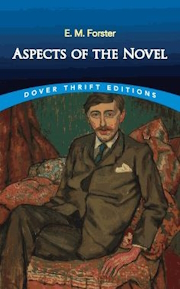
10. Aspects of the Novel Kindle Edition — E. M. Forster
Forster is one of my all-time favorite novelists, a capital-G Great Writer who penned classics like Howard’s End and A Passage to India. So, he could write with some authority on both the broad and fine points of novel-writing. It’s also a very practical book. Best of all, it’s in the public domain, so you can get it for free/cheap.
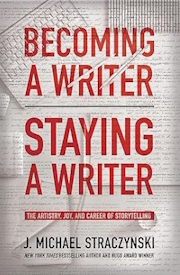
9. Becoming a Writer, Staying a Writer
J. Michael Straczynski is best known as the creator of the classic sci-fi TV show Babylon Five. But he’s also had a long, successful career in screenwriting and producing. He takes his title from a quote by his friend, the late Harlan Ellison: “The trick is not becoming a writer. The trick is staying a writer.” Indeed. Straczynski has good, strategic advice for writers at every level, from novice to published (and wanting to stay published).
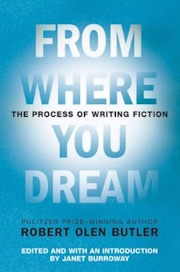
8. From Where You Dream – Robert Olen Butler
This is not a book on craft, but rather a high-level meditation on how to channel inspiration into the art of writing, and how writing itself can almost be a form of spiritual practice. Butler makes a strong case that this practice is what really separates “hack” writers from true artists.
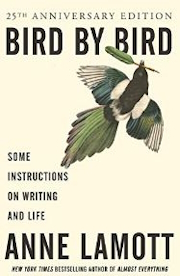
7. Bird by Bird – Anne Lamott
An extremely witty and inspirational book about starting a novel, keeping momentum, and fighting off self-doubt. The title comes from an anecdote that Lamott tells about her father instructing her brother on how to write a big term-paper on local bird-life.
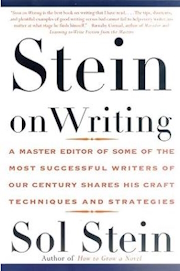
6. Stein on Writing – Sol Stein
This is one of my favorite books on the practical matter of writing fiction that doesn’t suck. From description, to pacing, to style and character motivation, Stein covers it all. His section on titles alone is worth the cost of the book.
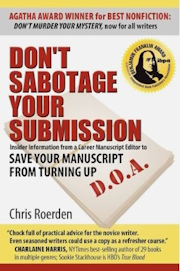
5. Don’t Sabotage Your Submission: Save Your Manuscript from Turning Up D.O.A. – Chris Roerden
This is the absolutely best craft manual that I’ve ever found. No joke—reading it changed the way I write. What this book teaches you is the fiction-writing equivalent of not picking your nose in public. Avoid tons of stupid, stupid shit (that I have done and many others have done) in your fiction—the kinds of things that make an agent or a publisher sock your manuscript straight into the circular file. If you can find this book, new or used, it’s worth the money.
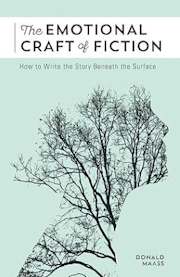
4. The Emotional Craft of Fiction: How to Write the Story Beneath the Surface – Donald Maass
Maass is the only author on this list who is also a successful literary agent. The Emotional Craft of Fiction is a great book about how to make the reader feel something—which, to me, is the highest (and perhaps the only important) goal of fiction. How do you do it? Well, obviously, by making your characters feeling something—that is, complex, believable, and yet somehow ineffable emotions.
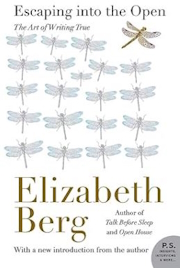
3. Escaping into the Open: The Art of Writing True – Elizabeth Berg
This has recently become one of my favorite books on the writing life. One great quote:
I believe that fiction feeds on itself, grows like a pregnancy. The more you write, the more there is to draw from; the more you say, the more there is to say. The deeper you go into your imagination, the richer that reservoir becomes. You do not run out of material by using all that’s in you; rather, when you take everything that is available one day, it only makes room for new things to appear the next.
2. Big Magic – Elizabeth Gilbert
Gilbert is one of the best writers of her generation, so it makes perfect sense that she would write one of the best books ever on the creative process. While not limited to the literary arts specifically, Big Magic is a meditation on how any kind of creative art is a kind of inexplicable, real magic. It has to be nurtured, defended, shared, and—above all—respected.
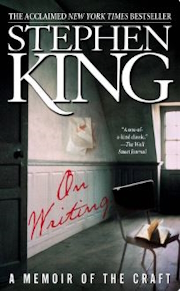
1. On Writing – Stephen King
As one might expect, this is my favorite of all the books on this list, and the one I find myself re-reading. Stephen King is a master, and his is the most entertaining and trenchant book on this list. Part is devoted to practical matters like plot, description, dialog, etc., while the rest is a very compelling memoir.
Back in the late 1980s, INXS bestrode the rock world like a colossus. Their most successful album, Kick, came out in 1987 and included such minor classics as “Never Tear Us Apart” and “Need You Tonight”. But I had already been a fan for years by that time, having gone through high school listening to their earlier hits, especially their first major one, “Don’t Change.”
When the Grunge phenomenon hit in the 1990, INXS pretty much disappeared from the premier stage. The band’s popularity dropped off, and lead singer Michael Hutchence killed himself in 1997, just three years after Kurt Cobain, the frontman for Nirvana (the band most primarily responsible for INXS’s displacement) did the same.
I really, really wish he hadn’t.
“Don’t Change” is one of the best rock songs of the 1980s. I remember clearly the first time I heard it, standing in a bookstore here in Gainesville, Florida. (Yes, that’s right—I first heard it a bookstore. I am that kind of nerd.) And even through the tinny, five-dollar speakers that had been installed in the shop’s ceiling, I picked up on the soaring lyricism and heavy rock beat of the song. And I was instantly a fan.
Enjoy…
BONUS!!! Here’s a surprising (and surprisingly moving) cover by The Boss…
One of the first books I ever checked out by myself from the library was Ray Bradbury’s The Illustrated Man. I was a tween-aged sci-fi nerd at the time (as opposed to a middle-aged sci-fi nerd now), and this book started my life-long love affair with Bradbury’s fiction. More magical realism than actual sci-fi, his work always evokes a sense of the wonder I first felt when reading great science fiction.
Like Bradbury’s other masterpiece, The Martian Chronicles, this book is actually a “fix-up”—a collection of previously published short stories that are grouped together by a framing device. In this case, the “frame” is an unnamed drifter and former carnival worker who has tattoos all over his body (except for one crucial, bare spot on his upper back; you’ll have to read it to find out why). If you stare at any of the tattoos long enough, it comes to life and shows you a story—which leads directly into the short story in question.
It’s a very clever idea, and hauntingly rendered. Some of the more famous stories in the collection are “The Veldt,” “Zero Hour,” and (my favorite) “The Long Rain.”
The cover for the book’s first edition, by artist Dean Ellis, is still the best, and is also the one on the edition I checked out from the library, lo those many years ago. A work of trippy surrealism, the man in the painting does not look like the character in the book (who is flabby and middle-aged and has hair) but it captures brilliantly the sense of intellectual lyricism and magic, of which Bradbury was a master.





 Ash Clifton, Writer