In his amazingly good sci-fi novel, The Peripheral, William Gibson describes a environmental cataclysm called The Jackpot. The name is perfect, in that it evokes not a single-cause catastrophe but rather a horrific alignment (like the diamonds on a slot machine) of multiple ones. Global heating. Drought. Pollution. Pandemics. Poverty. Et cetera.
But, as is ruefully noted by the protagonists of Gibson’s novel, The Jackpot hit at almost the same time as a technological revolution (actually several revolutions) that might have avoided it. Geoengineering. Nanotechnology. Artificial Intelligence. Fusion power. Genetic engineering.
All of these fields are exploding, right now, in the early 21st Century. That’s why I’m guarded optimistic about humanity’s chances of surviving the next fifty years. (Note that I said “surviving”; it’s going to be incredibly challenging, and will involve great suffering and sacrifice.) Many environmentalists scoff at this kind of optimism. There is no technological silver bullet, they warn, that will get us off the hook.
And, of course, they’re right. There is no big silver bullet. But there might be a lot of small silver bullets that, if aimed precisely (have I tortured this metaphor long enough?) might at least blunt the looming crisis.
After all, we’ve been here before. In the mid-20th Century, scientists were warning that current agriculture techniques would not be sufficient to feed the booming post-war population of Earth. A global famine was almost inevitable. But it didn’t happen. Why? Well, in a word, we innovated our way out of it. Improved science resulted in the so-called Green Revolution, which allowed farmers to feed millions more people on the same amount of arable land (which they continue to do to this day).
So, I like to collect articles about possible new “revolutions” that might help us survive, and even thrive, in this century. Here is an article for The Guardian about how scientists are manipulating natural enzymes to break down plastic into basic nutrients (i.e., food). Yes, plastic into food. Will it pan out? Will it be scalable? I don’t know. But it gives me hope.
When I was in college in the 80s, there was only one dance club in town that didn’t play the usual top 40 pop music. It was a little joint called My Friend’s Place, and it wasn’t actually in town, but rather out in the county between Gainesville and Hawthorn. We called it MFP, and every Friday and Saturday night around 10:00 we would make the long drive down Hawthorn Road to where alone sodium lamp marked the entrance. MFP was really just an old warehouse that some enterprising folks had converted into a club, and the dance floor wasn’t much bigger than a squash court. But my friends and I whiled away countless hours doing our best Alt-Rock dance moves, (weight on the heels, shoulders tilted back, smug expression on the face, arms doing the wavy thing down by the waist, etc.; ahhhh, it was great). The Smiths, The Cure, The Violent Femmes, ABC, XTC, Killing Joke, The English Beat and even a little U2 were blended into the mix by the unseen DJ.
It was an important era in my life, and the most iconic song from it was Lips Like Sugar by Echo and the Bunnymen. The Bunnymen were so cool, so slick, so melodic, and so dark that they weren’t just a Great Alt-Rock Band. They were a Great Alt-Rock Band’s Great Alt-Rock Band. I think that Lips like Sugar, along with The Smith’s How Soon is Now, are the two greatest songs of the genre.
I find it ironic that, here in America, we have only two socially acceptable ways to identify ourselves with regard to religion: you’re either a believer, or an atheist.
Yeah, this is crazy. For all kinds of reasons.
We all know that the first category—believer—really describes a vast spectrum of religious faith, from rigid practitioners of an orthodox religion (which, in the U.S., probably means some brand of Christianity or Judaism), to non-practicing believers (i.e. lapsed Catholics, lapsed Jews, etc.), to people who believe in God but don’t correspond to any formal religion (we had a whole class of such people in the middle of the 19th Century—the Transcendentalists.)
But what most people fail to realize is that the category of atheism also includes a spectrum, one that is almost as broad and diverse as the believer category.
I love Stephen King. I watch his interviews and lectures on YouTube, and I re-read his book, On Writing, once or twice a year, finding it one of the best meditations on the craft around, not to mention a very fine memoir. I follow him on Twitter (er…X), and you should, too (he’s @StephenKing, if you’re interested).
And yet, in one of the stranger ironies of my adult life, I went over twenty years without reading a King novel. Sure, I once devoured books like The Stand and Firestarter in high school, but then I became an English major and, for a multitude of reasons, I stopped.
(Author’s Note: The recent tragedy in Maui got me thinking about one of my favorite novels of the past twenty years, The Descendants, which is set nearby. I am reposting this essay about it as a kind of semi-tribute.)
Even though I fancy myself a literary fiction writer (even when I’m writing detective or sci-fi novels), I don’t read that much literary fiction. I read a ton when I was young, especially in college, and lately I’ve found it difficult to find novels that don’t seem derivative or poorly imagined or just downright silly. And for those rare books I do find engaging, I often arrive at them in circuitous ways.
Take Kaui Hart Hemmings’ celebrated novel, The Descendants. Like a lot of books I read, it became known to me from a movie adaptation, although, strangely enough, I didn’t actually see the movie. I was on a flight to Europe some years ago, on an older model jet that still had drop-down movie screen, and the in-flight movie was The Descendants. I didn’t pay for the earphones, but even as a silent film it looked interesting, with George Clooney skulking about some lush tropical landscape that I somehow knew was Hawaii. I looked the movie up on Imdb.com and found that it was based on a novel, so I looked that up. It was a debut novel and looked the kind of book I might like: a literary story, told from a single point-of-view, with relatively few characters, a vivid setting, a compressed time-span, and an intriguing premise.
So, I checked it out on Overdrive. And, man, was I lucky I did.
Down here in Florida, we know a thing or two about hurricane preparation. So, for all my friends out on the west coast about to face down their first-ever hurricane, I thought I’d offer my personal short list of things to do and have on-hand before the storm hits.
Water (obviously). Bottles. Buy a big (like a disperser sized) bottle if you can’t find any smaller ones.
Bleach. You can use this to treat water if you know what you’re doing and don’t poison yourself. You can also use it to help wash dishes.
Flashlights/Lanterns/Candles. Duh.
Charge everything. Cell phones, laptops, tablets. If you have an external or backup battery (I like camping batteries), change those, too.
Gas up your car. I don’t care if you aren’t planning on bugging out. Gas will be short for a week or two. Plus, you can use your car to recharge your phones, etc.
A radio. Yes, an honest-to-God, battery powered radio. If you don’t have one, download an app to turn your cell phone into an FM receiver. (You’ll need wired-headphones, however.)
Canned food. Beans are great. Soup is great. Anything you can cook on a grill is great. Also, sardines, tuna, etc are good to eat cold (buy crackers!).
A barbeque grill. You can use this to make coffee if nothing else.
Charcoal.
A coffee pot you can use on the grill.
A deck of playing cards. (Trust me.)
Board games.
While you have power, freeze as many water bottles/jugs as can in your freezer. The more your freezer resembles a solid block of ice, the longer your food will stay good.
Freeze a cup of water and leave it in the freezer. Once it’s frozen, drop a quarter on top. This will let you see how much your freezer has thawed after the fact.
I started binge-reading science fiction when I was in 8th grade. That was the year that the local school board rezoned the kids from my White, suburban neighborhood to attend the largely Black, urban middle school, Lincoln, across town. This was a miraculous development for me because I had already attended Lincoln (back when my parents and I still lived in the ‘hood, or thereabouts), and I already loved it. But there was a downside—I had a really, really long ride on the school bus. Like almost an hour each way.
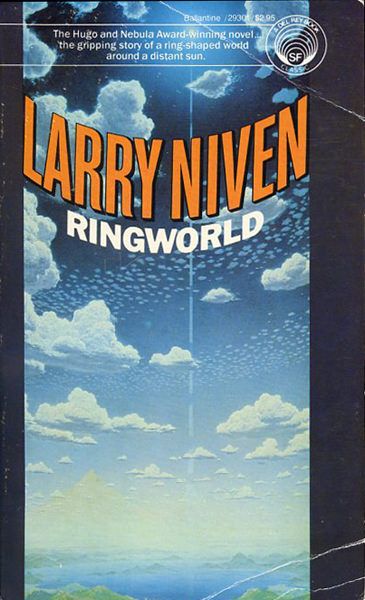
So, I started reading seriously, and as with a lot of boys at that age, my go-to genre was sci-fi. I read a lot of Arthur C. Clarke and Ray Bradbury and John Christopher. But perhaps the most revelatory, amazing book I had read up to that time was Larry Niven’s Ringworld. Never had a novel held such wonder for me, such a Tolkienesque landscape of adventure and possibility. The fact that Niven was able to pull this off in a book which is, even today, a prime example of so-called “Hard SF,” in which every story element must be grounded in, or acknowledge the effect of, some scientific principle.
The fact that Niven’s novel (the first of a tetralogy) has never been adapted to film is perhaps testament to this fact, the book’s off-the-chart nerd factor. Set in the 29th century, the story concerns an Earth-man, Louis Wu, who goes on adventure with two aliens and a human woman to visit a distant, recently discovered artifact called the Ringworld. It’s basically a giant, taurus-shaped space colony, so big that it wraps completely around its sun-like star. The entire ring spins to simulate 1G of gravity, and thousand-kilometer high mountains along the rim keep the air from leaking out. An inner ring of smaller, checker-box squares creates a shadow pattern on the inside of the big ring, creating a day/night cycle.
And there you have it, a plausible sci-fi world with normal gravity and a recognizable biosphere, including oceans, forests, deserts, mountains, and so on, but with an unbroken surface area equivalent to three million earths.
Oh, how this idea fired my thirteen-year-old imagination. Forget Shangri-La or Cathay or Edgar Rice Burroughs’s Mars or Middle Earth or any of the other fantasy lands of pre-1970s literature. Here was an endless realm that you could explore for a million years and never reach the end of. And, sure enough, as Louis and his alien comrades (one is a humanoid, Tiger-like creature called a Kzin, the other a two-headed cowardly alien called a Puppeteer) wander across the Ringworld, they encounter many of the tropes of 19th century adventure lit, including castles, galleons, savage tribes (including sexy native girls), shamans, sword-wielding heroes, etc. Niven accomplishes all this by establishing that the once high-tech inhabitants of the Ringworld have long since fallen into a pre-industrial state, leaving open the mystery of how this apocalypse happened and what remnants of the original civilization might remain, if any.
It’s a great, great adventure book, and it has inspired a number of fine covers. My favorite is the one above by Don Davis. Davis was in some ways an inspired choice since he was best known as a “space artist,” doing representations of proposed space colonies for NASA. (And, as I said above, the Ringworld is basically a giant space colony.) Davis’s cover captures the sense of wonder and endless possibility that novel creates, depicting a typical (summer-like) day on the Ringworld. In the distance, you can see the arc of the ring itself (the primitive inhabitants think it is an “arch”), complete with light-and-dark sections from the shadow squares.
It’s a fine cover, and I have no doubt that it and the book itself probably inspired the current obsession on the part of certain high-tech billionaires with the idea of space colonies, a possibility for a kind of endless utopia in outer space. And why not? Deep down, we’re all still thirteen-year-olds. Right?
Okay, this one is kind of a no-brainer. Seven Nation Army by The White Stripes contains one of the most iconic guitar riffs since The Rolling Stones’ Satisfaction. (And, as with that song, the riff supposedly came to the artist, Jack White, in a dream).
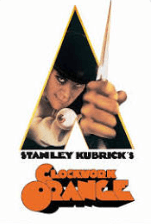
Yeah, it’s got a great riff, but I mainly like it because it feels kind of demented, the way it moves between fast and slow, loud and soft. Also, in keeping with the demented motif, the video is great. I can’t prove it, but it seems to be channeling the original poster for Stanley Kubrick’s A Clockwork Orange, which is possibly the most demented movie ever made.
Anyway, enjoy. And rock on…
Here is the Kubrick poster…
And here is The White Stripes video. You be the judge:
Recently I was enjoying a long-distance phone chat with an old friend of mine, and the conversation turned, as it inevitably does, to the weather. She lives in Ohio, I live in Florida, and yet our answers to our respective inquiries about “How’s the weather where you are” were identical: Hot AF.
Fortunately, scientists like David Keith have been telling us for years that we are not helpless in the battle against climate change. If worse comes to worst, for a few billion dollars we could deploy specialized aircraft to release particles of sulfur (or some more exotic material) into the upper atmosphere, thus reflecting enough sunlight back into space to cool the planet very quickly. Of course, as professor David warns, we have a poor grasp of what possible, global side-effects such a radical course of action might have (although one one wonders if these side-effects could be any worse than a Canada-sized wildfire or a continent-wide heat-wave in India). It is precisely because of these unknown side-effects, he explains, that we need to start thinking about the problem now, with a clear head.
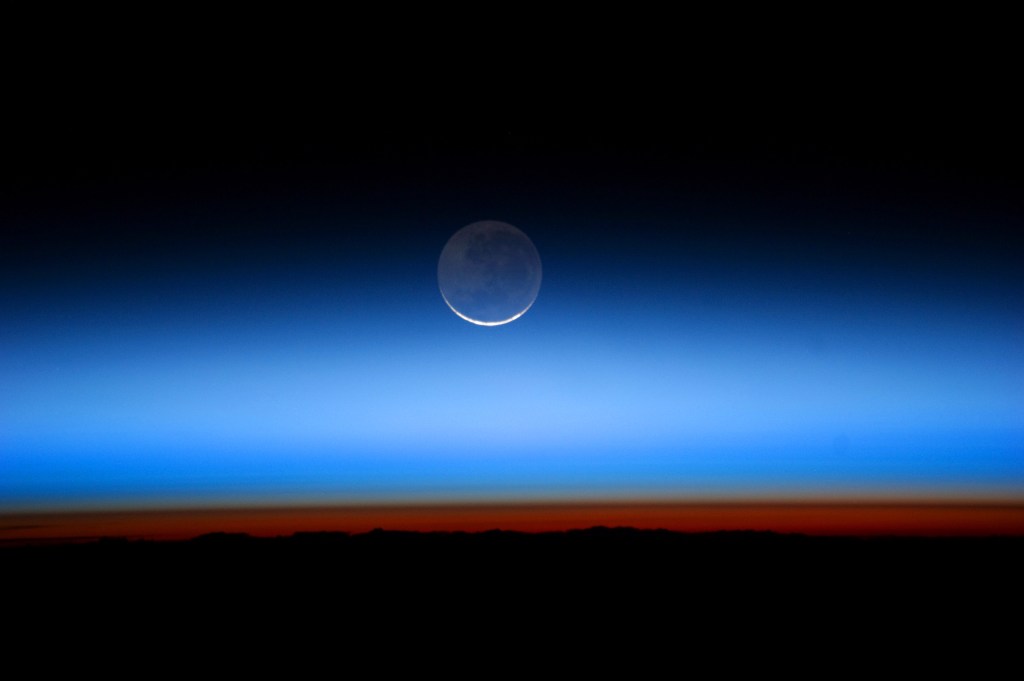
Along these lines, one of the strangest—and yet most encouraging—options to the “solar dimming” set of possible mitigation strategies is the idea that we might blast moondust into outer space. Yeah. For real. This dust, if aimed properly, would linger in one of the Lagrange points between the earth and the sun and, for a time, reduce solar radiation falling on the earth’s surface. The effect would be short-lived due to solar wind blowing the dust away into interplanetary space, but this is a good thing in that the technique would thus be throttleable. We could blast as much as or little dust as needed to cool the planet without plunging it inadvertently into a new ice age. (Have you seen that movie SnowPiercer?) Also, unlike the sulfur-in-the-sky option, the lunar dust wouldn’t contribute to air pollution or acid rain here on earth.
Obviously, the notion that we might somehow shoot lunar dust into space on a routine, industrial scale seems like science fiction. But is it? The space agencies of many nations such as the U.S., China, and Japan have planned future missions to the moon. One can imagine a gradual infrastructure of settlements, supplies, and equipment gathering on the moon over time, much as one formed in the American West in the 19th Century. One could presumably build some kind of mass-driver or rail-gun that could shoot the dust into space, and power it with solar energy. (Extra power could be stored during the two-week long lunar “day” to keep the gun shooting during the “night”).
How much would such a setup cost? Billions? Trillions? On the other hand, how much would it cost to rescue two-hundred million people from Europe if the Atlantic thermohaline circulation is disrupted, as some scientists predict it will? Or to build sea-walls around New York and Miami and San Diego and every other major coastal city? Or to feed South America if the crops there dry up during the next heat wave?
It’s time to think outside-the-box, people.
If worse comes to worst, we shouldn’t rule out going back to the moon. And building a huge cannon there. Or anything else we have to do to cool off the planet.
Here is the original article on SingularityHub where I learned about this idea:
Fifteen years ago I read Mark Harris’s excellent non-fiction book Pictures at a Revolution: Five Movies and the Birth of New Hollywood. It recounts five movies that came out in 1968, a kind of annus mirabilis of American film, a pivot point in both cinema and culture when Hollywood reinvented itself for the better.
I was reminded of Mr. Harris’s book last night as I sat in a crowded IMAX theater watching Christopher Nolan’s vaunted new film, Oppenheimer. It is, of course, a terrific movie on almost every level: technically, visually, dramatically, and, yes, historically. Moreover, it marks the second very good movie I’ve seen in the last month (Wes Anderson’s Asteroid City was the other), and both films struck me as indications of turning-point in American movies, similar to the one Harris describes so beautifully. Both Asteroid City and Oppenheimer are gorgeous, inventive, and lyrica films—a dark, nostalgic kind of lyricism in the former, and a dark, horrific kind in the latter. Coming just a few years after the movie industry was declared dead during the COVID pandemic, this new wave of excellent films (I’m guessing Greta Gerwig’s Barbie will continue it) makes me hopeful that a new revolution is afoot.
Regarding Oppenheimer, I sat next to my son, Connor, who is also a film and history buff, and we were both mesmerized by the power of the film, but even more so by its cleverness. For a film based on a non-fiction source (Kai Bird’s fine biography of Oppenheimer, American Prometheus), Oppenheimer the movie feels like a fiction film. Unrelentingly tense and dramatic, it is almost free of exposition. Noland trusts the viewer to figure out what is going on in each scene, whether or not you’re familiar with the actual history.
I am, actually, familiar with it. I read Kai Bird’s book years ago and loved it. So, at one moment in the film when Oppenheimer reads from a sanskrit book and intones the words: “I am become death, the destroyer of worlds,” I knew that he is reading from the Hindu epic The Bhagavad Gita, and that these are the same words that would come to mind later as he witnesses the first nuclear test in the New Mexico desert. Part of Nolan’s genius, however, is to reframe this quote into a dramatic (um…actually erotic) scene, in which the character is having sweaty sex with his lover (the tormented Jean Tatlow, played with intelligence and verve by Florence Pugh). This is history done right. If you’re going to insert a famous quote by a famous man in a famous moment in history, you’re better off sneaking it into a steamy sex scene.
I don’t mean to brag—oh, who am I kidding; I totally mean to brag—but not only have I read Kai Bird’s book, I’ve read The Bhagavad Gita, too. And while I only read an English translation (unlike Oppenheimer), I gleaned enough meaning from it to know that it’s a story about a man who finds himself caught between duty and humanity, action and paralysis. Which strikes me as the central theme of Oppenheimer, too, both the man and the movie. Like Arjuna, the super-warrior hero of the Bhagavad Gita, who doesn’t want to go into battle against his friends, Oppenheimer was naturally reluctant to use his talents to create a bomb. But, from a moral and existential point-of-view, he finds himself trapped in a cosmic dilemma. As he explains to a friend at one point in the film, giving the Allies an atomic weapon would be dangerous, but giving the Nazis one would be apocalyptic.
But did he make the right choice? The question becomes even thornier when focused on the specific issue of how the bomb was first used, against Japan, an enemy that never had an atomic weapons program of its own and which was pretty much on the ropes by 1945. Personally, I have always found the question of whether or not America was right to drop the bomb on Japan to be mildly ridiculous. If we were fighting a war today in which hundreds of thousands of our soldiers had been killed fighting an implacable enemy, and if someone then told us, “We’ve got a bomb that will insert a colony of mutant spiders into country X, and those spiders will eat the face off everyone there, soldiers included,” I’d probably say, “Drop the friggin spiders.” This was essentially the decision Oppenheimer himself reached when advocating for the use of the bomb on Japan (an event he eventually celebrated, as is shown in the film’s most chilling scene).
But the best thing about Nolan’s film is that it never descends to this level of after-the-fact, arm-chair quarterbacking. Indeed, through Oppenheimer’s own hallucinations and fever dreams about a potential World War III, it makes clear that the decisions made in 1945—like the cosmic forces they unleashed—surpass ordinary human judgment, if not human understanding. Was Oppenheimer right to lobby for dropping the bomb? God knows. Perhaps not even Him.