If you’re a liberal-arts nerd like me who thinks about culture all the time, you have probably pondered this question: why do people remake movies, but not books?
Yeah, I know. On the surface, this seems like a silly and even naive question. Movies, after all, are a popular medium. They belong primarily in the category of the performing arts, like theater and ballet and classical music. And, as we all understand, no one over ever gives the “final” performance of Hamlet or Don Giovanni or The Jupiter Symphony. Yes, there are certainly “classic” performances of all these works—some of them, made in the past century, have been recorded for the ages—but none is ever the last performance. Each generation must have its own Hamlet, Don Giovanni, etc.
I was surfing the YouTube this morning when I stumbled upon this really cool video essay about the (diminished) immersive experience of modern films as opposed to old, classic ones. The author echoes some of the ideas I sketched out in a similar post from a few years ago called Whatever Happened to Open-Form Films?
Please check-out the video and the post if you are interested.
I must admit that I had never heard of Awolnation until a few years ago when my son played me a couple of their songs. This song, in particular, has a big, anthemic sound of the sort one doesn’t hear very often in alt-rock. I really like it. Even the soft parts sound really, really loud. And lead singer Aaron Bruno has the vocal range to pull it off without sounding like he’s screaming.
“Passion” is from Awolnation’s 2017 album Here Come the Runts. Rock on…
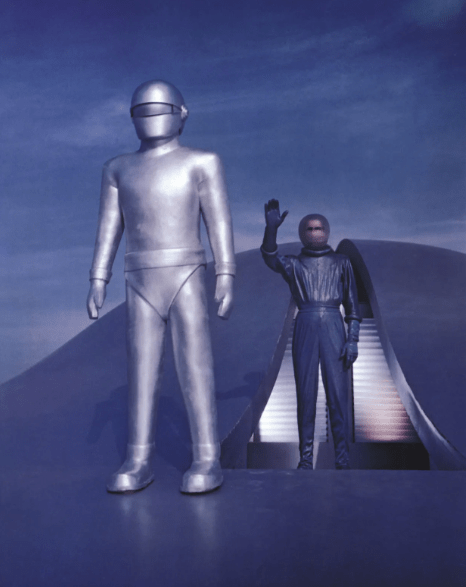
Well, over a week has passed since Halloween, and I’m still working through the classic horror and sci-fi movies that I rewatch every year around this time. One of my favorites (heck, one of everybody’s favorites, as far as I can tell, assuming that everybody is a nerd of a certain age) is Roger Wise’s 1951 classic The Day the Earth Stood Still (henceforth, TDTESS). Here are ten things I love about it….
1.) The Opening
This movie doesn’t dick around. It opens with the frantic calls of radar operators across the globe tracking an ultra-fast UAP as it enters the earth’s atmosphere. Word leaks out to press, generating a world-wide media frenzy—the “media,” in this case, being radio. Wise cast several then-famous, real-life radio broadcasters to play themselves, and I simply love hearing their great, precise modulated voices as they simultaneously try to inform the public without causing panic. It’s hard to believe there was ever such a time when journalists were so revered and appreciated, with good reason.
2.) The Music
From the title sequence onward, the film makes great use of Bernard Herrmann’s brilliant score. Hermann notably employed electronic instruments, including a kind of stone-age synthesizer called a theremin. It’s the theremin that gives the score that haunting, weird quality that has since become synonymous with atomic-era sci-fi movies.
Speaking of atomic-era stuff, this leads me to my next item…
3.) Analog technology
I don’t know why, but I am fascinated by how the movie gives the viewer a glimpse—almost a cross-section, really—of the analog technology of the day. We see radio transmitters, of course, but also phone switch boards with dozens of (women) operators frantically switching lines, and people yelling into telephones. And, of course, we have all the accoutrements of World War II, which was still a recent event: tanks, jeeps, motorcycles, rifles (yes, rifles). There is something soothing about all this old-fashioned stuff, especially when it is contrasted with….
4.) Singularity Technology
When the UAP finally lands (in Washington D.C., naturally, near the Capitol), we see that it represents a kind of futuristic tech that is the diametrical opposite of the local analog, atomic-era tech. The ship is all smooth silver metal until a seam appears, and the seam opens smoothly to allow a ramp to extend. A door forms in the same way, and the alien pilot Klaatu (Michael Renne) emerges, dressed in a silver suit and a helmet that, one assumes, is made of the same silver metal. All of this seems magical, even now, and also presages the later sci-fi tropes of nanotechnology, lasers, force-fields, atomic energy, computers, etc. etc.
Of course, Klaatu’s most impressive piece of tech is….
5.) Gort
Why is Gort so damned cool? Because he’s terrifying. As a giant, lumbering robot, he evokes the golem myth of implacable, supernatural force that has no emotions and no fear. And, with his single, death-ray emitting eye, he also reminds us of another mythic archetype—the cyclops. And in the way he suggests enormous power, barely held in check, he anticipates The Terminator films of three decades later.
6.) Michael Rennie
As with most classic, once-in-a-lifetime performances, Michael Rennie’s portrayal of Klaatu is so good that it’s now impossible to imagine anyone else doing it. With his smiling, gentle, athletic demeanor, he projects a firm but benevolent presence. He genuinely wants to help humanity escape its seemingly inevitable fate (i.e., being destroyed, either at its own hand or that of Gort). Also, he seems genuinely curious and likeable, especially in…
7.) Klaatu’s Interactions with Danny
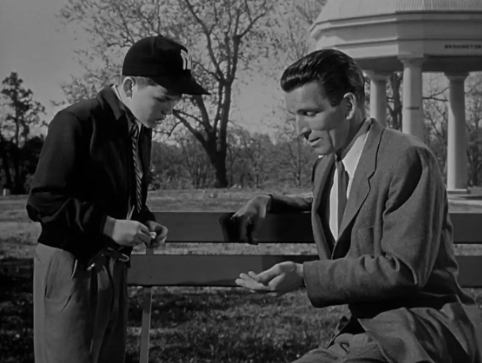
I love the scenes where Klaatu and Danny, the little boy whose boarding house Klaatu finds himself in, go on a site-seeing tour of Washington D.C. They are the emotional core of the movie. After all, in our world, Klaatu is very much like a little boy himself. His sense of wonder is almost as strong as Danny’s.
8.) Patricia Neal
Instead of casting some bombshell scream-queen in the role of Helen, Danny’s mother, Wise chose the formidable and mesmerizing Patrica Neal. She was a great actress who would later hold her own against Paul Newman in 1963’s Hud. As Helen, she exudes an intelligence and moral strength that not only saves Klaatu from capture and death; she saves the entire planet.
9.) How Much you Don’t See
I could write an entire post on the paradox of old thriller movies whose lack of CGI effects (TDTESS was made thirty-three years before Jurassic Park), was actually an advantage. The film is actually made stronger by how much Wise doesn’t show on-screen. That is, we don’t see how Klaatu stops all electrical stuff from working on the titular day. We don’t see Gort walking across D.C. on his way to liberate Klaatu’s body from its jail cell. You know, stuff that would be easy to render in the CGI era (and which would also be rather boring). After all, the ultimate special effect is the human imagination, which happily fills in the blanks better than any whiz-bang effect.
My favorite example of this in the film is when Danny secretly follows Klaatu to his spaceship one night. He watches as Klaatu uses a flashlight to wake-up Gort, who then knocks-out the two G.I. ‘s guarding the ship. The genius of this scene is that we don’t actually see Gort do this. We just see him lumber over to the two dudes. Then, at the last moment, the camera switches back to Danny’s horrified face as he watches the moment of (rather mild) violence. Then, the camera switches back to Gort as he stands over the crumpled, unconscious bodies of the soldiers on the ground. Brilliant.
10.) Multiculturalism
It’s important to remember that TDTESS is a cold-war era movie, produced at the very height of the Red Scare and its attendant paranoia and xenophobia. It also came out just a few years before the start of the American Civil Rights movie. So, I am always amazed, and even a bit moved, by how progressive Wise’s vision is. In the opening scenes, we see people from other countries—France, India, China, and even Russia—depicted in a sympathetic light, human light. At least once in the film, Wise goes out of his way to show some genuine, actual Black people in the crowd watching Klaatu’s spaceship land. (This might seem trivial, now, but it was momentous decision back then.) And, of course, the climax of the movie comes with a miniature U.N. assembly, arranged by Professor Barnhardt (wonderfully played by the great Sam Jaffe, incidentally), full of people of all ethnicities and cultures. The message is clear—it’s only by cooperation and friendship that humanity can survive. And it’s a message that is just as relevant now as it was back then, perhaps even more so.
See also this cool post from another blogger (from whom I stole one of the screenshots above)…
A lady I follow on Twitter named @johnstonglenn posted earlier that on this day in 1925, the famous Welsh actor Richard Burton was born. Yes, this would have been the great man’s 100th birthday.
I’ve written about Burton a lot on this blog (see links below), and so I thought I would share this bit of trivia. A fabulously gifted Shakespearean actor, Burton had the second-greatest voice in Western theater (after James Earl Jones, who had the very best). But Burton wasn’t just a great voice. He was a deeply intelligent man who brought enormous power to every part he played. And soul. Lots of it. (He was a bit like Viggo Mortensen in that last regard, actually). If you’ve never seen a Burton film and are looking for a good one to start with, I recommend 1965’s The Spy Who Came in from the Cold. A snippet of it is shown below.
Author’s Note: There has a been a lot of really cool UFO news lately (especially this article), so I thought I would re-share an old post I wrote some years ago regarding a fine book on the subject. Enjoy!
From 1989 to 1992 I went to graduate school at the University of Arizona. This was around the same time that Fife Symington was elected governor of that fine state. I don’t remember having any opinion of Symington at the time, except that he seemed a man very much in the mold of Arizona politicians: a conservative, folksy cowboy.
So it was probably not that big of a surprise when, six years later, Symington handled an unusual political crisis in what many saw as a callous, flippant way. The crisis in question was a UFO—literally, an unidentified flying object—that was spotted by hundreds of people in the Phoenix area on the night of March 13th, 1997. The incident, which has since become known as The Phoenix Lights UFO Incident, resulted in dozens of 911 calls and hundreds of letters being written to the governor. Eventually, Symington was forced to hold a press conference about the event, in which he essentially laughed-off the whole affair. (One of his aides came to conference dressed as a green alien. Hilarity ensued.)
Ever since the paperback edition of my mystery thriller book, Twice the Trouble, came out in August, the price of the hard-cover edition has dropped through the basement. That’s bad for me but good for you (assuming you like hard-cover mysteries). It’s currently on sale for $6.00. Yes, that’s six Ameroes. Cheap!
It would make a great Christmas gift. I’m just sayin…
There have been a lot of great rock duos over the years—Hall and Oates, Tears for Fears, The White Stripes, David and David—but there haven’t been that many hard rock duos. I’m guessing this because you typically need a minimum of three musicians to form a hard rock band: a drummer, a bassist, and a lead guitarist. (One of those folks has to sing, too, obviously.)
The great British duo Royal Blood gets around this minimum by ditching the lead guitarist and having their bassist, Mike Kerr, do double-duty. On this little gem, which has become one of my favorites, he is actually playing a distorted bass that sounds like a lead guitar. (Jack White does the same thing on “Seven Nation Army“.)
I recently learned that this year’s Nobel Prize in Physics went to a team of scientists who conducted experiments on quantum tunneling. Their experiments were conducted in the 1980s, which is typical of how the Nobel committees work—it takes around thirty years for a scientific consensus to build that a body of work was truly worthy of a Nobel Prize.
I was interested in this news because, like most sci-fi nerds, I have an unflagging fascination with quantum mechanics. Heck, I even have a passing understanding of the fundamentals. (No, not just from Star Trek; I’ve read a few actual books! With facts, and stuff!) A few years ago, I even tried to write a non-fiction book about Bell’s Theorem, which is a famous consent in Quantum Mechanics, albeit one that you’ve probably never heard of (unless you’re a physicist or a science teacher or a sci-fi nerd).
John Stewart Bell (copyright CERN)
To be frank, I had never heard of it either, until I read about it in a science book and then ventured to the Wikipedia page, where I learned that the theorem was written by an Anglo-Irish physicist named John Stewart Bell in the 1960s, and it hit the scientific community like a hurricane. Later, in 1975, another physicist Henry Stapp called it “the most profound discovery of science.”
When I read this quote, I thought, “Whoa, dude! If it’s really the most ‘profound discovery of science’,” I should probably learn something about it.”
And I did. Sort of.
Obviously, I will never really understand the underlying math, or even the root concepts that the math represents (which is one reason I abandoned the aforementioned book project). But the theorem itself is pretty easy to understand….
Author’s Note: I first posted this essay a few years ago. I’ve decided to repost it now due to some recent interest.
When I finally watched Todd Field’s 2022 movie Tár, starring Cate Blanchett. I really didn’t know much about the film, except that it had been well received (Blanchett received an Oscar nomination) and that it was about a female orchestra conductor named Lydia Tár. From this scant information, I assumed it would be a worthy but standard drama about a woman artist’s struggle to thrive in a male-dominated world.
Boy, was I wrong! Tár is a great movie. So great, in fact, that I became temporarily obsessed with it, so much so that I tried to figure out what the name Tár means. I ran it through Google translate and got a hit: tár is Icelandic for tear (the verb, as in “to tear to shreds”). I don’t know if this was Field’s intention, but it fits well—Lydia rips everything and everyone around her to shreds. And in the last part of the film, she faces an almost literal tear in the fabric of reality.
Put simply, Tár is a monster movie. Lydia is the monster.
French intellectual Charlotte Aïssé is credited with saying, “No man is a hero to his valet.” This is certainly true for the character of Francesca (Noémie Merlant), Lydia’s apprentice conductor, personal assistant, a general factotem. As one would expect, Francesca knows all the skeletons in Lydia’s closet. And there are a lot of them. Lydia Tár, we soon learn, is a bit of a sexual predator, in the Harvey Weinstein model. She uses her influence and fame to seduce young women in her orchestra, then keeps them silent with threats. When one of her former conquests, Krista, commits suicide (she was depressed because she couldn’t get another orchestra job; Lydia made sure of this by writing bad recommendations for her), Lydia orders Francesca to delete all their emails regarding the matter. Thus begins the intrigue that will constitute the main action of the film.
But Tár is not just a clever twist on the #MeToo movement narrative, or a meditation on the corrosive effects of fame. Rather, it’s more like a descent into hell, albeit a coldly beautiful version. Filmed in desaturated grays and blues, the first two acts reminded me of Stanley Kubrick’s Eyes Wide Shut, in its brutal, almost clinical exploration of intellectual high culture (transposed from Manhattan in Kubrick’s movie to Berlin in this one). Lydia is shown as an ultimately tragic character, a female MacBeth—brilliant, gifted, and strong but hopelessly in thrall to her ambition and darker impulses.
In other words, she is a nasty piece of work, sadistic to her enemies and overbearing to her friends. (And that’s without even considering her sexual predations.)
But it’s in the final act that the movie really becomes something otherworldly. When Lydia’s misdeeds finally catch up to her, and her carefully controlled world of power and influence begins to unravel (to tear apart, as it were), the film’s tone and pacing becomes less like Eyes Wide Shut and more like Nicholas Roeg’s Don’t Look Now. Both films climax when the main character locks eyes with an even greater monster (literal, in Roeg’s horror masterpiece; metaphorical in Tár), one that manifests the hitherto unseen evil of the story.
In fact, the last third of the film can be read as a supernatural horror tale, complete with ghosts, as Dan Kois does in his excellent essay for Slate. I would go even further and suggest that the entire move is best interpreted as a David Lynch-style surrealist nightmare. A descent into hell.
I’ve often thought that if hell exists, it’s probably not eternal, and it’s probably not a lake of fire. My bet is that hell looks almost exactly like earth, and the people trapped there do not know they’re in hell. Instead, they are forced to re-commit their sins over and over, but with a twist: this time, the victims get revenge.
Regardless of how you interpret it, Tár is a great movie. Check it out, if you dare…










 Ash Clifton, Writer