
Many thanks to Cara Putman for interviewing me on her excellent Book Talk podcast. She’s a great writer and interviewer and I’m very grateful. Please check it out.
What We Talk About When We Talk About “Theme”
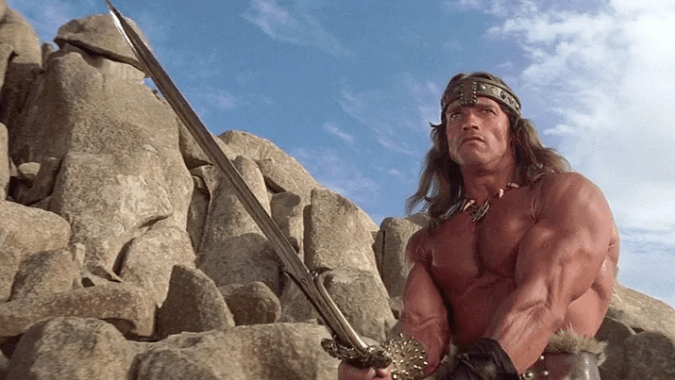
As I was working on a recent post about the great sci-fi and fantasy movies of 1982, I re-read the Wikipedia page on one of those films, Conan the Barbarian. It’s a great movie, despite the fact that it’s really just a raunchy, gory, over-the-top B-movie with an A-movie budget. I loved it when it came out, as did millions of others. It was, in fact, a culturally significant film, in its own way, and the Wiki page reflects this. A lot of passionate, obviously smart people have contributed to the page over the years. (Wikipedia is, imho, the single greatest triumph of the internet, but that’s a subject for another post.)
Of course, the page inevitably includes a rather insightful section called Themes, in which people have enumerated the topics that the film explores—or at least seems concerned with. These include “The Riddle of Steel,” “Death,” “Wagnerian Opera,” “Individualism,” and “Sex.”
I’m sorry, but “Sex” is not a theme of this movie, nor any other. Neither, for that matter, is “Death.” It’s a topic, surely, perhaps even a motif. (Note that I’m using the word “motif” in its strictest, compositional sense, as it is referenced in musicology.) But it’s not a theme.
Yeah, I know. I’m being a bit of an English-major-snob on this one. A word-Nazi. But bear with me, please. If you’re a person who really tries to appreciate literature, either on the page or on film, then the distinction between theme and motif is important. It’s even more important if you’re a fiction writer who struggles to create books that have some meaning and not mere entertainment that is purely disposable. Not that there is anything wrong with fiction that is mere entertainment—entertainment is great—but let’s not kid ourselves that it’s the pinnacle that people should aim for.
The film’s Wiki page comes much closer to the idea of a real theme when it discusses “The Riddle of Steel” (although it completely mischaracterizes and misinterprets the real matter at hand). As anyone who has seen the movie knows, The Riddle of Steel is a connundrum—not so much a riddle as a philosophical question—that Conan believes god will ask him when he dies. The question goes something like this: “Which is stronger? The sword, or the hand that wields it?” Or, put another way, “Technology? Or willpower?” “Brute force, or the power of conviction?”
It’s actually a pretty deep question, especially when one considers that film’s original script writer, Oliver Stone (who later went on to direct a few films, himself) is a veteran of the Vietnam War, which surely represented one of the greatest struggles of all time between technology, on the American side, versus sheer determination and courage on the North Vietnamese side. (Please don’t write to me and tell me that determination and courage were displayed on both sides of that tragic war. I realize this, and I am over-simplifying the conflict for the sake of argument.)
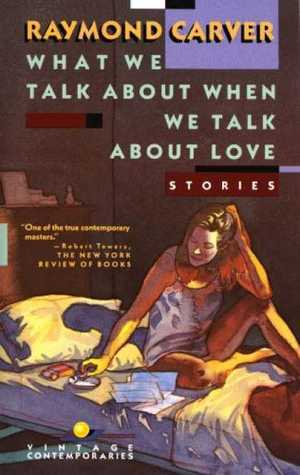
This posing of a philosophical and moral question, which the hero of the film (and, thus, the viewer) struggles to answer is, to my mind, the real definition of a theme. Perhaps the supreme example of this questioning is Raymond Carver’s classic short story, “What We Talk About When We Talk About Love,” in which three couples—all in late middle-age, all alchohic, and all jaded—discuss the definition of “love” over drinks. It’s a great story, not just because it captures the individual voice and attitude of each character, but also because all of the characters seem to be genuinely struggling with something—a matter of real import that, each one senses, will reveal something about their own lives. As one might expect, each character has their own story to tell about the subject, beginning with this one from a woman named Terri.
Terri said the man she lived with before she lived with Mel loved her so much he tried to kill her. Then Terry said, “He beat me up one night. He dragged me around the living room by my ankles. He kept saying, “I love you, I love you, you bitch.” He went on dragging me around the living room. My head kept knocking on things.” Terri looked around the table. “What do you do with love like that.”
She was a bone-thin woman with a pretty face, dark eyes, and brown hair that hung down her back. She like necklaces made of turquoise, and long pendant earrings.
“My god, don’t be silly. That’s not love and you know it,” Mel said. “I don’t know what you’d call it, but I sure know you wouldn’t call it love.”
The story continues around the table, with each character telling their own story about the general subject of “love.”
In Carver’s supremely able hands, each of these stories is shocking, yet rings true. Completely, brutally true. Some of them are also funny as hell, in a gallows-humor sort of way. One of the greatest things about the story, though, is the way it never gives us a definitive answer to the question it asks. To the contrary, the story raises even more questions—deeper meta-questions that the characters, themselves, are unaware of but which we, as readers, are. Is there a single definition for love? Is that question even meaningful? Does love even exist, really, in the cosmic sense? Does it matter?
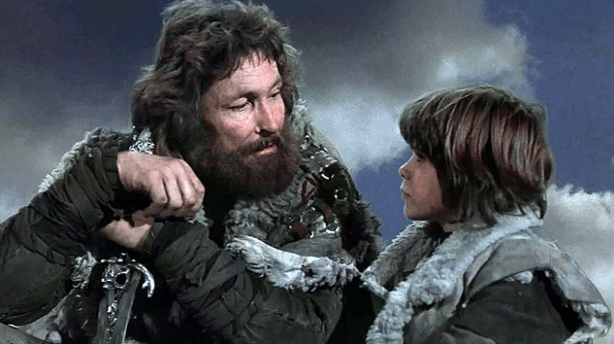
In the same way, Conan the Barbarian presents its hero with several possible answers to its central thematic question. The first is given by Conan’s father (played by the great character actor William Smith) in the opening scene, where he tells the young Conan that the one thing he can ever depend on. “Not men. Not women. Not beasts. This,” he says, gesturing to a sword he has just forged. Of course, he is not talking about that particular sword, or even swords in general. He is, we sense, talking about all the intangible things for which the sword is a symbol—discipline, training, courage. The martial ideal.
Later in the film, the villainous Thulsa Doom presents Conan with another answer. In that famous (and surprisingly shocking, even now) scene when he beckons one of his followers to literally jump off a cliff, he suggests that control over the human mind—through dogma, religion, and all the other tools of tyrants—is far more powerful than strength of arms, either literal or metaphorical.
So, which of these answers does Conan accept. Neither! In fact, his tale seems to suggest a third answer, one which is never articulated—never explicitly told—to either Conan or the viewer, but is rather born out by the action of the narrative. The answer, simply, is love. It’s Conan’s love for his murdered parents that sustains him through the ordeal of slavery and drives his desire for revenge. He also loves his friend, Subotai, and he comes to love Valeria even though she is, initially, a rival. Later, it’s Valeria’s love of Conan (along with some help from Subotai) that saves his life after they rescue him from the Tree of Woe. And it’s Conan’s grief over the death of Valeria that causes him to go on his final (foolhardy) confrontation with Thulsa Doom, where he uses his father’s broken sword (note the symbolism, there; steel really isn’t that strong, after all) to behead the man.
I think it is important to note that even in a “silly” genre movie like Conan the Barbarian, good writing can add a level of thematic resonance to any work of fiction. That is, it can turn a potentially crappy movie into a good movie, and a good movie into a great movie. It’s this complexity that separates the vast majority of films (and books, for that matter) from the few we remember years later—that tiny minority that we deem “classics” after the fact.
Another thing to consider is how Conan the Barbarian, like Carver’s short story, doesn’t fully answer its own thematic question. At least, not completely. The ending is ambiguous. Yes, Conan kills the bad guy, and (we are told) ends up a king himself, but he “sits on his throne with a troubled brow.” In others, the verdict is still out on what the real answer to The Riddle of Steel is, after all.This kind of ambiguity is, of course, a hallmark of all good fiction. We, as viewers and readers, don’t get a definitive answer—mainly because the kinds of questions that good fiction asks are, ultimately, unanswerable in any objective sense. They are always about choices. Priorities. Does honor matter more, or friendship? Revenge, or love?
Friday Night Rock-Out: “In Undertow”
I don’t remember how I stumbled upon Canadian band Alvvays, but I’m glad I did. This song, really got to me. It’s one of those singles that gets labelled as “Indie Pop” or whatever, but in fact it’s just a kick-ass rock song.
Rock on…
Myopic Duplicity Audiobook!
The audiobook for MYOPIC DUPLICITY is out today. The brilliant actor Jenn Lee did the voice narration for my short story. Please check it out here on Audible!!!
And, once again, many thanks to Jeff Circle and Leonardo Audio.

Synchronicity for Bookworms: Harlan Ellison

The great film critic Roger Ebert once noted that the people we think of as heroes are those we looked up to when we were kids. As adults, we might admire a particularly talented athlete or actor or musician, but they won’t really be “heroes” to us; they’ll just be really cool (but life-sized) people.
I think that my middle-aged affection for Harlan Ellison might be a slight exception to this adage, however. I was a fan of his when I was growing up (he became famous in the 1970s with his revolutionary, sci-fi short-stories like “I Have No Mouth, and I Must Scream”), but he wasn’t exactly a “hero” of mine. Then, in the 1990s, Ellison began to appear on TV as a talk-show celebrity, especially on the sci-fi channel, where he essentially co-hosted a show called Sci-Fi Buzz, where he was often very funny and always insightful. Also, to my amazement, one of his stories, “The Man Who Rowed Christopher Columbus Ashore,” was included in 1993’s Best American Short Stories collection. I saw an Ellison interview around that time, in which related that the series’ editor called him to give him the good news. At the end of their brief conversation, she asked him if had written any other short stories—an unintentional slight that Ellison said felt like “a dagger to the heart.”
But this was typical of Ellison’s relationship to the literary world, and to Hollywood. He couldn’t get no respect. Part of this life-long diss was, surely, his own fault. He was famously abrasive and out-spoken, and hated to have his work messed with. When he wrote the screenplay for the what is generally considered the best episode of the original Star Trek series, “City on the Edge of Forever,” he hated Gene Roddenbury’s changes so much that he tried to have his name taken off the credits. (Fortunately, he failed.) In fact, he was so contentious about such matters that he had a special pseudonym, Cordwainer Smith, that he would use when he felt his work had been to mangled by studio executives that he no longer wanted his real name associated with it.
Paradoxically, the more interviews I watched of Ellison in the 1990s and beyond, the more I liked him. He had a razor wit, and he did not suffer fools easily. He could also be mean as hell when he felt attacked. But these were all characteristics I had seen before in some exceptional people I have met over the years, including my great teacher, the writer Harry Crews. I never met Ellison, but I suspect that we would have gotten along just fine.
Indeed, I came to admire even Elllison’s famously pugilistic nature. He was quick to sue anyone who he felt had stolen his ideas. Most famously, he sued Orion Pictures over 1984’s The Terminator, alleging that director/writer James Cameron had cribbed the concept from a script Ellison wrote for The Outer Limits. Orion settled the suit out of court. (Cameron later called Ellison a “blood-sucking ghoul,” which I still find hilarious.)
Clearly, Ellison knew how to defend himself and his ideas, and to get what he felt was owed to him. Much of this toughness, I imagine, came from Ellison’s early life, growing up as an diminutive Jewish kid in Ohio. Like a lot of smart, little guys, Ellison learned how to punch back, and punch hard.
After I wrote a blog post about Ellison and Isaac Asimov last year, I found myself thinking about Ellison more and more. So much so, in fact, that a couple of weeks ago I decided to write something about him, although what form that would take.
Then, in one of those moments of synchronicity that happen to writers when they immerse themselves in a subject, I stumbled upon a fact regarding Ellison that I had never read before, and it came from a totally unrelated source.
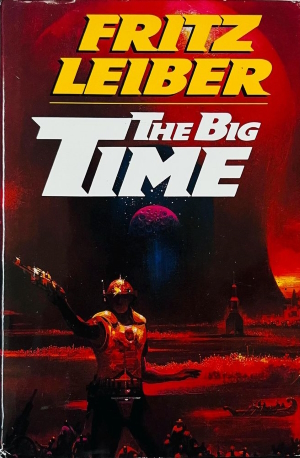
I was looking at some classic sci-fi book covers when I spotted one for Fritz Leiber’s The Big Time. I hadn’t thought of Leiber in decades (he was a favorite of a friend of mine in middle school), so out of pure curiosity I checked out his Wikipedia page. There, I was saddened to learn that Leiber spent the last few years of his life in poverty. As with so many writers, alcohol had taken its toll, and Leiber ended up living in a cheap motel. Apparently, Ellison came to visit him one day and was appalled by the state of his affairs, with Leiber not even able to afford a writing table. Rather, he was composing his latest work on a “manual typewriter propped up over the sink.”
Okay, maybe this wasn’t a good example of full-blown, Jungian synchronicity. I guess it wasn’t that unlikely that I should stumble upon a Ellison anecdote while reading about Leiber. They were both great science fiction writers, after all, and it make sense that they might have known each other. In fact, as I learned, Ellison included some of Leiber’s short stories in the Dangerous Vision anthologies that he (Ellison) edited for decades. Still, I didn’t know of any connection between the men. They were of different generations and circumstances, linked only by their genre and talent.
Unfortunately, the Wikipedia article does not cite the source of this (if anyone knows, please tell me), nor does it say what action, if any, Ellison took to improve Leiber’s circumstances. But I like to think that he did something to help. After all, he was a pugnacious, smart-ass little guy who looked after himself and other little guys. I miss him.
Here is a good interview that Ellison gave to the BBC in the 1970s.
Cool Article About William Petersen
For those of you who enjoyed my recent post about the movie Manhunter, the L.A. Times just ran this really nice article about him. Apparently, a film festival is celebrating two of his movies: Manhunter (of course) and To Live and Die in L.A.
Enjoy…

Friday Night Rock-Out: “Avalon”
Bryan Ferry turned 80 today. I bet he still has more style in his little finger than most rock stars have in their whole leg.
This is his best song, imho.
Rock on…
Book Talk – “The Dispossessed”, Part 2 of 2!
As usual, it took us a while, but Margaret and I finally posted our second (and final) book talk episode on Ursula K. Le Guin’s classic sci-fi novel The Dispossessed. I will probably be doing another post on my final thoughts about the book soon. In the meantime, please check out the videos (Part I is here) and give them a like.
Friday Night Rock-Out: “The Man Who Sold the World”
David Bowie was a musical genius. And perhaps the only bad thing about being a musical genius is the possibility that someday another genius might come along and do a cover of one your songs that’s better than the original. That’s what Kurt Cobain did, I think, with this cover, recorded in 1993 on MTV. And he was only twenty-six at the time.
Oh, well. Here, for your entertainment (and, I hope, solace) is a song written by one genius and sung by another, with some really great musicians playing along.
Rock on…
R.I.P. Robert Redford
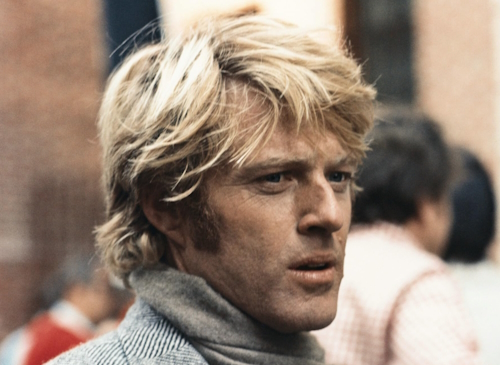
The great scholar Joseph Campbell once explained that every time we go into a cinema and see a movie star—Tom Cruise, for example—up on the screen, some part of our brains is aware that the real person, the actor Tom Cruise, is alive somewhere else in that same, exact moment. This ability to exist in two places at once, Campbell said, is an aspect of a God, a living divinity.
Our subconscious perception of actors as gods is one reason we are always surprised by the death of a movie star, especially one who has been around since we, ourselves, were kids. How could they ever die? They seem to occupy a higher plane of reality, immortal, always youthful if not actually young.
Robert Redford was surely one of the greatest movie stars of my youth, and he starred in two of my favorite films of all time, All the President’s Men and Three Days of the Condor, both of which I have written about on this blog. What made him interesting was that weird dichotomy of blond, athletic, all-American good-looks combined with a reserved, wary intelligence. (On my list of Hollywood Archetypes, he fits squarely in the “Dark Prince” slot.) He was a very smart man, who did a lot of amazing things both on-screen and off-. Among the most notable of these was his founding of the Sundance Film Festival, which has come to rival Cannes as the preferred venue for indie-film directors to premiere their movies.
The fact that Redford would create an alternative festival for “the little guys” in the film industry was typical. He was, in some ways, the most counter-cultural movie star of the last fifty years—even more so than Easy Rider himself, Peter Fonda—in that he made movies about men fighting some vast, evil establishment. Often, this was the military-industrial complex in either its actual (All the President’s Men) or its fantasy (Three Days of the Condor) form. In his later years, when Redford could no longer play the lead, he took on the role of the villain who represents this evil empire, as in Captain America: The Winter Soldier.
As a kid, I always found something soothing about Robert Redford, even in movies filled with threats and violence. I suspect that, in my mind, he represented the best spirit of my parents’ generation (he was roughly the same age as my father). That is, the young adults of the 1960s and 70s. Post-hippie, but very hip. World-weary, but not broken. Brave, but not foolhardy. Idealistic, but not naïve.
And, above all, ready to fight the system.
Godspeed, Mr. Redford…
 Ash Clifton, Writer