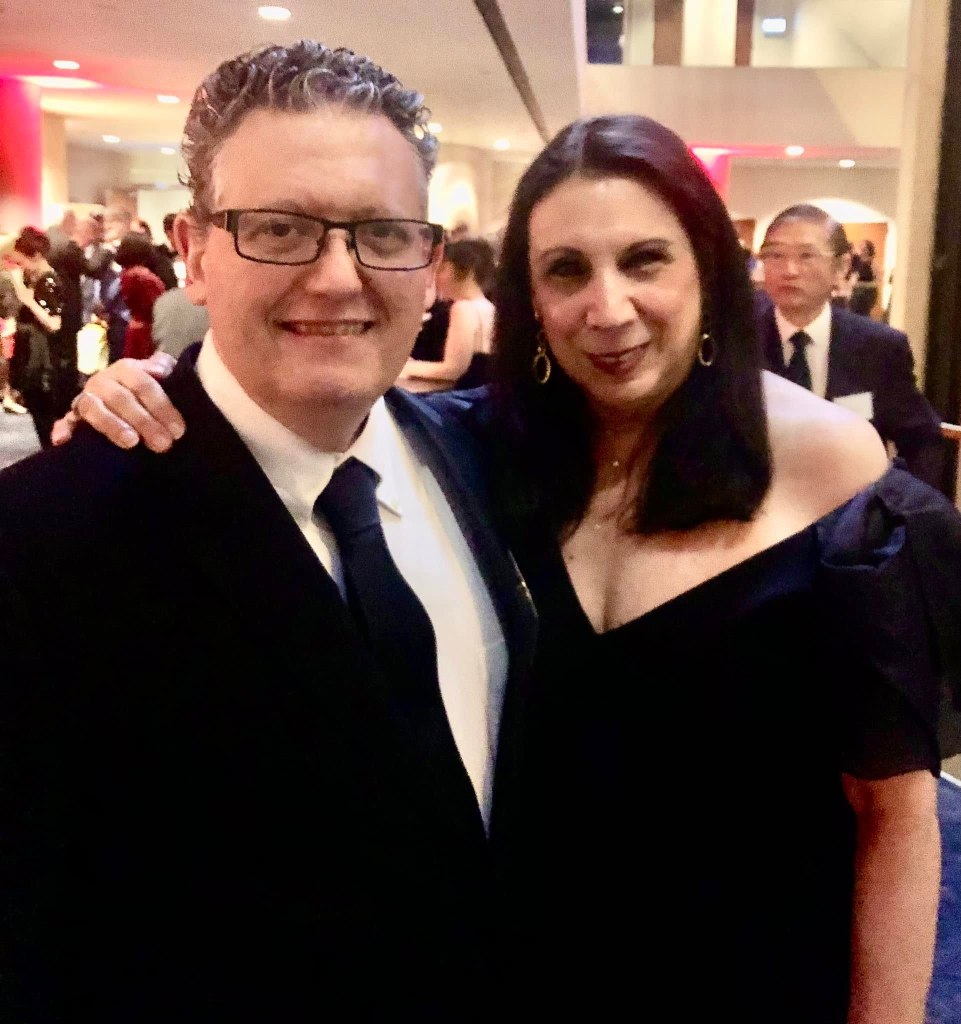
Well, the 2025 Edgar Awards Ceremony is over. I didn’t win my category (that honor went to Henry Wise for his excellent novel Holy City, but I still had a blast. I met a lot of cool people, including my new editor at Crooked Lane, Sara Henry, CLB founder Matt Martz, and others. Best of all, I made some new friends in writers Kerri Hakoda, Audree Lee, and Carol Floriani.
And, for a bonus, Cathy and I got to spend some time in the greatest city in the world, Manhattan. (I am writing this post from inside a Starbucks on 7th Ave.) I used to come here pretty often in the early 2000s, when I was working for software consulting company on Prince Street, and I always loved it. I was last here for fun in 2017 with my son Connor, doing the tourist thing. The city hasn’t changed that much as far as I can tell. It’s still a rambling, teeming, kinetic barrage of sights, sounds, and languages. Manhattan is one of the few places on earth where you can step into a crowded elevator and hear Spanish, French, German, Russian, Hausa, and several others being spoken.
It’s also got the best museum in the world, the Met, which Cathy and I visited, of course. We got to see the John Singer Sargent exhibit, with Sargent’s masterpiece Portrait of Madame X on prominent display. I first learned about this amazing picture (and the scandal it caused) from David McCollough’s excellent history The Greater Journey: Americans in Paris, in which Sargent is one of the Paris-bound artists discussed. (Sargent painted Madame X in Paris with a well-known socialite as his subject; hence the scandal.)
So, all in all, a damn fine trip so far. I don’t know if I will ever get another Edgar nom, but if I do, you can bet I will be back.
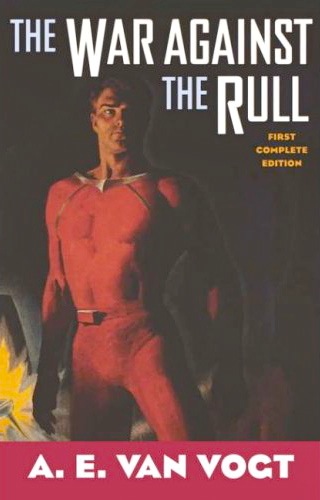
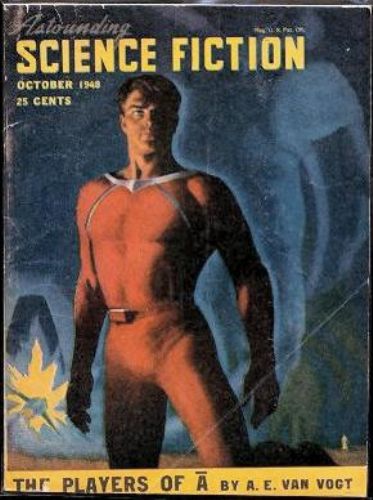
This entry in my on-going Classic Sci-Fi Book Covers series is both old and new. That is, it’s a modern touch-up of the cover from the October 1949 edition of Astounding Science Fiction painted by Hubert Rogers. That issue included a work by A.E. van Vogt, but not the one we are interested in here. This modern version is from a 1999 edition of van Vogt’s classic sci-fi novel, The War Against the Rull, which I distinctly remember devouring in two days when I was in eighth-grade.
I like this cover a lot. It’s not just a classic. It’s an archetype. Specifically, the archetype of the heroic (America) scientist, a buff intellectual and polymath whose ilk could be found in countless works of Isaac Asimov, Robert Heinlein, Roger Zelazny, and on an on. In The War Against the Rull, the man is Dr. Trevor Jamieson, a brilliant scientist who is also a fierce warrior and survival-expert. He’s stranded on an alien planet with a huge, six-legged, intelligent creature called an ezwal who wants to kill him. But when both Jamieson and the ezwal encounter a mutual enemy—a race of aggressive, centipede-like aliens called the Rull—they decide to work together to survive.
It’s a great story, like so many from the sci-fi’s Golden Age. I’ve written before about why sci-fi novels from that era are so much more enjoyable (to me, at least) than most of those written in the last ten years or so. I think it has to do with the gritty humanity of such stories. Yeah, Jamieson is essentially a comic-book character (think Doctor Quest and Race Bannon rolled into one), but van Vogt does a great job of making you believe he’s in real trouble. The ezwal, too—he’s a compelling character in his own right. You get involved in the desperate nature of their situation, and you keep reading to see how they will get out of it.
Anyway, check it out if you can…
Original Cover from AstoundingCover from the 1970 edition that I read as a kid (by artist John Schoenherr)Another version of the Scientist Hero Archetype (by artist James Bama)
Ever since Donald Trump was first elected in 2016, people have been talking about the “two Americas.” Namely, the working class, poorly educated, white, xenophobic America that voted for Trump and the middle- and upper-class, highly educated, “elitist,” multi-cultural America that voted for Hillary Clinton (and, later, Kamala Harris).
This perception of two Americas—and, indeed, of a “cold” Civil War that is currently being waged between them—is warranted and realistic. America is more polarized than it has been since the 1860s, and there is a very real possibility of the country tearing itself apart (not militarily, I think, but politically, in the same way the USSR erased itself in 1990).
However, I’m not sure we are in a battle between two Americas, per se, as in one between two worldviews. In one worldview, America is under threat of racial dilution, socialist revolution, and religious transgression, all of which will create an evil, perverse America, which its adherents would rather be dead than live in. In the other world view, America is under threat of nascent Fascism, corporatism, kleptocracy, and the climate apocalypse that will inevitably result from all these things.
As usual, the Germans have a much better word for this: Weltanschauung, a term that encapsulates the philosophical and cognitive underpinnings that define a social group or generation (or both). As an English major in the 1980s, I was obliged to read Eustace M. Tillyard’s classic The Elizabethan World Picture, which explores the conscious and subconscious belief system of Britons in the time of Shakespeare. More recently, I read Robert O’Niell’s memoir The Operator, which recounts his years as a Navy Seal fighting in Iraq and Afghanistan. In this book, he describes the weltanschauung of the Afghani locals whom he encountered, some of whom—quite literally—believed in dragons.
My privious entry in this continuing “Classic Sci-Fi Book Covers” series was also devoted to Roger Zelazny, so please forgive me for double-dipping into the Zelazny well. But I couldn’t resist talking about one of Zelazny’s other great novels, …And Call Me Conrad—published in 1966 as This Immortal. Most people have never heard of it, but it’s an interesting book for several reasons.
For one, it was Zelazny’s first novel, and it has many of his signature obsessions (e.g, ancient mythology mixed with science fiction; a wise-cracking anti-hero who is also an Übermensch; epic fight scenes; etc.). For another, it actually won a Hugo Award, tying in 1966 with a slightly better-known book…Frank Herbert’s Dune. And finally, it’s just a hell of an entertaining adventure tale.
I chose this cover (by fantasy artist Rowena Morrill) because it really captures the sense of the book’s main character, Conrad Nomikos, a world-weary man-of-mystery who might be immortal. (The text suggests that he is at least a century old, and hints that he might be several thousand years older still.) He works as director of a government agency tasked with protecting and preserving the surviving relics of a destroyed earth. A nuclear war referred to by the characters as “The Three Days” has occurred many decades before, leaving most of the planet uninhabitable. The survivors, which include a wide variety of mutants both human and animal, live mainly on islands like Greece, Conrad’s home.
And that’s not even the main subject this wild, wild little book. Conrad is assigned the duty of escorting a group of VIP tourists—including Cort Myshtigo, an alien from the Vega star system whose race has purchased earth as a kind of vast museum—as they tour the planets once great sites (now ruins). Conrad soon realizes that another of the tourists, an Egyptian assassin named Hassan with whom Conrad has befriended in the past, is secretly on a mission to kill the Vegan. Hassan, it seems, has been hired for this task by an obscure, underground political group who want to reclaim earth for humanity. So, Conrad finds himself not only being a tour-guide but also an unpaid protector of Myshtigo—who he hates.
It’s a crazy book, and the cover conveys this craziness well. Though the edition is from 1980, the cover really feels like a 1970s cover, with its vaguely photorealistic painting of a ruggedly handsome dude with great hair (think Roger Staubach in his prime). I also like how Morrill works in the other tropes of the book—its setting among Greek ruins, as well as the presence of some mythological creatures in the background (which, the reader eventually learns, are actually just animals that have been mutated by radioactive fall-out).
It’s a very dated cover, but still a really cool one. Classic, one might say…
One of the many things I learned from Rod Stewart’s memoir, Rod: The Autobiography, is that the technical process of recording a studio album is very strange. For instance, the lead singer usually records his vocal track in a soundproofed room, by himself, wearing headphones so that he can listen to the band’s instrumental track.
It seems a very sterile and artificial process–not at all what one pictures when imagining a rock singer at work. And so I was impressed to learn that Stewart has always rejected this technique, insisting on recording all tracks directly with his band:
When we were recording, I liked to be in the sound room with the band, walking around with a microphone in hand, so that I could look them in the eye, interact with them, perform with them, basically. I think it slightly startled the engineer, who was more used to having the singer isolated behind screens, or in an entirely separate vocal booth. I remember hearing how Frank Sinatra had once been parked by an engineer behind a screen in a recording studio and he had made them take it down. In order to sing, he needed to feel the sound of the orchestra hit him in the chest. I guess this was my own version of that.
It’s interesting that Stewart draws a comparison between himself and Sinatra. As I learned from James Kaplan’s fine bio of Sinatra, the great crooner himself exerted tremendous effort when preparing for one his recordings. He was known to read the song lyrics aloud to himself, almost like prose. He felt he had to discover the emotional truth of the lyric before he could sing it, and if that truth was not forthcoming, he would nix the song.
It feels a little silly, writing SPOILERS BELOW considering I am discussing a novel that came out 123 years ago. Is it possible that any reader of this blog—or, for that matter, any book nerd over the age of thirty—is not already familiar with the plot of The Hound of the Baskervilles? Even those who haven’t read the book have probably seen the movie in one of its many incarnations over the decades. I first saw the Basil Rathbone version from 1939 (which is free on Youtube) when I was about ten years old. This was about the same time my mom gave me a faux-leather bound edition of the complete Sherlock Holmes collection, which I read and re-read many, many times. And the work I re-read the most was The Hound of the Baskervilles (henceforth, HOTB).
Which might lead one to ask: Why would anybody re-read a mystery? After all, the whole point of a mystery is to figure whodunnit, right?
For the average mystery, this is largely true. But the great mysteries—like great books of any kind—operate on many levels and hold different kinds of appeal. For me, the very best mystery novels are character-driven, with a vivid setting and a lot of drama that stands above mere plot mechanics. HOTB is such a novel.
When I was an English major at the University of Florida, one of the best classes I took was a Survey of Science Fiction Literature course. It covered a lot of famous American and British SF, some of which I had already read as a teenager and some of which were new to me.
Looking back on it now, it occurs to me that two of the writers we read in the class were not only totally different from each other, they also presented two completely opposite visions of what we now call artificial intelligence. These writers were Isaac Asimov and Harlan Ellison.
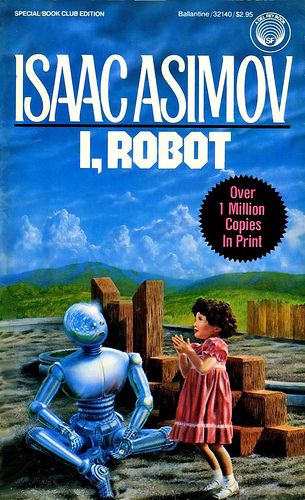
For Asimov, we read his early, seminal work, I, Robot. This is the short story collection that included his first formulation of the Three Laws of Robotics, which have been alluded to (i.e, ripped off) in countless other science fiction stories, including Star Trek. The book came out before the term AI became common parlance. Yet, in Asimov’s imagined future, the world is rife with robots that are essentially AIs with mechanical bodies. All of them have positronic brains (yeah, Star Trek ripped off this conceit, too) with the Three Laws hard-wired in. The result is that all robots function as humanity’s tireless, benevolent servants. (Some would say, slaves.)
Actually, they are much more than that. They can think, reason, and make choices. In fact, they have to make choices. The moral dilemmas created by the Three Laws as the robots interact with chaotic (and often evil) human beings is the source of drama in most of the stories.
Despite the mystery and drama of the stories, though, Asimov’s vision is a very optimistic, almost Buck-Rogers-esque idea of the future—not quite a utopia but close to it. There is no poverty, no hunger, no war. It’s only upon close reading of the stories in I, Robot that the exact nature of the master/servant relationship between humans and robots appears fraught—probably more so than Asimov consciously intended. This is especially true in a few of the stories, where it’s revealed that future governments are secretly run by the highest order of HAL 9000 style robots, whose plans might be beyond human comprehension.
Later in the Science Fiction class, we read Harlan Ellison’s short story “I Have No Mouth and I Must Scream,” which is quite possibly the darkest and most disturbing short story I have ever read, sci-fi or otherwise. And, of course, it involves an AI.
The story is mostly set underground, about one hundred years after a nuclear war wiped out all of humanity except for five people. The war was started by a mutinous Pentagon computer (yeah, just like Skynet) called AM that becomes self-aware and decides it hates human beings more than anything. After killing everyone on the planet, it preserves the five people as its playthings, running them through an endless number of elaborate, sadistic games. Unfortunately for them, AM has somehow obtained God-like technological power over physics, able to shape and project matter wherever it wishes, and also to keep the humans alive and immortal in their banged-up, miserable state. So, in effect, the protagonists spend an eternity in a kind of Holodeck-like hellscape, trying to figure out how to either escape or kill themselves.
Yeah, it’s heavy.
This enormous gulf between Asimov’s and Ellison’s visions of the future—an AI paradise versus an almost literal AI hell—is, in part, symptomatic of various generational and cultural shifts between the two men. I, Robot was published in 1950, on the tail-end of the Golden Age of Science Fiction, the time when the prosperity of America in the post-war years seemed destined to go on forever, fueled by newer and greater technological innovations (AI among them). In contrast, Ellison’s short story was published in 1967, at the height of a counter-cultural revolution that extended into science fiction literature —the New Wave that introduced some of my favorite sci-fi writers of all time, such as Samuel R. Delany, Ursula K. Le Guin, Roger Zelazny, and Ellison himself.
Thus, the difference between Asimov and Ellison’s work is essentially the difference between the lingering triumph of World War II and the horrors of VietNam. Between the optimism of the Atomic Age and the nihilism of the Cold War. In some ways, it’s also the difference between fantasy and realism, and between genre fiction and literary fiction. As dark as Ellison’s short story is, it’s also a much better work of fiction than Asimov’s. More convincing, too, alas. Told from the point-of-view of AM’s youngest victim, Ted, the story is filled with vivid, sharp writing and devastating passages, like this one:
Nimdok (which was the name the machine had forced him to use, because AM amused itself with strange sounds) was hallucinating that there were canned goods in the ice caverns. Gorrister and I were very dubious. “It’s another shuck,” I told them. “Like the goddam frozen elephant AM sold us. Benny almost went out of his mind over that one. We’ll hike all that way and it’ll be putrified or some damn thing. I say forget it. Stay here, it’ll have to come up with something pretty soon or we’ll die.”
Benny shrugged. Three days it had been since we’d last eaten. Worms. Thick, ropey.
You don’t have to be a literary critic to see that Asimov and Ellison are worlds apart, not just on the subject of Artificial Intelligence but on literally everything. Asimov was a scientist, a rationalist, and his optimistic views on the future of humanity were deeply rooted in the legacy of the Enlightenment. Ellison is more of a Gothic Romantic, full of existential angst and cosmic horror. His story is essentially an updated version of Mary Shelley’s Frankenstein, with the supercomputer in the role of the monster, determined to torment its creator.
Of course, the Frankenstein story is, itself, a reworking of an even older one—the Faustian myth. According to German legend, Faust is an intellectual who sells his soul to the devil in exchange for knowledge, and ends up going to hell. If the story seems familiar, it’s probably because the legend has been the psychological basis for countless tales of perverted science for centuries. Scientists, the story goes, want to attain the power of God, and thus end up being destroyed by their own hubris (often in the form of some infernal creation like Frankenstein’s monster or, more recently, SkyNet).
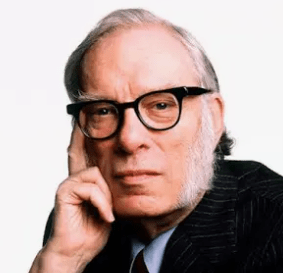
Isaac Asimov
Perhaps the biggest irony here (at least for me, personally) is that while I have great admiration for Ellison’s story, and I believe it is a much greater artistic work that anything ever penned by Asimov, Asimov’s vision is probably more accurate of what we can actually expect from the AI revolution. For all the hype about AIs destroying art and music and literature and taking away our jobs, I think AI will be a net positive for humanity. Perhaps a big net positive. It’s already making contributions in the fields of materials science, medicine, and even fusion energy. Yeah, it’s probably going to take away some people’s jobs, but those were probably crap jobs anyway. (If you train an AI to do it as well as a human, it’s probably not worth doing.)
As for the whole AM/Skynet thing, I don’t worry about it because I don’t believe computers will ever become conscious. In fact, the very idea of a machine becoming conscious seems like a category error, the kind of conceit that will seem laughable a hundred years from now as those old drawings of “men of the future” with feathered wings strapped to their arms.
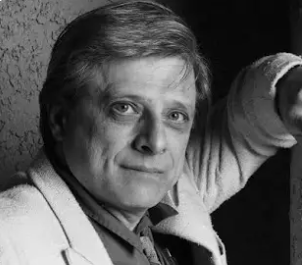
Harlan Ellison
This doesn’t mean, of course, that we won’t, someday, create an artificial life form that might replace us. But it won’t be a computer. It will be…something else.
A few years ago, I was reading yet another popular science book—I think it was Brian Greene’s The Elegant Universe—when I came across a reference to one of those barroom brain teasers. It goes like this: if your image in a mirror is reversed with regard to right/left and left/right, why is not also reversed from up/down and down/up?
The answer, while elementary, is surprisingly difficult to articulate. It helps to imagine yourself, not face-to-face with your reflection, but back-to-back, with the plane of the mirror between you and your mirror-doppelgänger. Now stick your arms out and waggle your fingers. For both you and your reflection, up is still up, and down is still down. This side (left to you, right to your doppelgänger) is still this side, and that side (right) is still that side.
The only real difference is that up/down has an objective definition; that is, which direction is the earth and which the sky. But left/right has a purely subjective definition, relative to whose set of eyes one is looking through.
Ever since I read her famous short story “Where Are You Going? Where Have You Been?” in college, I have loved Joyce Carol Oates. I continued to read her short stories through the 1980s and 90s, and my admiration only grew. She seemed to combine the style and critical eye of other great practitioners of modern realist fiction (think John Updike, Phillip Roth, John Cheever) with her own particularly empathic sensibility.
Empathic, yes, and also brutal. Oates writes about working class people in dire straights, including physical danger. Her female protagonists, especially, often face the threat of violence and even death (several of Oates’s stories involve rapists and serial killers). But even in these heightened situations, the primary threat is the internal, psychological one. For Oates, the real adversary is the self—that is, ourselves, with all of our passions and desires and resentments and jealousies.
And fear, of course. Fear is the greatest enemy in Oates’s imagined world, and overcoming fear, in all of its manifestations, is the greatest achievement of any Oates character. And so it makes perfect sense that the opening scene of her epic novel, Night. Sleep. Death. The Stars, would present the reader with a man engaged in an act of actual heroism. John Earle “Whitey” McClaren is the patriarch of an big family in Hammond, New York. His five children, all grown, are pillars of the community, and Whitey himself was once mayor of the Hammond. But when he spots two police officers brutalizing an Indian man on the side of the road, he pulls over and intervenes. The cops turn their fury on him, and he is brutally beaten. Whitey ends up in a coma, with his family gathering around him in the hospital. I don’t think I’m spoiling much when I state that White doesn’t survive his ordeal. And his death, in turn, impacts all the members of his family, from his devoted wife, Jessalyn, to his five adult children.
But instead of writing just another book about the grieving process—a so-called aftermath novel—Oates describes a series of titanic transformations that take place in each individual over the following two years. Flannery O’Connor once wrote that fiction is about the mystery of personality, and Oates seems to confirm this in the way she reveals how Whitey’s loss “breaks” the each of his children’s personalities. Like crystals, they all fracture along unique and unpredictable fault lines, and that’s the genius of Oates’s novels. Some of the children find themselves growing spiritually and sexually (with lots of missteps and false starts), while others spiral down into paranoia and bitterness. Jessalyn, Whitey’s widow, works her way through survivor’s guilt to find new love with a Hispanic liberal photographer who is as different from Whitey as a man could be (at least on the surface; spiritually, they are similar, as Jessalyn soon realizes).
One common shortcoming of big, third-person novels with many view-point characters is that some of those characters blur together. But Oates renders each of these people so vividly and convincingly that, by the end of the book, they feel as real to us as…well…someone in our own family. This is, I think, the highest achievement of fiction—to make us feel what it’s like to be another human being.





 Ash Clifton, Writer