
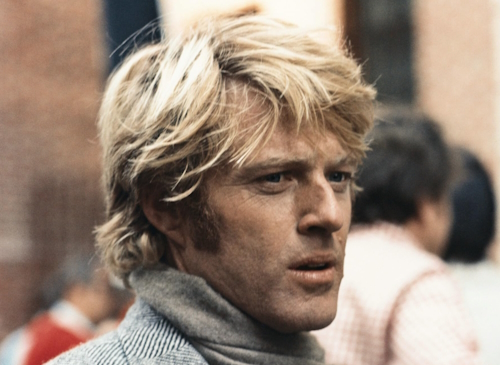
The great scholar Joseph Campbell once explained that every time we go into a cinema and see a movie star—Tom Cruise, for example—up on the screen, some part of our brains is aware that the real person, the actor Tom Cruise, is alive somewhere else in that same, exact moment. This ability to exist in two places at once, Campbell said, is an aspect of a God, a living divinity.
Our subconscious perception of actors as gods is one reason we are always surprised by the death of a movie star, especially one who has been around since we, ourselves, were kids. How could they ever die? They seem to occupy a higher plane of reality, immortal, always youthful if not actually young.
Robert Redford was surely one of the greatest movie stars of my youth, and he starred in two of my favorite films of all time, All the President’s Men and Three Days of the Condor, both of which I have written about on this blog. What made him interesting was that weird dichotomy of blond, athletic, all-American good-looks combined with a reserved, wary intelligence. (On my list of Hollywood Archetypes, he fits squarely in the “Dark Prince” slot.) He was a very smart man, who did a lot of amazing things both on-screen and off-. Among the most notable of these was his founding of the Sundance Film Festival, which has come to rival Cannes as the preferred venue for indie-film directors to premiere their movies.
The fact that Redford would create an alternative festival for “the little guys” in the film industry was typical. He was, in some ways, the most counter-cultural movie star of the last fifty years—even more so than Easy Rider himself, Peter Fonda—in that he made movies about men fighting some vast, evil establishment. Often, this was the military-industrial complex in either its actual (All the President’s Men) or its fantasy (Three Days of the Condor) form. In his later years, when Redford could no longer play the lead, he took on the role of the villain who represents this evil empire, as in Captain America: The Winter Soldier.
As a kid, I always found something soothing about Robert Redford, even in movies filled with threats and violence. I suspect that, in my mind, he represented the best spirit of my parents’ generation (he was roughly the same age as my father). That is, the young adults of the 1960s and 70s. Post-hippie, but very hip. World-weary, but not broken. Brave, but not foolhardy. Idealistic, but not naïve.
And, above all, ready to fight the system.
Godspeed, Mr. Redford…
 Ash Clifton, Writer