
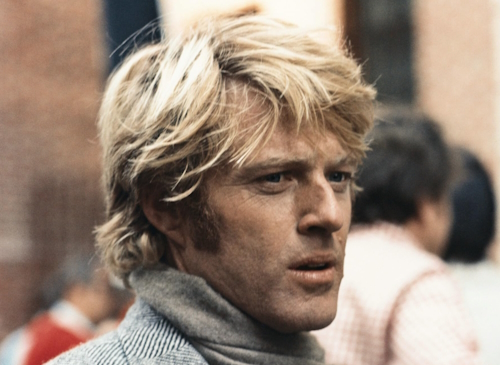
R.I.P. Robert Redford

The great scholar Joseph Campbell once explained that every time we go into a cinema and see a movie star—Tom Cruise, for example—up on the screen, some part of our brains is aware that the real person, the actor Tom Cruise, is alive somewhere else in that same, exact moment. This ability to exist in two places at once, Campbell said, is an aspect of a God, a living divinity. 

Our subconscious perception of actors as gods is one reason we are always surprised by the death of a movie star, especially one who has been around since we, ourselves, were kids. How could they ever die? They seem to occupy a higher plane of reality, immortal, always youthful if not actually young. 

Robert Redford was surely one of the greatest movie stars of my youth, and he starred in two of my favorite films of all time, All the President’s Men and Three Days of the Condor, both of which I have written about on this blog. What made him interesting was that weird dichotomy of blond, athletic, all-American good-looks combined with a reserved, wary intelligence. (On my list of Hollywood Archetypes, he fits squarely in the “Dark Prince” slot.) He was a very smart man, who did a lot of amazing things both on-screen and off-. Among the most notable of these was his founding of the Sundance Film Festival, which has come to rival Cannes as the preferred venue for indie-film directors to premiere their movies. 

The fact that Redford would create an alternative festival for “the little guys” in the film industry was typical. He was, in some ways, the most counter-cultural movie star of the last fifty years—even more so than Easy Rider himself, Peter Fonda—in that he made movies about men fighting some vast, evil establishment. Often, this was the military-industrial complex in either its actual (All the President’s Men) or its fantasy (Three Days of the Condor) form. In his later years, when Redford could no longer play the lead, he took on the role of the villain who represents this evil empire, as in Captain America: The Winter Soldier.

As a kid, I always found something soothing about Robert Redford, even in movies filled with threats and violence. I suspect that, in my mind, he represented the best spirit of my parents’ generation (he was roughly the same age as my father). That is, the young adults of the 1960s and 70s. Post-hippie, but very hip. World-weary, but not broken. Brave, but not foolhardy. Idealistic, but not naïve. 

And, above all, ready to fight the system. 

Godspeed, Mr. Redford…

What I’m Reading: “Tinseltown”

tinseltown

Ever since I was a kid I’ve had a deep love for classic murder mysteries like The Maltese Falcon and The Big Sleep. Combine this with my obsession with history and biography—especially Hollywood biography—and you get something like William J. Mann’s Tinseltown: Murder, Morphine, and Madness at the Dawn of Hollywood, the true story of one of the most notorious crimes in American history.

Centered on the still-unsolved killing of director William Desmond Taylor in 1922, Mann’s book comes as close to a “nonfiction novel” as I’ve seen since Truman Capote first coined the term.  Being lit geek, I know that 1922 happens to be the year in which The Maltese Falcon is set, and Mann’s story might well have been lifted from one of Hammet’s books, filled as it with hoods, con-men, cops, junkies, sugar daddies and blackmailers.

And beautiful women, of course. Beautiful, deadly women.

The Los Angeles police implicated three women in Taylor’s murder, all actresses of some renown: Mabel Norman, a one-time star whose addiction to cocaine and booze nearly ended her career; Mary Mile Minters, a vapid teenage starlet whose romantic delusions were exceeded only by her considerable box office appeal; and Margaret “Gibby” Gibson, a former Vitagraph player (and occasional prostitute) determined to make herself into a producer.

Continue reading “What I’m Reading: “Tinseltown””

15 Hollywood Archetypes

Well, another summer is about to begin, and, once again, I don’t plan on seeing any of the summer “blockbusters” that are coming out. I just can’t work up much enthusiasm for the big summer debut. The problem is that now, in my 50s, I have seen so many movies that I recognize the same characters over and over in an endlessly repeating loop.  Don’t believe me? Check out the list below…

The Dark Prince

flynn
redford
cage
dicaprio
mathew


Brooding, sexy, and smart, the Dark prince is often caught up in a hopeless battle against a larger system that is both impersonal and oppressive. These guys don’t smile a lot.

Famous Examples:

  • Errol Flynn
  • Robert Redford
  • Nicholas Cage
  • Leonardo Dicaprio
  • Matthew McConaughey

The Vixen (with a Brain)

dietrich
taylor
turner
basinger
scarlet


This archetype is reserved for actresses whose sex appeal is so strong that it blasts off the screen like a blowtorch. But the magic comes when the viewer realizes that there is much more to these women than just a pretty face. Often portrayed as a scarlet woman or a femme fatale, this archetype always has a troubled past and is unable to sustain a genuine relationship.

Continue reading “15 Hollywood Archetypes”