
The great sci-fi writer Clifford D. Simak was known for writing novels and short stories with off-beat main characters. Often, his protagonists were cynical, working-class stiffs (often with a drinking problem) who stuck to their own, private, moral code, often at great cost to themselves. One of Simak’s editors once groused that all of his stories were about “losers.”
“I like losers,” Simak replied.
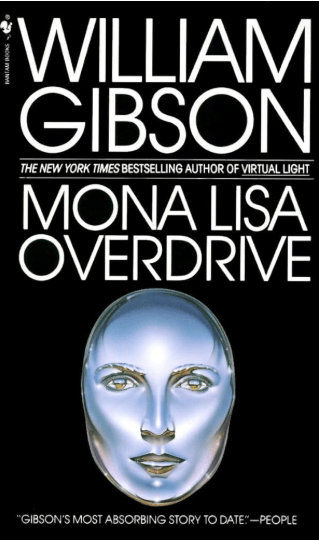
I just read this quote the other day, and I immediately thought of William Gibson’s books—specifically, Mona Lisa Overdrive. I first read MLO back in the early 1990s, just a few years after its publication, and I thought it was great. I never really thought of reading it again, but for some reason—perhaps because I’ve been a bit down, of late—I recently checked-out the book and re-read it. And I’m really glad I did. One of the foundational works of the cyberpunk sub-genre (along with Gibson’s Burning Chrome, Neuromancer, Count Zero, and other books), it still holds up, both as a work of speculative fiction as well as just a damned good, vividly imagined, human story.
A lot of people heap praise on Gibson’s novel—and on the Cyberpunk genre in general—because of their ideas, the thematic questions they ask about how humanity can relate in an age of overwhelming, dehumanizing technology. And what are the brutalizing effects of the ever-increasing disparity between the high-tech haves and the lower-tech have nots? Et cetera et cetera.
Myself, I like Gibson’s characters. Often, they are losers, of the sort Simak wrote about. Little people eking-out an existence on the fringes of society. MLO is no exception. The last of Gibson’s Sprawl trilogy, after Neuromancer and Count Zero, it’s set on a near-ish future Earth where mega-corporations, trillionaires, and criminal cartels have replaced all governments, and most of humanity muddles along in a rat-race of late-stage capitalism. The plot is a complicated skein of four interlocking narratives, each centered on a different character: Mona, a teenaged prostitute; Kumiko, the tween-aged daughter of a Yakuza boss; Angie, a beautiful young star of virtual reality films (“simstims”); and Slick Henry, an artist who sculpts robots and suffers from government-inflicted memory loss. I find it interesting that, of these four characters, two are children (Mona is sixteen), one is addicted to drugs, and one is brain-damaged. Additionally, two of them (Mona and Slick Henry) are poor, while the other two “rich” characters (Angie and Kumiko) are virtual prisoners of their wealth and position, separated from any real friendships or human connection.
Most notably, none of them have real families. Mona is an orphan; Kumiko’s mother died under mysterious circumstances, and her father is an aloof cypher.
In short, all of Gibson’s view-point characters are underdogs, one way or another. The closest he has ever come to a real, kick-ass hero is in one of his best supporting characters, Molly Millions, the cybernetically enhanced mercenary who figures so prominently throughout the Sprawl trilogy (not to mention Gibson’s landmark short-story “Johnny Mneumonic”, which first appeared in Omni Magazine in 1981; yeah, I read it fresh off the newsstand). And even Molly is more of an anti-hero, selling her services to the highest bidder, yet always displaying a basic, inner decency and compassion.
It is Molly, in fact, who becomes the physical catalyst that eventually brings the four narrative threads of the plot together in the MLO’s final chapters. I don’t want to spoil it completely, but the story involves a plot to kidnap Angie (the simstim star, whom Mona strongly resembles; hint, hint) and prevent her from reuniting with her boyfriend, Bobby Newmark, whose body lies comatose in Slick Henry’s art studio while his mind is busy in cyberspace. Kumiko, too, finds herself caught up in this plot, if only tangentially.
Having just re-read the book for the first time in thirty-odd years, I find myself liking it even more now than I did back then. I am awestruck by how deft Gibson’s prose is (he is surely one of America’s most underrated writers), as well as how quickly the story sucks the reader in. Almost every pop-novel out there these days is written from multiple, shifting points-of-view, but very, very few manage to draw their individual characters so vividly, or keep the reader as invested in the plight of each.
And, yeah, Gibson’s ideas are really, really cool. My favorite revelation in the book is when Slick Henry’s friend, Gentry, figures out that the L.F., the device attached to Bobby’s skull, is really an aleph, referencing the 1945 short story by Jorge Luis Borges. (If you read enough cyberpunk novels—or urban fantasy novels, for that matter—you’re going to run into Borges eventually.)
To sum up, Mona Lisa Overdrive is one of my favorite novels, sci-fi or otherwise. Check it out…

 Ash Clifton, Writer