I’m no expert on the subject, but when I think of The History of Science Fiction, I imagine it in three big chunks. First came the “Golden Age” of the 1920s and 1930s, when pulp magazines like Astounding and Amazing Stories became enormously popular. Second was the era during and after World War II, when the so-called “Big Three” superstar authors—Issac Asimov, Robert Heinlein, and Authur C. Clarke—emerged. Then came science fiction’s “New Wave,” when literary writers like Philip K. Dick, Ursula K. Le Guin, Harlan Ellison, Samuel R. Delany, and J. G. Ballard transformed the genre.
Over my reading lifetime, I have mostly explored this third era—the New Wave—mainly because, frankly, it’s the only one where you can find some genuinely great novels. But in middle school and high school, I read some of the post-WWII writers, too, especially Clarke. I read Childhood’s End, 2001: A Space Odyssey, Earthlight, and Rendezvous with Rama. I loved all of them, particularly Childhood’s End, which is probably his best book.
Clarke was, by far, my favorite of the Big Three, even though he was far from a great writer. (Heinlein was probably the best, from a stylistic sense, but I disliked his books for other reasons.) Almost invariably, Clarke’s characters fall into a two-dimensional, generic type—the stalwart (male) hero, the honorable scientist, the devoted wife, the curious child, etc. etc.—but he was such a good story teller that no one cared. Essentially, his books are like extended Astounding magazine short stories, beginning with a fascinating, nerdy premise and weaving a cerebral-yet-exciting adventure tale around it.
I read one of his later novels, The Fountains of Paradise, when I was in college and enjoyed it immensely. Set in the near-future, it focuses on a stalwart scientist-hero—a civil engineer, in this case, named Vannevar Morgan—who is determined to build the world’s first space elevator, a literal railway to the stars. He needs to build it somewhere on the earth’s equator and chooses a mountain on the fictional island of Taprobane (a thinly veiled Sri Lanka, which was Clarke’s home for the latter half of his life). Naturally, he immediately faces challenges, beginning with the intractable head-monk of a Buddhist monastery that happens to be smack in the middle of the site Morgan has chosen. The rest of the story follows Morgan’s struggle to build the elevator. Technical problems abound, and several mini-crisis intrude on the elevator’s progress.
One element that The Fountains of Paradise stand-out from the rest of his novels is a clever narrative trick he pulls off. The 21st Century story Morgan is interwoven with a 5th Century tale of a local monarch, King Kalidasa, who tried to build a heaven-like palace on the exact same mountain top. The parallels between the two men are obvious but interesting—each is driven, almost to the point of madness, to see his dream come to reality. But while Kalidasa is a ruthless dictator who amputates the hands off his craftsmen after they finish their task (so they can never reproduce the work for another king), Morgan is a deeply moral, modern, scientific visionary whose goal is the betterment of humanity. He also cares about his workers. In the books final act, an accident occurs that requires Morgan to risk his own life to get oxygen to the workers who are stranded high-up on the elevator’s monofilament cable. It’s a great sequence. (I won’t spoil the ending, of course.)
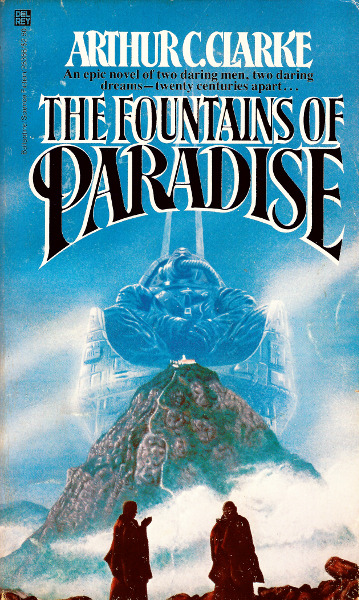
I really like this cover (by veteran illustrator Terry Oakes) from the 1979 Del Rey edition. I like the juxtaposition of the monks in the foreground with the ghost of King Kalidasa hovering over the mountain (albeit in a high-tech reincarnation, wearing a pressure suit) and the space-elevator cable shooting up into the sky. It’s a crazy cover, in some ways, but it captures the clever dichotomy of the book.
 Ash Clifton, Writer