The great scholar Joseph Campbell once explained that every time we go into a cinema and see a movie star—Tom Cruise, for example—up on the screen, some part of our brains is aware that the real person, the actor Tom Cruise, is alive somewhere else in that same, exact moment. This ability to exist in two places at once, Campbell said, is an aspect of a God, a living divinity.
Our subconscious perception of actors as gods is one reason we are always surprised by the death of a movie star, especially one who has been around since we, ourselves, were kids. How could they ever die? They seem to occupy a higher plane of reality, immortal, always youthful if not actually young.
Robert Redford was surely one of the greatest movie stars of my youth, and he starred in two of my favorite films of all time, All the President’s Men and Three Days of the Condor, both of which I have written about on this blog. What made him interesting was that weird dichotomy of blond, athletic, all-American good-looks combined with a reserved, wary intelligence. (On my list of Hollywood Archetypes, he fits squarely in the “Dark Prince” slot.) He was a very smart man, who did a lot of amazing things both on-screen and off-. Among the most notable of these was his founding of the Sundance Film Festival, which has come to rival Cannes as the preferred venue for indie-film directors to premiere their movies.
The fact that Redford would create an alternative festival for “the little guys” in the film industry was typical. He was, in some ways, the most counter-cultural movie star of the last fifty years—even more so than Easy Rider himself, Peter Fonda—in that he made movies about men fighting some vast, evil establishment. Often, this was the military-industrial complex in either its actual (All the President’s Men) or its fantasy (Three Days of the Condor) form. In his later years, when Redford could no longer play the lead, he took on the role of the villain who represents this evil empire, as in Captain America: The Winter Soldier.
As a kid, I always found something soothing about Robert Redford, even in movies filled with threats and violence. I suspect that, in my mind, he represented the best spirit of my parents’ generation (he was roughly the same age as my father). That is, the young adults of the 1960s and 70s. Post-hippie, but very hip. World-weary, but not broken. Brave, but not foolhardy. Idealistic, but not naïve.
Having once been an art student (well, a creative-writing student; close enough), I know from experience that the quickest way to start an argument among a bunch of art majors is to ask them what the definition of “real” art is. Similarly, the best way to start an argument among a bunch of cinephiles is to ask them what “real” cinema is.
That is essentially what the great director Martin Scorsese did in 2019 when he suggested that Marvel superhero movies (in their zenith, at the time) were “not cinema”. He stated:
Honestly, the closest I can think of them, as well made as they are, with actors doing the best they can under the circumstances, is theme parks. It isn’t the cinema of human beings trying to convey emotional, psychological experiences to another human being.
Scorsese thus not only managed to make himself sound like a bit of a snob—not to mention a grumpy old man—but to also start an internet flame-war that continues to this day.
Ultimately, though, the whole affair was a tempest-in-a-teapot. Of course the Marvel films are “real” cinema. That is, they are fabulously well-crafted motion pictures that, at their best, have an emotional and even a physical impact on their viewers. They also (again, at their best) make important philosophical and political points.
However, they are a different kind of cinema than what Scorsese works in. In other words, what we’re really talking about her is the difference between literary cinema and popular (that is, genre-based) cinema.
This is the same distinction one must make between literary fiction and genre fiction. The purest and simplest definition of genre fiction is that, for the most part, the reader knows what they’re gonna get. A mystery is going to have a murderer and a sleuth. A horror story is going to have a monster and hero/heroine fighting it. A rom-com is going to have two people who should get together romantically but just can’t, for some reason, until the very end. And a superhero movie is going to have, well, a superhero with some kind of superpowers who is fighting some equally superlative evil.
The devil, of course, is in the details. We consume genre cinema for the same reason we consume genre literature—because we want to see how they pull it off. “They” in the case of cinema, being the director and the writer and the actors. How do they change-up the old formula, make it interesting and somehow new?
That is how genres evolve and adapt to new time periods and new zeitgeists. Daniel Craig’s interpretation of James Bond was different from Sean Connery’s or Roger Moore’s—it was more brutal, more bloodthirsty, and yet somehow more vulnerable, too. Just like us, the American film-viewing public.
In the same way, Marvel superhero movies are different from superhero movies of the 1970s (think Superman) or the 1980s. The characters are more believable, as well as being more complex and even vulnerable. I am, again, thinking of the very best Marvel movies: the first Ironman starring Robert Downey Jr. and Captain America: The Winter Soldier. This latter film, which came out in 2014 (yes, it’s been that long), is probably the best film of the entire series. And, yes, it is “real” cinema.
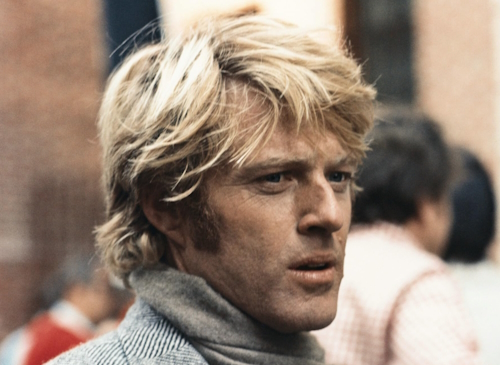
Robert Redford in “Three Days of the Condor”
In fact, as very few people have realized, The Winter Soldier is almost a remake of a 1975 film that most film snobs would agree is “real” cinema: Three Days of the Condor.
The only obvious similarity is that both films feature Robert Redford. In Condor, Redford plays a brilliant but very bookish CIA analyst named Turner who works in a New York City branch office. One day, he comes back from lunch to find everyone in the office dead, murdered by professional assassins. Turner goes on the run. Unsure of who he can trust, he kidnaps an unsuspecting, beautiful woman (Faye Dunnaway) and hides in her apartment. From there, he gradually figures out that the assassins who killed his work-mates were sent by a rogue faction inside the CIA itself. Apparently, Turner’s branch had stumbled upon a secret plot by the faction to invade the Middle East and capture all the oil fields (how very far-fetched, right?). Turner eventually confronts the leader of the faction, as well the head assassin, a Zen-Master-like Frenchman named Joubert (played with brilliant, icy effectiveness by Max von Sydow).
On the surface, Condor might seem like a very different film from The Winter Soldier. But the closer you look, the more The Winter Soldier seems almost like a remix of the earlier film. That is, it has all the same elements. The good-guy-betrayed-by-his-government figure is Steve Rogers (a.k.a. Captain America) who, like Turner in Condor, discovers a vast conspiracy within U.S. intelligence (S.H.I.E.L.D, in this case, rather than the CIA). Like Turner, Rogers finds himself on the run with a beautiful woman (Natasha Romanoff/Black Widow). He confronts the leader of the conspiracy (played by none other than Robert Redford himself). And of course he confronts the lead assassin, Barnes, who (like Joubert in Condor) turns out to be far more complicated than he appears.
Even some of the individual scenes in The Winter Soldier are eerily reminiscent of those in Condor. Take the now famous elevator sequence, which is not only the best in the film but one of the best in the entire MCU series. On his way out of the high-tech and vaguely fascistic H.Q. of S.H.I.E.L.D., Rogers steps into an elevator and rides down. As the elevator stops at successive floors, more and more men step on, each menacing but seemingly disinterested. The scene works so well because everyone can relate to it, to that sense of unease we all fell when forced into close proximity with strangers. We begin to wonder: what if some of these people were evil. They could hurt us—maybe even kill us—before we could react. And yet, despite this unease, we do nothing because we have no real evidence of evil intent. We’re playing a social role. And that’s just what Rogers—a good-natured man if ever there was one, willing to give anyone the benefit of the doubt—does.
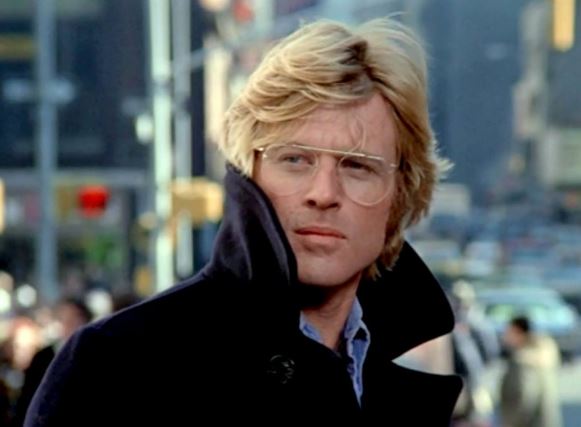
Robert Redford in “The Winter Soldier”
I love the moment when Rogers notices sweat streaming down the face of one of the men next to him. He knows—as we, the viewers, know—that this is really, really bad. But there is nothing he can do about it…yet. It’s still in the future. Alfred Hitchcock couldn’t have done it any better. Nor, for that matter, could Sidney Pollack, who has an almost identical scene in Condor, in which the hapless Turner finds himself in an elevator with Joubert, the master assassin. Each man knows that the other man knows who he really is, but neither can take any action…yet.
Ever since I read Mark Crispin Miller’s landmark essay “Hollywood: The Ad” many years ago, I’ve been fascinated the way in which the tropes and elements of an early “classic” movie can end up rearranged and transformed in a later pop film. Miller gives the example of 2001: A Space Odyssey (1968) and Star Wars (1977). If you look closely, many of the components of the former get transmogrified in the latter. The apes of 2001 become the loyal Wookie Chewbacca. The cold, robotic voice of HAL the computer becomes that of C3PO the droid. The white, sterile interiors of the spaceship Discovery become the stark, sterile halls of the Death Star. And so on and so forth.
Martin Scorsese
That’s just what has happened here, with Condor and The Winter Solider. They’re practically the same movie, but shaken up by time and changing purposes. That is, The Winter Soldier is every inch a pop film, with the full intention of stimulating the audience with all the action and explosions and kung-fu fights that we’ve come to expect from a Hollywood blockbuster. But, on some level, the kernel of Condor is still there. The Winter Soldier is also a story about evil, rapacious men seizing control of government, and also the creeping power of America’s military-industrial complex. It’s also about the dehumanization the soldiers like Rogers and Barnes undergo as pawns in the hands of callous leaders and ruthless institutions.
In short, despite all its roller-coaster-ride thrills and spectacle, The Winter Solider is a “real” movie.





 Ash Clifton, Writer