Ten Things I Love About “Margin Call”

margin_call_poster

I have had the dubious privilege of living through three epic financial bubbles: the Reagan stock rally of the 1980s (it crashed in 1987); the DotCom boom of the 1990s (crashed in 2002); and the Sub-Prime bubble of the mid-2000s (crashed in 2008).  As if we needed more proof that rich people run our country, none of these bubbles resulted in significant financial reform, despite the millions of innocent people who suffered.  As one character proclaims in the recent movie The Big Short, all the American electorate did was “blame immigrants and poor people” while the fat cats mostly got off Scot-free.

Perhaps the only good thing to come out of this endless cycle of boom-and-bust is an entirely new category of movie:  the so-called financial thriller.  This young genre (okay, sub-genre) has its origins as far back as Alan J. Pakula’s Rollover in 1981, and perhaps even earlier (Sidney Lumet’s 1976 masterpiece Network shares many of the same themes and obsessions).

But the genre really took off in 1987 with Oliver Stone’s brilliant Wall Street.  Most people still see it as the definitive financial thriller, not only because it’s a great movie but also because it so vividly defines the genre’s basic elements:  a young man tempted by the lure of easy money; an evil mentor who shows him how to cheat the suckers; a “good” mentor who warns him of the dangers; a sleek urban landscape of metal and glass; and (most important) a corrupting lifestyle of drugs and sex which tempt him deeper into corruption.

Continue reading “Ten Things I Love About “Margin Call””

Friday Night Rock-Out

In some ways, Missing Persons was the ultimate west coast 80s band. With their heavy synth sound and propulsive drum beats, they were a band that could make you think and make you dance. Plus, I simply loved Dale Bozzio. Not just your average bottle-blonde space-age sex-kitten with a plexiglass bustier, Bozzio could really sing. And her baby-doll, hiccuping style was tempered with just enough knowing irony to make you realize how cool she was. In fact, she presaged another super-smart front-girl from a decade later, Shirley Manson of Garbage.

My favorite Missing Persons song is “Destination Unknown”. Ah, how true.

Enjoy!

What I’m Reading: “George Lucas – A Life”

Jones

One of my favorite novels is William Makepeace Thackery’s The Luck of Barry Lyndon. I first got interested in it after seeing Stanley Kubrick’s amazing film adaptation, Barry Lyndon, which I didn’t really understand but which blew me away anyway. Like the movie, the book is a tragedy, the story of an honorable young man who slowly transforms into a selfish adventurer and scoundrel.

It’s a beautiful and rollicking novel, but the main reason I like it has to do with Thackery’s unusual take on the tragic hero. We were all taught in school that the reason a hero falls in a classic tragedy is because of some fatal flaw—some negative quality. But in Thackery’s vision, it is not Barry’s flaws that bring about his downfall, but rather his strengths.  That is, the very qualities that bring him riches and fame in the short run—his intelligence, courage, and ambition—are the very qualities which lead to his eventual destruction.

It might seem melodramatic, but I was reminded of this idea as I read Brian J. Jones’s excellent biography, George Lucas: A Life. Although Jones never actually uses the term tragic hero in the book—to do so would be ludicrous in the case of an actual, living man, especially one as laid-back and funny as George Lucas—he nonetheless gives a sense of a person whose determination and genius have sometimes led him dangerously close to self-destruction.

Continue reading “What I’m Reading: “George Lucas – A Life””

What I’m Reading: “The Girl with All the Gifts”

Girl1

If there is a single genre that has been totally overused, tapped-out, wrung-dry, and exhausted, it would have to be the Zombie Apocalypse genre. From books to movies to TV shows, the idea of a world overrun with mindless, brain-eating zombies has been so fertile that it even engendered a classic spoof in Shawn of the Dead (and that was fifteen years ago!).

Having said that, it’s nice and even uplifting to remember that great writing, a kick-ass story, vivid characters and a hideously evil villain can overcome anything.

Oh, and a brilliant twist. That helps, too.

The “twist” in M. R. Carey’s The Girl with All the Gifts is that the novel’s young heroine is, herself, a zombie. Or, at least, infected with the fungus that has caused the “Breakdown” which has reduced human civilization to a few small, besieged cities. Other than having a genius I.Q. and an almost uncontrollable hunger for human flesh, Melanie is an ordinary ten-year-old. She likes school (actually a prison filled with other infected kids), and she especially likes her teacher, Miss Justineau (actually a psychologist tasked with studying the kids’ neurological responses).

Continue reading “What I’m Reading: “The Girl with All the Gifts””

Ten Things I Love About “Alien”

weaver

Next year will mark the 45th anniversary of Ridley Scott’s landmark sci-fi horror movie, Alien. I saw the movie when I kid way back in 1979. Here are ten things I (still) love about it:

  1. The Opening

For a movie that has the second-most disturbing scene in the history of cinema (the shower scene in Psycho is #1), the film starts with an empty field of quiescent darkness. The single letter I appears in the middle of the screen, and over the next few minutes as the opening credits appear and disappear on the screen, the I is joined by other letters to eventually form the single title: ALIEN. Talk about building tension. And what a great title it is! Both a noun and an adjective, it sums up everything frightening about this film. Namely, the fear of being consumed by the other, (the one outside and the one inside).

Continue reading “Ten Things I Love About “Alien””

Friday Night Rock-Out: “Stupid Girl”

When I first heard the band Garbage, I was struck by lead singer Shirley Manson and her fabulously expressive voice—at times monotonal, at other times growling. This pale goth girl from Scotland had somehow tailored her vocals to exactly fit the manic-depressive zeitgeist of the 90s.

Indeed, I would argue that the band’s premier song, “Stupid Girl,” is the definitive song of the period (yes, even more so than Nirvana’s brilliant “Smells Like Teen Spirit”). In the song’s now-famous lyric, the narrator accuses an unnamed girl of being…well…stupid. In fact, the aspects of her stupidity are those evidenced by practically every person under 40 in modern urban America: vanity, self-absorption, consumerism, nihilism.

And fakery. Especially fakery. “[I] can’t believe you fake it…” as Manson sings portentously to the stupid girl in question. What is she faking? Being human.

What I’m Reading: “The Peripheral”

A few months ago, I wrote a post about M. R. Carey’s excellent sci-fi novel, The Girl with All the Gifts. I recounted how incredibly impressed I was by the way Carey took an exhausted genre—the zombie apocalypse story—and found a way to make it fresh and vital.

ThePeripheral

As luck would have it, the next novel I chose to read was William Gibson’s latest book, The Peripheral. I tore through it over the course of a weekend, and at some point, it occurred to me how similar the book is—in spirit, if not content—to Carey’s. Gibson, after all, faced a similar challenge to Carey in that his preferred genre, the cyberpunk novel, was also played out, in large part due to his (Gibson’s) own amazing success. His iconic works like Mona Lisa Overdrive and Burning Chrome helped define the cyberpunk aesthetic, that weirdly prescient vision of a future divided between poor street people and the ultra-rich. It was Gibson who coined the term cyberspace, and, by the end of the 1990s, the cyberpunk vibe had permeated not only popular fiction but movies (Blade RunnerThe Matrix) and anime (Akira).

Now, in 2019, reality itself seems to have caught up with Gibson’s work. We live in a world where the vast bulk of humanity is virtually impoverished and uneducated. These teeming masses distract themselves with 3D games and social media (literal cyberspace) while a few fantastically rich individuals build spaceships and private islands for themselves. We live in a world where teenaged soldiers kill people via satellite-controlled drones on the other side of the planet, and where rogue Chinese scientists make designer babies.

How’s a poor science fiction writer supposed to keep up?

Continue reading “What I’m Reading: “The Peripheral””

Friday Night Rock-Out

If you were alive in the early days of MTV, you probably remember this gem from Kiwi pop group Split Enz. It’s got everything an 80’s New Wave hit should have: trippy synthesizer riffs, an infectious hook, and a truly bizarre video (complete with the players dressed in New Wave zoot suits). And—oh, yeah—it’s also a great dance song.

Enjoy!

Shameless Plug

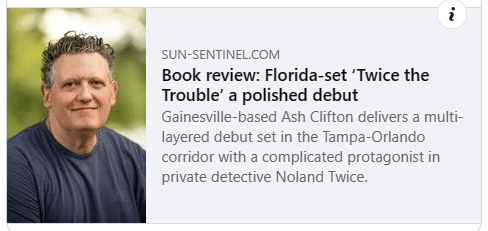
Well, it’s official. My book is now available for pre-order (make that pre-pre-PRE-order) on Amazon, Barnes & Noble, Books-a-Million, etc. (Yes, even Walmart.com.)

I’m not asking you to buy it (although it would make an excellent gift for that special someone in your life; or for your boss, co-worker, distant relative, crazy uncle, etc.). But if you want to help me out, please request that your local library buy it. Most public libraries have a “Suggest Materials” link on their website. Or you can just ask a librarian. (Duh!)

Here’s a link to the book on the publisher’s distribution site:

https://www.penguinrandomhouse.com/books/741923/twice-the-trouble-by-ash-clifton/