I learned many things from reading the excellent nonfiction book Would You Baptize an Extraterrestrial? For instance, I learned that the Vatican has its own astronomical observatory, which is run, in part, by the authors, Guy Consolmagno and Paul Mueller. Both men are also Jesuits. (The current Pope, Francis, is also a Jesuit—that’s another thing I learned).
Now, I was raised Catholic, and I thought a knew a thing or two about the religion. But not only did I learn from this book that the Vatican has its own observatory, but that it has had one for hundreds of years. In fact, I was so taken by this discovery that I Googled “Vatican observatory” and, to my amazement, found that the Vatican also runs an observatory in Tucson, Arizona.
Talk about synchronicity! When I was twenty-two years old, I went off to attend grad school at the University of Arizona, in Tucson, and I distinctly remember the first night I spent there. I impressed by the size of the city—much larger than my little hometown of Gainesville, Florida—but also by how beautiful the desert sky was. Even in the downtown area, the stars were clearly visible. This was no accident; the city, I was told, purposely kept the streets relatively dark, in deference to the many astronomical observatories that surround the valley, which could not function if too much light pollution bled from the metro area.
Apparently, the Vatican’s observatory is one of them.
On those rare occasions when I choose to read a big, fat, thick-as-a-brick book about a famous person, I usually pick one about a politician. David McCullough’s Truman is a great example. I tend to gravitate toward books about political figures because, in the course of reading about their lives, you also get a free history lesson. That is, the story of Harry Truman is also the story of World War II, the atomic bomb, Korea, the founding of Israel, and the Berlin Wall.
Biographies of artists are more problematic, for me. I just finished reading de Kooning: An American Master, by Mark Stevens and Annalyn Swan. It chronicles the long life of the great painter—a life barely contained within the span of the Twentieth Century—in which de Kooning lived to be the celebrated, Grand Old Man of modern American art. He became, in fact, the only American artist whose figure and reputation approached those of Picasso.
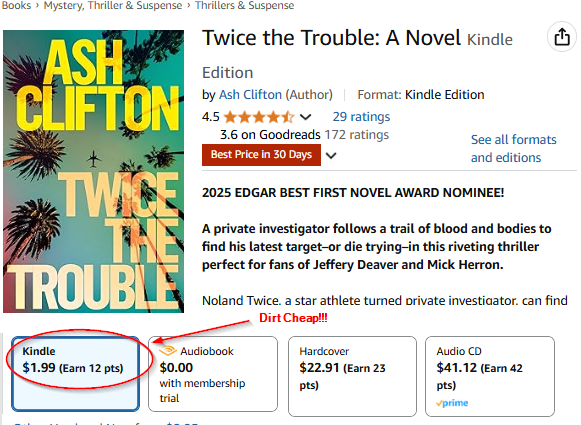
Have I no shame? Not a shred! Therefore, I am letting everyone know that the Kindle edition of my Edgar-nominated novel, Twice the Trouble, is currently on-sale for two Ameros! If you like mystery fiction, or want to support this blog, please buy a copy.
When most people think of the archetypal techno-thriller writer, they probably think of Tom Clancy. He didn’t invent the genre, but with the publication of his 1984 mega-hit The Hunt for Red October, he took it to a whole new level of mainstream popularity. Henceforth, the pop lit shelves in bookstores and airport gift shops across the countries would be filled with works by Clancy and an army of his imitators.
And why not? The techno-thriller novel combines aspects of several other genres, including “caper” fiction (a group of determined men taking on a seeming impossible mission), science fiction (the “techno” part is often so cutting-edge that it is more like sci-fi), mysteries (there is always a hidden bad guy in the mix), and, of course, thrillers (duh).
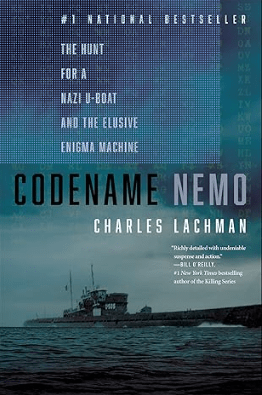
I kept thinking of The Hunt for Red October as I read an excellent history book recently, Codename Nemo: The Hunt for a Nazi U-Boat and the Elusive Enigma Machine by Charles Lachman. It recounts the fantastical story of a visionary naval captain, Daniel Gallery, who comes up with a hare-brained plan to capture a German U-boat. He developed the idea while stationed at a naval base in Iceland, seeing the damage that U-boats could wreak. He also learned how to sink them.
I was going to make a new Christmas Sci-Fi List to go with the first one that I wrote some years ago. But…well…I flaked out. So, here is a belated list of some of my favorite science fiction novels. And why not? New Year’s Day is a time to think about the future, right? RIGHT?
Anyway, here’s the list…
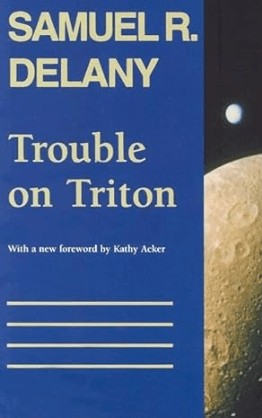
Trouble on Triton
Samuel R. Delany’s Trouble on Triton (published as Triton in the U.S.) is one of the finest written, poorly known works of literary sci-fi in publishing history. Perhaps this is due to the fact that it’s a short work—really a novella—with a post-modern, elliptical plot, not to mention some gender-bending content that was way ahead of its time. Set in a dome-style space colony on the farthest moon in the solar system, it tells the story of Bron, an ordinary schlemiel who’s in love with a mysterious, beautiful performance-artist. What really makes this book fascinating is its depiction of a high-tech, post-scarcity society that anticipated Iain Banks’s Culture novels by decades.
The Peripheral
William Gibson pretty much invented cyberpunk, so it’s fitting that he should write one of the best twists on that genre to come along in years. The Peripheral begins in what appears to be standard Gibson territory. Set in an economically devastated near-future, the story centers on Flynn, a young woman who makes her living as a remote contractor who works in the virtual reality of cyberspace. She thinks she is testing on a prototype for a video game set in a much farther distant, higher-tech future. But when she witnesses a murder in this other, virtual world, she realizes that it’s not virtual at all, but an actual, alternate future earth to which she is connected through a mysterious Chinese server.
The rest of the novel involves her getting to know her future-based boss, Wilf, and helping him solve the murder mystery. Wilf, in return, gives Flynn money and technology to help her and her friends change their timeline, hoping to avoid the environmental catastrophe—a.k.a. “The Jackpot”—that has denuded the planet in Wilf’s. (He explains that their timelines are now independent of each other, so she won’t be messing with his present.) It’s one of Gibson’s best, tightest books with a page-turner plot and some brilliant twists.
The Man in the High Castle
Speaking of alternate timelines, have you ever felt like you were stuck in the wrong one? And it’s not a good one? This is the experience of all the characters in The Man in the High Castle. Set in the 1960s, the book imagines an alternate earth where the Axis powers won World War II. Nazi Germany controls the American east coast, Japan the west coast, and the midwest serves as a vast DMZ between the two. Like most of Dick’s novels, the novel involves several interlocking narratives concerning characters from all classes, high and low, each of whom struggles to be a good person in an insane world.
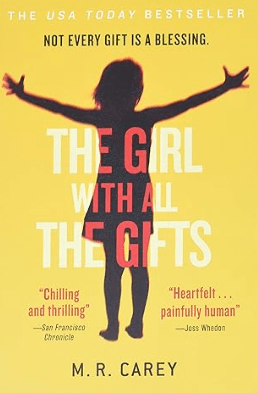
The Girl with All the Gifts
In the last twenty years, there have been so many zombie apocalypse novels, movies, tv shows, and video games that one would expect it to be completely…well, dead. Played out. Void of new ideas.
That’s what I thought when I picked up The Girl with All the Gifts. You can imagine my surprise when I found it to be one of the best written, engrossing, and often thrilling novels I’ve ever read. Its great strength lies in its central twist on the zombie story: the hero (actually heroine) is, herself, a zombie.Sort of. Ten year-old Melanie is infected with the fungus that turns people into zombies, but despite an almost irresistible hunger for human flesh, she retains her human intellect and sensibility. A prisoner in a military-run research station tasked with studying zombie children, Melanie has super-human strength, a genius I.Q., and a love of Greek mythology. She also loves her “teacher” (actually, a sympathetic scientist), Miss Justineau.
When the research station is overrun by zombies, Melanie becomes the savior of her former captors as they make their way across the English countryside, trying to get back to human-controlled territory. The great irony of the novel is that most of the evil Melanie confronts on her journey comes from humans, not zombies. (Or maybe that’s not so ironic, after all.)
The Wave
Known primarily for his mystery novels, Walter Mosley is just a damned good writer, period. The Wave is a rip-snorting, old-school sci-fi novel with a modern sensibility. It’s about a working-class stiff named Errol who comes home one night to find that his father has paid him a visit. No big deal, except for the fact that his father has been dead for years.
The explanation lies is an sentient extremophile that lives so deep in the earth’s crust it has never been discovered…until now. Intelligent and deadly, it can take the shape of any biological form (including poor Errol’s dead father), accessing the target’s memories and consciousness in the process. Errol soon finds himself on the run from scientists who want to study the entity and military men who want to kill it. Good stuff from one of the best.
I’ve been seeing a lot of on-line ads for the new Nosferatu movie directed by Dave Eggers. It looks like a pretty good movie, although, judging by the trailers, it seems to be emphasizing the horror (e.g., slasher) elements of the classic Nosferatu/Dracula story over the erotic angle (which most film adaptations have veered toward).
Or does it? Looking at the poster, the hook line poster reads “Succumb to the Darkness.” It’s a seductive line, which doesn’t quite seem to go with the image portrayed—that of a beautiful young woman in a nightgown lying on her back with her mouth open, while a skeletal, monstrously taloned hand reaches for her face.
Erotic? Not really. Gross? Yeah, kinda. This thematic confusion between the film’s trailer and its poster reflects, I think, the difficulty in adapting the Dracula story to the screen. (Yes, I know that Nosferatu is not the same as Dracula, but close enough.) The difficulty is made worse in our present time, the 21st Century, when porn is only a few clicks away and the idea of truly transgressive sexual activity is more and more difficult to imagine.
(Author’s Note: this post originally appeared on my old blog, Bakhtin’s Cigarettes.) I don’t want to jinx the man, but the fact that Kirk Douglas still lives is an unmitigated source of joy for me. If you believe, as I do, that movie stars become movie stars because of some internal life-force, whose aura is palpable even when projected onto a silver screen, then Kirk Douglas seems like the best proof of this theory.
At 101, Douglas is a living bridge to Hollywood’s second Golden Age—the 1940s to late 1950s. A bone fide movie start by 1949, Douglas was, along with other mavericks like Burt Lancaster, one of the first major actors to become a power-player in his own right. In an era when the Hollywood studio system traded actors like cattle, he formed his own studio and made his own films. He fostered young writers and directors—most notably, a brilliant, aloof young filmmaker named Stanley Kubrick.
Christmas came early for me this year! Many thanks to Ms. Oline Cogdill and the good folks at the Sun-Sentinel for putting Twice the Trouble on their Best Mystery Fiction Books of 2024 list! I am very honored.
One of the coolest classes I took at U.F. was Intro To Astronomy, taught by a funny old German guy named Heinrich Eichorn who, I later learned, was Chair of the Astronomy Department. (Yes, this was back in those quaint old days when top-notch professors had to actually, you know, teach class. And not just to grad students!) While Professor Eichorn’s lectures tended to meander a bit, he had a genuine enthusiasm for the subject that students, myself included, could sense and respond to. I remember one particular class when, in one of his usual, off-topic asides, he said, “We know the universe is not infinite. If it were, then every point in the sky above us would always be as bright as a star.”
For me, this was one of those mind-blowing moments when one is exposed to the wisdom of the ages. In this case, it was that of another German astronomer, Johannes Kepler, who in 1610 realized that if the universe really were infinitely large, and infinitely old, then every line-of-sight direction one looks at in the sky should eventually hit a star. Thus, the entire sky should be as bright as (and, worse still, as hot as) the surface of a star. Nevermind the fact that most of these stars would be very, very far away. Their light would still have an infinite amount of time to reach us, and there would be an infinite number of them shining down on us.










 Ash Clifton, Writer