The audiobook for MYOPIC DUPLICITY is out today. The brilliant actor Jenn Lee did the voice narration for my short story. Please check it out here on Audible!!!
And, once again, many thanks to Jeff Circle and Leonardo Audio.


The audiobook for MYOPIC DUPLICITY is out today. The brilliant actor Jenn Lee did the voice narration for my short story. Please check it out here on Audible!!!
And, once again, many thanks to Jeff Circle and Leonardo Audio.
As usual, it took us a while, but Margaret and I finally posted our second (and final) book talk episode on Ursula K. Le Guin’s classic sci-fi novel The Dispossessed. I will probably be doing another post on my final thoughts about the book soon. In the meantime, please check out the videos (Part I is here) and give them a like.

In the summer of 1982, I was a very unhappy boy. Being a nerd in an upper-class high school full of preppies and jocks, I didn’t fit in very well. I hated most of my classes. I had a few good, close friends (including some jocks), but that was it. As one would expect, I spent a lot of time in my room reading sci-fi novels and typing short stories on the typewriter my mother had bought me.
The only thing that kept me sane was movies. Fortunately, 1982 turned out to be the most incredible time in cinematic history to be a nerd. A string of classics came out that summer including Blade Runner, The Thing, The Road Warrior (a.k.a. Max Max II), Star Trek II: The Wrath of Khan, Poltergeist, Tron, Conan the Barbarian, and (the 800-pound gorilla) E.T. Even at the time, I was cognizant that this bumper crop of cool films, all coming out within a few weeks of each other, was a very unusual, almost magical development. I spent many hours on the bus with my friends going to and from the local cineplex, where we watched many of these films over and over.
For forty years, I labored under the delusion that this rapid series of classics was just a lucky coincidence. But while reading Chris Nashawaty’s fine nonfiction book, The Future Was Now: Madmen, Mavericks, and the Epic Sci-Fi Summer of 1982, I learned otherwise. A good historian will reveal that any event, no matter how seemingly incredible or unlikely, actually emerges logically from previous events. That is, the seeds were planted years or even decades before. And in 1982, main seed was a little film called Star Wars. As Nashawaty explains:
Continue reading “What I’m Reading: “The Future Was Now””There’s an unwritten rule for reporters and trendwatchers who cover Hollywood that if you want to know why a movie—or a particular group of movies—was made, all you need to do is look back and see what was a hit at the box office five years earlier since that’s the typical gestation period for studio executives to spot a trend, develop and green-light an imitator, push it into production, and usher it into theaters. And the summer of 1982 would prove no exception, coming exactly five years after Star Wars. What seemed underreported, however, was how this new wave of sci-fi titles had been conceived and carried out. It is a wave that we’re still feeling the aftereffects of, for better and worse, today.
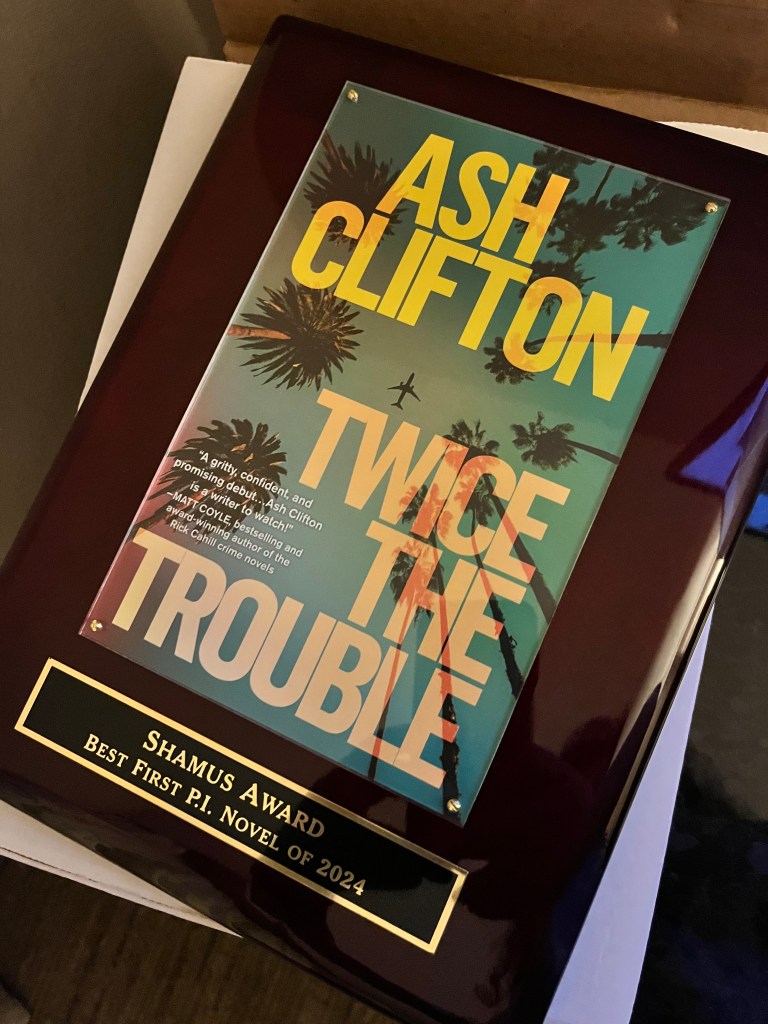
I’m very honored to announce that Twice the Trouble has won this year’s Shamus Award in the First Novel category. Many, many thanks to the Private Eye Writers of America, my incredible agent Cindy Bullard, and Crooked Lane Books!!!

Well, Cathy and I got back from Orlando on Thursday, and this is the first chance I’ve had to write a post about it. All in all, it was a fine trip! My book talk at Barnes and Noble went well, mostly due to Danni and Michelle, the hosts of the excellent podcast Book Club After Dark, who were nice enough to interview me. They asked great, insightful questions, and I had a lot of fun. The turn-out was modest, but the people who did show up seemed really interested. They asked some great questions, too. It was especially nice to see my old friend Norm, who came to the event to cheer me on. He also snapped the picture above.
Afterward, Cathy and I had a great dinner and some fine beers at the Harp and Celt Pub downtown. The next day, we did a driving tour of Orlando, Noland Twice’s home turf, refamiliarizing ourselves with our old stomping grounds. As one might expect, parts of the city seem completely different from when we lived there, while other parts seemed exactly the same. Overall, O-Town still feels like two cities. There’s the lovely, old, Southern city, with its tree-shaded streets and gorgeous houses from the 1930s and ‘40s. Then, there’s the litter-on-a-stick, urban sprawl of Generica, with its strip-malls and fast-food shacks and liquor stores. And traffic. Lots of traffic. The really sad part about Orlando is that you have to drive through the nasty bits to get to the nice, old, quaint bits. But oh well. I still love the city.

When we were done exploring, Cathy and I drove down Mills Avenue and visited the Mennello Museum of American Art, which is perhaps the best small museum I’ve ever visited. I was especially taken with their current exhibit, entitled Pool Party, which had lots of amazing photos and paintings of American pool culture from all over the country. I was especially taken with this 1970 photo, above, by former combat photographer Slim Aarons. It’s titled Catchup by the Pool, and it seems to encapsulate the entire upper-class, White, suburban culture of the U.S., right on the cusp between two equally garish decades. And yet, it’s also kind of…sweet. I find myself wanting to go to this party.

And then, just this morning, in one of those instances of synchronicity that seem to happen fairly often to me (and which I blog about, a lot), I happened to be presented with a YouTube ad (for Speechify, of all things). Before the skip button came up, I had to leave the room, so I paused the ad so I wouldn’t miss the beginning of the actual video I was waiting for. (Just to prove I wasn’t crazy, I did a screen grab, above left.)
When I came back, I noticed that there was something weirdly familiar about the freeze-frame that I happened to pause on. If you look at the background, on the wall of whatever apartment or motel room the ad was apparently filmed in, you can see—lo-and-behold!—the same photo by Slim Aarons.
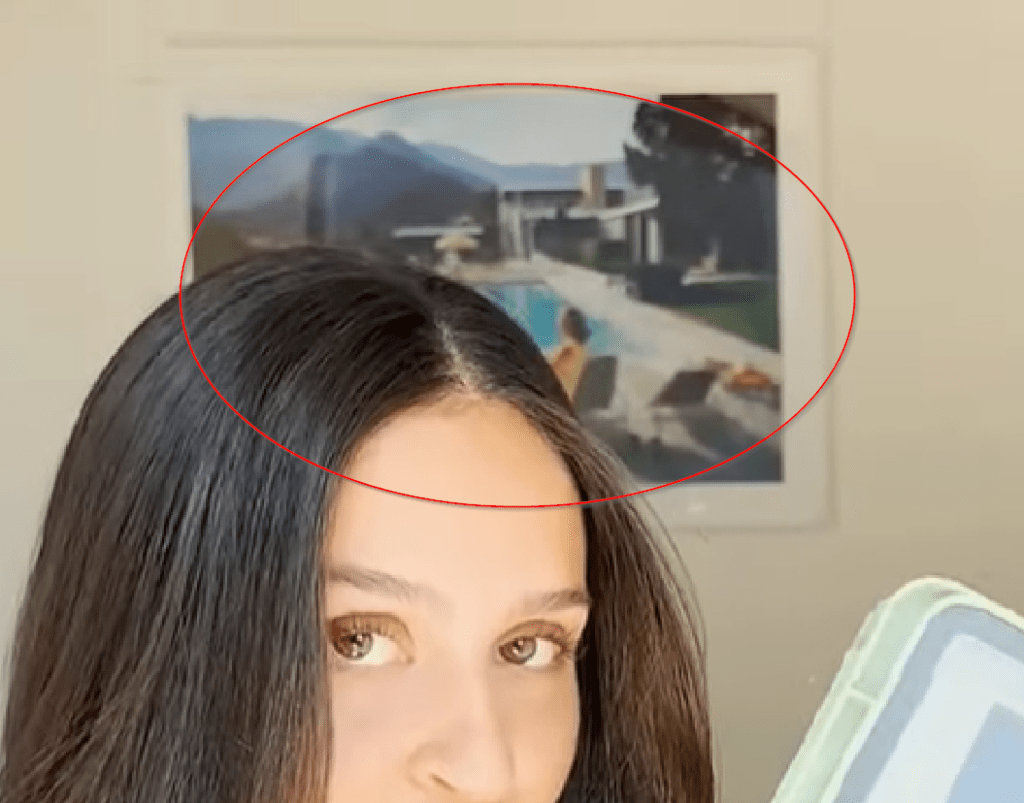
What are the odds? Like, a bazillion-to-0ne! Talk about synchronicity-on-steroids!
Anyway, it seemed like a magical end to a good trip.
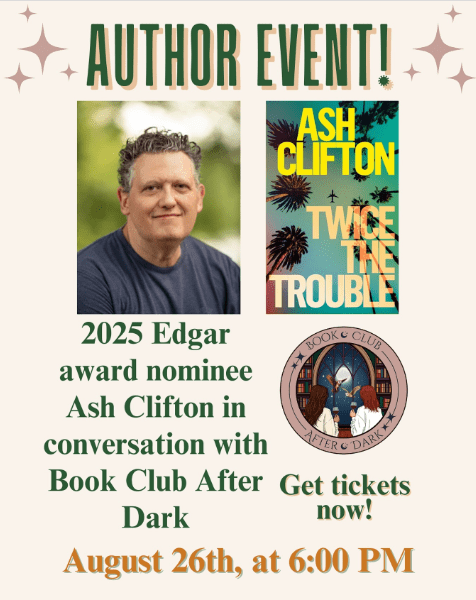
I’m heading off to O-Town tomorrow (yes, the setting for Twice the Trouble) to hold an author talk at the Barnes & Noble on Colonial. If you’re in the area, please come! Danni and Michelle, the hosts of the excellent Book Club After Dark podcast will be presiding.
(This is a ticketed event, so please click here to get your ticket.)

As I’ve stated before, one mark of a truly fine mystery novel—for me at least—is if I feel the need to go back and reread it. This isn’t just a matter of me waiting long enough to forget whodunnit (a period of time that grows shorter the older I get), it’s also an indication that something about the novel stuck with me, and made me want to revisit its imagined world.
So, it’s perhaps not surprising that I find myself rereading many of Edith Pargeter’s (writing as Ellis Peters) Brother Cadfael novels. Currently, I’m on The Rose Rent, which is about as fine an episode in the series as any. It has all the components of a truly great mystery novel—namely, a compelling and complicated sleuth; an entrancing and alien setting; original and interesting secondary characters; and a multi-layered plot.
And a voice. Of course, a great narrative voice. Take the opening paragraph of the novel:
By reason of the prolonged cold, which lingered far into April, and had scarcely mellowed when the month of May began, everything came laggard and reluctant that spring of 1142. The birds kept close about the roofs, finding warmer places to roost. The bees slept late, depleted their stores, and had to be fed, but neither was there any early burst of blossom for them to make fruitful. In the gardens there was no point in planting seed that would rot or be eaten in soil too chilly to engender life.
I love the elegance and almost romantic feel to this passage, which is characteristic of all Pargeter’s writing. You feel like you’re in competent hands, which is crucial considering that you’ve been transported to England in the Twelfth Century. (Specifically, to Shrewsbury, the town where Cadfael lives as the resident herbalist of the local Benedictine monastery.) I love the sense of desolation in this opening. We can almost feel the lingering winter, which has gone on too long and threatens the well-being of the town, including the ordinary folk, the monks, and even the nobles. It also suggests the coming tragedy of the murder around which the story will be revolve—that of a young, love-stricken monk who is killed trying to protect the woman with whom he has become infatuated.
Yes, it’s a desolate opening. But with Pargeter, you never really feel hopeless. Sure, it’s the Dark Ages, but her stories are populated with good, strong, shrewd people who always find a way to make the best of things. Take this paragraph, which comes a bit later and introduces Brother Cadfael himself:
Brother Cadfael, preoccupied with his own narrower concerns, continued to survey the vegetable patch outside the wall of his herb-garden, digging an experimental toe into soil grown darker and kinder after a mild morning shower. “By rights,” he said thoughtfully, “carrots should have been in more than a month ago, and the first radishes will be fibrous and shrunken as old leather, but we might get something with more juices in it from now on. Lucky the fruit-blossom held back until the bees began to wake up, but even so it will be a thin crop this year. Everything’s four weeks behind, but the seasons have a way of catching up, somehow. Wareham, you were saying? What of Wareham?”
#
He is speaking, of course, to his best friend, Hugh Berenger, the Sheriff of Shrewsbury. Berenger is a much younger man, but like Cadfael he is world-weary, experienced, and tough. Indeed, many of the best novels in the series depict bad guys who underestimate Berenger, with his mild demeanor and slight build, as weak. He is, in fact, an intelligent man and a cunning fighter. Berenger has just brought news of the most recent battle of the on-going English civil war (the Anarchy) which serves as the backdrop for all the novels. Berenger, we know, has befriended Cadfael in part because they have both been soldiers—in Cadfael’s case, a veteran of the First Crusade, which caused him to live in the Middle East for many years, where he lived with a Muslim widow and fathered a child with her.
A great part of the appeal of these novels is this tension between two sides of Cadfael’s character. He is the very opposite of an oblate—a person who has come into the monastery as a child. Rather, Cadfael has converted later in life, after have seen many terrible and wondrous things and had many worldly experiences. As such, he brings a shrewd, wise perspective to his role as a monk, healer, and protector of the innocent—a shrewdness that is matched by the “hatchet-faced” Abbot Rudolfus, who often conspires with Cadfael to bend the rules in favor of a remorseful miscreant or helpless person.
And, of course, there is just Pargeter’s unerring talent for winning, memorable description. For instance, take this passage, in which a self-serving (and possibly villainous) young character, Vivian, is introduced.
[Vivian] was a very personable young man indeed, tall and athletic, with corn-yellow hair that curled becomingly, and dancing pebble-brown eyes in which a full light found surprising golden glints. He was invariably elegant in his gear and wear, and knew very well how pleasant a picture he made in most women’s eyes. And if he had made no headway yet with the Widow Perle, neither had anyone else, and there was still hope.
The woman on whom Vivian has set his sights is Judith Perle, a young widow who has leased her old house to the monastery for the meager “rent” of a single rose per year, plucked from the bush that grows outside the doorway. Judith is, of course, very rich woman, and must of the plot revolves around a murder who is intent of separating her from that wealth—even if this means killing her in the process.
The Rose Rent is a great mystery novel. Check it out…
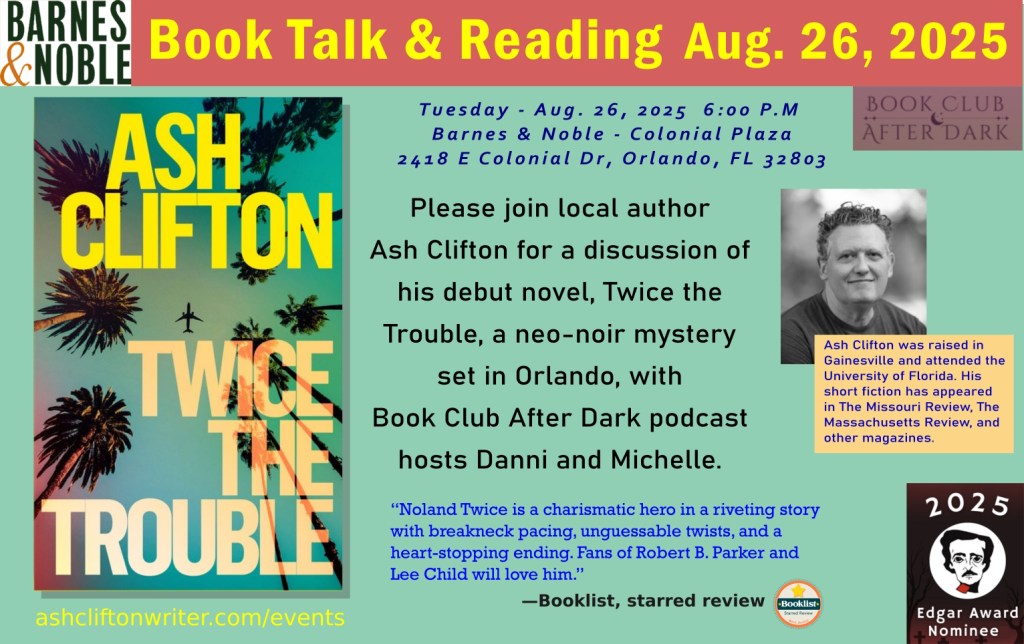
If you’re going to be in Central Florida later this month, please try to attend my book talk on August 26 at the Barnes & Noble with Danni and Michelle, the hosts of the Book Club After Dark. We will be discussing Twice the Trouble, the paperback edition of which goes on sale that day.
The event is ticketed, so please click here to get your (free) ticket and reserve a seat.
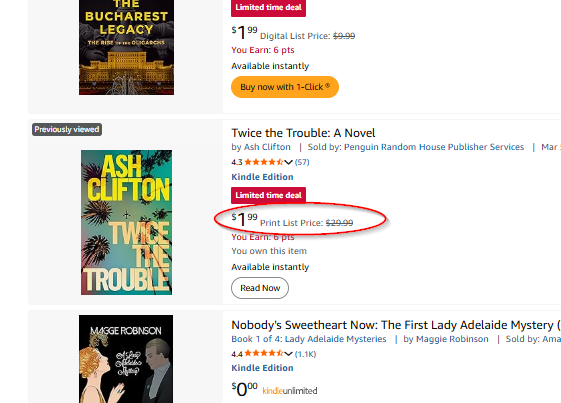
What can two bucks buy you in today’s economy? A copy of my book, that’s what! For the entire month of August, the Kindle edition of Twice the Trouble is on sale for just two bucks. That’s right. Just two Ameros!
You should buy it! Right now! Don’t give me that “I don’t even have a Kindle” crap! Just buy the damned book. Buy buy buy!
What’s worse than a shameless plug? A rerun of a shameless plug!
I’ve been laid up with back problems all week and haven’t been doing much, so I thought I would repost this oldie. I had a lot of fun writing this essay. Many thanks to the good people at CrimeReads for giving me the opportunity.
Check it out…

