
I had a really good time this week doing a Q&A with Bianca Vendenbos of Book Notions. Check it out here when you can!

I had a really good time this week doing a Q&A with Bianca Vendenbos of Book Notions. Check it out here when you can!

One of my favorite movies of the last twenty years is Ridley Scott’s The Martian. It’s a science-fiction/adventure movie about an astronaut (Matt Damon) who becomes stranded on Mars after his comrades leave him for dead. Marooned on a barren, hostile world, he has to use his brains and ingenuity to survive until his friends come back to rescue him. By the end of the movie, he has survived dust storms, explosions, freezing temperatures, and starvation.
How does he overcome all these challenges?
Science.
The story is familiar, of course. It has many antecedents, including with the original stranded-on-an-island novel, Robinson Crusoe, and also (more directly) to a great B-movie Robinson Crusoe on Mars. In that classic 1964 cheese-fest, the hero survives by finding a Martian cave full of air where plants still grow, water still flows, and there’s a steady source of light (which is never explained). He even befriends an alien who is also trapped on the planet.
Continue reading “The Scientist Hero: Our Newest Cinema Archetype”
I am very honored (not to mention shocked, amazed, and overwhelmed) to have received an Edgar Award nomination for Best First Novel by an American Author. Many thanks to the Mystery Writers of America, Crooked Lane Books, and my outstanding agent, Cindy Bullard of Birch Literary.
I am also humbled to be in such fine company. The other five nominees have written some truly great books.
And, by the way, the Kindle edition of Twice the Trouble is on sale right now on Amazon. I’m just sayin…

(…or, Everything That’s Wrong with Deadpool & Wolverine)
Well, I finally got around to watching Marvel’s latest blockbuster, Deadpool & Wolverine. This was the first Marvel movie I’d watched in a while, and now I remember why. Holy smoke, what a crappy film! As I watched it—doggedly, hoping it would get better, resisting the urge to switch it off—I began to realize that this film is not only bad, it is profoundly bad. That is, bad in a way that’s worth talking about.
Normally, being a nominal “artist” myself, I don’t lay into other people’s work just because I don’t like it. Why bother? But this movie triggered me in such a way that I have to rant about it for a while. Specifically, it pissed me off because it breaks the single most important rule of genre fiction (which applies equally to genre film): Keep it Real.
Wait a moment, you say. Realistic genre fiction? Realistic fantasy fiction? Sounds like an oxymoron, right? Actually, no. For while every Marvel movie, like every James Bond movie and every action movie and every horror movie and even every science fiction movie, is, in a sense a fantasy, the good ones display a kind of realism that’s critical, and vastly more important than any sense of day-to-day realism in the story itself. This is psychological realism. And psychological realism has its root in physiological realism—the realism of the human body.
Continue reading “Getting Stabbed Doesn’t Hurt”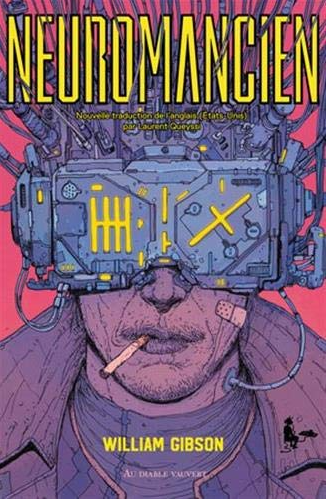
If I were to make a list of the most influential science fiction novels of all time, William Gibson’s Neuromancer would surely be on it. How often does a book create a whole genre—almost single-handedly? I say “almost” because there were other cultural touchstones of the cyberpunk genre, primarily Ridley Scott’s landmark film Blade Runner. But Neuromancer was the primary literary component of the movement, with its landscape of towering, high-tech super-cities where the rich live high (in every sense of the word), and the poor live very, very low.
Expanding on his ground-breaking short story, “Johnny Mnemonic,” Gibson created a dark near-future in which giant “mega-corporations,” many of them Japanese, have taken control of all aspects of life, and the richest people have almost become a different species. Average people work as wage-slaves to the corporations, and the closest thing to a counterculture is a teeming underclass of rebel hackers who make their existence by spying on (and stealing from) the corporate oligarchy.
These underground, anti-heroes are the punks of cyberpunk, and they are what made it so compelling as a genre. In a world where technology and corporate greed have dehumanized everyone, the punks beat the system at its own game. They do so by humanizing it, using their courage, individuality, and creativity to win in the one place where everyone is still equal—the virtual world of cyberspace.
That’s why I like this cover so much. Strangely, though Neuromancer was published forty years ago, there has never been a cover that really captured the vibe and essence of the book. Until this one. It’s a very obscure cover belonging to a Brazilian edition of the novel and created by Spanish artist Josan Gonzalez (a.k.a. Deathburger). I like it because it feels like a 1980s comic book—specifically, the work of French artist Moebius from the magazine Métal hurlant back in the 1980s (truly, the golden age of cyberpunk). The character portrayed is, presumably, that of Case, the hacker-hero of the novel. With a cigarette dangling from his mouth and a welter of wires rising from his VR goggles (from his “brain,” essentially), he personifies the spirit of cyberpunk: a rebellious unflappability combined with human creativity and technical skill.
I was going to make a new Christmas Sci-Fi List to go with the first one that I wrote some years ago. But…well…I flaked out. So, here is a belated list of some of my favorite science fiction novels. And why not? New Year’s Day is a time to think about the future, right? RIGHT?
Anyway, here’s the list…
Trouble on Triton
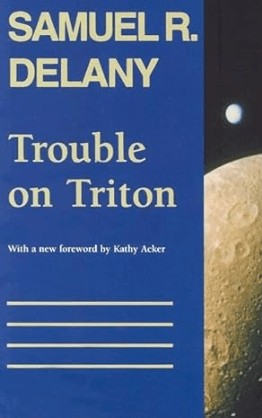
Samuel R. Delany’s Trouble on Triton (published as Triton in the U.S.) is one of the finest written, poorly known works of literary sci-fi in publishing history. Perhaps this is due to the fact that it’s a short work—really a novella—with a post-modern, elliptical plot, not to mention some gender-bending content that was way ahead of its time. Set in a dome-style space colony on the farthest moon in the solar system, it tells the story of Bron, an ordinary schlemiel who’s in love with a mysterious, beautiful performance-artist. What really makes this book fascinating is its depiction of a high-tech, post-scarcity society that anticipated Iain Banks’s Culture novels by decades.

The Peripheral
William Gibson pretty much invented cyberpunk, so it’s fitting that he should write one of the best twists on that genre to come along in years. The Peripheral begins in what appears to be standard Gibson territory. Set in an economically devastated near-future, the story centers on Flynn, a young woman who makes her living as a remote contractor who works in the virtual reality of cyberspace. She thinks she is testing on a prototype for a video game set in a much farther distant, higher-tech future. But when she witnesses a murder in this other, virtual world, she realizes that it’s not virtual at all, but an actual, alternate future earth to which she is connected through a mysterious Chinese server.
The rest of the novel involves her getting to know her future-based boss, Wilf, and helping him solve the murder mystery. Wilf, in return, gives Flynn money and technology to help her and her friends change their timeline, hoping to avoid the environmental catastrophe—a.k.a. “The Jackpot”—that has denuded the planet in Wilf’s. (He explains that their timelines are now independent of each other, so she won’t be messing with his present.) It’s one of Gibson’s best, tightest books with a page-turner plot and some brilliant twists.

The Man in the High Castle
Speaking of alternate timelines, have you ever felt like you were stuck in the wrong one? And it’s not a good one? This is the experience of all the characters in The Man in the High Castle. Set in the 1960s, the book imagines an alternate earth where the Axis powers won World War II. Nazi Germany controls the American east coast, Japan the west coast, and the midwest serves as a vast DMZ between the two. Like most of Dick’s novels, the novel involves several interlocking narratives concerning characters from all classes, high and low, each of whom struggles to be a good person in an insane world.
The Girl with All the Gifts
In the last twenty years, there have been so many zombie apocalypse novels, movies, tv shows, and video games that one would expect it to be completely…well, dead. Played out. Void of new ideas.
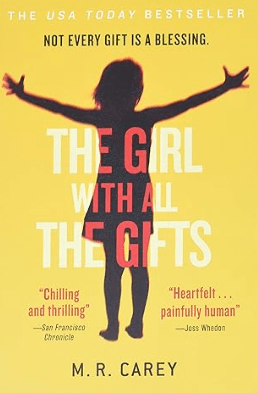
That’s what I thought when I picked up The Girl with All the Gifts. You can imagine my surprise when I found it to be one of the best written, engrossing, and often thrilling novels I’ve ever read. Its great strength lies in its central twist on the zombie story: the hero (actually heroine) is, herself, a zombie.Sort of. Ten year-old Melanie is infected with the fungus that turns people into zombies, but despite an almost irresistible hunger for human flesh, she retains her human intellect and sensibility. A prisoner in a military-run research station tasked with studying zombie children, Melanie has super-human strength, a genius I.Q., and a love of Greek mythology. She also loves her “teacher” (actually, a sympathetic scientist), Miss Justineau.
When the research station is overrun by zombies, Melanie becomes the savior of her former captors as they make their way across the English countryside, trying to get back to human-controlled territory. The great irony of the novel is that most of the evil Melanie confronts on her journey comes from humans, not zombies. (Or maybe that’s not so ironic, after all.)

The Wave
Known primarily for his mystery novels, Walter Mosley is just a damned good writer, period. The Wave is a rip-snorting, old-school sci-fi novel with a modern sensibility. It’s about a working-class stiff named Errol who comes home one night to find that his father has paid him a visit. No big deal, except for the fact that his father has been dead for years.
The explanation lies is an sentient extremophile that lives so deep in the earth’s crust it has never been discovered…until now. Intelligent and deadly, it can take the shape of any biological form (including poor Errol’s dead father), accessing the target’s memories and consciousness in the process. Errol soon finds himself on the run from scientists who want to study the entity and military men who want to kill it. Good stuff from one of the best.

1.) Alternate Realities One of the great things about living in a university town is that you get to hear some great lectures by famous people—for free. Back in the 80s, I attended a lecture on the subject of evolution by the late, great Stephen Jay Gould. He talked about how incredibly subtle mutations in the gene pool can, over time, create titanic changes in the history of earth. He called this the Phenomenon of Contingency. To illustrate his point, he mentioned two movies that deal primarily with the subject of an individual’s impact on the course of history—the way small choices can resonate through the future. The movies he sited were It’s a Wonderful Life and Back To The Future. He might have mentioned a dozen or so works of modern science fiction, or the Hindu concept of the Net of Jewels. Or all of Buddhism, for that matter. But he was right on the money with It’s a Wonderful Life. The movie is about keeping your eye on the Cosmic View, rather on selfish or ego-centric desires. George has forgotten how much good he had done in Bedford Falls because the effects of his actions have been blurred by time. Clarence the Angel reveals (or re-reveals) it to him.
Continue reading “Ten Things I Love About “It’s a Wonderful Life””
I’ve been seeing a lot of on-line ads for the new Nosferatu movie directed by Dave Eggers. It looks like a pretty good movie, although, judging by the trailers, it seems to be emphasizing the horror (e.g., slasher) elements of the classic Nosferatu/Dracula story over the erotic angle (which most film adaptations have veered toward).
Or does it? Looking at the poster, the hook line poster reads “Succumb to the Darkness.” It’s a seductive line, which doesn’t quite seem to go with the image portrayed—that of a beautiful young woman in a nightgown lying on her back with her mouth open, while a skeletal, monstrously taloned hand reaches for her face.
Erotic? Not really. Gross? Yeah, kinda. This thematic confusion between the film’s trailer and its poster reflects, I think, the difficulty in adapting the Dracula story to the screen. (Yes, I know that Nosferatu is not the same as Dracula, but close enough.) The difficulty is made worse in our present time, the 21st Century, when porn is only a few clicks away and the idea of truly transgressive sexual activity is more and more difficult to imagine.
Continue reading ““Dracula” Isn’t About What You Think It’s About”I have a theory about horror novels. The secret to a good horror novel, I think, is not gore, or violence, or even suspense. The secret is empathy. The empathy we, as readers, form for the main characters, and the empathy the main characters feel for each other.

This should be obvious, but it’s not. I have read (well, started) many celebrated horror novels, some of them very well written, only to set them aside after a chapter two because I didn’t care about any of the characters. Contrast this with the very best horror fiction from masters like Stephen King. King is famous for creating main characters who are kind, decent, spirited people with whom the reader instantly connects (and worries about). King’s characters also tend to be underdogs and outcasts. Nerds. Geeks. Handicapped kids. Fat kids. Gay kids. Such types are the most vulnerable in our society, and therefore most vulnerable to whatever monster Kings pits them against. Their underdog status makes them even more sypathetic to readers, and makes their courage even more admirable.
This is not to say that protagonists of horror novels should be all good. Far from it. In fact, King often presents the reader with deeply flawed, erratic main characters who must discover their own inner resilience and courage to face the evil that confronts them.
Recently, I found myself thinking about such matters as I read Lois Murphy’s excellent novel Soon from 2019. Like many great horror books (or many great books of any kind), Soon stays with you long after you finish the last page. It’s got some genuinely creepy stuff in it. Most of all, though, it has a likable, sympathetic, and funny main character named Pete.
Pete is a retired cop who lives in the tiny town of Nebulah in rural Australia. Nebulah is a new twist on the concept of a “ghost town” in that its inhabitants are literally tormented by ghosts. Rather, by a strange, evil entity called The Mist that descends upon the town every evening. From this vapor, a hellish gallery of semi-corporeal spirits attacks any person foolish or unlucky enough to be caught outside after sundown. The victims suffer grisly, violent deaths, but their bodies are never found. (Their remains dissolve mysteriously in the mist soon after being discovered.)
Not surprisingly, the town’s population rapidly dwindles from a few hundred to a few dozen, and then down to just eleven. Most people leave. The rest are picked off one by one. Pete is one of the de facto leaders of this tiny remnant of hard-core town folk, most of whom are too poor or feckless or otherwise attached to the place to ever leave. Pete is neither poor, nor attached, nor feckless, but he stays anyway, mainly to protect his friends. These survivors meet each night at one of their homes and spend the night together, trying to hear the demonic wailings and thrashings coming from outside the windows and doors. (The Mist, rather like vampires, can’t cross the solid threshold of a home unless there is some gap that would let it in.)
I find myself admiring much of Ms. Murphy’s writing, especially in the way she renders the character of Pete. The plot also has some genuinely surprising twists and interludes, such as when Pete goes to visit his estranged daughter in a distant city.
Most of all, I liked the psychological realism of the book. Everyone left in Nebulah has some damned good, practical reasons for not leaving (just ask them), but none of these seems greater than what we suspect is a fundamental weakness in their character. Some are afraid of being poor in a new place. Others are reluctant to give up the homesteads they have labored to improve over the years. Some are just too tired.
Others, like Pete himself, have some secret sin to atone for, and a guilt that keeps them from leaving.
Soon is a cool book. Check it out…
When I was a public school kid back in the 1980s, I used to spend hours at the bookstore, mostly looking at science fiction books. It wasn’t just the stories themselves that interested me, but the cover art. Back then, before the internet gave one an endless supply of great sci-fi concept art of any kind, the only way to get one’s imagination going was to head to the bookstore.
So, it’s probably inevitable that I would regard that time as a golden age of sci-fi cover art. And I do. When I look at sci-fi books today, there is usually no cover art to speak of, but just an exercise in graphic design. The title goes in this font 38 point; the author’s name goes in this font at 28 point; etc.; with some blurry, abstract notion of an alien planet or a futuristic city. Back in the pre-digital days, sci-fi cover art consisted mainly of actual paintings, made by actual painters.
One of the best actual painters was (and is) Michael Whelan. His work has that perfect blend of realism, action, and whimsy that I always looked for in a good sci-fi cover. For five decades, he created some of the best covers ever made, and they earned him a place in the Science Fiction Hall of Fame.
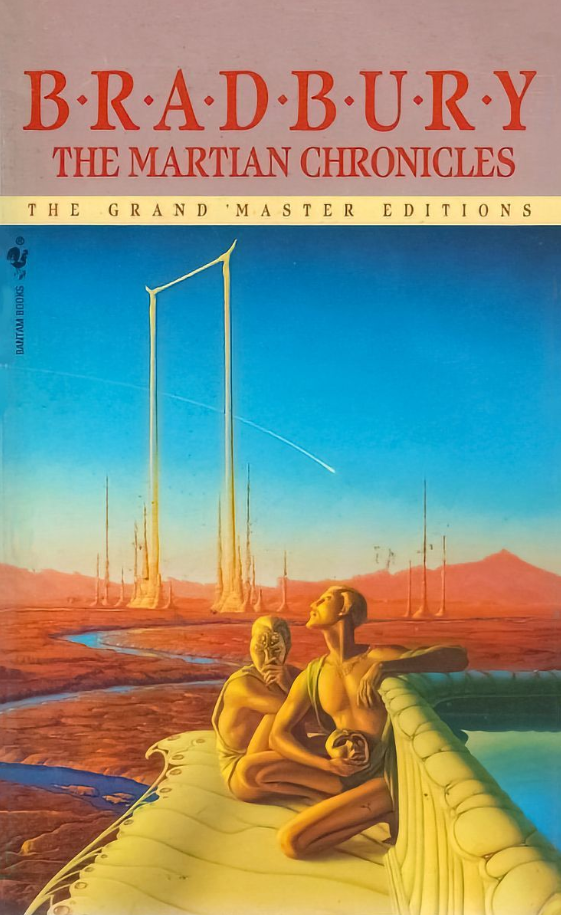
One of my favorites is the one above, his cover for the 1990 Bantam/Spectra edition of Ray Bradbury’s The Martian Chronicles. If you haven’t read it (and you should), it’s an allegory about the loss of ancient wisdom, the horrors of capitalism, and even the conquest of the American West. Haunting the work are the ghosts of the Martians themselves, who once-great civilization is helpless in the face of the invading Earth-men, with their guns and disease and endless greed. I love this cover because it gives you a sense of that lost majesty, but it also makes you curious about the story.
In other words, it kindles the imagination.

