
Well, it’s another day of the week ending Y, so it’s time for another Shameless Plug! This one is not even original, alas. Even so, it’s pretty cool that you can listen to the first three chapters of my novel, Twice the Trouble, totally free on Youtube! And it’s legal, even! (I think.)
Category: Genre Fiction
Do I Have the Gall to Post Another Shameless Plug? Yes. Yes, I do.
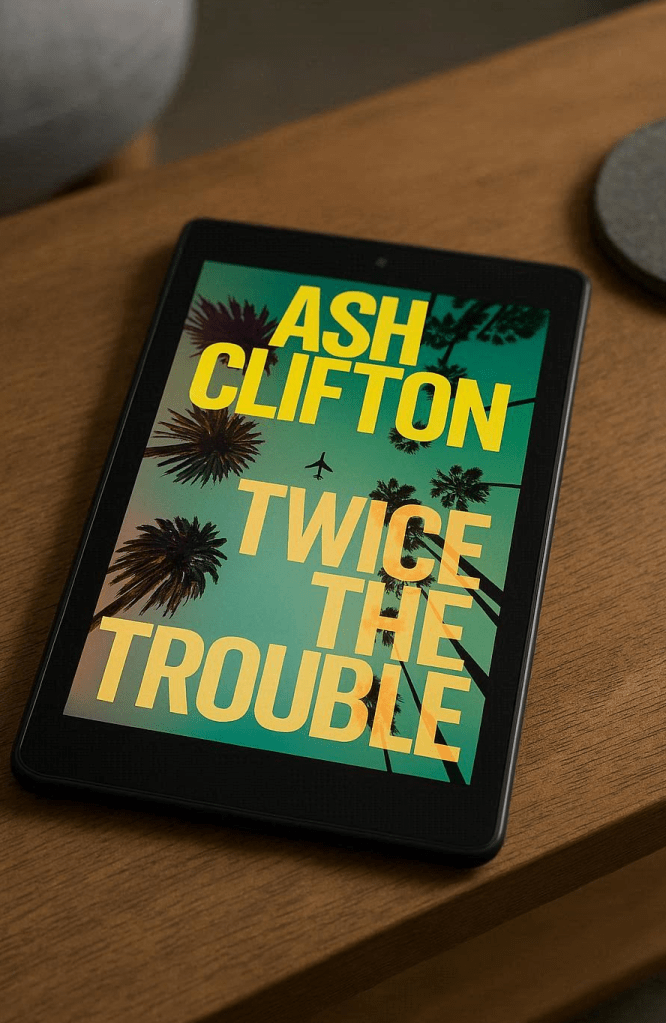
Just a heads-up…. My Edgar-nominated and Shamus-winning novel, Twice the Trouble, is a Kindle Deal all this month. You can get the ebook for just $1.99. That’s less than half the price of a Starbucks’ latte (and it will last a lot longer)!
Classic Sci-Fi Book Cover: “Babel-17”

I know, I know. This cover is a bit out-there. Not every sci-fi book cover, after all, has a spaceship hovering in a night sky over a plus-size female model in a metal bikini, go-go boots, and mail headdress. (But I kind of wish they did.)
Even so, this cover for Babel-17 by Samuel R. Delany is a bonafide classic by the great Spanish illustrator Vicente Segrelles, who has created a ton of great covers throughout his long and brilliant career. It was done for a series of Delany’s novels that were re-released by Bantam in the 1980s, all of which had great, subtle, off-beat covers.
Now, I’ve read a lot of snark about this cover on various chat-boards. Younger guys, especially, find it hilariously bad (and perhaps a lot of girls, too). I think this is because the woman depicted is not the usual, skinny, spandex-clad sci-fi babe. Personally, that’s one reason I like her. I think she’s mysterious, regal, and (yes) sexy.
More importantly, she captures the essence of the novel’s main character, Rydra Wong, who is not only the captain of a spaceship but also a master linguist. When government operatives seek her help in cracking an enemy, alien code called Babel-17, she discovers that it is not just a code—it’s an entire language. She promptly sets-off on a space-adventure to decipher the language, a quest that leads her into a war zone on the edge of the galaxy.
One of the things I love about Babel-17 is the way Delany, even way back in 1966, managed to push a message of tolerance and multi-culturalism. Wong’s spaceship is crewed by a rag-tag group of mercenaries, some of whom are not only transsexual but transhuman, opting for synthetically altered bodies that make them resemble wild animals or fairy tale creatures, and so on. Moreover, Wong’s desire to find the source of Babel-17—and, thus, better understand the aliens who are attacking humanity—suggests a deeper response to the usual fear and xenophobia that was so endemic in America at the time (and is again now, alas).
Babel-17 a classic sci-novel with a classic cover. Check it out…
What I’m Reading: “Paperbacks from Hell”
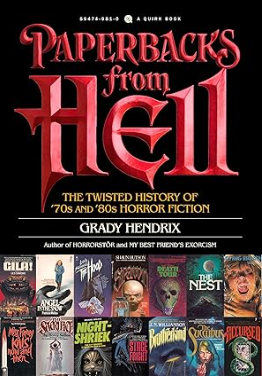
Having had exactly one book traditionally published, I am far from an expert on the world of publishing. Even so, I learned a lot more than I ever expected, and have since become fascinated by the industry as a whole. Also, I am currently working on a supernatural horror novel. So, it makes perfect sense that I would be drawn to Grady Hendrix’s excellent non-fiction book, Paperbacks from Hell, which examines (skewers?) pulp horror literature as it existed in the 1970s and 80s, both as a uber-genre and as an industry.
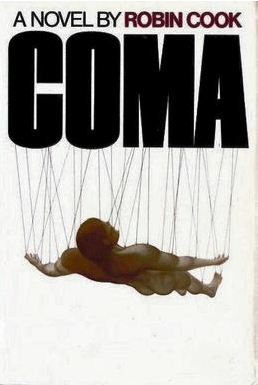
Let me say right up front that this is a very funny book. I found myself laughing out loud many, many times as Hendrix describes the trends and fads that overtook the genre. Take this passage where he introduces the wildly successful pop writer Robin Cook, whose 1977 book Coma is, in Hendrix’s words, the “source of the medical-thriller Nile.” As Hendrix goes on:
It all started with Robin Cook and his novels: Fever, Outbreak, Mutation, Shock, Seizure…terse nouns splashed across paperback racks. And just when you thought you had Cook pegged, he adds an adjective: Fatal Cure, Acceptable Risk, Mortal Fear, Harmful Intent. An ophthalmologist as well as an author, Cook has checked eyes and written best sellers with equal frequency. He’s best known for Coma (1977)…. Its heroine, Susan Wheeler, is one of those beautiful, brilliant medical students who’s constantly earning double takes from male colleagues or looking in the mirror and wondering if she’s a doctor or a woman—and why can’t she be both, dammit? On her first day as a trainee at Boston Memorial, she settles on “woman” and allows herself to flirt with an attractive patient on his way into a routine surgery. They make a date for coffee, but something goes wrong on the table and he goes into…a COMA!
Hendrix cleverly divides each chapter to a single, overarching trend in the pulp horror universe, with titles like HAIL, SATAN (novels of demonic possession and devil-sex), WEIRD SCIENCE (evil doctors and mad scientist-sex), INHUMANIOIDS (deformed monsters and mutant-sex), and so on. I was especially impressed by the way Hendrix explains each publishing fad as a symptom of a larger societal shift. For example, he explains how the white-flight phenomenon of the 1970s in which white middle- and upper-class families abandoned the big cities and moved to quaint, charming little towns in upstate New York or the mid-west or norther California or wherever, results in a surge of small-town horror novels like Harvest Home (wherein evil pagan matriarchs conduct human sacrifices to make the corn grow) and Effigies (wherein Satan is breeding grotesque monsters in the basement of the local church).
Another chapter entitled CREEPY KIDS, which deals with such diverse plot concepts as children who are fathered by Satan, children are who are really small adults pretending to be children, and children who, for whatever reason, just love to kill people. I particularly love this passage:
Some parents will feel helpless. “How can I possibly stop my child from murdering strangers with a hammer because she thinks they are demons from hell?” you might wail (Mama’s Little Girl). Fortunately there are some practical, commonsense steps you can take to lower the body count. Most important, try not to have sex with Satan. Fornicating with the incarnation of all evil usually produces children who are genetically predisposed to use their supernatural powers to cram their grandmothers into television sets, headfirst. “But how do I know if the man I’m dating is the devil?” I hear you ask. Here are some warning signs learned from Seed of Evil: Does he refuse to use contractions when he speaks? Does he deliver pickup lines like, “You live on the edge of darkness”? When nude, is his body the most beautiful male form you have ever seen, but possessed of a penis that’s either monstrously enormous, double-headed, has glowing yellow eyes, or all three? After intercourse, does he laugh malevolently, urinate on your mattress, and then disappear? If you spot any of these behaviors, chances are you went on a date with Satan. Or an alien.
One the many things I learned from reading the book was how the entire publishing world (not just horror) was permanently changed in 1979 by an obscure tax-law case called The Thor Power Tool Co. v Commissioner. In this case, the U.S. Supreme Court ruled that manufacturers could not write-down poor-selling or slow-selling inventory and thus reduce their tax liability. The case was focused on unsold parts for power-tools, but the ruling equally applied to publishing houses, who had hitherto done the same kind of write-down on their slow-selling novels. As Hendrix explains: “Suddenly, the day of the mid-list novel was over. Paperbacks were given six weeks on the racks to find an audience, then it was off to the shredder.” And so, inevitably, came the frantic scramble to find those half-dozen or so “blockbuster” books each season, behind which publishers focused their resources. (A similar “blockbuster” effect ravaged Hollywood in the 1970s, in this case due to the success of summer films like Jaws and Star Wars.) Books got less pulpy and more sparkly, with foil covers and die-cast cutouts like those made famous by the V.C. Andrews novels (which continued to be published, zombie-like, long after Andrews’s death).
Whether you’re a writer or just a pulp-paperback fan, Paperbacks from Hell is a great read. Check it out…

Ten Things I Love About “The Day the Earth Stood Still”

Well, over a week has passed since Halloween, and I’m still working through the classic horror and sci-fi movies that I rewatch every year around this time. One of my favorites (heck, one of everybody’s favorites, as far as I can tell, assuming that everybody is a nerd of a certain age) is Roger Wise’s 1951 classic The Day the Earth Stood Still (henceforth, TDTESS). Here are ten things I love about it….
1.) The Opening
This movie doesn’t dick around. It opens with the frantic calls of radar operators across the globe tracking an ultra-fast UAP as it enters the earth’s atmosphere. Word leaks out to press, generating a world-wide media frenzy—the “media,” in this case, being radio. Wise cast several then-famous, real-life radio broadcasters to play themselves, and I simply love hearing their great, precise modulated voices as they simultaneously try to inform the public without causing panic. It’s hard to believe there was ever such a time when journalists were so revered and appreciated, with good reason.
2.) The Music
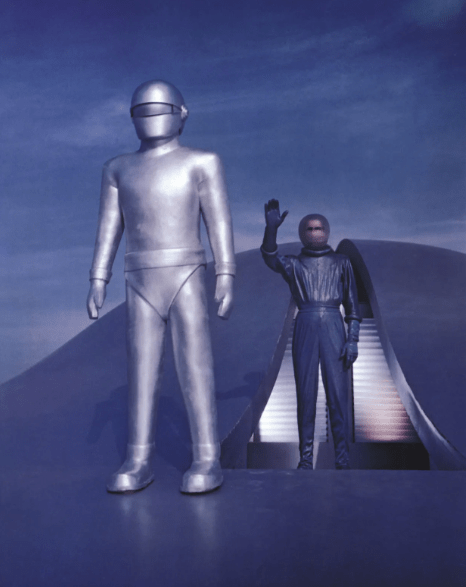
From the title sequence onward, the film makes great use of Bernard Herrmann’s brilliant score. Hermann notably employed electronic instruments, including a kind of stone-age synthesizer called a theremin. It’s the theremin that gives the score that haunting, weird quality that has since become synonymous with atomic-era sci-fi movies.
Speaking of atomic-era stuff, this leads me to my next item…
3.) Analog technology
I don’t know why, but I am fascinated by how the movie gives the viewer a glimpse—almost a cross-section, really—of the analog technology of the day. We see radio transmitters, of course, but also phone switch boards with dozens of (women) operators frantically switching lines, and people yelling into telephones. And, of course, we have all the accoutrements of World War II, which was still a recent event: tanks, jeeps, motorcycles, rifles (yes, rifles). There is something soothing about all this old-fashioned stuff, especially when it is contrasted with….
4.) Singularity Technology
When the UAP finally lands (in Washington D.C., naturally, near the Capitol), we see that it represents a kind of futuristic tech that is the diametrical opposite of the local analog, atomic-era tech. The ship is all smooth silver metal until a seam appears, and the seam opens smoothly to allow a ramp to extend. A door forms in the same way, and the alien pilot Klaatu (Michael Renne) emerges, dressed in a silver suit and a helmet that, one assumes, is made of the same silver metal. All of this seems magical, even now, and also presages the later sci-fi tropes of nanotechnology, lasers, force-fields, atomic energy, computers, etc. etc.
Of course, Klaatu’s most impressive piece of tech is….

5.) Gort
Why is Gort so damned cool? Because he’s terrifying. As a giant, lumbering robot, he evokes the golem myth of implacable, supernatural force that has no emotions and no fear. And, with his single, death-ray emitting eye, he also reminds us of another mythic archetype—the cyclops. And in the way he suggests enormous power, barely held in check, he anticipates The Terminator films of three decades later.
6.) Michael Rennie
As with most classic, once-in-a-lifetime performances, Michael Rennie’s portrayal of Klaatu is so good that it’s now impossible to imagine anyone else doing it. With his smiling, gentle, athletic demeanor, he projects a firm but benevolent presence. He genuinely wants to help humanity escape its seemingly inevitable fate (i.e., being destroyed, either at its own hand or that of Gort). Also, he seems genuinely curious and likeable, especially in…
7.) Klaatu’s Interactions with Danny
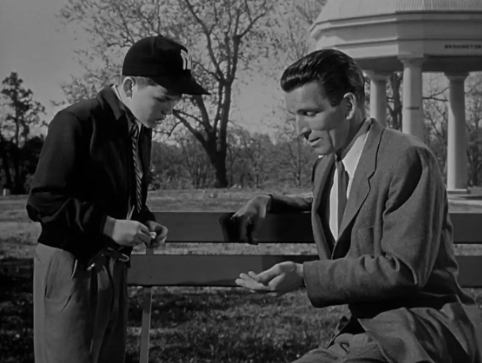
I love the scenes where Klaatu and Danny, the little boy whose boarding house Klaatu finds himself in, go on a site-seeing tour of Washington D.C. They are the emotional core of the movie. After all, in our world, Klaatu is very much like a little boy himself. His sense of wonder is almost as strong as Danny’s.
8.) Patricia Neal
Instead of casting some bombshell scream-queen in the role of Helen, Danny’s mother, Wise chose the formidable and mesmerizing Patrica Neal. She was a great actress who would later hold her own against Paul Newman in 1963’s Hud. As Helen, she exudes an intelligence and moral strength that not only saves Klaatu from capture and death; she saves the entire planet.
9.) How Much you Don’t See
I could write an entire post on the paradox of old thriller movies whose lack of CGI effects (TDTESS was made thirty-three years before Jurassic Park), was actually an advantage. The film is actually made stronger by how much Wise doesn’t show on-screen. That is, we don’t see how Klaatu stops all electrical stuff from working on the titular day. We don’t see Gort walking across D.C. on his way to liberate Klaatu’s body from its jail cell. You know, stuff that would be easy to render in the CGI era (and which would also be rather boring). After all, the ultimate special effect is the human imagination, which happily fills in the blanks better than any whiz-bang effect.
My favorite example of this in the film is when Danny secretly follows Klaatu to his spaceship one night. He watches as Klaatu uses a flashlight to wake-up Gort, who then knocks-out the two G.I. ‘s guarding the ship. The genius of this scene is that we don’t actually see Gort do this. We just see him lumber over to the two dudes. Then, at the last moment, the camera switches back to Danny’s horrified face as he watches the moment of (rather mild) violence. Then, the camera switches back to Gort as he stands over the crumpled, unconscious bodies of the soldiers on the ground. Brilliant.
10.) Multiculturalism
It’s important to remember that TDTESS is a cold-war era movie, produced at the very height of the Red Scare and its attendant paranoia and xenophobia. It also came out just a few years before the start of the American Civil Rights movie. So, I am always amazed, and even a bit moved, by how progressive Wise’s vision is. In the opening scenes, we see people from other countries—France, India, China, and even Russia—depicted in a sympathetic light, human light. At least once in the film, Wise goes out of his way to show some genuine, actual Black people in the crowd watching Klaatu’s spaceship land. (This might seem trivial, now, but it was momentous decision back then.) And, of course, the climax of the movie comes with a miniature U.N. assembly, arranged by Professor Barnhardt (wonderfully played by the great Sam Jaffe, incidentally), full of people of all ethnicities and cultures. The message is clear—it’s only by cooperation and friendship that humanity can survive. And it’s a message that is just as relevant now as it was back then, perhaps even more so.
See also this cool post from another blogger (from whom I stole one of the screenshots above)…
Shameless Plug Saturday

Ever since the paperback edition of my mystery thriller book, Twice the Trouble, came out in August, the price of the hard-cover edition has dropped through the basement. That’s bad for me but good for you (assuming you like hard-cover mysteries). It’s currently on sale for $6.00. Yes, that’s six Ameroes. Cheap!
It would make a great Christmas gift. I’m just sayin…
What We Talk About When We Talk About “Theme”
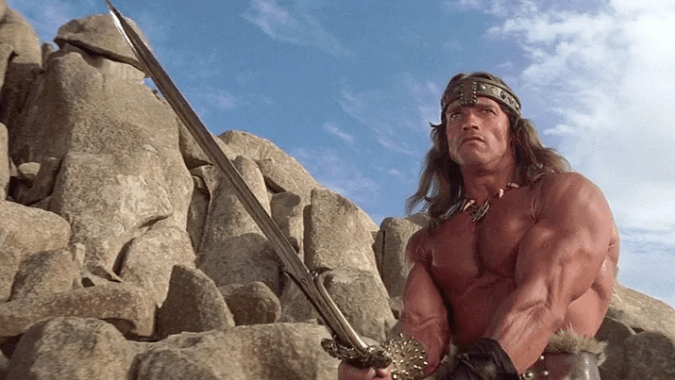
As I was working on a recent post about the great sci-fi and fantasy movies of 1982, I re-read the Wikipedia page on one of those films, Conan the Barbarian. It’s a great movie, despite the fact that it’s really just a raunchy, gory, over-the-top B-movie with an A-movie budget. I loved it when it came out, as did millions of others. It was, in fact, a culturally significant film, in its own way, and the Wiki page reflects this. A lot of passionate, obviously smart people have contributed to the page over the years. (Wikipedia is, imho, the single greatest triumph of the internet, but that’s a subject for another post.)
Of course, the page inevitably includes a rather insightful section called Themes, in which people have enumerated the topics that the film explores—or at least seems concerned with. These include “The Riddle of Steel,” “Death,” “Wagnerian Opera,” “Individualism,” and “Sex.”
I’m sorry, but “Sex” is not a theme of this movie, nor any other. Neither, for that matter, is “Death.” It’s a topic, surely, perhaps even a motif. (Note that I’m using the word “motif” in its strictest, compositional sense, as it is referenced in musicology.) But it’s not a theme.
Yeah, I know. I’m being a bit of an English-major-snob on this one. A word-Nazi. But bear with me, please. If you’re a person who really tries to appreciate literature, either on the page or on film, then the distinction between theme and motif is important. It’s even more important if you’re a fiction writer who struggles to create books that have some meaning and not mere entertainment that is purely disposable. Not that there is anything wrong with fiction that is mere entertainment—entertainment is great—but let’s not kid ourselves that it’s the pinnacle that people should aim for.
The film’s Wiki page comes much closer to the idea of a real theme when it discusses “The Riddle of Steel” (although it completely mischaracterizes and misinterprets the real matter at hand). As anyone who has seen the movie knows, The Riddle of Steel is a connundrum—not so much a riddle as a philosophical question—that Conan believes god will ask him when he dies. The question goes something like this: “Which is stronger? The sword, or the hand that wields it?” Or, put another way, “Technology? Or willpower?” “Brute force, or the power of conviction?”
It’s actually a pretty deep question, especially when one considers that film’s original script writer, Oliver Stone (who later went on to direct a few films, himself) is a veteran of the Vietnam War, which surely represented one of the greatest struggles of all time between technology, on the American side, versus sheer determination and courage on the North Vietnamese side. (Please don’t write to me and tell me that determination and courage were displayed on both sides of that tragic war. I realize this, and I am over-simplifying the conflict for the sake of argument.)
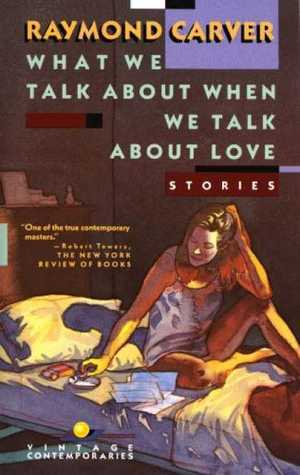
This posing of a philosophical and moral question, which the hero of the film (and, thus, the viewer) struggles to answer is, to my mind, the real definition of a theme. Perhaps the supreme example of this questioning is Raymond Carver’s classic short story, “What We Talk About When We Talk About Love,” in which three couples—all in late middle-age, all alchohic, and all jaded—discuss the definition of “love” over drinks. It’s a great story, not just because it captures the individual voice and attitude of each character, but also because all of the characters seem to be genuinely struggling with something—a matter of real import that, each one senses, will reveal something about their own lives. As one might expect, each character has their own story to tell about the subject, beginning with this one from a woman named Terri.
Terri said the man she lived with before she lived with Mel loved her so much he tried to kill her. Then Terry said, “He beat me up one night. He dragged me around the living room by my ankles. He kept saying, “I love you, I love you, you bitch.” He went on dragging me around the living room. My head kept knocking on things.” Terri looked around the table. “What do you do with love like that.”
She was a bone-thin woman with a pretty face, dark eyes, and brown hair that hung down her back. She like necklaces made of turquoise, and long pendant earrings.
“My god, don’t be silly. That’s not love and you know it,” Mel said. “I don’t know what you’d call it, but I sure know you wouldn’t call it love.”
The story continues around the table, with each character telling their own story about the general subject of “love.”
In Carver’s supremely able hands, each of these stories is shocking, yet rings true. Completely, brutally true. Some of them are also funny as hell, in a gallows-humor sort of way. One of the greatest things about the story, though, is the way it never gives us a definitive answer to the question it asks. To the contrary, the story raises even more questions—deeper meta-questions that the characters, themselves, are unaware of but which we, as readers, are. Is there a single definition for love? Is that question even meaningful? Does love even exist, really, in the cosmic sense? Does it matter?
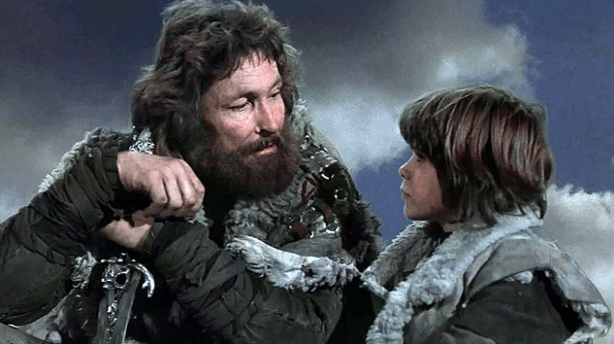
In the same way, Conan the Barbarian presents its hero with several possible answers to its central thematic question. The first is given by Conan’s father (played by the great character actor William Smith) in the opening scene, where he tells the young Conan that the one thing he can ever depend on. “Not men. Not women. Not beasts. This,” he says, gesturing to a sword he has just forged. Of course, he is not talking about that particular sword, or even swords in general. He is, we sense, talking about all the intangible things for which the sword is a symbol—discipline, training, courage. The martial ideal.
Later in the film, the villainous Thulsa Doom presents Conan with another answer. In that famous (and surprisingly shocking, even now) scene when he beckons one of his followers to literally jump off a cliff, he suggests that control over the human mind—through dogma, religion, and all the other tools of tyrants—is far more powerful than strength of arms, either literal or metaphorical.
So, which of these answers does Conan accept. Neither! In fact, his tale seems to suggest a third answer, one which is never articulated—never explicitly told—to either Conan or the viewer, but is rather born out by the action of the narrative. The answer, simply, is love. It’s Conan’s love for his murdered parents that sustains him through the ordeal of slavery and drives his desire for revenge. He also loves his friend, Subotai, and he comes to love Valeria even though she is, initially, a rival. Later, it’s Valeria’s love of Conan (along with some help from Subotai) that saves his life after they rescue him from the Tree of Woe. And it’s Conan’s grief over the death of Valeria that causes him to go on his final (foolhardy) confrontation with Thulsa Doom, where he uses his father’s broken sword (note the symbolism, there; steel really isn’t that strong, after all) to behead the man.
I think it is important to note that even in a “silly” genre movie like Conan the Barbarian, good writing can add a level of thematic resonance to any work of fiction. That is, it can turn a potentially crappy movie into a good movie, and a good movie into a great movie. It’s this complexity that separates the vast majority of films (and books, for that matter) from the few we remember years later—that tiny minority that we deem “classics” after the fact.
Another thing to consider is how Conan the Barbarian, like Carver’s short story, doesn’t fully answer its own thematic question. At least, not completely. The ending is ambiguous. Yes, Conan kills the bad guy, and (we are told) ends up a king himself, but he “sits on his throne with a troubled brow.” In others, the verdict is still out on what the real answer to The Riddle of Steel is, after all.This kind of ambiguity is, of course, a hallmark of all good fiction. We, as viewers and readers, don’t get a definitive answer—mainly because the kinds of questions that good fiction asks are, ultimately, unanswerable in any objective sense. They are always about choices. Priorities. Does honor matter more, or friendship? Revenge, or love?
Synchronicity for Bookworms: Harlan Ellison

The great film critic Roger Ebert once noted that the people we think of as heroes are those we looked up to when we were kids. As adults, we might admire a particularly talented athlete or actor or musician, but they won’t really be “heroes” to us; they’ll just be really cool (but life-sized) people.
I think that my middle-aged affection for Harlan Ellison might be a slight exception to this adage, however. I was a fan of his when I was growing up (he became famous in the 1970s with his revolutionary, sci-fi short-stories like “I Have No Mouth, and I Must Scream”), but he wasn’t exactly a “hero” of mine. Then, in the 1990s, Ellison began to appear on TV as a talk-show celebrity, especially on the sci-fi channel, where he essentially co-hosted a show called Sci-Fi Buzz, where he was often very funny and always insightful. Also, to my amazement, one of his stories, “The Man Who Rowed Christopher Columbus Ashore,” was included in 1993’s Best American Short Stories collection. I saw an Ellison interview around that time, in which related that the series’ editor called him to give him the good news. At the end of their brief conversation, she asked him if had written any other short stories—an unintentional slight that Ellison said felt like “a dagger to the heart.”
But this was typical of Ellison’s relationship to the literary world, and to Hollywood. He couldn’t get no respect. Part of this life-long diss was, surely, his own fault. He was famously abrasive and out-spoken, and hated to have his work messed with. When he wrote the screenplay for the what is generally considered the best episode of the original Star Trek series, “City on the Edge of Forever,” he hated Gene Roddenbury’s changes so much that he tried to have his name taken off the credits. (Fortunately, he failed.) In fact, he was so contentious about such matters that he had a special pseudonym, Cordwainer Smith, that he would use when he felt his work had been to mangled by studio executives that he no longer wanted his real name associated with it.
Paradoxically, the more interviews I watched of Ellison in the 1990s and beyond, the more I liked him. He had a razor wit, and he did not suffer fools easily. He could also be mean as hell when he felt attacked. But these were all characteristics I had seen before in some exceptional people I have met over the years, including my great teacher, the writer Harry Crews. I never met Ellison, but I suspect that we would have gotten along just fine.
Indeed, I came to admire even Elllison’s famously pugilistic nature. He was quick to sue anyone who he felt had stolen his ideas. Most famously, he sued Orion Pictures over 1984’s The Terminator, alleging that director/writer James Cameron had cribbed the concept from a script Ellison wrote for The Outer Limits. Orion settled the suit out of court. (Cameron later called Ellison a “blood-sucking ghoul,” which I still find hilarious.)
Clearly, Ellison knew how to defend himself and his ideas, and to get what he felt was owed to him. Much of this toughness, I imagine, came from Ellison’s early life, growing up as an diminutive Jewish kid in Ohio. Like a lot of smart, little guys, Ellison learned how to punch back, and punch hard.
After I wrote a blog post about Ellison and Isaac Asimov last year, I found myself thinking about Ellison more and more. So much so, in fact, that a couple of weeks ago I decided to write something about him, although what form that would take.
Then, in one of those moments of synchronicity that happen to writers when they immerse themselves in a subject, I stumbled upon a fact regarding Ellison that I had never read before, and it came from a totally unrelated source.
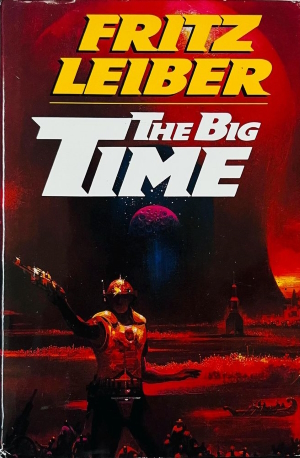
I was looking at some classic sci-fi book covers when I spotted one for Fritz Leiber’s The Big Time. I hadn’t thought of Leiber in decades (he was a favorite of a friend of mine in middle school), so out of pure curiosity I checked out his Wikipedia page. There, I was saddened to learn that Leiber spent the last few years of his life in poverty. As with so many writers, alcohol had taken its toll, and Leiber ended up living in a cheap motel. Apparently, Ellison came to visit him one day and was appalled by the state of his affairs, with Leiber not even able to afford a writing table. Rather, he was composing his latest work on a “manual typewriter propped up over the sink.”
Okay, maybe this wasn’t a good example of full-blown, Jungian synchronicity. I guess it wasn’t that unlikely that I should stumble upon a Ellison anecdote while reading about Leiber. They were both great science fiction writers, after all, and it make sense that they might have known each other. In fact, as I learned, Ellison included some of Leiber’s short stories in the Dangerous Vision anthologies that he (Ellison) edited for decades. Still, I didn’t know of any connection between the men. They were of different generations and circumstances, linked only by their genre and talent.
Unfortunately, the Wikipedia article does not cite the source of this (if anyone knows, please tell me), nor does it say what action, if any, Ellison took to improve Leiber’s circumstances. But I like to think that he did something to help. After all, he was a pugnacious, smart-ass little guy who looked after himself and other little guys. I miss him.
Here is a good interview that Ellison gave to the BBC in the 1970s.
Classic Sci-Fi Book Cover: “The Deathworld Trilogy”

Harry Harrison’s Deathworld trilogy kept me sane during one long-ago summer when I was bored and lonely. As I recall, my father gave it to me, having bought it in an airport bookshop after a long trip. (Yes, he was a good dad.)
Harrison is most famous for his Stainless Steel Rat series, but I liked these books better. As in all of Harrison’s work, the Deathworld stories center around a trickster anti-hero—in this case, Jason dinAlt, a smart, conniving rogue who is also telepathic. (He uses his E.S.P. to cheat at cards and thus travels from casino-to-casino, and planet-to-planet, having adventures but never a real job.)
Looking back on it, I would bet that this cover by illustrator David Egge, depicting dinAlt in futuristic battle gear, had a lot to do with further popularizing the military science fiction sub-genre, of which Robert Heinlein’s Starship Troopers is the best-known example. (Current examples are too numerous to name.) In fact, the Deathworld books are not military sci-fi. The characters dress like soldiers because they live on a very dangerous planet named Pyrrus (as in pyrrhic; get it?) where every living thing from plants to animals is lethal to humans. Indeed, the entire ecosystem of Pyrrus seems determined to kill all the human colonists, for reasons that dinAlt will try to discover using his telepathic powers as well as his finely honed survival skills.
The Deathworld books are just fun, well-plotted, fast-paced adventure stories, reminiscent of science fiction’s Golden Age—albeit with a bit more wit attached to them than the average sci-fi fair. Moreover, Harrison should be lauded for the series’ strong ecological message (well hidden, at first, but definitely in there), which was usual at the time, especially in “guy’s” books.
Check them out…
“Myopic Duplicity” Anthology is Out!
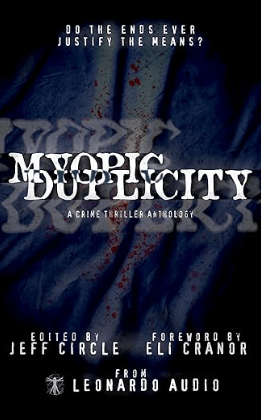
I’m very happy to announce that my new short story, “Hallucinogenic Toreador”, is included in this fine, just-released noir anthology from Jeff Circle and Leonardo Audio! It’s available in Kindle format from Amazon. Check it out…!
 Ash Clifton, Writer