Yesterday I got a three-word text message from my son Connor: Kilgore is dead.
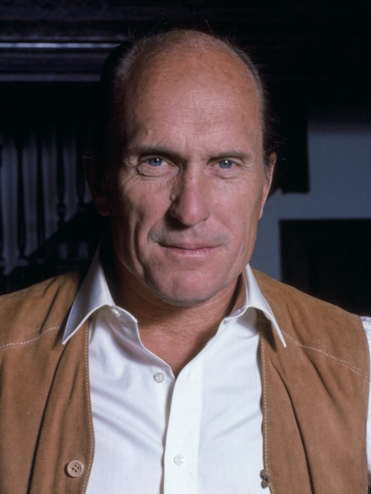
I knew, of course, exactly who he was referring to—Robert Duvall, the great actor who passed away yesterday at the age of 95. More specifically, Connor was calling out one of Duvall’s most memorable characters, that of Lt. Colonel Kilgore, the cheerfully psychopathic Army commander in Francis Ford Coppola’s Apocalypse Now.
Everyone, it seems, has a favorite Duvall role. For many young dudes these days, it is Kilgore. For others, it’s the soft-spoken but iron-willed Tom Hagen in the Godfather films. For still others, it is the authoritarian Marine dad in The Great Santini, or the fearless Texas Ranger Augustus McCrae. No matter what kind of character he was playing, Duvall’s own, real-life character always shone through: smart, fierce, tough, and comfortable in his own skin.
Being a mega-film-nerd, my definitive Duvall role was that of THX 1138, the titular character in George Lucas’s first film, which is still one of the most daring and visually stunning movies ever made. THX 1138 also marked one of the few films in which Duvall got to play the lead. Most of the time, he was cast in supporting roles, working in the background. Invariably, this allowed him—like Kilgore in his helicopter—to swoop in and steal the movie.
Although he trained with many famous Method actors, he was not generally considered to be one himself. Yet, he could hang with the De Niros, Pacinos, and Hoffmans of the world with seemingly effortless ease. Indeed, as an actor, he could hang with anybody.
For many (White) guys my age, Duvall represented the ideal American man. German/Irish but still cool. Macho but not toxic. Smart but not showy.
And funny. Even in the midst of mass-slaughter, Kilgore is funny. So is Santini. So, in his own way, is THX 1138. One of my favorite, later roles that Duval played is that of the craggy old Marine who helps Tom Cruise in the 2012’s Jack Reacher. With just a few lines of dialogue, and a barely suppressed, ghoulish chuckle, he manages to deliver some of the funny moments in recent cinema.
The brilliant singer and musician Chris Rea has passed away. I remember when I first heard this song (my favorite of his). I was in grad school in Tucson, Arizona and had a summer job teaching English at Pima Community College. I was driving there one day in July when the temperature hit 117. My little car started to overheat so I turned off the A/C, rolled the windows down, and hoped for the best. Then this song came on. It had such a great groove to it that I almost forgot my miserable circumstances. Almost.
It was also so very, very appropriate. Still is, even in winter.
I find it interesting that the two most famous architects in American history—famous, that is, among ordinary people who don’t subscribe to Architectural Digest—were both named Frank. They were, of course, Frank Lloyd Wright and Frank Gehry. Both men created buildings that captured the popular imagination like few others. And both were mavericks whose vision of what architecture could do often offended the mavens of the status quo (not to mention the bean-counters who worked for the rich people who funded their projects).
Both men also shared a sense of play and in their work—Gehry to a much greater degree, sometimes designing homes and offices and other buildings that veered into pure fantasy. He often brainstormed new projects with strips of paper and cardboard, envisioning light, fluid, soaring structures that, one could argue, would not have been possible to actually build in an age before computer-assisted design was available.
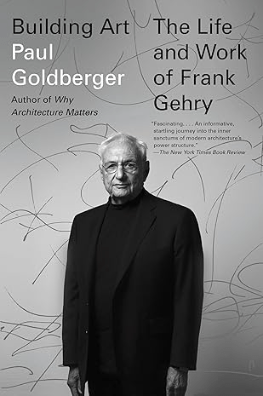
This emphasis on play and the power of imagination was evident in all his work, even in huge, civic projects like his Walt Disney Concert Hall in Los Angeles. As Paul Goldberger relates in his fine biography, Building Art: The Life and Work of Frank Gehry, Gehry took an almost impish pleasure in fooling around with his own designs. When he was in the early stages of mocking-up his plans for another auditorium in Asia, he shocked and amazed his colleagues by adjusting the position for the auditorium every night or so. As one friend put it,
…[H]e became a monster. He started moving stuff around.… We were doing a project in Korea that never got built [the museum for Samsung] but every time I went on a trip and came back he had moved the auditorium. He was impeccable. He had incredible reasons for it. He’s really brilliant. He doesn’t sleep at night and he comes back the next morning and moves the auditorium.”
As Goldberger explains…
Moving the auditorium, in Frank’s view, was a form of what he liked to call “play,” and it was largely instinctive. “A serious CEO, you would imagine, does not think of creative spirit as play. And yet it is,” he said. “Creativity, the way I characterize it, is that you’re searching for something. You have a goal. You’re not sure where it’s going. So when I meet with my people and start thinking and making models and stuff, it is like play.”
As the title of Goldberger’s book relates, Gehry saw himself almost as more an artist than an architect. At times, he refused to believe that one needed, necessarily, to make a distinction between the two. Early in his career, Gehry befriended and hung-out with great modern artists in Southern California, and they reciprocated his admiration. Perhaps this is the reason that Gehry’s greatest buildings resemble art more than perhaps other architect.
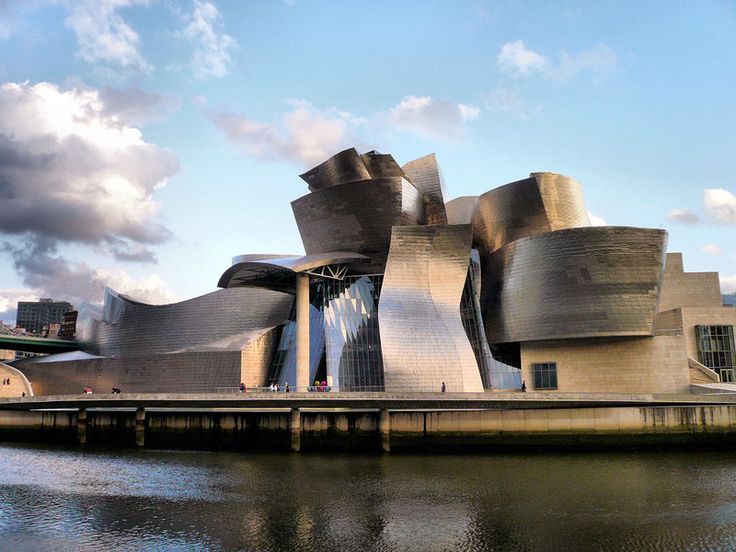
Guggenheim Museum, Bilbao
His most famous is, of course, the Guggenheim Museum in Bilbao, Spain. When the museum finally opened in 1987, a flood of tourists came from all over the world to see it, prompting some of the artists whose work was displayed inside the museum to feel that they were playing second fiddle to the building itself. This grumbling grew into a modest backlash among the artistic community, focused not so much on Gehry himself as on the fawning admiration of journalists and other architects who often lauded Gehry as an “artist.” As Gehry’s own collaborator and friend, the sculptor Richard Serra, said,
I don’t believe Frank is an artist. I don’t believe Rem Koolhaas is an artist. Sure, there are comparable overlaps in the language between sculpture and architecture, between painting and architecture. There are overlaps between all kinds of human activities. But there are also differences that have gone on for centuries.”
Whether he was being lauded or criticized, Gehry himself never seemed concerned. In fact, when compared to that other great architect named Frank, Gehry usually seemed downright humble, if not pathologically shy. Goldberger writes:
Even though Gehry was ridden with angst throughout his life, his manner came off as relaxed, low-key, and amiable, and his steely determination, far from being obvious like Wright’s, was hidden behind an easygoing exterior, a kind of “aw shucks” air that Gehry’s old friend the artist Peter Alexander called “his gentle, humble ways.” Wright was never mistaken for being modest; Gehry often was.
Gehry was so shy, in fact, that I feel he could have been much more famous than he was if he gotten himself out there, gone on TV more and granted more interviews and written some puff-pieces for various magazines and web sites. The fact that he did not is, I suppose, the most telling fact about the man’s character. Namely, that he was a genius who was determined to create the most original and uplifting works as he could…and, then, to let those works speak for themselves.
One indication of Diane Keaton’s greatness is the simple fact that two of the most iconic of the 1970s end with her face. That is, with her face literally filling their final frames, as she looks straight at the viewer. These films are, of course, The Godfather (1972) and Looking for Mr. Goodbar (1977). In the former, her character, Kay, gives a stricken expression as she watches her young husband, Michael Corleone, go over to the Dark Side of the Force to become, at last, the new godfather of his crime family. In the Looking for Mr. Goodbar, her character, Theresa, lies on the floor in her darkened apartment, dying. She has just been fatally stabbed by a psycho guy she picked up at a bar. The guy runs off, and the camera stays fixed on her face as she breathes her last breath, alone.
I’m not sure which ending is more disturbing. In both cases, her character dies a kind of death (spiritual, in The Godfather; literal in Looking for Mr. Goodbar). And this death is brought on, directly or indirectly, by a man’s act of evil. This might seem ironic, given the fact that Keaton, more than other female star, best embodied the spirit of the New Woman, especially the second-wave version that swept the culture in the 60s and 70s. In fact, it’s not ironic at all. In both films, she becomes a kind of casualty-of-war, defiant but ultimately destroyed by a male-centered (if not actually misogynistic) culture.
No, I am not trying to define Keaton’s long, brilliant career through the single lens of feminism-vs-toxic-masculinity. But you can’t talk about Diane Keaton without considering how important a symbol she was for both boys and girls watching movies when I was growing up. From the moment she appeared on-screen at the titular character in Woody Allen’s masterpiece, Annie Hall, she captured the heart of a generation. Dressed in men’s clothing, she was beautiful, elegant, and breath-takingly feminine. With her goofy demeanor, mixed with her sharp-as-a-whip intellect, she was the gawky, A-student who all the smart, gawky, A-student girls in the audience could look up to (and who all the A-student guys secretly fell in love with.)
As with any movie star of any gender, it is impossible to separate Keaton’s appeal from her physiognomy. She was, of course, beautiful, but in a more muted, subtle way than someone like Jacqueline Bisset, Britt Ekland, Jill St. John, or any other of the “off-the-charts-sexy” actresses of her generation. (On my list of 15 Hollywood Archetypes, Keaton would sit firmly in the “Goddess Next Door” bucket.) To me, the most remarkable thing about Keaton was the way she always seemed to glow. She was literally luminous, in all her films, an attribute that a cynic might write-off as a testament to good genetics (i.e., good skin), or perhaps expert lighting.
Being a bit of mystical, woo-hoo type, I would call it the emanation of her sublime, inner being, filtering out into our mortal plane…
She carried this luminous quality into old age. Alas, though she was 79, she left us too soon.
The great scholar Joseph Campbell once explained that every time we go into a cinema and see a movie star—Tom Cruise, for example—up on the screen, some part of our brains is aware that the real person, the actor Tom Cruise, is alive somewhere else in that same, exact moment. This ability to exist in two places at once, Campbell said, is an aspect of a God, a living divinity.
Our subconscious perception of actors as gods is one reason we are always surprised by the death of a movie star, especially one who has been around since we, ourselves, were kids. How could they ever die? They seem to occupy a higher plane of reality, immortal, always youthful if not actually young.
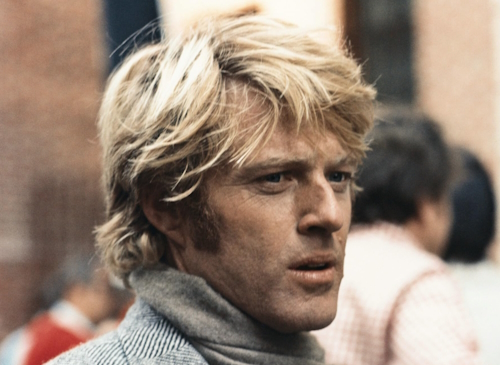
Robert Redford was surely one of the greatest movie stars of my youth, and he starred in two of my favorite films of all time, All the President’s Men and Three Days of the Condor, both of which I have written about on this blog. What made him interesting was that weird dichotomy of blond, athletic, all-American good-looks combined with a reserved, wary intelligence. (On my list of Hollywood Archetypes, he fits squarely in the “Dark Prince” slot.) He was a very smart man, who did a lot of amazing things both on-screen and off-. Among the most notable of these was his founding of the Sundance Film Festival, which has come to rival Cannes as the preferred venue for indie-film directors to premiere their movies.
The fact that Redford would create an alternative festival for “the little guys” in the film industry was typical. He was, in some ways, the most counter-cultural movie star of the last fifty years—even more so than Easy Rider himself, Peter Fonda—in that he made movies about men fighting some vast, evil establishment. Often, this was the military-industrial complex in either its actual (All the President’s Men) or its fantasy (Three Days of the Condor) form. In his later years, when Redford could no longer play the lead, he took on the role of the villain who represents this evil empire, as in Captain America: The Winter Soldier.
As a kid, I always found something soothing about Robert Redford, even in movies filled with threats and violence. I suspect that, in my mind, he represented the best spirit of my parents’ generation (he was roughly the same age as my father). That is, the young adults of the 1960s and 70s. Post-hippie, but very hip. World-weary, but not broken. Brave, but not foolhardy. Idealistic, but not naïve.
There is a scene in Steven Soderbergh’s 1999 noir thriller The Limey when the main character, Wilson, a career-criminal and generally scary guy, is questioning a woman in her house about a man named Valentine. Wilson (played with enormous power by Terance Stamp), is looking for the man who killed his daughter, and Valentine is his prime suspect. The woman, naively, offers to give Wilson Valentine’s phone number, at which point Wilson smiles wickedly and says, mostly to himself, “I’ve got his number.”
It’s a great, almost chilling moment. What we, the viewers, know (and the woman doesn’t) is that Wilson has already killed five men to get Valentine’s “number”, every sense of the term. And Stamp’s delivery of this line speaks volumes about Wilson’s character—his steely-eyed determination, his courage, and his constant, barely controlled rage.
It’s a great moment in a great movie, which marked one of several come-backs in Stamp’s long career. His filmography is so great and varied that one must divide not in stages but in ages. First, there was Stamp the movie star, an epically handsome, Angry-Young-Man who got the lead in several fine, gritty films in the 1960s, including William Wyler’s The Collector and Ken Loach’s Poor Cow. But he never really clicked as a leading-man, either in England or in Hollywood, and his next big break didn’t come until 1980’s Superman II, in which he reprised his role as the evil General Zod (a.k.a. the chief of the three baddies whom Superman’s dad banishes to the Phantom Zone in Superman.)
To this day, Stamp is best remembered for this one, silly role, Zod—at least, in America. But film nerds such as myself admired his work in many other small, supporting roles throughout the 80s. My favorite was his scene-stealing cameo in 1987 Wall Street, playing a redoubtable corporate raider who has reformed his ways and stands in opposition to the evil Gordon Gekko.
Then, in the 1990’s, Stamp had his next, and greatest, comeback with his role as transexual woman in The Adventures of Priscilla, Queen of the Desert, which remains one of my favorite films of all time. Stamp was nominated for a BAFTA for that one, and he should have been nominated for an Oscar, too. But no matter. The role is a classic, and it re-introduced him to American audiences.
This led to Stamp’s last leading role in a major motion picture. This was, of course, The Limey, and it is perhaps his greatest performance, in part because he was able to leverage his own, real-life history as 1960s hipster in the role of Wilson, who was a master thief in 1960s England. Indeed, Soderbergh sampled black-and-white footage of Stamp from Ken Loach’s Poor Cow to use in flashbacks of Wilson’s earlier life—a daring artistic choice which, although done with permission from Loach himself, remains controversial to this day. However one might feel about this cinematic cribbing, though, Soderbergh made one hell of a good movie—a genuine classic—in which Stamp finally got a chance to shine in the lead, one last time.
Terance Stamp passed away on Sunday, at the age of 87. Not bad, for such a hell-raiser. I’ll miss him.
Once again, I’m writing a very belated obituary for a fine actor. The great British character actor Kenneth Colley passed away a couple of weeks ago. Thanks to the enduring magic of Star Wars, many young people today will know Colley from his brilliant, understated performance as Admiral Piett (a.k.a. the closest thing Darth Vader has to a trusted friend) in The Empire Strikes Back and Return of the Jedi.
With his stern voice, dour face, and no-fucks-left-to-give demeanor, Colley specialized in world-weary, authoritarian roles. But like Gene Hackman (who also passed away recently), Colley was an amazingly versatile actor who appeared in dozens of films and TV shows, playing everything from Jesus in The Life of Brian to Frédéric Chopin in Lisztomania.
My favorite of his performances was that of a revenge-corrupted cop in the great Inspector Morse series episode “The Second Time Around.”
If you were a nerdy poor kid growing up in the 1970s and ’80s, you probably watched a lot of public television. Starting with kid shows like Sesame Street and the Electric Company, you graduated in your teens to science shows like Nova and edgy entertainment shows like Monty Python and surreal action series like The Prisoner, which PBS stations played late at night.
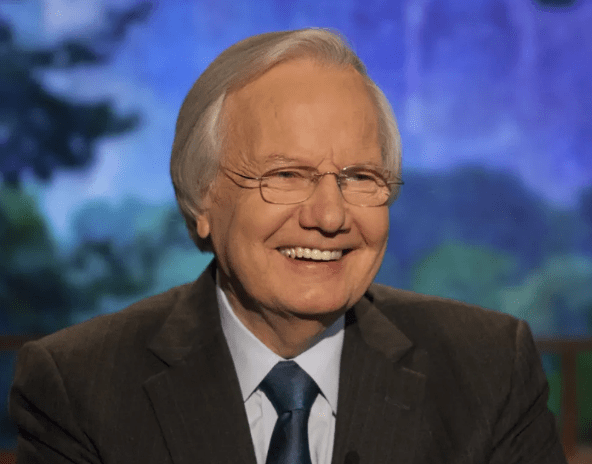
As for myself, I also watched a lot of PBS news, especially The MacNeil/Lehrer NewsHour. And Bill Moyers. Lots of Bill moyers. If MacNeil and Lehrerwere the Kings of PBS news, then Bill Moyer was the high-ranking courtier. Moyers, who passed away last week, specialized in thoughtful and intelligent interviews with brilliant people of various stripes. As a would-be teenage intellectual, I really loved and appreciated these shows, and they introduced me to a lot of very smart artists, politicians, and writers. Chief among these was the iconic scholar of world mythology Joseph Campbell. Moyers’s now-famous interviews with Campbell, conducted at George Lucas’s Skywalker ranch (Lucas was inspired by Campbell’s writing when he penned the Star Wars saga), were probably the pinnacle of both men’s careers.
I’ve been a fan of Campbell ever since, and also of Moyers. A one-time Baptist preacher, Moyers was a gentle, kind-spirited man who never descended into sentimentality or fatuous optimism. He was, rather, a first-rate journalist. And God knows there are very few of those these days.
Moyers has been the subject of many on-line tributes in the past few days, including this one by the excellent historian Jonathan Alter.
American cinema and theater has lost another great character actor this week, Harris Yulin. With his lumpy face and gruff demeanor, Yulin was an everyman—one of those actors that you recognize from countless roles but whose name you never knew.
He was one of the most respected stage, film, and TV actors in the country. And yet, ironically, most viewers today will know his work from two unlikely sources: the TV show Frasier on which he played an affable crime boss and Star Trek: Deep Space Nine, for which Yulin appeared in one famous episode, Duet. It was this particular gig (yes, a frickin episode of Star Trek) that gave Yulin one of his few chances to really show-off his acting chops to a mass audience. I still think he should have gotten an Emmy nomination for it, but oh, well.
In all his performances, Yulin was one of those actors who exude a kind of intelligence, presence and grace that make them stand out a mile on the screen or stage.
The world is a little less interesting today without him in it.
Once again, it has taken me far too long to write a short tribute to a fine person who has passed away—Val Kilmer, who died of pneumonia on April 1. This time, it was more than just my workload that explains the delay. I had a bit of trouble discovering what I wanted to say about Kilmer, who was a great actor but also a bit of a cipher. A few years ago, I read his memoir, I’m Your Huckleberry, and I enjoyed it. I was struck, however, by how little Valmer says about his filmmaking experiences. For instance, he barely mentions the production of Tombstone, the film in which Kilmer had his most celebrated film performance—playing the famous gunfighter Doc Holliday—and from which the book’s title is taken. He says even less about the making of Michael Mann’s Heat, in which Kilmer portrays a talented but slightly crazy master-burglar with pitch-perfect ferocity.
This lack of detail was especially disappointing, to me, in part because Heat has my favorite action-sequence of all time—the shoot-out in Century City. More than any other actor in the scene, it’s Kilmer who makes it work, with his fluid transition from cool and controlled bank-robber to machine-gun wielding warrior. I read an autobiography written by a Navy Seal who wrote that he and his comrades once watched Heat together and were impressed by Kilmer’s magazine-changing speed in the film. High praise, indeed.
This reticence on Kilmer’s part to discuss his film-making career—the very aspect of his life that made him famous across the world—suggests to me that Kilmer was deeply ambivalent about being a movie star. I suspect that, like the great Welsh actor Richard Burton, Kilmer was simply too intelligent to think that movie-making was a worthy and serious endeavor. I also suspect that, like Burton, Kilmer was much happier as a stage actor. (His one-man show of Mark Twain was universally praised.)
Unfortunately, his ambivalence somehow bled into his performances whenever he played a leading man, as he did in several major films, none of which was terribly successful. He never seemed to really have his heart in it. But that self-doubt evaporated when he played supporting roles, and these are what he will be remembered for: Iceman in the Top Gun films; Doc Holliday in Tombstone; Chris in Heat. In each of the movies, Kilmer seemed to bring his entire soul to the performance, and he was every inch the movie star.







 Ash Clifton, Writer