What I’m Reading: “Soon”

I have a theory about horror novels. The secret to a good horror novel, I think, is not gore, or violence, or even suspense. The secret is empathy. The empathy we, as readers, form for the main characters, and the empathy the main characters feel for each other.

This should be obvious, but it’s not. I have read (well, started) many celebrated horror novels, some of them very well written, only to set them aside after a chapter two because I didn’t care about any of the characters. Contrast this with the very best horror fiction from masters like Stephen King. King is famous for creating main characters who are kind, decent, spirited people with whom the reader instantly connects (and worries about). King’s characters also tend to be underdogs and outcasts. Nerds. Geeks. Handicapped kids. Fat kids. Gay kids. Such types are the most vulnerable in our society, and therefore most vulnerable to whatever monster Kings pits them against. Their underdog status makes them even more sypathetic to readers, and makes their courage even more admirable.

This is not to say that protagonists of horror novels should be all good. Far from it. In fact, King often presents the reader with deeply flawed, erratic main characters who must discover their own inner resilience and courage to face the evil that confronts them. 

Recently, I found myself thinking about such matters as I read Lois Murphy’s excellent novel Soon from 2019. Like many great horror books (or many great books of any kind), Soon stays with you long after you finish the last page. It’s got some genuinely creepy stuff in it. Most of all, though, it has a likable, sympathetic, and funny main character named Pete.

Pete is a retired cop who lives in the tiny town of Nebulah in rural Australia. Nebulah is a new twist on the concept of a “ghost town” in that its inhabitants are literally tormented by ghosts. Rather, by a strange, evil entity called The Mist that descends upon the town every evening. From this vapor, a hellish gallery of semi-corporeal spirits attacks any person foolish or unlucky enough to be caught outside after sundown. The victims suffer grisly, violent deaths,  but their bodies are never found. (Their remains dissolve mysteriously in the mist soon after being discovered.)

Not surprisingly, the town’s population rapidly dwindles from a few hundred to a few dozen, and then down to just eleven. Most people leave. The rest are picked off one by one. Pete is one of the de facto leaders of this tiny remnant of hard-core town folk, most of whom are too poor or feckless or otherwise attached to the place to ever leave. Pete is neither poor, nor attached, nor feckless, but he stays anyway, mainly to protect his friends. These survivors meet each night at one of their homes and spend the night together, trying to hear the demonic wailings and thrashings coming from outside the windows and doors. (The Mist, rather like vampires, can’t cross the solid threshold of a home unless there is some gap that would let it in.) 

I find myself admiring much of Ms. Murphy’s writing, especially in the way she renders the character of Pete. The plot also has some genuinely surprising twists and interludes, such as when Pete goes to visit his estranged daughter in a distant city.

Most of all, I liked the psychological realism of the book. Everyone left in Nebulah has some damned good, practical reasons for not leaving (just ask them), but none of these seems greater than what we suspect is a fundamental weakness in their character. Some are afraid of being poor in a new place. Others are reluctant to give up the homesteads they have labored to improve over the years. Some are just too tired.

Others, like Pete himself, have some secret sin to atone for, and a guilt that keeps them from leaving. 

Soon is a cool book. Check it out…

Book Reading at DeKalb Library

For those of you who might be in the Atlanta area on October 7, please stop by the Flat Shoals library for my book talk. The event is at 6:00 p.m., and I’ll be reading from my mystery novel, Twice the Trouble.

Classic Sci-Fi Book Cover: “The Left Hand of Darkness”

Ursula K. Le Guin was one of our finest science fiction writers, and The Left Hand of Darkness is probably her best book. Not only did it anticipate by half-a-century the seismic cultural shifts that are currently roiling Western society regarding issues of gender-identity and sexual orientation, it’s also just a damned good sci-fi story.

Set in the far future, it takes place on Gethen, a wintery planet with a post-industrial civilization. Genly Ai is an Earth-man who is sent to Gethen on a diplomatic mission, hoping to convince the locals to join the Ekumen (basically, Le Guin’s version of the United Federation of Planets). Genly’s efforts are frustrated by long-standing, internecine conflicts between the Gethenians themselves, and also by his own difficulty in relating to the local people. People on Gethen are, it seems, are androgenous—serially androgenous, actually, existing as one sex for a part of the month and as females for the other. (As Le Guin beautifully describes, they subtly change their outer physiognomy, depending on which gender they are currently occupying, appearing to be “men” some of the time and “women” at others.)

Even now, it’s a pretty far-out concept, but it was totally mind-blowing in 1969 when the novel came out. Trust me, though—it’s a very exciting book. Genly soon finds himself caught between warring nations and is arrested as a potential spy. He is rescued by Estraven, the former prime minister of one of the countries, who helps Genly escape. They set off on a life-and-death adventure, sledding across the frozen wilderness of Gethen and trying to get to safety. In the process, Genly is forced to come to terms with his own deep-rooted conceptions of sexuality, while Estraven faces the prospect of Gethen being just one small planet in a vast, strange galaxy.

Le Guin is often described as a literary science fiction writer, and it’s true. Her prose and descriptive eye were top-notch, and she was able to weave Big Ideas (Feminism, Taoism, etc.) into her fiction without it feeling like a Humanities 101 lecture. The edition I read had this great cover by veteran illustrator Alex Ebel, which might seem a bit cheesy today but was striking and evocative at the time. I love the way it captures one of the major visual motifs of the novel, that of linked-opposites (light and dark, male and female, good and evil, progressive and reactionary). It’s a great, surreal representation of a great novel.

The Enchanting Labyrinths of Vortex Fiction

Of all the categories of genre fiction that I’ve consumed over my lifetime, fantasy has probably best the least represented. Sure, I love The Lord of the Rings, and The Narnia Chronicles, and the works of Ray Bradbury that I consider to be dark fantasy (see Something Wicked this Way Comes). But I don’t keep up with many modern fantasy writers nor read many contemporary fantasy novels.

So, you can imagine my surprise when I took a chance on Susanna Clarke’s Piranesi, a fantasy novel that made quite a splash when it came out in 2020, and I enjoyed the hell out of it. It’s a fascinating story of a man trapped in a labyrinth that he calls The House, and which is composed of endless Greco-Roman halls lined with innumerable statues and vestibules. There is a sky above and ocean tides below, which often flood the lower levels. The man is called Piranesi by the only other person (i.e., “the Other”) in The House, an older man who seems able to leave somehow, only to return with key supplies like vitamins and batteries, which he shares with Piranesi.

It’s a fascinating book, and unexpectedly suspenseful, too, especially when Piranesi begins having flashbacks of who he is and how he came to be in the House. This happens about the same time as the sudden appearance of mysterious, written messages that are scattered throughout the House. They seem to have been left by another, recent intruder (one who seems interested in helping Piranesi escape).

For me, at least half of the appeal of Piranesi lies in this whodunnit factor. Like the protagonist himself, I was caught up in the mystery of how he came to be there, who he is, and how he might get out. But the other half lay in the dizzying, intricate nature of the setting—the endless labyrinth that Piranesi inhabits. Such dreamlike settings are more common in literature than one might think, and their appeal is very much like that of a vivid, fabulously detailed diorama, of the sort that all children love to gaze into (and imagine themselves inside).

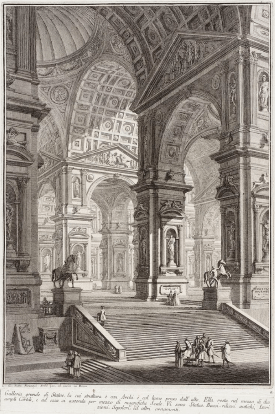
Capriccio Illustration by Giovanni Piranesi

 I don’t know what it is, exactly, about mazes, labyrinths, and castles that evokes the power of imagination, But I think it has to do with their endless novelty, the promise of infinite rooms and corridors that we, like children, would love to explore. More to the point, such structures also symbolize the power of imagination—especially the child-like imagination that each of us still harbors. That’s why there is such a grand tradition of castles and mazes in fantasy literature and mythology, from the Minotaur’s labyrinth to the vast, rambling ruins of the Gormenghast trilogy.

Clarke herself acknowledges this tradition in her main character, Piranesi, who is named after Giovanni Battista Piranesi, the 18th Century illustrator who was famous for his drawings of impossibly grand and complicated imaginary buildings. His most famous works are a series of etchings titled Carceri d’invenzione (Imaginary Prisons), and these are, themselves, part of a much older tradition of so-called capricci, drawings that depict architectural fantasy.

Continue reading “The Enchanting Labyrinths of Vortex Fiction”

AI Heaven, AI Hell

When I was an English major at the University of Florida, one of the best classes I took was a Survey of Science Fiction Literature course. It covered a lot of famous American and British SF, some of which I had already read as a teenager and some of which were new to me.

Looking back on it now, it occurs to me that two of the writers we read in the class were not only totally different from each other, they also presented two completely opposite visions of what we now call artificial intelligence. These writers were Isaac Asimov and Harlan Ellison.

For Asimov, we read his early, seminal work, I, Robot. This is the short story collection that included his first formulation of the Three Laws of Robotics, which have been alluded to (i.e, ripped off) in countless other science fiction stories, including Star Trek. The book came out before the term AI became common parlance. Yet, in Asimov’s imagined future, the world is rife with robots that are essentially AIs with mechanical bodies. All of them have positronic brains (yeah, Star Trek ripped off this conceit, too) with the Three Laws hard-wired in. The result is that all robots function as humanity’s tireless, benevolent servants. (Some would say, slaves.) 

Actually, they are much more than that. They can think, reason, and make choices. In fact, they have to make choices. The moral dilemmas created by the Three Laws as the robots interact with chaotic (and often evil) human beings is the source of drama in most of the stories. 

Despite the mystery and drama of the stories, though, Asimov’s vision is a very optimistic, almost Buck-Rogers-esque idea of the future—not quite a utopia but close to it. There is no poverty, no hunger, no war. It’s only upon close reading of the stories in I, Robot that the exact nature of the master/servant relationship between humans and robots appears fraught—probably more so than Asimov consciously intended. This is especially true in a few of the stories, where it’s revealed that future governments are secretly run by the highest order of HAL 9000 style robots, whose plans might be beyond human comprehension. 

Later in the Science Fiction class, we read Harlan Ellison’s short story “I Have No Mouth and I Must Scream,” which is quite possibly the darkest and most disturbing short story I have ever read, sci-fi or otherwise. And, of course, it involves an AI.

The story is mostly set underground, about one hundred years after a nuclear war wiped out all of humanity except for five people. The war was started by a mutinous Pentagon computer (yeah, just like Skynet) called AM that becomes self-aware and decides it hates human beings more than anything. After killing everyone on the planet, it preserves the five people as its playthings, running them through an endless number of elaborate, sadistic games. Unfortunately for them, AM has somehow obtained God-like technological power over physics, able to shape and project matter wherever it wishes, and also to keep the humans alive and immortal in their banged-up, miserable state. So, in effect, the protagonists spend an eternity in a kind of Holodeck-like hellscape, trying to figure out how to either escape or kill themselves.

Yeah, it’s heavy. 

This enormous gulf between Asimov’s and Ellison’s visions of the future—an AI paradise versus an almost literal AI hell—is, in part, symptomatic of various generational and cultural shifts between the two men. I, Robot was published in 1950, on the tail-end of the Golden Age of Science Fiction, the time when the prosperity of America in the post-war years seemed destined to go on forever, fueled by newer and greater technological innovations (AI among them). In contrast, Ellison’s short story was published in 1967, at the height of a counter-cultural revolution that extended into science fiction literature —the New Wave that introduced some of my favorite sci-fi writers of all time, such as Samuel R. Delany, Ursula K. Le Guin, Roger Zelazny, and Ellison himself. 

Thus, the difference between Asimov and Ellison’s work is essentially the difference between the lingering triumph of World War II and the horrors of VietNam. Between the optimism of the Atomic Age and the nihilism of the Cold War. In some ways, it’s also the difference between fantasy and realism, and between genre fiction and literary fiction. As dark as Ellison’s short story is, it’s also a much better work of fiction than Asimov’s. More convincing, too, alas. Told from the point-of-view of AM’s youngest victim, Ted, the story is filled with vivid, sharp writing and devastating passages, like this one:

Nimdok (which was the name the machine had forced him to use, because AM amused itself with strange sounds) was hallucinating that there were canned goods in the ice caverns. Gorrister and I were very dubious. “It’s another shuck,” I told them. “Like the goddam frozen elephant AM sold us. Benny almost went out of his mind over that one. We’ll hike all that way and it’ll be putrified or some damn thing. I say forget it. Stay here, it’ll have to come up with something pretty soon or we’ll die.”

Benny shrugged. Three days it had been since we’d last eaten. Worms. Thick, ropey.

You don’t have to be a literary critic to see that Asimov and Ellison are worlds apart, not just on the subject of Artificial Intelligence but on literally everything. Asimov was a scientist, a rationalist, and his optimistic views on the future of humanity were deeply rooted in the legacy of the Enlightenment. Ellison is more of a Gothic Romantic, full of existential angst and cosmic horror. His story is essentially an updated version of Mary Shelley’s Frankenstein, with the supercomputer in the role of the monster, determined to torment its creator.  

Of course, the Frankenstein story is, itself, a reworking of an even older one—the Faustian myth. According to German legend, Faust is an intellectual who sells his soul to the devil in exchange for knowledge, and ends up going to hell. If the story seems familiar, it’s probably because the legend has been the psychological basis for countless tales of perverted science for centuries. Scientists, the story goes, want to attain the power of God, and thus end up being destroyed by their own hubris (often in the form of some infernal creation like Frankenstein’s monster or, more recently, SkyNet). 

Isaac Asimov

Perhaps the biggest irony here (at least for me, personally) is that while I have great admiration for Ellison’s story, and I believe it is a much greater artistic work that anything ever penned by Asimov, Asimov’s vision is probably more accurate of what we can actually expect from the AI revolution. For all the hype about AIs destroying art and music and literature and taking away our jobs, I think AI will be a net positive for humanity. Perhaps a big net positive. It’s already making contributions in the fields of materials science, medicine, and even fusion energy. Yeah, it’s probably going to take away some people’s jobs, but those were probably crap jobs anyway. (If you train an AI to do it as well as a human, it’s probably not worth doing.) 

As for the whole AM/Skynet thing, I don’t worry about it because I don’t believe computers will ever become conscious. In fact, the very idea of a machine becoming conscious seems like a category error, the kind of conceit that will seem laughable a hundred years from now as those old drawings of “men of the future” with feathered wings strapped to their arms. 

Harlan Ellison

This doesn’t mean, of course, that we won’t, someday, create an artificial life form that might replace us. But it won’t be a computer. It will be…something else. 

But that’s a subject for another post.

Shepherd Book List

The good people at Shepherd.com invited me to post a “5 best” list on their site. I had a lot of fun with it. Thanks to Ben Shepherd for making this happen.

Here’s my list. Check it out…

https://shepherd.com/best-books/literary-novels-masquerading-as-crime-novels