Great Mystery Novels: “The Doorbell Rang”

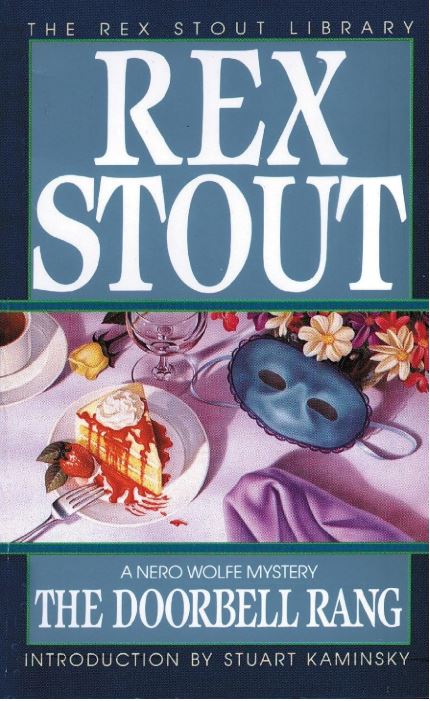
Frequent readers of this blog might remember a post a did some years ago called “My Rex Stout Shout-Out,” and will therefore already know of my long and abiding admiration for Rex Stout. Specifically, for his Nero Wolfe novels, the best of which is perhaps The Doorbell Rang.

It’s one of Stout’s later novels, published in 1960, and it was also the most controversial, involving as its central, unseen villain no other than J. Edgar Hoover himself. And, yeah, that’s one reason I like it. Stout’s detestation of the American right-wing’s tendency toward fascist behavior reached a fever-pitch level, which I share. But the main reason I like the book is for its story, which is actually two interlocking plot lines, each of which complements the other in inventive and surprising ways. The central line involves a very rich widow, Rachel Bruner, who suspects that the FBI is tapping her phones and generally harassing her. She wants Wolfe—the most brilliant man in New York City—to figure out a way to stop them. (Fun fact: this is an example of a little-known sub-sub-sub-genre of detective fiction in which the P.I. serves as a kind of fixer for some rich person’s critical problem.)

Through the intervention of NYPD Inspector Cramer (a highly intelligent but belligerent recurring character, who serves as a frequent foil for Wolfe throughout the series), Wolfe learns that FBI agents are suspects in the murder investigation of a journalist. Thus, Wolfe (and Stout) sees an opportunity to connect these two lines of inquiry. That is, by solving the mystery of the murdered journalist, Wolfe might be able to get some leverage on the FBI, and thus stop its harassment of Mrs. Bruner.

It’s a devilishly clever story, and made even more entertaining by the ways in which Wolfe and his loyal “leg-man,” Archie Goodwin (the narrator of all the Wolfe novels), contrive to outwit the dunder-headed FBI agents. This involves hiring actors to copy the dress and mannerisms of both Archie and Wolfe, so that the actors can impersonate both men and lure the agents into a trap.

Every good story is, in my opinion, a kind of whodunit, if only in a psychological or philosophical sense. Every successful novel asks a question, which the reader must keep reading to discover. With actual mystery novels, this question is explicit—who did the murder and how will the P.I. catch them—but that’s the only real difference. What always amazes me about Rex Stout is how good he is at asking this essential question. In fact, in The Doorbell Rang, he essentially poses it in the opening lines of the book

Since it was the deciding factor, I might as well begin by describing it. It was a pink slip of paper three inches wide and seven inches long, and it told the First National City Bank to pay to the order of Nero Wolfe one hundred thousand and 00/100 dollars. Signed, Rachel Bruner. It was there on Wolfe’s desk, where Mrs. Bruner had put it. After doing so, she had returned to the red leather chair.

Already, the reader is sucked in. We have to find out what’s the deal with that check, which leads us to the crux of the entire mystery.

This passage also illustrates another great strength of the Nero Wolfe novels—and it ain’t Nero Wolfe. Rather, it’s Archie. Archie’s voice. Smart. Sharp. Sardonic. But a bit noble, too. Take this example from a few paragraphs, later:

After she was in the red leather chair I put her coat, which was at least a match for a sable number for which a friend of mine had paid eighteen grand, on the couch, sat at my desk, and took her in. She was a little too short and too much filled out to be rated elegant, even if her tan woolen dress was a Dior, and her face was too round, but there was nothing wrong with the brown-black eyes she aimed at Wolfe as she asked him if she needed to tell him who she was.

I love that bit about Brunner’s eyes. Archie is, of course, an avowed heterosexual, with some kind of romantic exploit in every book. Yet here he finds himself taken with a woman (an older woman, at that) not for her looks but for her obvious intelligence and determination. It’s a great detail, of the sort Stout always delivers.

It’s also a great example of how vividly drawn Stout’s characters are, especially the recurring characters. The snarky and slightly amoral newspaper editor Lon Cohen. The fastidious and unflappable chef, Fritz Brenner. The cool and precise leg-man Saul Panzer. All of them become as familiar to us over the course of the series, like old friends.

Naturally, Wolfe and Archie manage to pull off the caper, trap the FBI agents, and solve the murder, all simultaneously. I won’t spoil it by giving away the climax of the novel, but trust me…it’s a dozy.

Check it out…

What I’m Reading: “Tinseltown”

tinseltown

Ever since I was a kid I’ve had a deep love for classic murder mysteries like The Maltese Falcon and The Big Sleep. Combine this with my obsession with history and biography—especially Hollywood biography—and you get something like William J. Mann’s Tinseltown: Murder, Morphine, and Madness at the Dawn of Hollywood, the true story of one of the most notorious crimes in American history.

Centered on the still-unsolved killing of director William Desmond Taylor in 1922, Mann’s book comes as close to a “nonfiction novel” as I’ve seen since Truman Capote first coined the term.  Being lit geek, I know that 1922 happens to be the year in which The Maltese Falcon is set, and Mann’s story might well have been lifted from one of Hammet’s books, filled as it with hoods, con-men, cops, junkies, sugar daddies and blackmailers.

And beautiful women, of course. Beautiful, deadly women.

The Los Angeles police implicated three women in Taylor’s murder, all actresses of some renown: Mabel Norman, a one-time star whose addiction to cocaine and booze nearly ended her career; Mary Mile Minters, a vapid teenage starlet whose romantic delusions were exceeded only by her considerable box office appeal; and Margaret “Gibby” Gibson, a former Vitagraph player (and occasional prostitute) determined to make herself into a producer.

Continue reading “What I’m Reading: “Tinseltown””

Great Mystery Novels: “The Hound of the Baskervilles”

*** SPOILERS BELOW ***

It feels a little silly, writing SPOILERS BELOW considering I am discussing a novel that came out 123 years ago. Is it possible that any reader of this blog—or, for that matter, any book nerd over the age of thirty—is not already familiar with the plot of The Hound of the Baskervilles? Even those who haven’t read the book have probably seen the movie in one of its many incarnations over the decades. I first saw the Basil Rathbone version from 1939 (which is free on Youtube) when I was about ten years old. This was about the same time my mom gave me a faux-leather bound edition of the complete Sherlock Holmes collection, which I read and re-read many, many times. And the work I re-read the most was The Hound of the Baskervilles (henceforth, HOTB).

Which might lead one to ask: Why would anybody re-read a mystery? After all, the whole point of a mystery is to figure whodunnit, right?

For the average mystery, this is largely true. But the great mysteries—like great books of any kind—operate on many levels and hold different kinds of appeal. For me, the very best mystery novels are character-driven, with a vivid setting and a lot of drama that stands above mere plot mechanics. HOTB  is such a novel.

Continue reading “Great Mystery Novels: “The Hound of the Baskervilles””

R.I.P. Gene Hackman

My parents divorced when I was a little kid. My mom was struggling with mental illness (undiagnosed, at the time) and so I went to live with my father and his new wife, my step-mother Eileen. I saw my mom mostly on the weekends, and we would invariably go to the movies. I probably saw over fifty movies in the theater per year, all with my mom.

I seldom went to the movies with my father, and even more seldomly when it was just the two of us. The last time I remember was in 1992. Eileen was out-of-town with my brother and sister, so Dad and I went to see Clint Eastwood’s Unforgiven. It’s a great movie, and both my father and I loved it. We especially admired Gene Hackman’s performance as the villainous sheriff Little Bill Daggett, who, as Hackman himself revealed, is a kind of precursor to the modern right-wing movement. 

My dad and I went out to dinner after the movie, and we shared our favorite moments from the film. It’s one of my fondest memories. I thought of it this morning when I read that Hackman had died. And I thought of something else, too. It occurred to me that the last movie I saw alone with my mother was also a Gene Hackman film, 1985’s Twice in a Lifetime. It’s about as different a film from Unforgiven as one can possibly imagine, with Hackman playing a completely different kind of character. And yet, it was still Hackman. Still low-key. Still forceful. Still brilliant.

What are the odds that the two last movies I saw with each of my parents alone were both Hackman films? Pretty good, actually. He was in a lot of movies. In fact, you could argue that he was the most versatile, compelling, and attractive character actor in Hollywood history. He played villains and heroes, and everything in between, across genres from action to mystery to sci-fi. In Twice in a Lifetime, he played an unassuming everyman who, on the tail-end of middle-age, leaves his wife to make a new start. He was also Lex Luthor in Superman. And Pop-eye Doyle in The French Connection. And the blind guy in Young Frankenstein

Being a writer of mysteries, I’m particularly fond of Authur Penn’s 1975 film Night Moves, in which Hackman played a world-weary P.I. searching for a missing girl. It’s one of trademark, understated performances, and yet it crackles with energy. That was his gift. 

Godspeed, Mr. Hackman…!!!

Edgar Award Nomination for “Twice the Trouble”

I am very honored (not to mention shocked, amazed, and overwhelmed) to have received an Edgar Award nomination for Best First Novel by an American Author. Many thanks to the Mystery Writers of America, Crooked Lane Books, and my outstanding agent, Cindy Bullard of Birch Literary.

I am also humbled to be in such fine company. The other five nominees have written some truly great books.

And, by the way, the Kindle edition of Twice the Trouble is on sale right now on Amazon. I’m just sayin…

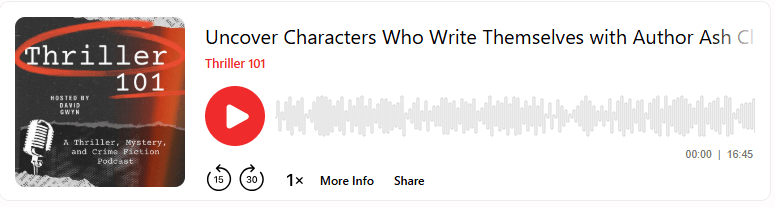
My Thriller 101 Interview with David Gwin

Somebody shared an old post on Facebook today regarding my interview with David Gwyn back in March on his Thriller101 podcast. It got me thinking about how much I enjoyed that particular talk, and what great questions David asks.

So, I thought I’d repost the link. What the heck…

(Yet Another) Shameless Plug

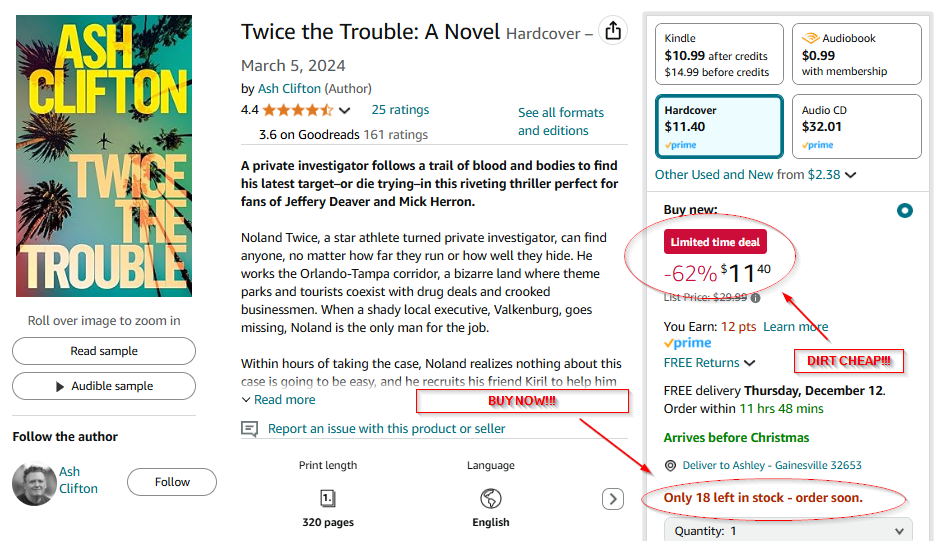
Hey, it’s been DAYS since I plugged my book, so obviously it’s time for yet another shameless plug! Just in time for Christmas!

Amazon is running a sale on my book, Twice the Trouble. It’s 60% off! In hardcover! It would make a heck of a Christmas gift. I’m just sayin…