I had an event to attend in New York City last week, but I couldn’t afford the hotel when the event was actually being held. So, I got a room for my wife and me a few blocks north, on 7th Avenue and 53rs Street. Venturing out for coffee the next morning, I was thrilled to see a sculpture directly across the street, a giant rendering of the word HOPE in red and green letters.
The sculpture is, of course, by pop-artist Robert Indiana, and is a version of his famous LOVE print from 1964. With its simple, Didone letters and bright, primary colors, it’s one of the most instantly recognizable images in art history. Later, Indiana transformed the image into a sculpture which was installed in Central Park for decades. Later still, he made parallel sculptures using other words, like the HOPE version I saw (and photographed, below).
For me, seeing that particular sculpture, in that particular spot, literally right outside my randomly chosen hotel, seemed like a profound instance of synchronicity. This is because I had been reading Prudence Peiffer’s excellent non-fiction book The Slip: The New York City Street That Changed American Art Forever, which illuminates the history of Coenties Slip (pronounced koh-ENT-tees), a semi-abandoned industrial area of lower Manhattan that had once been a small pier jutting into the East River. The slip was filled-in during the early 19th Century and became a locus for sail-making, one of the most skilled and highest-paying trade jobs of the era. Sail-making requires a lot of open warehouse space, and in the early 1960s, those same warehouses (long since abandoned) became cheap studio space for struggling artists and actors, and it is these brave figures that Peiffer’s book illuminates. Chief among them were Robert Indiana, James Rosenquist, Agnes Martin, Elsworth Kelly, and Lenore Tawney.
Ever since I was a kid I’ve had a deep love for classic murder mysteries like The Maltese Falcon and The Big Sleep. Combine this with my obsession with history and biography—especially Hollywood biography—and you get something like William J. Mann’s Tinseltown: Murder, Morphine, and Madness at the Dawn of Hollywood, the true story of one of the most notorious crimes in American history.
Centered on the still-unsolved killing of director William Desmond Taylor in 1922, Mann’s book comes as close to a “nonfiction novel” as I’ve seen since Truman Capote first coined the term. Being lit geek, I know that 1922 happens to be the year in which The Maltese Falcon is set, and Mann’s story might well have been lifted from one of Hammet’s books, filled as it with hoods, con-men, cops, junkies, sugar daddies and blackmailers.
And beautiful women, of course. Beautiful, deadly women.
The Los Angeles police implicated three women in Taylor’s murder, all actresses of some renown: Mabel Norman, a one-time star whose addiction to cocaine and booze nearly ended her career; Mary Mile Minters, a vapid teenage starlet whose romantic delusions were exceeded only by her considerable box office appeal; and Margaret “Gibby” Gibson, a former Vitagraph player (and occasional prostitute) determined to make herself into a producer.
Ever since Donald Trump was first elected in 2016, people have been talking about the “two Americas.” Namely, the working class, poorly educated, white, xenophobic America that voted for Trump and the middle- and upper-class, highly educated, “elitist,” multi-cultural America that voted for Hillary Clinton (and, later, Kamala Harris).
This perception of two Americas—and, indeed, of a “cold” Civil War that is currently being waged between them—is warranted and realistic. America is more polarized than it has been since the 1860s, and there is a very real possibility of the country tearing itself apart (not militarily, I think, but politically, in the same way the USSR erased itself in 1990).
However, I’m not sure we are in a battle between two Americas, per se, as in one between two worldviews. In one worldview, America is under threat of racial dilution, socialist revolution, and religious transgression, all of which will create an evil, perverse America, which its adherents would rather be dead than live in. In the other world view, America is under threat of nascent Fascism, corporatism, kleptocracy, and the climate apocalypse that will inevitably result from all these things.
As usual, the Germans have a much better word for this: Weltanschauung, a term that encapsulates the philosophical and cognitive underpinnings that define a social group or generation (or both). As an English major in the 1980s, I was obliged to read Eustace M. Tillyard’s classic The Elizabethan World Picture, which explores the conscious and subconscious belief system of Britons in the time of Shakespeare. More recently, I read Robert O’Niell’s memoir The Operator, which recounts his years as a Navy Seal fighting in Iraq and Afghanistan. In this book, he describes the weltanschauung of the Afghani locals whom he encountered, some of whom—quite literally—believed in dragons.
One of the many things I learned from Rod Stewart’s memoir, Rod: The Autobiography, is that the technical process of recording a studio album is very strange. For instance, the lead singer usually records his vocal track in a soundproofed room, by himself, wearing headphones so that he can listen to the band’s instrumental track.
It seems a very sterile and artificial process–not at all what one pictures when imagining a rock singer at work. And so I was impressed to learn that Stewart has always rejected this technique, insisting on recording all tracks directly with his band:
When we were recording, I liked to be in the sound room with the band, walking around with a microphone in hand, so that I could look them in the eye, interact with them, perform with them, basically. I think it slightly startled the engineer, who was more used to having the singer isolated behind screens, or in an entirely separate vocal booth. I remember hearing how Frank Sinatra had once been parked by an engineer behind a screen in a recording studio and he had made them take it down. In order to sing, he needed to feel the sound of the orchestra hit him in the chest. I guess this was my own version of that.
It’s interesting that Stewart draws a comparison between himself and Sinatra. As I learned from James Kaplan’s fine bio of Sinatra, the great crooner himself exerted tremendous effort when preparing for one his recordings. He was known to read the song lyrics aloud to himself, almost like prose. He felt he had to discover the emotional truth of the lyric before he could sing it, and if that truth was not forthcoming, he would nix the song.
It feels a little silly, writing SPOILERS BELOW considering I am discussing a novel that came out 123 years ago. Is it possible that any reader of this blog—or, for that matter, any book nerd over the age of thirty—is not already familiar with the plot of The Hound of the Baskervilles? Even those who haven’t read the book have probably seen the movie in one of its many incarnations over the decades. I first saw the Basil Rathbone version from 1939 (which is free on Youtube) when I was about ten years old. This was about the same time my mom gave me a faux-leather bound edition of the complete Sherlock Holmes collection, which I read and re-read many, many times. And the work I re-read the most was The Hound of the Baskervilles (henceforth, HOTB).
Which might lead one to ask: Why would anybody re-read a mystery? After all, the whole point of a mystery is to figure whodunnit, right?
For the average mystery, this is largely true. But the great mysteries—like great books of any kind—operate on many levels and hold different kinds of appeal. For me, the very best mystery novels are character-driven, with a vivid setting and a lot of drama that stands above mere plot mechanics. HOTB is such a novel.
I’ve read a lot of trippy science books in my time, but Roger Zelazny’s Lord of Light is probably the trippiest. The only one that sort of comes close is Frank Herbert’s Dune, which makes a lot of sense considering both were written in the 1960s by two extremely smart and talented writers. (One of Zelazny’s other books, This Immortal, actually shared the Hugo Award with Dune in 1967.)
In fact, there’s not really a name for what Lord of Light is. Technically, it’s science fiction fantasy (a sub-genre I’ve written about before). That is, it looks and feels like a fantasy novel (as does Dune) until you realize that the plot has a sci-fi underpinning. Lord of Light is set on an alien world in which the population is stuck in a pre-industrial state, ruled over by gods of the Hindu pantheon. These gods interact with mortal humans on a daily basis, using magical powers and objects to control their destiny. Throughout the novel, however, Zelazny drops carefully crafted clues that the “gods” are actually the crew of a starship called The Star of India, which crash-landed on the planet centuries before.
These faux-deities use high-technology to set themselves up as gods, complete with a kind of immortality (they can transfer their consciousness to new, young bodies when the old ones wear out). They rule over the common people (who are revealed to be the descendants of the passengers of the ship) with an iron fist, doling out justice and retrobution from a floating, anti-gravity city (“heaven”). This reign is, ostensibly, for the people’s own good (tyrants always say this, right?). But when one of the last democratically-minded crew members, Sam, takes on the role of Siddhartha, he poses a threat to the status quo, which has kept humanity stagnant for generations.
This 1987 edition from Avon was the one I read in college, and I still own it. Its cover was done by an English illustrator named Tim White. I really like it because it captures that essential trippiness. At first, it looks like a pop-religion book, depicting figures dressed like Hindu gods. But what’s with the blue electric bolts? Or the floating city? And why is one of the Hindu “goddesses” blonde?
I learned many things from reading the excellent nonfiction book Would You Baptize an Extraterrestrial? For instance, I learned that the Vatican has its own astronomical observatory, which is run, in part, by the authors, Guy Consolmagno and Paul Mueller. Both men are also Jesuits. (The current Pope, Francis, is also a Jesuit—that’s another thing I learned).
Now, I was raised Catholic, and I thought a knew a thing or two about the religion. But not only did I learn from this book that the Vatican has its own observatory, but that it has had one for hundreds of years. In fact, I was so taken by this discovery that I Googled “Vatican observatory” and, to my amazement, found that the Vatican also runs an observatory in Tucson, Arizona.
Talk about synchronicity! When I was twenty-two years old, I went off to attend grad school at the University of Arizona, in Tucson, and I distinctly remember the first night I spent there. I impressed by the size of the city—much larger than my little hometown of Gainesville, Florida—but also by how beautiful the desert sky was. Even in the downtown area, the stars were clearly visible. This was no accident; the city, I was told, purposely kept the streets relatively dark, in deference to the many astronomical observatories that surround the valley, which could not function if too much light pollution bled from the metro area.
Apparently, the Vatican’s observatory is one of them.
On those rare occasions when I choose to read a big, fat, thick-as-a-brick book about a famous person, I usually pick one about a politician. David McCullough’s Truman is a great example. I tend to gravitate toward books about political figures because, in the course of reading about their lives, you also get a free history lesson. That is, the story of Harry Truman is also the story of World War II, the atomic bomb, Korea, the founding of Israel, and the Berlin Wall.
Biographies of artists are more problematic, for me. I just finished reading de Kooning: An American Master, by Mark Stevens and Annalyn Swan. It chronicles the long life of the great painter—a life barely contained within the span of the Twentieth Century—in which de Kooning lived to be the celebrated, Grand Old Man of modern American art. He became, in fact, the only American artist whose figure and reputation approached those of Picasso.
I was going to make a new Christmas Sci-Fi List to go with the first one that I wrote some years ago. But…well…I flaked out. So, here is a belated list of some of my favorite science fiction novels. And why not? New Year’s Day is a time to think about the future, right? RIGHT?
Anyway, here’s the list…
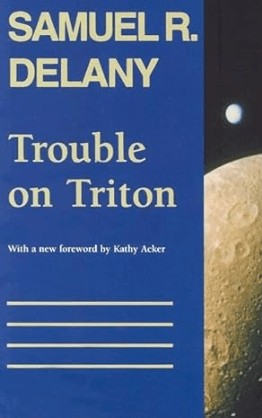
Trouble on Triton
Samuel R. Delany’s Trouble on Triton (published as Triton in the U.S.) is one of the finest written, poorly known works of literary sci-fi in publishing history. Perhaps this is due to the fact that it’s a short work—really a novella—with a post-modern, elliptical plot, not to mention some gender-bending content that was way ahead of its time. Set in a dome-style space colony on the farthest moon in the solar system, it tells the story of Bron, an ordinary schlemiel who’s in love with a mysterious, beautiful performance-artist. What really makes this book fascinating is its depiction of a high-tech, post-scarcity society that anticipated Iain Banks’s Culture novels by decades.
The Peripheral
William Gibson pretty much invented cyberpunk, so it’s fitting that he should write one of the best twists on that genre to come along in years. The Peripheral begins in what appears to be standard Gibson territory. Set in an economically devastated near-future, the story centers on Flynn, a young woman who makes her living as a remote contractor who works in the virtual reality of cyberspace. She thinks she is testing on a prototype for a video game set in a much farther distant, higher-tech future. But when she witnesses a murder in this other, virtual world, she realizes that it’s not virtual at all, but an actual, alternate future earth to which she is connected through a mysterious Chinese server.
The rest of the novel involves her getting to know her future-based boss, Wilf, and helping him solve the murder mystery. Wilf, in return, gives Flynn money and technology to help her and her friends change their timeline, hoping to avoid the environmental catastrophe—a.k.a. “The Jackpot”—that has denuded the planet in Wilf’s. (He explains that their timelines are now independent of each other, so she won’t be messing with his present.) It’s one of Gibson’s best, tightest books with a page-turner plot and some brilliant twists.
The Man in the High Castle
Speaking of alternate timelines, have you ever felt like you were stuck in the wrong one? And it’s not a good one? This is the experience of all the characters in The Man in the High Castle. Set in the 1960s, the book imagines an alternate earth where the Axis powers won World War II. Nazi Germany controls the American east coast, Japan the west coast, and the midwest serves as a vast DMZ between the two. Like most of Dick’s novels, the novel involves several interlocking narratives concerning characters from all classes, high and low, each of whom struggles to be a good person in an insane world.
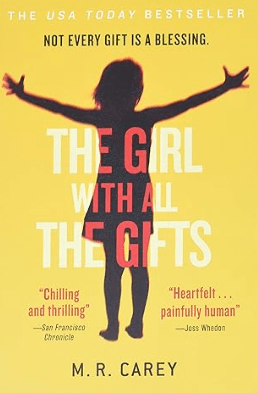
The Girl with All the Gifts
In the last twenty years, there have been so many zombie apocalypse novels, movies, tv shows, and video games that one would expect it to be completely…well, dead. Played out. Void of new ideas.
That’s what I thought when I picked up The Girl with All the Gifts. You can imagine my surprise when I found it to be one of the best written, engrossing, and often thrilling novels I’ve ever read. Its great strength lies in its central twist on the zombie story: the hero (actually heroine) is, herself, a zombie.Sort of. Ten year-old Melanie is infected with the fungus that turns people into zombies, but despite an almost irresistible hunger for human flesh, she retains her human intellect and sensibility. A prisoner in a military-run research station tasked with studying zombie children, Melanie has super-human strength, a genius I.Q., and a love of Greek mythology. She also loves her “teacher” (actually, a sympathetic scientist), Miss Justineau.
When the research station is overrun by zombies, Melanie becomes the savior of her former captors as they make their way across the English countryside, trying to get back to human-controlled territory. The great irony of the novel is that most of the evil Melanie confronts on her journey comes from humans, not zombies. (Or maybe that’s not so ironic, after all.)
The Wave
Known primarily for his mystery novels, Walter Mosley is just a damned good writer, period. The Wave is a rip-snorting, old-school sci-fi novel with a modern sensibility. It’s about a working-class stiff named Errol who comes home one night to find that his father has paid him a visit. No big deal, except for the fact that his father has been dead for years.
The explanation lies is an sentient extremophile that lives so deep in the earth’s crust it has never been discovered…until now. Intelligent and deadly, it can take the shape of any biological form (including poor Errol’s dead father), accessing the target’s memories and consciousness in the process. Errol soon finds himself on the run from scientists who want to study the entity and military men who want to kill it. Good stuff from one of the best.






 Ash Clifton, Writer