I’ve been seeing a lot of on-line ads for the new Nosferatu movie directed by Dave Eggers. It looks like a pretty good movie, although, judging by the trailers, it seems to be emphasizing the horror (e.g., slasher) elements of the classic Nosferatu/Dracula story over the erotic angle (which most film adaptations have veered toward).
Or does it? Looking at the poster, the hook line poster reads “Succumb to the Darkness.” It’s a seductive line, which doesn’t quite seem to go with the image portrayed—that of a beautiful young woman in a nightgown lying on her back with her mouth open, while a skeletal, monstrously taloned hand reaches for her face.
Erotic? Not really. Gross? Yeah, kinda. This thematic confusion between the film’s trailer and its poster reflects, I think, the difficulty in adapting the Dracula story to the screen. (Yes, I know that Nosferatu is not the same as Dracula, but close enough.) The difficulty is made worse in our present time, the 21st Century, when porn is only a few clicks away and the idea of truly transgressive sexual activity is more and more difficult to imagine.
(Author’s Note: this post originally appeared on my old blog, Bakhtin’s Cigarettes.) I don’t want to jinx the man, but the fact that Kirk Douglas still lives is an unmitigated source of joy for me. If you believe, as I do, that movie stars become movie stars because of some internal life-force, whose aura is palpable even when projected onto a silver screen, then Kirk Douglas seems like the best proof of this theory.
At 101, Douglas is a living bridge to Hollywood’s second Golden Age—the 1940s to late 1950s. A bone fide movie start by 1949, Douglas was, along with other mavericks like Burt Lancaster, one of the first major actors to become a power-player in his own right. In an era when the Hollywood studio system traded actors like cattle, he formed his own studio and made his own films. He fostered young writers and directors—most notably, a brilliant, aloof young filmmaker named Stanley Kubrick.
I have a theory about horror novels. The secret to a good horror novel, I think, is not gore, or violence, or even suspense. The secret is empathy. The empathy we, as readers, form for the main characters, and the empathy the main characters feel for each other.
This should be obvious, but it’s not. I have read (well, started) many celebrated horror novels, some of them very well written, only to set them aside after a chapter two because I didn’t care about any of the characters. Contrast this with the very best horror fiction from masters like Stephen King. King is famous for creating main characters who are kind, decent, spirited people with whom the reader instantly connects (and worries about). King’s characters also tend to be underdogs and outcasts. Nerds. Geeks. Handicapped kids. Fat kids. Gay kids. Such types are the most vulnerable in our society, and therefore most vulnerable to whatever monster Kings pits them against. Their underdog status makes them even more sypathetic to readers, and makes their courage even more admirable.
This is not to say that protagonists of horror novels should be all good. Far from it. In fact, King often presents the reader with deeply flawed, erratic main characters who must discover their own inner resilience and courage to face the evil that confronts them.
Recently, I found myself thinking about such matters as I read Lois Murphy’s excellent novel Soon from 2019. Like many great horror books (or many great books of any kind), Soon stays with you long after you finish the last page. It’s got some genuinely creepy stuff in it. Most of all, though, it has a likable, sympathetic, and funny main character named Pete.
Pete is a retired cop who lives in the tiny town of Nebulah in rural Australia. Nebulah is a new twist on the concept of a “ghost town” in that its inhabitants are literally tormented by ghosts. Rather, by a strange, evil entity called The Mist that descends upon the town every evening. From this vapor, a hellish gallery of semi-corporeal spirits attacks any person foolish or unlucky enough to be caught outside after sundown. The victims suffer grisly, violent deaths, but their bodies are never found. (Their remains dissolve mysteriously in the mist soon after being discovered.)
Not surprisingly, the town’s population rapidly dwindles from a few hundred to a few dozen, and then down to just eleven. Most people leave. The rest are picked off one by one. Pete is one of the de facto leaders of this tiny remnant of hard-core town folk, most of whom are too poor or feckless or otherwise attached to the place to ever leave. Pete is neither poor, nor attached, nor feckless, but he stays anyway, mainly to protect his friends. These survivors meet each night at one of their homes and spend the night together, trying to hear the demonic wailings and thrashings coming from outside the windows and doors. (The Mist, rather like vampires, can’t cross the solid threshold of a home unless there is some gap that would let it in.)
I find myself admiring much of Ms. Murphy’s writing, especially in the way she renders the character of Pete. The plot also has some genuinely surprising twists and interludes, such as when Pete goes to visit his estranged daughter in a distant city.
Most of all, I liked the psychological realism of the book. Everyone left in Nebulah has some damned good, practical reasons for not leaving (just ask them), but none of these seems greater than what we suspect is a fundamental weakness in their character. Some are afraid of being poor in a new place. Others are reluctant to give up the homesteads they have labored to improve over the years. Some are just too tired.
Others, like Pete himself, have some secret sin to atone for, and a guilt that keeps them from leaving.
When I was teenager (ahem, some years ago) I had the good fortune to see Robin Williams perform. He was the lead entertainment for that year’s Gator Growl, the annual pep rally thrown by the University of Florida. At the time, Williams was mainly known as the odd but extremely funny star of TV’s Mork & Mindy. Few were aware that he was first and foremost a stand-up comedian, and even fewer knew just how brilliant—not to mention obscene—his style of comedy could be. So, you can imagine the surprise (and shock) that ensued when he walked out on stage and did his first joke, miming the cocking action of a shotgun as well as the sound: KA-CHICK. “Down here in the South,” he said, “if you hear that sound, you’d better be one fast motherfucker!”
The ensuing performance became a local legend. I remember it as being as incredibly manic and astoundingly creative. William’s comedy was like nothing else around at that time. It wasn’t long before he emerged as the premier comedian of his generation. And, since his suicide in 2014, he has become firmly embedded in our national consciousness as the Greatest Comedian of All Time.
This is a justifiable opinion. For my money, though, there was one comic who surpassed even Williams in his intellect, inventiveness, and sheer genius. This was Richard Pryor.
Of all the categories of genre fiction that I’ve consumed over my lifetime, fantasy has probably best the least represented. Sure, I love The Lord of the Rings, and The Narnia Chronicles, and the works of Ray Bradbury that I consider to be dark fantasy (see Something Wicked this Way Comes). But I don’t keep up with many modern fantasy writers nor read many contemporary fantasy novels.
So, you can imagine my surprise when I took a chance on Susanna Clarke’s Piranesi, a fantasy novel that made quite a splash when it came out in 2020, and I enjoyed the hell out of it. It’s a fascinating story of a man trapped in a labyrinth that he calls The House, and which is composed of endless Greco-Roman halls lined with innumerable statues and vestibules. There is a sky above and ocean tides below, which often flood the lower levels. The man is called Piranesi by the only other person (i.e., “the Other”) in The House, an older man who seems able to leave somehow, only to return with key supplies like vitamins and batteries, which he shares with Piranesi.
It’s a fascinating book, and unexpectedly suspenseful, too, especially when Piranesi begins having flashbacks of who he is and how he came to be in the House. This happens about the same time as the sudden appearance of mysterious, written messages that are scattered throughout the House. They seem to have been left by another, recent intruder (one who seems interested in helping Piranesi escape).
For me, at least half of the appeal of Piranesi lies in this whodunnit factor. Like the protagonist himself, I was caught up in the mystery of how he came to be there, who he is, and how he might get out. But the other half lay in the dizzying, intricate nature of the setting—the endless labyrinth that Piranesi inhabits. Such dreamlike settings are more common in literature than one might think, and their appeal is very much like that of a vivid, fabulously detailed diorama, of the sort that all children love to gaze into (and imagine themselves inside).
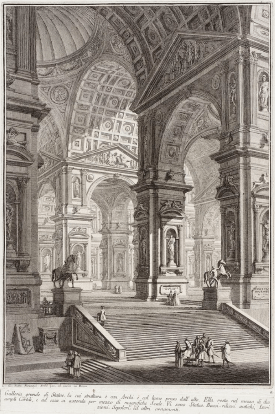
Capriccio Illustration by Giovanni Piranesi
I don’t know what it is, exactly, about mazes, labyrinths, and castles that evokes the power of imagination, But I think it has to do with their endless novelty, the promise of infinite rooms and corridors that we, like children, would love to explore. More to the point, such structures also symbolize the power of imagination—especially the child-like imagination that each of us still harbors. That’s why there is such a grand tradition of castles and mazes in fantasy literature and mythology, from the Minotaur’s labyrinth to the vast, rambling ruins of the Gormenghast trilogy.
Clarke herself acknowledges this tradition in her main character, Piranesi, who is named after Giovanni Battista Piranesi, the 18th Century illustrator who was famous for his drawings of impossibly grand and complicated imaginary buildings. His most famous works are a series of etchings titled Carceri d’invenzione (Imaginary Prisons), and these are, themselves, part of a much older tradition of so-called capricci, drawings that depict architectural fantasy.
In the past decade or so, it’s become fashionable to talk about creativity as the result of freedom, relaxation, and “flow”—that ineffable point where the artist connects with the sources of inspiration deep within the human soul. I, for one, believe in this idea. Art is really about connecting with the spiritual subconscious, and all of us have the ability to channel this source (although very few of us are willing to put in the work that is also required to develop it).
But not enough has been written about the role of conflict in creativity. Specifically, the role of rivalry, competition, and—yes—jealousy, at its most venomous and sincere. The history of art is, in some ways, a history of rivalries. Picasso and Matisse. Faulkner and Hemingway. The Eagles and Fleetwood Mac. Rivals have a way of inspiring each other, of spurring each other on in ways that “healthier” forms of motivation just can’t reach. The greatest rivalries of all are, perhaps, those that exist within a rock-and-roll band. Would Lennon have been as good without McCartney breathing down his neck? Richards without Jagger? Henley without Frey?
Such internal rivalries are more intense because they also bring the family dynamic to bear. A rock band is like a family, and the members are like siblings. They love each other, but they hate each other, too. Worst of all, they know each other’s weaknesses. Which buttons to push.
Surely one of the greatest rock rivalries of all time is that between Roger Daltrey, the mesmerizing lead-singer for The Who, and that band’s lead guitarist and resident genius, Pete Townshend. As in any rivalry, one competitor eventually gets the upper-hand—in the judgment of history, at least—and that is also the case with Daltrey and Townshend. Daltrey has long been acknowledged as a brilliant singer, but it’s Townshend who gets the real credit for The Who’s iconic status. After all, Townshend is the writer of the pair, the creator of all the band’s great hits, including the classic rock opera Tommy.
One can hardly imagine my admiration and delight as I read Alex Kenna’s fine and refreshingly original novel, What Meets the Eye. One thing that sets this book above—far above—the vast majority of mysteries is the symbolic connection it draws between two central characters–a cop-turned-P.I. named Kate Myles, and a brilliant artist named Margot Starling. Kenna sets them up as linked opposites, each a very smart and driven woman struggling to succeed in a dangerous (and largely male-dominated) world. Both are driven by a deep outrage at the injustice they see around them. And both have some dark history.
Ultimately, of course, Kate and Margot are connected in a different way: Margot becomes the victim of a murder, and Kate is hired to find her killer.
Very seldom have I seen a mystery novel that attempts multiple points-of-view, and never with such skill. Kenna bounces back and forth between past and present, giving the reader before-and-after clues as to what, exactly, befell Margo, even as Kate unravels the mystery. It’s a very fresh and compelling technique. I also really enjoyed the surprising and original insights the novel offers about both women’s realms: the art world for Margot, and the law enforcement world for Kate.
But the real triumph of this book, for me, is Kate herself. It’s her book, and she’s a great character. Funny, smart, earthy, and fearless, she gives the reader an unequivocal here to root for. Yes, she’s done some questionable things in her past (she had a bit of an opioid habit), but she’s a devoted mother and a driven seeker of truth. She makes a great, new entry in the cannon of classic private detective heroes.
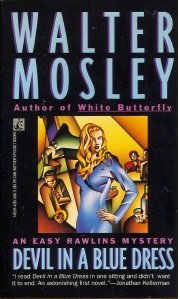
Like a lot of people, my first exposure to Walter Mosely was when I saw the 1995 film adaptation of his novel, Devil in a Blue Dress, starring Denzel Washington. It’s a good movie, with fine performances by Washington and Don Cheadle, but it didn’t inspire me to seek out Mosely’s fiction. As far as I knew, he was just another solid mystery writer, one of many whom I hadn’t read.
Sometime later, I bought a copy of The Best American Short Stories and I was surprised to see a story by Mosely among that year’s selections. The story is called “Pet Fly” and it’s a deceptively simple tale of an office grunt (who happens to be black) trying to keep his integrity while working in modern corporate America. I was knocked-out by it. Later still, I stumbled upon an actual novel by Mosely, a science fiction work called The Wave, which turned out to be one of the best novels (sci-fi or otherwise) that I had read in years.
My great friend Margaret Luongo and I just released the premier episode of our new YouTube Channel, Read a Classic Novel…Together. In this series, we tackle classic novels that we’ve been meaning to read forever, and we invite the viewer to read each chunk along with us. (We try not to read ahead, but do anyway sometimes. Sorry.)
For this first episode, we take on Part I of Jean Rhys’s Wide Sargasso Sea. Check it out when you can.



 But not enough has been written about the role of conflict in creativity. Specifically, the role of rivalry, competition, and—yes—jealousy, at its most venomous and sincere. The history of art is, in some ways, a history of rivalries. Picasso and Matisse. Faulkner and Hemingway. The Eagles and Fleetwood Mac. Rivals have a way of inspiring each other, of spurring each other on in ways that “healthier” forms of motivation just can’t reach. The greatest rivalries of all are, perhaps, those that exist within a rock-and-roll band. Would Lennon have been as good without McCartney breathing down his neck? Richards without Jagger? Henley without Frey?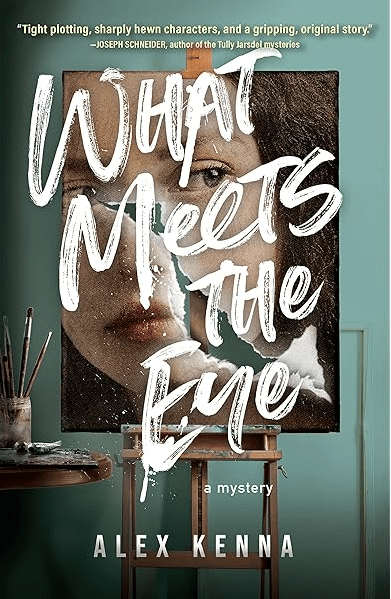
 Ash Clifton, Writer