The ad starts with a thirty-something blond man standing in the kitchen of what appears to be an expensive, post-modern home, spacious and bright, with some well-manicured trees visible through the bay windows. Dressed in a tasteful-yet-generic linen shirt, the man is vaguely handsome yet nerdy. With his Germanic features, beard, and shoulder-length blond hair, he looks a bit like Thor, if Thor were retired and had become a web designer. In other words, he seems to represent the best-case scenario for a lot of aging tech-bros. Sure, your features might have sagged a little, and you might have a bit of a paunch, but you’re still a stud.
The opening shot shows the man slipping on what appears to be an extra-large set of ski goggles, with some strange, high-tech Whangdoodles on the side. This is, we instantly realize, the product that the ad is hawking—Apple latest virtual reality headset, the Apple Vision Pro. Meanwhile, the soundtrack is taken up by the opening ostinato of Supertramp’s “Dreamer,” a song once beloved by the late 70s, post-Vietnam counterculture but which has now been co-opted by the Apple Corporation. Indeed, the song sets the theme for the entire ad. The man we are looking at is the “dreamer,” but we, the viewers, are too. We are all, the ad suggests, preparing to enter a world of high-technology magic, where our entire lives will be transformed (for the better, as in a dream) by this newest gizmo.
Christmas came early for me this year! Many thanks to Ms. Oline Cogdill and the good folks at the Sun-Sentinel for putting Twice the Trouble on their Best Mystery Fiction Books of 2024 list! I am very honored.
One of the coolest classes I took at U.F. was Intro To Astronomy, taught by a funny old German guy named Heinrich Eichorn who, I later learned, was Chair of the Astronomy Department. (Yes, this was back in those quaint old days when top-notch professors had to actually, you know, teach class. And not just to grad students!) While Professor Eichorn’s lectures tended to meander a bit, he had a genuine enthusiasm for the subject that students, myself included, could sense and respond to. I remember one particular class when, in one of his usual, off-topic asides, he said, “We know the universe is not infinite. If it were, then every point in the sky above us would always be as bright as a star.”
For me, this was one of those mind-blowing moments when one is exposed to the wisdom of the ages. In this case, it was that of another German astronomer, Johannes Kepler, who in 1610 realized that if the universe really were infinitely large, and infinitely old, then every line-of-sight direction one looks at in the sky should eventually hit a star. Thus, the entire sky should be as bright as (and, worse still, as hot as) the surface of a star. Nevermind the fact that most of these stars would be very, very far away. Their light would still have an infinite amount of time to reach us, and there would be an infinite number of them shining down on us.
Like all great rock bands, U2 has always has always had the ability to reinvent itself. Just when you think it’s completely washed out and finished, the members come up with another great album. They did it in 1991 withAchtung Baby and again in 1994 with How to Assemble an Atomic Bomb. The best song off that latter album is “Vertigo,” which also has one of the cooler music videos the band has ever appeared in.
The first DVD I bought was Blade Runner. The second was Forbidden Planet. This latter film is a science fiction classic from Hollywood’s second golden age, 1956 (the same year that John Ford’s landmark film The Searchers was released). Perhaps the definitive pulp sci-fi movie, it’s got everything you might expect: stalwart heroes, spaceships, lasers, aliens, a teen-aged hottie, a mad scientist, and even a talking robot.
And monsters, of course. Monsters from the Id.
Ever since I first saw Forbidden Planet on TV when I was kid, I’ve loved it. Here are ten reasons why…
1.) Altair IV
Forbidden Planet is, to my knowledge, the first Hollywood movie to depict human beings landing a spaceship on a planet of another star. This was a fairly landmark achievement in the history of science fiction cinema, made even better by the film’s two art directors, Cedric Gibbons and Arthur Lonergan. In their vision, Altair becomes a green- and blue-tinged desert, not unlike that of John Ford’s American Southwest. Considering this was done with matte paintings and other pre-CGI effects, it’s amazing how good the landscapes are, so desolate and full of foreboding. It’s a prefiguration of all the wild worlds of Star Wars, Star Trek, and so on, yet to come.
I have a theory about horror novels. The secret to a good horror novel, I think, is not gore, or violence, or even suspense. The secret is empathy. The empathy we, as readers, form for the main characters, and the empathy the main characters feel for each other.
This should be obvious, but it’s not. I have read (well, started) many celebrated horror novels, some of them very well written, only to set them aside after a chapter two because I didn’t care about any of the characters. Contrast this with the very best horror fiction from masters like Stephen King. King is famous for creating main characters who are kind, decent, spirited people with whom the reader instantly connects (and worries about). King’s characters also tend to be underdogs and outcasts. Nerds. Geeks. Handicapped kids. Fat kids. Gay kids. Such types are the most vulnerable in our society, and therefore most vulnerable to whatever monster Kings pits them against. Their underdog status makes them even more sypathetic to readers, and makes their courage even more admirable.
This is not to say that protagonists of horror novels should be all good. Far from it. In fact, King often presents the reader with deeply flawed, erratic main characters who must discover their own inner resilience and courage to face the evil that confronts them.
Recently, I found myself thinking about such matters as I read Lois Murphy’s excellent novel Soon from 2019. Like many great horror books (or many great books of any kind), Soon stays with you long after you finish the last page. It’s got some genuinely creepy stuff in it. Most of all, though, it has a likable, sympathetic, and funny main character named Pete.
Pete is a retired cop who lives in the tiny town of Nebulah in rural Australia. Nebulah is a new twist on the concept of a “ghost town” in that its inhabitants are literally tormented by ghosts. Rather, by a strange, evil entity called The Mist that descends upon the town every evening. From this vapor, a hellish gallery of semi-corporeal spirits attacks any person foolish or unlucky enough to be caught outside after sundown. The victims suffer grisly, violent deaths, but their bodies are never found. (Their remains dissolve mysteriously in the mist soon after being discovered.)
Not surprisingly, the town’s population rapidly dwindles from a few hundred to a few dozen, and then down to just eleven. Most people leave. The rest are picked off one by one. Pete is one of the de facto leaders of this tiny remnant of hard-core town folk, most of whom are too poor or feckless or otherwise attached to the place to ever leave. Pete is neither poor, nor attached, nor feckless, but he stays anyway, mainly to protect his friends. These survivors meet each night at one of their homes and spend the night together, trying to hear the demonic wailings and thrashings coming from outside the windows and doors. (The Mist, rather like vampires, can’t cross the solid threshold of a home unless there is some gap that would let it in.)
I find myself admiring much of Ms. Murphy’s writing, especially in the way she renders the character of Pete. The plot also has some genuinely surprising twists and interludes, such as when Pete goes to visit his estranged daughter in a distant city.
Most of all, I liked the psychological realism of the book. Everyone left in Nebulah has some damned good, practical reasons for not leaving (just ask them), but none of these seems greater than what we suspect is a fundamental weakness in their character. Some are afraid of being poor in a new place. Others are reluctant to give up the homesteads they have labored to improve over the years. Some are just too tired.
Others, like Pete himself, have some secret sin to atone for, and a guilt that keeps them from leaving.
One of my favorite films of all time is Michael Mann’s first feature, 1981’s Thief. That movie was not only the beginning of my life-long love of Mann’s movies, but also with the soundscapes of the German band Tangerine Dream, who composed the score.
When I saw the movie, I had never heard of Tangerine Dream, and thus had no idea that they were one of the iconic avant-guarde bands of the 1970s, producing legendary albums like Phaedra and Zeit. All I knew was their music was hypnotic and unbelievably powerful.
In fact, Tangerine Dream was sort of the Hans Zimmer of their day, creating some of truly great soundtracks. One of their other great scores was for William Friedkin’s 1977 suspense film Sorcerer. If you haven’t seen it, you should check it out. Nominally a thriller, it’s about four guys from totally different backgrounds, all hiding in out from the law in South America. When a local oil platform catches fire, the guys are offered a big payday if they will drive two trucks full of leaky nitroglycerin through the mountains to put the fire out. That’s the stated plot of the film. I have a theory, however, that its really about four guys who are in hell and just don’t realize it yet. They all have much to atone for, and each suffers and grows (or fails to grow) in his own way.
The score brilliantly evokes that sense of menace and evil that lies just around the corner. It’s a great piece to listen to when you’re in a dark and somewhat demented state of mind (or if you want to be in one, for whatever reason).
If you were to ask a music lover to name the most iconic pop band of the 1970s, their answer would probably be The Bee Gees. And they’d be right–mostly. For about three years, The Bee Gees bestrode the world like a collosus, leading the musical and cultural era that was disco.
But, for my money, it was the Electric Light Orchestra that most defined 70s pop. The creation of musical genius Jeff Lynne, E.L.O. was hit machine that cranked out gold records with regularity. Their songs were all over the radio here Gainesville, and their records were coveted.
And expensive. I remember looking at Out of Blue in the record store and was shocked to see that it was priced at $14.99. (This was back when ten bucks would get you a decent dinner in a real restaurant.)
My favorite E.L.O. song is, of course, “Turn to Stone”, which is the perfect fusion of pop and rock. Cinemaphiles will note that it was this song that P.T. Anderson ended his great film Boogie Nights with.
When I was a public school kid back in the 1980s, I used to spend hours at the bookstore, mostly looking at science fiction books. It wasn’t just the stories themselves that interested me, but the cover art. Back then, before the internet gave one an endless supply of great sci-fi concept art of any kind, the only way to get one’s imagination going was to head to the bookstore.
So, it’s probably inevitable that I would regard that time as a golden age of sci-fi cover art. And I do. When I look at sci-fi books today, there is usually no cover art to speak of, but just an exercise in graphic design. The title goes in this font 38 point; the author’s name goes in this font at 28 point; etc.; with some blurry, abstract notion of an alien planet or a futuristic city. Back in the pre-digital days, sci-fi cover art consisted mainly of actual paintings, made by actual painters.
One of the best actual painters was (and is) Michael Whelan. His work has that perfect blend of realism, action, and whimsy that I always looked for in a good sci-fi cover. For five decades, he created some of the best covers ever made, and they earned him a place in the Science Fiction Hall of Fame.
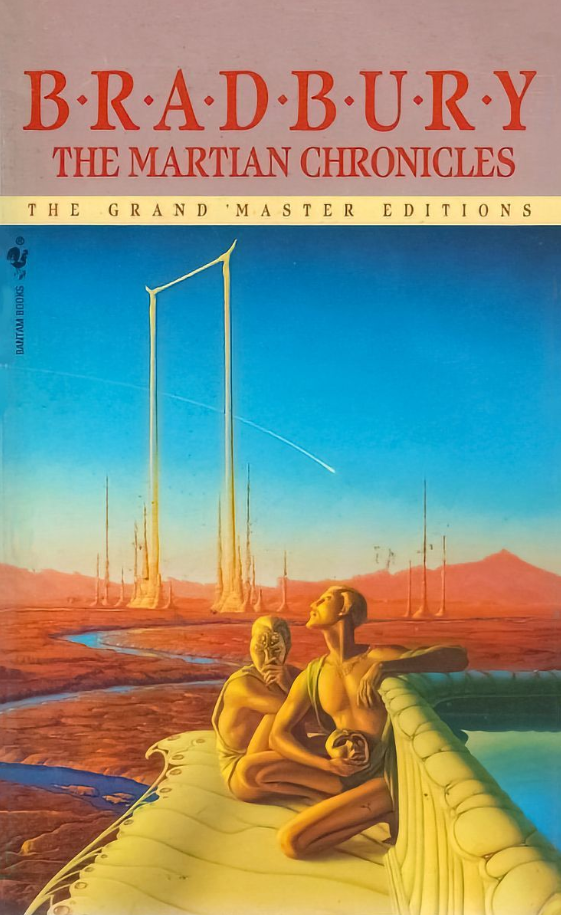
One of my favorites is the one above, his cover for the 1990 Bantam/Spectra edition of Ray Bradbury’s The Martian Chronicles. If you haven’t read it (and you should), it’s an allegory about the loss of ancient wisdom, the horrors of capitalism, and even the conquest of the American West. Haunting the work are the ghosts of the Martians themselves, who once-great civilization is helpless in the face of the invading Earth-men, with their guns and disease and endless greed. I love this cover because it gives you a sense of that lost majesty, but it also makes you curious about the story.