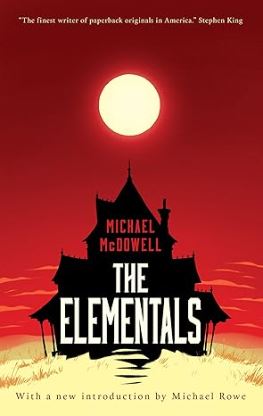
What I’m Reading: “The Elementals”

Last year, I wrote a post about a fine non-fiction book called Paperbacks from Hell: The Twisted History of ‘70s and ‘80s Horror Fiction. I enjoyed the book primarily for the way the author, Grady Hendrix, mixes his obvious love of old, pulpy horror novels with an enormous amount of mockery and snark. Basically, he makes fun of the trends that ran through horror fiction back in the day, as well their emphasis on over-the-top gore and hilariously silly plots. 

As I read the book, though, I noticed Hendrix mention one writer whom he does not mock: Michael McDowell. Rather, Hendrix uncharacteristically bestows a bit of praise on this particular novelist, which made me curious as to why I had never heard of the dude. 

As it turns out, most people haven’t heard of McDowell, even though he was a very respected paperback fiction writer (Stephen King called him one of the best) as well as a successful screenwriter (he wrote the screenplays for Beetlejuice and The Nightmare before Christmas, as well as a lot of TV shows). I, especially, should have heard of McDowell considering he was, like me, a Southern writer—from the Gulf Coast of Alabama, not far from where I spent my summers in Pass Christian, Mississippi. He was also a writer who tried to blend a literary sensibility with an appreciation of genre narrative, which is an achievement which I admire.

McDowell died in 1999, a latter casualty of the AIDS epidemic in America, just a few years before reliable HIV treatments came into common use. In the years since, his reputation seems to have grown, steadily if slowly, to the point where he is now considered a forgotten master. I was surprised to find an e-book edition of his most famous novel, The Elementals, on my local library’s Overdrive site, and I immediately checked it out and tore into it.

It’s definitely worth the read. Set in Alabama, it tells the story of a two wealthy, intermarried families: the Savages, with matriarch Marian and her adult son, Dauphin; and the McCrays, with matriarch Big Barbara and her adult children, Luker (who has a thirteen-year-old daughter, India) and Leigh (who is married to Dauphin Savage). At the start of the book, Marian has just died and the rest of the blended family is attending her funeral:

In the middle of a desolate Wednesday afternoon in the last sweltering days of May, a handful of mourners were gathered in the church dedicated to St. Jude Thaddeus in Mobile, Alabama. The air conditioning in the small sanctuary sometimes covered the noise of traffic at the intersection outside, but occasionally it did not, and the strident honking of an automobile horn would sound above the organ music like a mutilated stop. The space was dim, damply cool, and stank of refrigerated flowers. Two dozen enormous and very expensive arrangements had been set in converging lines behind the altar. A massive blanket of silver roses lay draped across the light-blue casket, and there were petals scattered over the white satin interior. In the coffin was the body of a woman no more than fifty-five. Her features were squarish and set; the lines that ran from the corners of her mouth to her jaw were deep-plowed. Marian Savage had not been overtaken happily.

Even for a funeral, it’s a very dreary and ominous affair. Yet it gets worse when, at one pre-arranged moment, Dauphin rises and stabs a ritual knife into his dead mother’s chest. Yeah, it’s that kind of book. The fact that McDowell can pull it off and still maintain a high-level of physical and emotional realism—not to mention vivid, sharp writing, as in the passage above—is a testament to his mastery. 

The book gets even weirder after the funeral, when the family retreats to their ancestral vacation spot, a tiny barrier island called Beldame, taking with them their Black maid, the long-suffering (and very smart) Odessa. We soon learn that there are three houses on Beldame, yet the family occupies only two of them, leaving the third abandoned. (You can probably guess the reason why, but it has something to do with the house’s intermittent habit of…well…eating people.) 
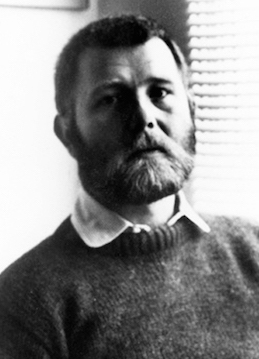
Michael McDowell

As the sand-dunes slowly encroach and bury it, the empty house attracts the curiosity of the young and intrepid India McCray, who ventures inside and sees something impossible yet real. And terrifying. 

Of course, The Elementals isn’t just a generic ghost story, nor a generic Southern Gothic novel. The characters are vividly drawn, sympathetic, and believable. Their conversation is fraught with age-old tensions and resentments, yet it’s often very funny in a Curb Your Enthusiasm kind of way. And the characters of India and Odessa are especially well-realized. Linked by their intelligence and, as McDowell implies, some kind of psychic power reminiscent of The Shining, each comes off as a kind of hero in their battle against the evil hiding (rather obviously) in House #3.

The Elementals is a literary horror novel, meaning that it bridges the gap between genre story-telling and development of realistic characters. The book really comes to life (forgive the pun) in the chapters about India as well as of the adult male characters, Luker and Dauphin, both of whom struggle—in true Southern fashion—with the dark legacy of the past and especially surround their own family. Self-indulgent, smothering matriarchs like the recently deceased Marian are, in particular, a source of psychological revulsion. Indeed, they are central to the main theme of the novel, which I will not spoil here.

There is also a good amount of subtle criticism about the racial divide that existed at the time (and now) in the deep south. Odessa, the Black maid, is the only character who does any real work in the book, busy doing the cooking and cleaning for the affluent Whites, just as she has done (we are told) for thirty years. And, of course, Odessa is not only smarter than most of the family members (except, perhaps, for India) she is the only one who knows what the hell is going on in House #3, using her power of second-sight as well as (it is implied) a familial knowledge of voodoo. 

Yes, as many reviewers on Reddit have observed, Odessa is an instance of the Magical Negro Trope, of the sort that genre writers, both Southern and not, have abused for a century. This trope is, of course, a literary stereotype, and like any stereotype it can be harmful if taken too far and left unexamined. But if Odessa is a Magical Negro, she is a very world-weary and snarky example, with both courage and brains. I simply loved her character. Sue me. 

In fact, I loved the whole book, which feels a bit like a mash-up of Tennessee Williams and Stephen King. Check it out. It deserves some attention. Better late than never.
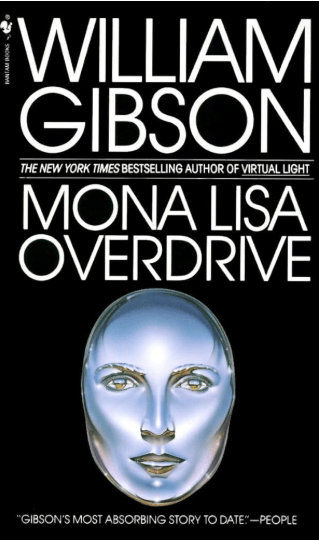
What I’m Reading: “Mona Lisa Overdrive”

The great sci-fi writer Clifford D. Simak was known for writing novels and short stories with off-beat main characters. Often, his protagonists were cynical, working-class stiffs (often with a drinking problem) who stuck to their own, private, moral code, often at great cost to themselves. One of Simak’s editors once groused that all of his stories were about “losers.”

“I like losers,” Simak replied.

I just read this quote the other day, and I immediately thought of William Gibson’s books—specifically, Mona Lisa Overdrive. I first read MLO back in the early 1990s, just a few years after its publication, and I thought it was great. I never really thought of reading it again, but for some reason—perhaps because I’ve been a bit down, of late—I recently checked-out the book and re-read it. And I’m really glad I did. One of the foundational works of the cyberpunk sub-genre (along with Gibson’s Burning Chrome, Neuromancer, Count Zero, and other books), it still holds up, both as a work of speculative fiction as well as just a damned good, vividly imagined, human story. 

A lot of people heap praise on Gibson’s novel—and on the Cyberpunk genre in general—because of their ideas, the thematic questions they ask about how humanity can relate in an age of overwhelming, dehumanizing technology. And what are the brutalizing effects of the ever-increasing disparity between the high-tech haves and the lower-tech have nots? Et cetera et cetera

Myself, I like Gibson’s characters. Often, they are losers, of the sort Simak wrote about. Little people eking-out an existence on the fringes of society. MLO is no exception. The last of Gibson’s Sprawl trilogy, after Neuromancer and Count Zero, it’s set on a near-ish future Earth where mega-corporations, trillionaires, and criminal cartels have replaced all governments, and most of humanity muddles along in a rat-race of late-stage capitalism. The plot is a complicated skein of four interlocking narratives, each centered on a different character: Mona, a teenaged prostitute; Kumiko, the tween-aged daughter of a Yakuza boss; Angie, a beautiful young star of virtual reality films (“simstims”); and Slick Henry, an artist who sculpts robots and suffers from government-inflicted memory loss. I find it interesting that, of these four characters, two are children (Mona is sixteen), one is addicted to drugs, and one is brain-damaged. Additionally, two of them (Mona and Slick Henry) are poor, while the other two “rich” characters (Angie and Kumiko) are virtual prisoners of their wealth and position, separated from any real friendships or human connection. 

Most notably, none of them have real families. Mona is an orphan; Kumiko’s mother died under mysterious circumstances, and her father is an aloof cypher.

In short, all of Gibson’s view-point characters are underdogs, one way or another. The closest he has ever come to a real, kick-ass hero is in one of his best supporting characters, Molly Millions, the cybernetically enhanced mercenary who figures so prominently throughout the Sprawl trilogy (not to mention Gibson’s landmark short-story “Johnny Mneumonic”, which first appeared in Omni Magazine in 1981; yeah, I read it fresh off the newsstand). And even Molly is more of an anti-hero, selling her services to the highest bidder, yet always displaying a basic, inner decency and compassion.

It is Molly, in fact, who becomes the physical catalyst that eventually brings the four narrative threads of the plot together in the MLO’s final chapters. I don’t want to spoil it completely, but the story involves a plot to kidnap Angie (the simstim star, whom Mona strongly resembles; hint, hint) and prevent her from reuniting with her boyfriend, Bobby Newmark, whose body lies comatose in Slick Henry’s art studio while his mind is busy in cyberspace. Kumiko, too, finds herself caught up in this plot, if only tangentially.

Having just re-read the book for the first time in thirty-odd years, I find myself liking it even more now than I did back then. I am awestruck by how deft Gibson’s prose is (he is surely one of America’s most underrated writers), as well as how quickly the story sucks the reader in. Almost every pop-novel out there these days is written from multiple, shifting points-of-view, but very, very few manage to draw their individual characters so vividly, or keep the reader as invested in the plight of each. 

And, yeah, Gibson’s ideas are really, really cool. My favorite revelation in the book is when Slick Henry’s friend, Gentry, figures out that the L.F., the device attached to Bobby’s skull, is really an aleph, referencing the 1945 short story by Jorge Luis Borges. (If you read enough cyberpunk novels—or urban fantasy novels, for that matter—you’re going to run into Borges eventually.)

To sum up, Mona Lisa Overdrive is one of my favorite novels, sci-fi or otherwise. Check it out…

Great Mystery Novels: “The Rose Rent”

As I’ve stated before, one mark of a truly fine mystery novel—for me at least—is if I feel the need to go back and reread it. This isn’t just a matter of me waiting long enough to forget whodunnit (a period of time that grows shorter the older I get), it’s also an indication that something about the novel stuck with me, and made me want to revisit its imagined world.

So, it’s perhaps not surprising that I find myself rereading many of Edith Pargeter’s (writing as Ellis Peters) Brother Cadfael novels. Currently, I’m on The Rose Rent, which is about as fine an episode in the series as any. It has all the components of a truly great mystery novel—namely, a compelling and complicated sleuth; an entrancing and alien setting; original and interesting secondary characters; and a multi-layered plot.

And a voice. Of course, a great narrative voice. Take the opening paragraph of the novel:

By reason of the prolonged cold, which lingered far into April, and had scarcely mellowed when the month of May began, everything came laggard and reluctant that spring of 1142. The birds kept close about the roofs, finding warmer places to roost. The bees slept late, depleted their stores, and had to be fed, but neither was there any early burst of blossom for them to make fruitful. In the gardens there was no point in planting seed that would rot or be eaten in soil too chilly to engender life.

I love the elegance and almost romantic feel to this passage, which is characteristic of all Pargeter’s writing. You feel like you’re in competent hands, which is crucial considering that you’ve been transported to England in the Twelfth Century. (Specifically, to Shrewsbury, the town where Cadfael lives as the resident herbalist of the local Benedictine monastery.) I love the sense of desolation in this opening. We can almost feel the lingering winter, which has gone on too long and threatens the well-being of the town, including the ordinary folk, the monks, and even the nobles. It also suggests the coming tragedy of the murder around which the story will be revolve—that of a young, love-stricken monk who is killed trying to protect the woman with whom he has become infatuated.

Yes, it’s a desolate opening. But with Pargeter, you never really feel hopeless. Sure, it’s the Dark Ages, but her stories are populated with good, strong, shrewd people who always find a way to make the best of things. Take this paragraph, which comes a bit later and introduces Brother Cadfael himself:

Brother Cadfael, preoccupied with his own narrower concerns, continued to survey the vegetable patch outside the wall of his herb-garden, digging an experimental toe into soil grown darker and kinder after a mild morning shower. “By rights,” he said thoughtfully, “carrots should have been in more than a month ago, and the first radishes will be fibrous and shrunken as old leather, but we might get something with more juices in it from now on. Lucky the fruit-blossom held back until the bees began to wake up, but even so it will be a thin crop this year. Everything’s four weeks behind, but the seasons have a way of catching up, somehow. Wareham, you were saying? What of Wareham?”

#

He is speaking, of course, to his best friend, Hugh Berenger, the Sheriff of Shrewsbury. Berenger is a much younger man, but like Cadfael he is world-weary, experienced, and tough. Indeed, many of the best novels in the series depict bad guys who underestimate Berenger, with his mild demeanor and slight build, as weak. He is, in fact, an intelligent man and a cunning fighter. Berenger has just brought news of the most recent battle of the on-going English civil war (the Anarchy) which serves as the backdrop for all the novels. Berenger, we know, has befriended Cadfael in part because they have both been soldiers—in Cadfael’s case, a veteran of the First Crusade, which caused him to live in the Middle East for many years, where he lived with a Muslim widow and fathered a child with her.

A great part of the appeal of these novels is this tension between two sides of Cadfael’s character. He is the very opposite of an oblate—a person who has come into the monastery as a child. Rather, Cadfael has converted later in life, after have seen many terrible and wondrous things and had many worldly experiences. As such, he brings a shrewd, wise perspective to his role as a monk, healer, and protector of the innocent—a shrewdness that is matched by the “hatchet-faced” Abbot Rudolfus, who often conspires with Cadfael to bend the rules in favor of a remorseful miscreant or helpless person.

And, of course, there is just Pargeter’s unerring talent for winning, memorable description. For instance, take this passage, in which a self-serving (and possibly villainous) young character, Vivian, is introduced.

[Vivian] was a very personable young man indeed, tall and athletic, with corn-yellow hair that curled becomingly, and dancing pebble-brown eyes in which a full light found surprising golden glints. He was invariably elegant in his gear and wear, and knew very well how pleasant a picture he made in most women’s eyes. And if he had made no headway yet with the Widow Perle, neither had anyone else, and there was still hope.

The woman on whom Vivian has set his sights is Judith Perle, a young widow who has leased her old house to the monastery for the meager “rent” of a single rose per year, plucked from the bush that grows outside the doorway. Judith is, of course, very rich woman, and must of the plot revolves around a murder who is intent of separating her from that wealth—even if this means killing her in the process.

The Rose Rent is a great mystery novel. Check it out…

Classic Sci-Fi Book Cover: “Something Wicked This Way Comes”

Okay, let’s get this out of the way: Something Wicked this Way Comes is not a science fiction novel. It’s dark fantasy, and, in my opinion, a precursor to many famous books in that genre from the likes of Stephen King, Anne Rice, Erin Morgenstern, and others. 

However, Ray Bradbury’s books were always sold in the science fiction aisle when I was a kid. And I read all his books thinking they were science fiction. (I didn’t read fantasy back then.) So, I’m shoe-horning him into my classic sci-fi book covers thread. 

Having said all that, let me add that this is one of my favorite novels, not to mention Bradbury’s best. It’s the tale of two 13-year-old boys, Will and Jim, who have grown up next door to each other in 1930s Illinois. Will and Jim are almost exactly the same age, with Will being born one minute before midnight on October 30th and Jim being born one minute after midnight on October 31st. Yes, one boy is born a minute before Halloween begins and the other born a minute after. (Guess which one is the “bad” kid?)

It might seem like clunky symbolism, but in Bradbury’s prolix hands, it works. The duality between the introverted, good-natured Will and the adventurous, mischievous Jim—that is, between light and dark sides of our being—is repeated throughout the novel. Both boys are forced to confront their darker impulses when a demonic carnival arrives on the edge of town in the middle of the night. Will and Jim soon discover that the carnival is a vehicle for a bunch of malevolent,  vampire-like beings who want nothing more to lure innocent people onto the midway and tempt them into evil.

The only person who believes the boys when they tell what they’ve seen is Will’s father, an older man who doubts his own strength and courage. Together, they challenge the men who run the carnival, Mr. Cougar and Mr. Dark (another light/dark duality) for the soul of the town.

I really like this cover—created by veteran illustrator David Grove—because it captures the nostalgia, magic, and dark wonder that are the great strengths of the novel. Specifically, it refers to a moment in the story when Mr. Dark wanders through the town looking for Will and Jim. He has the images of the boy tattooed on his palms, and he shows them to passersby to see if anyone recognizes them. It’s an extremely creepy scene in an amazing book. (It’s also the first moment when Will’s father shows his courage and guile in besting Mr. Dark.)

My appreciation for the cover is in no way diminished by the fact that it appears to be a poster tie-in with the film adaptation produced by Disney in 1983, depicting the likenesses of some of the actors (most notably, the great Jonathan Pryce, who performance as Mr. Dark is worth the price of admission all by itself).

Also, not long after Mr. Grove passed away, Tor.com published a tribute to him and his career. You can see it here

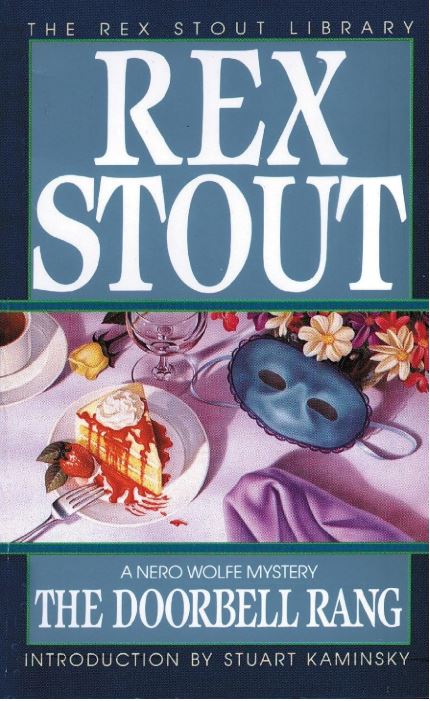
Great Mystery Novels: “The Doorbell Rang”

Frequent readers of this blog might remember a post a did some years ago called “My Rex Stout Shout-Out,” and will therefore already know of my long and abiding admiration for Rex Stout. Specifically, for his Nero Wolfe novels, the best of which is perhaps The Doorbell Rang.

It’s one of Stout’s later novels, published in 1960, and it was also the most controversial, involving as its central, unseen villain no other than J. Edgar Hoover himself. And, yeah, that’s one reason I like it. Stout’s detestation of the American right-wing’s tendency toward fascist behavior reached a fever-pitch level, which I share. But the main reason I like the book is for its story, which is actually two interlocking plot lines, each of which complements the other in inventive and surprising ways. The central line involves a very rich widow, Rachel Bruner, who suspects that the FBI is tapping her phones and generally harassing her. She wants Wolfe—the most brilliant man in New York City—to figure out a way to stop them. (Fun fact: this is an example of a little-known sub-sub-sub-genre of detective fiction in which the P.I. serves as a kind of fixer for some rich person’s critical problem.)

Through the intervention of NYPD Inspector Cramer (a highly intelligent but belligerent recurring character, who serves as a frequent foil for Wolfe throughout the series), Wolfe learns that FBI agents are suspects in the murder investigation of a journalist. Thus, Wolfe (and Stout) sees an opportunity to connect these two lines of inquiry. That is, by solving the mystery of the murdered journalist, Wolfe might be able to get some leverage on the FBI, and thus stop its harassment of Mrs. Bruner.

It’s a devilishly clever story, and made even more entertaining by the ways in which Wolfe and his loyal “leg-man,” Archie Goodwin (the narrator of all the Wolfe novels), contrive to outwit the dunder-headed FBI agents. This involves hiring actors to copy the dress and mannerisms of both Archie and Wolfe, so that the actors can impersonate both men and lure the agents into a trap.

Every good story is, in my opinion, a kind of whodunit, if only in a psychological or philosophical sense. Every successful novel asks a question, which the reader must keep reading to discover. With actual mystery novels, this question is explicit—who did the murder and how will the P.I. catch them—but that’s the only real difference. What always amazes me about Rex Stout is how good he is at asking this essential question. In fact, in The Doorbell Rang, he essentially poses it in the opening lines of the book

Since it was the deciding factor, I might as well begin by describing it. It was a pink slip of paper three inches wide and seven inches long, and it told the First National City Bank to pay to the order of Nero Wolfe one hundred thousand and 00/100 dollars. Signed, Rachel Bruner. It was there on Wolfe’s desk, where Mrs. Bruner had put it. After doing so, she had returned to the red leather chair.

Already, the reader is sucked in. We have to find out what’s the deal with that check, which leads us to the crux of the entire mystery.

This passage also illustrates another great strength of the Nero Wolfe novels—and it ain’t Nero Wolfe. Rather, it’s Archie. Archie’s voice. Smart. Sharp. Sardonic. But a bit noble, too. Take this example from a few paragraphs, later:

After she was in the red leather chair I put her coat, which was at least a match for a sable number for which a friend of mine had paid eighteen grand, on the couch, sat at my desk, and took her in. She was a little too short and too much filled out to be rated elegant, even if her tan woolen dress was a Dior, and her face was too round, but there was nothing wrong with the brown-black eyes she aimed at Wolfe as she asked him if she needed to tell him who she was.

I love that bit about Brunner’s eyes. Archie is, of course, an avowed heterosexual, with some kind of romantic exploit in every book. Yet here he finds himself taken with a woman (an older woman, at that) not for her looks but for her obvious intelligence and determination. It’s a great detail, of the sort Stout always delivers.

It’s also a great example of how vividly drawn Stout’s characters are, especially the recurring characters. The snarky and slightly amoral newspaper editor Lon Cohen. The fastidious and unflappable chef, Fritz Brenner. The cool and precise leg-man Saul Panzer. All of them become as familiar to us over the course of the series, like old friends.

Naturally, Wolfe and Archie manage to pull off the caper, trap the FBI agents, and solve the murder, all simultaneously. I won’t spoil it by giving away the climax of the novel, but trust me…it’s a dozy.

Check it out…

Great Mystery Novels: “The Hound of the Baskervilles”

*** SPOILERS BELOW ***

It feels a little silly, writing SPOILERS BELOW considering I am discussing a novel that came out 123 years ago. Is it possible that any reader of this blog—or, for that matter, any book nerd over the age of thirty—is not already familiar with the plot of The Hound of the Baskervilles? Even those who haven’t read the book have probably seen the movie in one of its many incarnations over the decades. I first saw the Basil Rathbone version from 1939 (which is free on Youtube) when I was about ten years old. This was about the same time my mom gave me a faux-leather bound edition of the complete Sherlock Holmes collection, which I read and re-read many, many times. And the work I re-read the most was The Hound of the Baskervilles (henceforth, HOTB).

Which might lead one to ask: Why would anybody re-read a mystery? After all, the whole point of a mystery is to figure whodunnit, right?

For the average mystery, this is largely true. But the great mysteries—like great books of any kind—operate on many levels and hold different kinds of appeal. For me, the very best mystery novels are character-driven, with a vivid setting and a lot of drama that stands above mere plot mechanics. HOTB  is such a novel.

Continue reading “Great Mystery Novels: “The Hound of the Baskervilles””