Author’s Note: This morning, I read that the 2026 Oscars Ceremony, which was held last night, omitted the great character actor Tom Noonan from its In Memoriam segment. I can’t throw stones at the Oscars. When Noonan passed away a few weeks ago, I didn’t say anything about it, either, in part because I had just posted a tribute to the great Robert Duval, who died about the same time. Also, I simply didn’t know enough about Noonan to do a proper post. He only had a few notable film roles, but they were all doozies.
His best was as the serial killer Dollarhyde in Michael Mann’s Manhunter. I am reposting this essay about the film as a kind of (admittedly lame) tribute.
*** SPOILERS BELOW ***
As any old movie buff knows (and many younger ones, too), crime thrillers in 1980s almost constituted their own sub-genre. That is, they had their own special vibe. Slick. Stylish. Erotic. Typically, they boasted good-looking actors with great 80s hair, wearing garish 80s clothes and doing dangerous things. These were exotic and entertaining films, usually set in one of two environments: a dark city landscape (i.e. L.A.) or a gorgeous, sun-drenched beach (i.e. Miami).
And then there was the soundtrack. Synth-heavy, but punctuated with propulsive rock songs from the era—usually something from Genesis or Phil Collins. Take 1984’s Against All Odds, for example, starring Jeff Bridges and Rachel Ward. Collins wrote and sang the theme song for that one, garnering him an Oscar nom. (And, yes, that movie was set against a dark L.A. landscape and a gorgeous beach.)
But my absolute favorite 1980s crime thriller, by far, is a movie almost no one remembers: Michael Mann’s 1986 serial killer flick Manhunter. I saw it when it first came out in 1986, and then saw it again, quickly, before it vanished from the cineplexes forever. In the forty years since, the film has gotten almost no respect, except from a few cinephiles like me. (Quinten Tarantino is a famous booster; he put Manhunter on his list of favorite 1980s films.)
I’ve often wondered why Manhunter is so underappreciated. It probably has something to do with its lame title, which the studio forced Mann for reasons too stupid to discuss here. The original working title was, of course, Red Dragon, taken from the source novel by Thomas Harris. I often think that if the studio had stuck with that title, the film would have been a hit. Another reason is that the brilliant soundtrack, which mostly samples great songs from the era but includes great original music from The Reds, was soon deemed as “dated”. (It has actually come back into fashion thanks to the rise of the Synthwave aesthetic.)
Yesterday I got a three-word text message from my son Connor: Kilgore is dead.
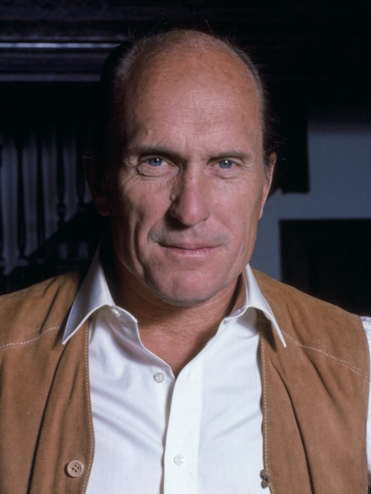
I knew, of course, exactly who he was referring to—Robert Duvall, the great actor who passed away yesterday at the age of 95. More specifically, Connor was calling out one of Duvall’s most memorable characters, that of Lt. Colonel Kilgore, the cheerfully psychopathic Army commander in Francis Ford Coppola’s Apocalypse Now.
Everyone, it seems, has a favorite Duvall role. For many young dudes these days, it is Kilgore. For others, it’s the soft-spoken but iron-willed Tom Hagen in the Godfather films. For still others, it is the authoritarian Marine dad in The Great Santini, or the fearless Texas Ranger Augustus McCrae. No matter what kind of character he was playing, Duvall’s own, real-life character always shone through: smart, fierce, tough, and comfortable in his own skin.
Being a mega-film-nerd, my definitive Duvall role was that of THX 1138, the titular character in George Lucas’s first film, which is still one of the most daring and visually stunning movies ever made. THX 1138 also marked one of the few films in which Duvall got to play the lead. Most of the time, he was cast in supporting roles, working in the background. Invariably, this allowed him—like Kilgore in his helicopter—to swoop in and steal the movie.
Although he trained with many famous Method actors, he was not generally considered to be one himself. Yet, he could hang with the De Niros, Pacinos, and Hoffmans of the world with seemingly effortless ease. Indeed, as an actor, he could hang with anybody.
For many (White) guys my age, Duvall represented the ideal American man. German/Irish but still cool. Macho but not toxic. Smart but not showy.
And funny. Even in the midst of mass-slaughter, Kilgore is funny. So is Santini. So, in his own way, is THX 1138. One of my favorite, later roles that Duval played is that of the craggy old Marine who helps Tom Cruise in the 2012’s Jack Reacher. With just a few lines of dialogue, and a barely suppressed, ghoulish chuckle, he manages to deliver some of the funny moments in recent cinema.
Fourteen years have passed since Skyfall, the twenty-third installment in the James Bond franchise, was released. The Daniel Craig era is now over, and the entire Bond series has just been dumped onto Netflix until a new actor is anointed and the series can undergo yet another reboot.
Of course, I have no idea who Eon Productions will pick as the new Bond, but I do know that he will have very large shoes to fill. Craig, who was initially dismissed as a blond pretty-boy, came to inhabit the role in its best incarnation since Sean Connery’s. With his baleful stare and ruthlessly sculpted physique—a body that, by its very existence, suggested military fanaticism—Craig interpreted Bond as a high-tech samurai, patrolling the alleyways, caves, and tunnels of the criminal underworld. This was a new, modern Bond. He still drank, but didn’t smoke. And where previous Bonds were sexually rapacious, Craig’s version seemed almost indifferent to the beautiful, amoral women surrounding him. Indeed, in the Craig era, it was the women who initiated all the lovemaking. For Bond himself, sex almost seemed like an afterthought, a distraction from his real objective: revenge.
I have written before about the revenge-fantasy as a seldom discussed—but hugely popular—Hollywood genre. And it seems very probable to me that the current explosion in the genre’s popularity, from the John Wick movies to Taken to Sisu and on and on, originally stems from Daniel Craig’s Bond. The best movies of the Craig era are, implicitly, revenge fantasies of a sort. From the very first film, Casino Royale, Craig’s austere expression and muted affect both imply some horrific past trauma, an experience of loss which transformed him into a fearless, disciplined operative. A killer looking for vengeance.
Of course, the central mystery of the Craig films, and a huge part of their appeal, lies in what, exactly, Bond is seeking vengeance for. And on whom? None of the films explores this mystery as deeply and effectively as Skyfall.
In one early scene, Bond, still traumatized from having almost been killed on his last mission, is forced to undergo a psychological evaluation. The bearded shrink asks him to play a word-association game, to which Bond reluctantly submits. When the shrink gives him the word “Skyfall”—the first mention of the term in the film—Bond’s expression freezes into a rictus of rage, pain, and contempt. He angrily ends the interview and storms out.
Not only is this scene a brilliant way to introduce the Skyfall term into the discourse of the film (“What could it be?” the viewer wonders), it also acts as a kind of clue to that deeper mystery to which I previously alluded. That is, the mystery of why Bond is so damned angry. We sense, immediately, that it has something to do with Skyfall (whatever that is), and that it involved some horrific trauma that Bond suffered in his past. Thus, it becomes the biggest clue in the psychological whodunnit of the movie, the mystery that we, as viewers, want to solve.
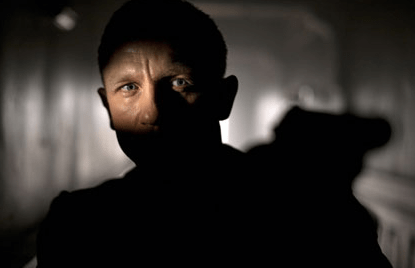
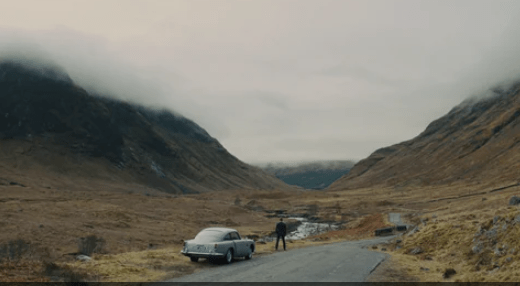
When I re-watched that scene recently, it occurred to me that if someone were to play the word-association game with me and mention “Skyfall,” my response would be “blue.” For if one had to pick a single word—both a color, and an emotion—that best sums up the film for me, it would be that: blue. It is the dominant palette of the movie, as well as its defining mood. In the film’s opening frames, Bond emerges from the shadows until half of his face is illuminated by a slender shaft of light, the viewer’s attention is drawn immediately to Craig’s cold, cobalt-blue eyes. Similarly, the last act of the film takes place in the wintery, blue-grey wilderness of Scotland, which surrounds Bond’s ancestral home—the vaunted Skyfall—a land which seems bleached of color, if not life itself.
Everything in between these opening and closing movements is equally cold and blue. The only real counterpoint is the yellow blaze of fire. Specifically, fire becomes an equal, opposite visual symbol in the film. In one scene, Bond stands at the bow of a rickshaw as he is rowed into the dark domain of a Macau casino, itself surrounded by hundreds of tiny, floating candles. Later, a different kind of fire—the flames of the burning Skyfall house—illuminate the cold, night-shrouded landscape in which Bond’s final confrontation with Silva, the villain, takes place. Such moments of stark, warm firelight only emphasize—accentuate—all the blue coldness that dominates the movie physical and psychological fabric. In the battle between fire and ice, the movie warns, ice eventually wins.
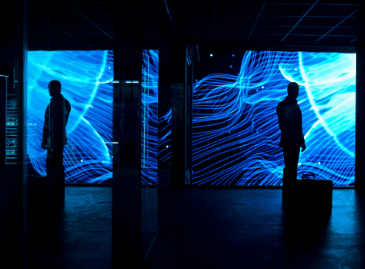
The most famous and talked about moment of blue-ness in the film comes in the middle of the second act, during a scene that some action-film-loving bros find maddingly slow. Bond stalks his quarry—an assassin named Patrice—into a Shanghai office tower at night. He follows Patrice to a high-level, empty floor that is completely shrouded in darkness, except for the unearthly, swirling blue light pouring in from a digital ad sign. It’s a completely silent scene that evokes more cinematic antecedents than I can count. There’s a good deal of Blade Runner in it, as well as Point Blank, Klute, The Mechanic, and many others. Beyond all that, even, the glass walls inside the builder make the scene into a classic Hall of Mirrors trope, which has been used repeatedly throughout the history of cinema to represent a journey into the subconscious—the battle against the self. And it works perfectly here, for what is Patrice if not a mirror image of Bond? They are both cold, disciplined killers, separated from any meaningful, human connection.
As the scene continues, Bond takes no action as Patrice prepares to assassinate a man in the building across the street. It’s only after Patrice does the deed that Bond takes action, jumping him and eventually knocking him out an open window. Fortunately, Bond finds a gambling chip that Patrice left behind, which allows Bond to impersonate him at a Macau casino. Thus, the twinning is complete.
The film’s arch-villain, Silva (brilliantly played by Javier Bardem), is also a twin. Another linked opposite. Silva, another 007 agent, was betrayed by MI6 in the same way Bond felt himself to be when he was shot by friendly fire in the film’s opening. And, like Bond, Silva has devoted his life to a single-minded purpose: revenge. The viewer doesn’t know who, exactly, Silva wants to inflict his revenge on, but we suspect it’s M, to whom Silva refers as “Mommy.” Talk about psychological baggage!
In this way, M (again, brilliantly played by Shakespearean actor Judy Dench), the steely-eyed matriarch of MI6, becomes the symbolic heart of the film, and the key to its structure. She represents a mother figure to both men, Bond and Silva. But whereas Silva wants to kill her, Bond decides to protect her.
That’s one reason why the setting for the film’s climax—Bond’s home, Skyfall—works so well. Bond has “come home” both literally and psychologically, protecting the woman who represents a substitute for the mother (and, in some ways, the father, too) that he lost as a child. In the final shootout, Silva “comes home,” too, and inevitably finds himself alone with Bond and M in church. It’s a great scene that feels like an Oedipal love-triangle, or perhaps a re-staging of the Cain and Abel story, or some other classic, archetypal conflict. It’s a great ending to a great film.
In fact, if Skyfall is not the very best James Bond movie of them all, it’s way, way up there. Directed by auteur, literary film director Sam Mendes (whose first film, American Beauty, won him an Oscar), Skyfall is also, in the ways that I have discussed above, the deepest Bond movie. The heaviest. With all its angst, psychologic trauma, and absurdist violence—not to mention all the arctic blues—it almost feels like an existentialist art-film. If Kierkegaard were to make a Hollywood action movie, this would be it.
No, really. I’m serious. The real difference between Bond and Silva (and Patrice) is that he struggles. He wrestles with the central theme of the movie—the question of how can a warrior be sure that the people he serves (M, in this case, and MI6 generally) are any better than the enemies he has been tasked to destroy?
Bond feels betrayed by M, and by the entire system she represents. Over the course of the narrative, though, he slowly regains his faith. When M eventually confesses what she did to Silva (giving him up to the Chinese in exchange for six other agents), he accepts her justifications as moral (if incredibly troubling). He stops seeking vengeance on the world, and he decides to protect M, even at the cost of his own life.
On the other end of the spectrum, Silva is completely selfish in his pursuit of revenge. He has no self-awareness of his own culpability in the ordeal he suffered. (M sold him out, in part, because he was enriching himself using his talents.) Nor does he make any attempt to understand why M did what she did. In this way, he becomes a brilliant, terrifying villain who is, nonetheless, a completely hollow man. He has no real personality, other than a kind of sneering arrogance. There is nothing left of him except his hatred.
Good versus evil. Heroism vs selfishness. It’s all in there. That’s why Skyfall is a perfect film.
Author’s Note: I just learned that Ridley Scott’s classic sci-fi film Blade Runner will be back in theaters this month (today, actually) in a limited release of the so-called “Final Cut” version. None of the participating theaters is near me, alas. So, instead of going, I thought I would re-post this tribute that I wrote some years ago. I hope you like it…
When Philip K. Dick was shown a rough cut of the classic movie Blade Runner a few months before his death in 1981, he was so amazed by the power of Ridley Scott’s vision that he said, “You would literally have to go five times to see it before you could assimilate the information that is fired at you.”
Dick might have been amused to know that I did go to see the movie five movies, when it was released in 1982—forty-four years ago. Ridley Scott might be amused, too, especially since I paid full price for every viewing, which means I am completely absolved of the dismal box office totals that the film accrued during that long-ago summer.
It’s hard to look back across so many years and try to remember what it was about the movie that captured my imagination so relentlessly. But I think it was simply this: for the 117 minutes of the film’s running time, I was in that world. I was completely immersed in that dark, crowded urban nightmare of some unknown future.
Yes, I said “unknown.” The opening crawl says that the movie is set in Los Angeles of 2019, but it’s really set in Scott’s imagination—a dizzying collage of 1940s film noir mixed in with 1980s Ginza, Japan, with a good dose of the Weimar Republic of 1930’s Germany thrown in for good measure. Oh, did I mention the Heavy Metal comic books?
Blade Runner was the first movie to actually pull-off this “collapsed time” effect, and it did so mainly thanks to Scott’s own obsessive genius for detail. It is perhaps the most dense visual landscape ever created on film. Every time I saw it in the theater, I noticed different details, whole new layers that I had missed before. Like a dream, this movie really is bottomless.
It’s also just very, very smart. 1982 was a big year for science fiction movies—The Wrath of Khan came out that year, as did E.T. and Tron. I liked those movies (especially Khaaan!!!), but even as a kid, I knew that they were full of crap. Blade Runner, despite being a movie about androids and flying cars and implanted memories, felt like the most realistic film I had ever seen.
Ironically, it’s one of the most human as well. It’s a love story, after all. (Actually, it’s two love stories, if you count Pris and Sebastian.) I found myself caring about all the characters in the film, replicant and otherwise. And despite the fact that he has pretty much disowned the film, Harrison Ford is the glue that holds it all together. Without his low-key, soulful performance as Deckard, the movie might have drowned in one of Scott’s magnificent sets. Ford keeps the movie centered.
Of course, when I watch the movie now, as a middle-aged man, I notice other great things about the movie. As a writer, I am struck by its tautness, its almost total mastery over film time and space. Contemporary directors should study it, if only as a brilliant demonstration of how to improve a film by leaving crap out. Think of all the scenes we don’t see: the replicants escaping from the off-world colony; Tyrell telling Deckard about Rachel’s memory implants; Baty killing Sebastian. All of this happens off-screen, and as a result we are never taken out of that vivid, meticulously imagined cityscape, (which, by the end of the movie, feels as real to me as my own hometown).
There is also no junk dialogue—no thinly-veiled backstory or explication. Scott seems to realize that the viewer is smart, and he asks us to keep up without a lot of summary. As a result, there is hardly a false note in the movie (one exception being the interview scene with Bryant, which clunks in one or two places, through no fault of the great character actor M. Emmet Walsh).
I also love how the script, penned by Hampton Fancher and David Peoples, delivers so many genuine surprises. My favorite moment, in fact, is one that I have never seen discussed at length in any tribute or essay. It’s the moment when Deckard drunk-dials Rachel on the video phone in Taffy’s bar. This gesture of neediness and naked humanity is totally unexpected. It seems to have nothing to do with the overall plot of the film. And yet it’s totally believable.
Very seldom does a director allow his film to venture off the rails like this. But Scott often does, with brilliant effect. It’s this kind of realism that gives his movies a totally different vibe than almost any other major-league filmmaker.
Anyway, here is my statement of thanks to Scott, Fancher, Peoples, and (of course) P. K. Dick. It was a great summer. I’m glad the rest of the world finally caught on.
It is almost a law of nature that if you scroll through Twitter for long enough, you will run across a Star Trek meme. And, if you keep scrolling, you will eventually run into a “There are four lights!” meme.
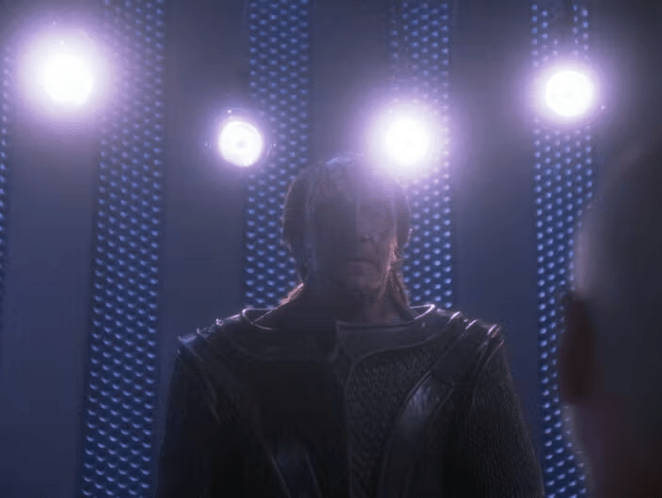
These memes are, of course, a reference to one of the most famous episodes of Star Trek: The Next Generation. Entitled “Chain of Command,” it depicts the ordeal that Captain Picard must endure at the hands of a Cardassian interrogator named Gul Madred. It is one of the most famous (infamous?) episodes because of its brutal depiction of torture and humiliation, up to and including the truly shocking moment when Picard is hung naked by his wrists (thus cinematically immortalizing Patrick Stewart’s impressively muscular British arse). Despite the disturbing subject—or, perhaps, because of it—the episode has become one of the most beloved and acclaimed of the entire series.
I, for one, believe that “Chain of Command” deserves every iota of the praise it has received. It’s brilliantly acted, of course, by Stewart and his former Shakespearean colleague David Warner, who was one of the greatest actors of his generation. And it tackles a dreadful but important subject—the nature of political torture. Screenwriter Frank Abatemarco conducted research into the impact and nature of such torture as reported by Amnesty International, and the episode seems completely believable, not to mention chilling. It dissects the psychology of the victim but also of the torturer, with Warner brilliantly conveying how Madred, an intelligent man and, apparently, a loving father, is nonetheless able to rationalize his activities by dehumanizing his victim.
If one trawls the many Reddit threads and other chat-board threads that have been devoted to the episode, one learns that many of its fans—especially those former English majors, like myself—were quick to seize on its central homage to George Orwell’s 1984. Specifically, it echoes the climactic scenes in 1984 when Winston Smith is tortured by O’Brien, a man whom Winston believes to be a friend and fellow-revolutionary but who turns out to be a commander of the Thought Police.
As every Star Trek nerd knows, of course, the most direct parallel between 1984 and “Chain of Command” comes in the episode’s climax, when Madred shines four lights on the wall and asks Picard how many lights he sees. When Picard answers, truthfully, “four,” Madred shocks him.
In 1984, O’Brien lays Winston out on an electronic torture-rack and says to him,
“Do you remember,” he went on, “writing in your diary, ‘Freedom is the freedom to say that two plus two make four?”
“Yes,” said Winston.
O’Brien held up his left hand, its back toward Winston, with the thumb hidden and the four fingers extended.
“How many fingers am I holding up, Winston?”
“Four.”
“And if the Party says that it is not four but five—then how many?”
“Four.”
The word ended in a gasp of pain.
The torment continues, with Winston replying “five” and “three” and anything else he can think of to stop the pain. At which point O’Brien pauses the interrogation and says, “Sometimes, Winston. Sometimes they are five. Sometimes they are three. Sometimes they are all of them at once. You must try harder. It is not easy to become sane.”
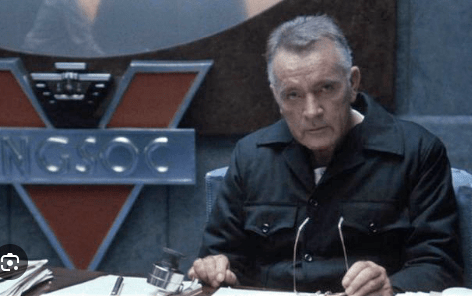
Richard Burton as O’Brien in 1984
It’s this portion of 1984 that, to me, establishes O’Brien as the supreme villain of world literature. He is also its greatest nihilist. He seems to have no illusions about the purpose of Big Brother’s totalitarian rule—namely, for the rulers to partake of the ultimate sadistic pleasure in endlessly tormenting their subjects, forever. He blithely explains to Winston how the state will soon make things even worse for the common people, including modifying human anatomy so that people cannot even have orgasms. When O’Brien also suggests that the state might increase the pace of life so that people go senile at thirty, Winston pleads:
“Somehow you will fail. Something will defeat you. Life will defeat you.”
“We control life, Winston, at all its levels. You are imagining that there is something called human nature which will be outraged by what we do and will turn against us. But we create human nature. Men are infinitely malleable.”
Many dudes on Reddit have observed, correctly, that the scene with Picard and Madred are about mind control, and how strong people must fight to resist it. But the greater issue comes in the last scene of “Chain of Command,” after Picard has been freed and is safely back on the Enterprise. There, washed and fed, he meets with Counselor Troy and explains the worst part of his ordeal—namely that, in the delirium of his agony, he actually saw “five lights,” as he was commanded to do by Madred.
In other words, despite his great intellect and courage, Picard’s body began to alter his perceptions. He became, in O’Brien’s words, “infinitely malleable.”
In 1984, Winston experiences the same horrific revelation.
And he did see them, for a fleeting instant, before the scenery of his mind changed. He saw five fingers, and there was no deformity. Then everything was normal again, and the old fear, the hatred, and the bewilderment came crowding back again. But there had been a moment—he did not know how long, thirty seconds, perhaps—of luminous certainty, when each new suggestion of O’Brien’s had filled up a patch of emptiness and become absolute truth, and when two and two could have been three as easily as five, if that were what was needed. It had faded out before O’Brien had dropped his hand; but though he could not recapture it, he could remember it, as one remembers a vivid experience at some remote period of one’s life when one was in effect a different person.
I have written before about how the greatest themes in literature are best posed as questions. The question here is, “Is there really some indominable spirit in us that can’t be crushed and mastered by force and torture?” Or, put another way, “Are human beings really infinitely malleable, to the point that they can’t even trust their own senses?”
To many—and especially to those who adhere to a philosophy of materialism—this might seem a banal question. Their answer would certainly be: Of course, people are infinitely malleable; human beings are the product of their sensations, and if those sensations can be completely controlled (through drugs or torture or propaganda), then those beings can be complete controlled, too.
If this is true, I fear that the future of humanity is hopeless. We will, eventually, devolve into some kind of hive-mind existence (yes, rather like the Borg in Star Trek), which, even if it isn’t quite as hellish as the nightmare-state that O’Brien creates for the proles of 1984, would still be devoid of individuality or any authentic human experience.
Fortunately, I don’t believe it is true. For one thing, as a practical matter, I don’t believe that a ruling class whose only motivation is sadistic sexual pleasure could sustain itself. It’s too destructive, and its members would inevitably turn on each other. And even if they didn’t, they would die out, unable to create and nurture the most basic form of life—children. In other words, Big Brother can only destroy. It cannot create.
On a more philosophical note, I do believe that there is a “something called human nature,” as O’Brien puts it, that will inevitably rebel against tyranny. All the hero stories of world mythology reflect this, as do our own, modern mythologies. Like, for instance, Star Trek. Clearly, in the imagined universe of the twenty-fourth century, civilization has not devolved into some kind of soul-destroying dystopia. Quite the opposite. The Federation represents civilizations response to the ever-present threat of oppression, in all its forms, from fascist militarism (the Klingons), xenophobic isolationism (the Romulans), to full-on, cybernetic collectivism (the Borg). The Federation beats them all.
So, what is the Federation’s secret? Probably a lot of things. But, for my money, it’s that the Federation is a pluralistic society, open to all races, ideas, and voices.
Back in college, I studied the great Russian literary critic M. M. Bakhtin, who saw the greatest innovation in art as the novel. The novel represents a quantum leap in art because it is the greatest example of what Bakhtin called dialogism—the interplay of voices and perceptions from which our shared experience of consciousness emerges. This impulse toward dialogism—dialogue—is always set in opposition to the evil but omnipresent forces of monologism, which strive to establish a singular, monolithic truth on humanity and thus control it.
Big Brother’s IngSoc party might be the most monologic literary creation ever imagined by a writer (Orwell). Conversely, the Federation might be the most dialogic, combining not only an endless multiple of voices and point-of-view but actual sentient species from all over the galaxy, united by there shared…humanity? For lack of a better word, yes.
Let’s hope Star Trek’s vision of the future is the one that plays out.
It still amazes me that Norman Jewison, the same guy that directed Moonstruck, also directed Rollerball. I can’t imagine two films that are more different in content, genre, style, and tone. Moonstruck is a rom-com (imho, the best ever made); Rollerball is a dystopian sci-fi movie. Moonstruck is a comedy; Rollerball is a violent, brutal drama.
And yet, when one thinks about it, the twinning of these two movies under Jewison’s visionary eye kind of makes sense. Both are about an individual seeking personal freedom—self-actualization, as the shrinks say. The main difference is that, in Moonstruck, the obstacle is the protagonist’s own self-doubt and traumatized soul, while in Rollerball, it’s an oppressive, corporatist state.
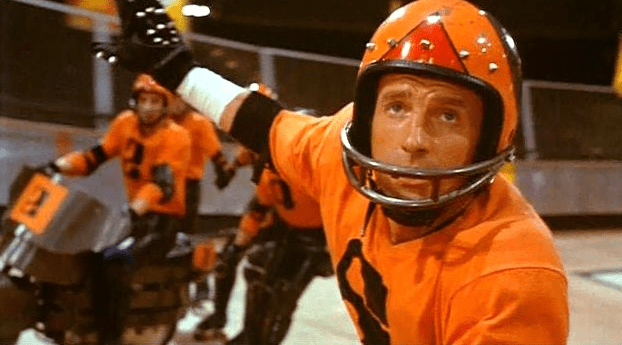
Moonstruck is the better film, by far. But, as a kid, I absolutely loved Rollerball. It came out fifty years ago, in 1975, and it’s hard to describe how incredibly cool it was among the 11-to-14-year-old boy demographic. It checked all the teenage-boy boxes: sci-fi, sports, violence, motorcycles, and sex.
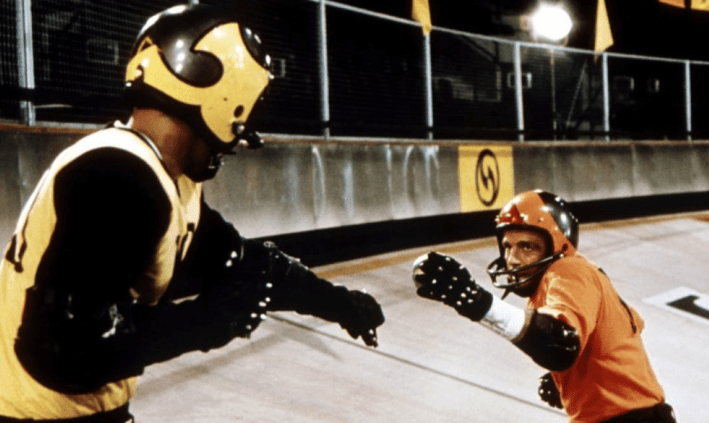
And then there was the novelty of the game itself, a nightmarish blend of NFL football, roller derby, motocross, and MMA. Of these, football seemed to be the primary influence, with the protagonist coming off very much like one of the celebrity quarterbacks of the era (think Joe Namath or Snake Stabler).
So, basically you had a futuristic, ultra-violent sport where Joe Namath got to kill people! How cool is that??? The film also had the appeal of forbidden fruit. A “hard R”-rated movie, its violence was deemed shocking, even transgressive, at the time. This was especially true considering the film’s A-list imprimatur; it was released by a major Hollywood studio (United Artists) with a major star (James Caan) and a major director (Jewison).
In retrospect, the fact that Rollerball was made at all seems a bit miraculous. It’s a good movie, and there is still much to love about it. Set on a near-future Earth where huge mega-corporations have replaced governments, it tells the story of an elite athlete, Jonathan E., who plays the violent, gladiatorial sport of Rollerball. Jonathan is so good that, after ten years in the sport, he is its oldest living practitioner, as well as its best. He is beloved and famous—so famous, in fact, that he worries the reigning cabal of corporate bosses, who use the game as a kind of panem et circenses form of mass entertainment, giving the oppressed masses an outlet for their (potentially revolutionary) rage.
Mr. Bartholomew, the CEO of the corporation that owns Jonathan’s team (and, it is implied, Jonathan himself, bodily, as a kind of company chattel), is especially concerned. He orders the aging star to announce his retirement. Jonathan refuses. Bartholomew orders him again. Jonathan refuses, again. Unfortunately, Jonathan is too famous to arrest or kill, so Bartholomew contrives to make the next few Rollerball matches so absurdly violent, even by the standards of the game, that Jonathan will change his mind, get injured, or get killed.
If this plot sounds familiar, it’s because it is. Rollerball essentially invented the extreme-sports-of-the-future sub-genre of sci-fi, beginning with Death Race 2000 and continuing all the way up to The Hunger Games series. It also anticipated cyberpunk, in which evil corporations have taken over all aspects of modern life, creating an authoritarian hellscape of haves vs have-nots.
In our current, CGI-corrupted age of cinema, Rollerball is especially impressive for its great, practical stunts. Supposedly, the stuntmen got so adept at the titular game that they would play matches amongst themselves between shooting sessions. And the acting is great, too. James Caan’s understated, nuanced performance as Jonathan is one of his best. He was bashed by some film critics for seeming “checked-out” in the role, but I think they were wrong. He’s playing a somewhat inarticulate but courageous character who is trying to make sense of his plight—and find a way to win.
Now that I have said all those good things about Rollerball, it’s time for me to add that it is also an extremely dated film. Alas, it suffers from much of the garishness of the 1970s, as well as a whiff of misogyny that even the patriarchal/fascist setting cannot quite explain. But if you can get past these flaws, it’s a good movie.
Check it out. It’s currently streaming on Amazon Prime.
If you’re a liberal-arts nerd like me who thinks about culture all the time, you have probably pondered this question: why do people remake movies, but not books?
Yeah, I know. On the surface, this seems like a silly and even naive question. Movies, after all, are a popular medium. They belong primarily in the category of the performing arts, like theater and ballet and classical music. And, as we all understand, no one over ever gives the “final” performance of Hamlet or Don Giovanni or The Jupiter Symphony. Yes, there are certainly “classic” performances of all these works—some of them, made in the past century, have been recorded for the ages—but none is ever the last performance. Each generation must have its own Hamlet, Don Giovanni, etc.
Well, over a week has passed since Halloween, and I’m still working through the classic horror and sci-fi movies that I rewatch every year around this time. One of my favorites (heck, one of everybody’s favorites, as far as I can tell, assuming that everybody is a nerd of a certain age) is Roger Wise’s 1951 classic The Day the Earth Stood Still (henceforth, TDTESS). Here are ten things I love about it….
1.) The Opening
This movie doesn’t dick around. It opens with the frantic calls of radar operators across the globe tracking an ultra-fast UAP as it enters the earth’s atmosphere. Word leaks out to press, generating a world-wide media frenzy—the “media,” in this case, being radio. Wise cast several then-famous, real-life radio broadcasters to play themselves, and I simply love hearing their great, precise modulated voices as they simultaneously try to inform the public without causing panic. It’s hard to believe there was ever such a time when journalists were so revered and appreciated, with good reason.
2.) The Music
From the title sequence onward, the film makes great use of Bernard Herrmann’s brilliant score. Hermann notably employed electronic instruments, including a kind of stone-age synthesizer called a theremin. It’s the theremin that gives the score that haunting, weird quality that has since become synonymous with atomic-era sci-fi movies.
Speaking of atomic-era stuff, this leads me to my next item…
3.) Analog technology
I don’t know why, but I am fascinated by how the movie gives the viewer a glimpse—almost a cross-section, really—of the analog technology of the day. We see radio transmitters, of course, but also phone switch boards with dozens of (women) operators frantically switching lines, and people yelling into telephones. And, of course, we have all the accoutrements of World War II, which was still a recent event: tanks, jeeps, motorcycles, rifles (yes, rifles). There is something soothing about all this old-fashioned stuff, especially when it is contrasted with….
4.) Singularity Technology
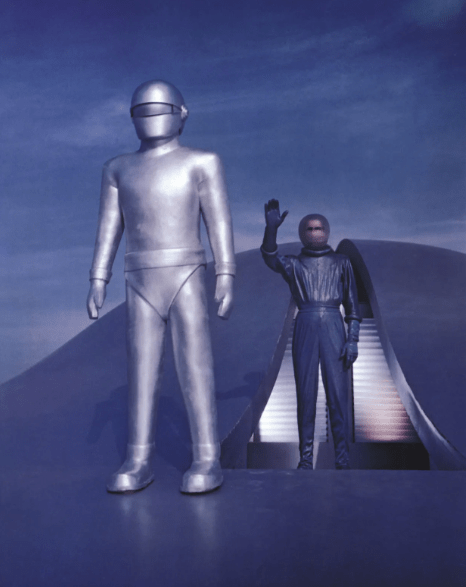
When the UAP finally lands (in Washington D.C., naturally, near the Capitol), we see that it represents a kind of futuristic tech that is the diametrical opposite of the local analog, atomic-era tech. The ship is all smooth silver metal until a seam appears, and the seam opens smoothly to allow a ramp to extend. A door forms in the same way, and the alien pilot Klaatu (Michael Renne) emerges, dressed in a silver suit and a helmet that, one assumes, is made of the same silver metal. All of this seems magical, even now, and also presages the later sci-fi tropes of nanotechnology, lasers, force-fields, atomic energy, computers, etc. etc.
Of course, Klaatu’s most impressive piece of tech is….
5.) Gort
Why is Gort so damned cool? Because he’s terrifying. As a giant, lumbering robot, he evokes the golem myth of implacable, supernatural force that has no emotions and no fear. And, with his single, death-ray emitting eye, he also reminds us of another mythic archetype—the cyclops. And in the way he suggests enormous power, barely held in check, he anticipates The Terminator films of three decades later.
6.) Michael Rennie
As with most classic, once-in-a-lifetime performances, Michael Rennie’s portrayal of Klaatu is so good that it’s now impossible to imagine anyone else doing it. With his smiling, gentle, athletic demeanor, he projects a firm but benevolent presence. He genuinely wants to help humanity escape its seemingly inevitable fate (i.e., being destroyed, either at its own hand or that of Gort). Also, he seems genuinely curious and likeable, especially in…
7.) Klaatu’s Interactions with Danny
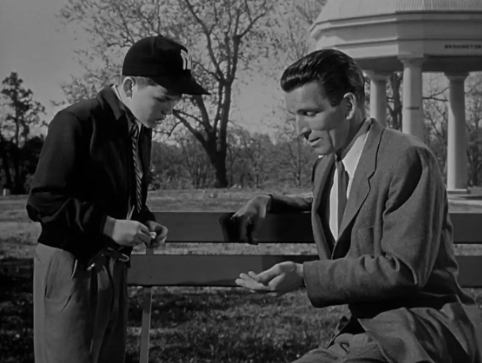
I love the scenes where Klaatu and Danny, the little boy whose boarding house Klaatu finds himself in, go on a site-seeing tour of Washington D.C. They are the emotional core of the movie. After all, in our world, Klaatu is very much like a little boy himself. His sense of wonder is almost as strong as Danny’s.
8.) Patricia Neal
Instead of casting some bombshell scream-queen in the role of Helen, Danny’s mother, Wise chose the formidable and mesmerizing Patrica Neal. She was a great actress who would later hold her own against Paul Newman in 1963’s Hud. As Helen, she exudes an intelligence and moral strength that not only saves Klaatu from capture and death; she saves the entire planet.
9.) How Much you Don’t See
I could write an entire post on the paradox of old thriller movies whose lack of CGI effects (TDTESS was made thirty-three years before Jurassic Park), was actually an advantage. The film is actually made stronger by how much Wise doesn’t show on-screen. That is, we don’t see how Klaatu stops all electrical stuff from working on the titular day. We don’t see Gort walking across D.C. on his way to liberate Klaatu’s body from its jail cell. You know, stuff that would be easy to render in the CGI era (and which would also be rather boring). After all, the ultimate special effect is the human imagination, which happily fills in the blanks better than any whiz-bang effect.
My favorite example of this in the film is when Danny secretly follows Klaatu to his spaceship one night. He watches as Klaatu uses a flashlight to wake-up Gort, who then knocks-out the two G.I. ‘s guarding the ship. The genius of this scene is that we don’t actually see Gort do this. We just see him lumber over to the two dudes. Then, at the last moment, the camera switches back to Danny’s horrified face as he watches the moment of (rather mild) violence. Then, the camera switches back to Gort as he stands over the crumpled, unconscious bodies of the soldiers on the ground. Brilliant.
10.) Multiculturalism
It’s important to remember that TDTESS is a cold-war era movie, produced at the very height of the Red Scare and its attendant paranoia and xenophobia. It also came out just a few years before the start of the American Civil Rights movie. So, I am always amazed, and even a bit moved, by how progressive Wise’s vision is. In the opening scenes, we see people from other countries—France, India, China, and even Russia—depicted in a sympathetic light, human light. At least once in the film, Wise goes out of his way to show some genuine, actual Black people in the crowd watching Klaatu’s spaceship land. (This might seem trivial, now, but it was momentous decision back then.) And, of course, the climax of the movie comes with a miniature U.N. assembly, arranged by Professor Barnhardt (wonderfully played by the great Sam Jaffe, incidentally), full of people of all ethnicities and cultures. The message is clear—it’s only by cooperation and friendship that humanity can survive. And it’s a message that is just as relevant now as it was back then, perhaps even more so.
See also this cool post from another blogger (from whom I stole one of the screenshots above)…
A lady I follow on Twitter named @johnstonglenn posted earlier that on this day in 1925, the famous Welsh actor Richard Burton was born. Yes, this would have been the great man’s 100th birthday.
I’ve written about Burton a lot on this blog (see links below), and so I thought I would share this bit of trivia. A fabulously gifted Shakespearean actor, Burton had the second-greatest voice in Western theater (after James Earl Jones, who had the very best). But Burton wasn’t just a great voice. He was a deeply intelligent man who brought enormous power to every part he played. And soul. Lots of it. (He was a bit like Viggo Mortensen in that last regard, actually). If you’ve never seen a Burton film and are looking for a good one to start with, I recommend 1965’s The Spy Who Came in from the Cold. A snippet of it is shown below.
Author’s Note: I first posted this essay a few years ago. I’ve decided to repost it now due to some recent interest.
When I finally watched Todd Field’s 2022 movie Tár, starring Cate Blanchett. I really didn’t know much about the film, except that it had been well received (Blanchett received an Oscar nomination) and that it was about a female orchestra conductor named Lydia Tár. From this scant information, I assumed it would be a worthy but standard drama about a woman artist’s struggle to thrive in a male-dominated world.
Boy, was I wrong! Tár is a great movie. So great, in fact, that I became temporarily obsessed with it, so much so that I tried to figure out what the name Tár means. I ran it through Google translate and got a hit: tár is Icelandic for tear (the verb, as in “to tear to shreds”). I don’t know if this was Field’s intention, but it fits well—Lydia rips everything and everyone around her to shreds. And in the last part of the film, she faces an almost literal tear in the fabric of reality.
Put simply, Tár is a monster movie. Lydia is the monster.
French intellectual Charlotte Aïssé is credited with saying, “No man is a hero to his valet.” This is certainly true for the character of Francesca (Noémie Merlant), Lydia’s apprentice conductor, personal assistant, a general factotem. As one would expect, Francesca knows all the skeletons in Lydia’s closet. And there are a lot of them. Lydia Tár, we soon learn, is a bit of a sexual predator, in the Harvey Weinstein model. She uses her influence and fame to seduce young women in her orchestra, then keeps them silent with threats. When one of her former conquests, Krista, commits suicide (she was depressed because she couldn’t get another orchestra job; Lydia made sure of this by writing bad recommendations for her), Lydia orders Francesca to delete all their emails regarding the matter. Thus begins the intrigue that will constitute the main action of the film.
But Tár is not just a clever twist on the #MeToo movement narrative, or a meditation on the corrosive effects of fame. Rather, it’s more like a descent into hell, albeit a coldly beautiful version. Filmed in desaturated grays and blues, the first two acts reminded me of Stanley Kubrick’s Eyes Wide Shut, in its brutal, almost clinical exploration of intellectual high culture (transposed from Manhattan in Kubrick’s movie to Berlin in this one). Lydia is shown as an ultimately tragic character, a female MacBeth—brilliant, gifted, and strong but hopelessly in thrall to her ambition and darker impulses.
In other words, she is a nasty piece of work, sadistic to her enemies and overbearing to her friends. (And that’s without even considering her sexual predations.)
But it’s in the final act that the movie really becomes something otherworldly. When Lydia’s misdeeds finally catch up to her, and her carefully controlled world of power and influence begins to unravel (to tear apart, as it were), the film’s tone and pacing becomes less like Eyes Wide Shut and more like Nicholas Roeg’s Don’t Look Now. Both films climax when the main character locks eyes with an even greater monster (literal, in Roeg’s horror masterpiece; metaphorical in Tár), one that manifests the hitherto unseen evil of the story.
In fact, the last third of the film can be read as a supernatural horror tale, complete with ghosts, as Dan Kois does in his excellent essay for Slate. I would go even further and suggest that the entire move is best interpreted as a David Lynch-style surrealist nightmare. A descent into hell.
I’ve often thought that if hell exists, it’s probably not eternal, and it’s probably not a lake of fire. My bet is that hell looks almost exactly like earth, and the people trapped there do not know they’re in hell. Instead, they are forced to re-commit their sins over and over, but with a twist: this time, the victims get revenge.
Regardless of how you interpret it, Tár is a great movie. Check it out, if you dare…












 Ash Clifton, Writer