Movies I Loved as a Kid: “Rollerball”

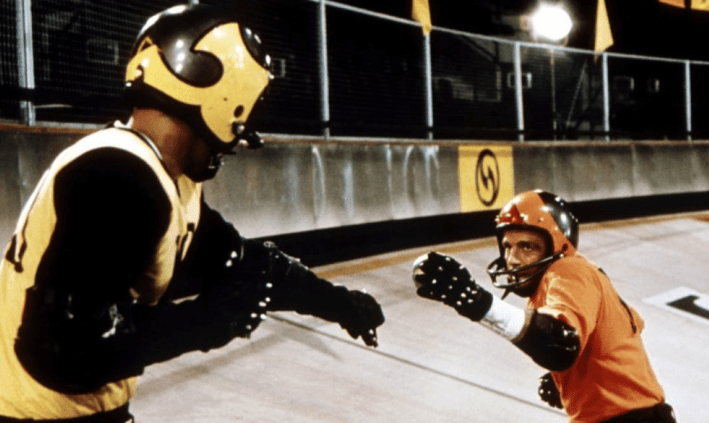
It still amazes me that Norman Jewison, the same guy that directed Moonstruck, also directed Rollerball. I can’t imagine two films that are more different in content, genre, style, and tone. Moonstruck is a rom-com (imho, the best ever made); Rollerball is a dystopian sci-fi movie. Moonstruck is a comedy; Rollerball is a violent, brutal drama.

And yet, when one thinks about it, the twinning of these two movies under Jewison’s visionary eye kind of makes sense. Both are about an individual seeking personal freedom—self-actualization, as the shrinks say. The main difference is that, in Moonstruck, the obstacle is the protagonist’s own self-doubt and traumatized soul, while in Rollerball, it’s an oppressive, corporatist state. 

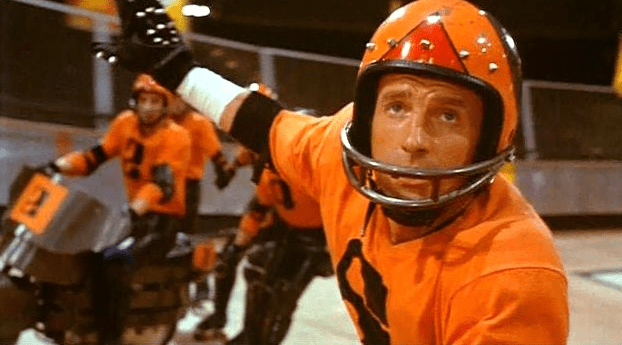
Moonstruck is the better film, by far. But, as a kid, I absolutely loved Rollerball. It came out fifty years ago, in 1975, and it’s hard to describe how incredibly cool it was among the 11-to-14-year-old boy demographic. It checked all the teenage-boy boxes: sci-fi, sports, violence, motorcycles, and sex. 

And then there was the novelty of the game itself, a nightmarish blend of NFL football, roller derby, motocross, and MMA. Of these, football seemed to be the primary influence, with the protagonist coming off very much like one of the celebrity quarterbacks of the era (think Joe Namath or Snake Stabler). 

So, basically you had a futuristic, ultra-violent sport where Joe Namath got to kill people! How cool is that??? The film also had the appeal of forbidden fruit. A “hard R”-rated movie, its violence was deemed shocking, even transgressive, at the time. This was especially true considering the film’s A-list imprimatur; it was released by a major Hollywood studio (United Artists) with a major star (James Caan) and a major director (Jewison).

In retrospect, the fact that Rollerball was made at all seems a bit miraculous. It’s a good movie, and there is still much to love about it. Set on a near-future Earth where huge mega-corporations have replaced governments, it tells the story of an elite athlete, Jonathan E., who plays the violent, gladiatorial sport of Rollerball. Jonathan is so good that, after ten years in the sport, he is its oldest living practitioner, as well as its best. He is beloved and famous—so famous, in fact, that he worries the reigning cabal of corporate bosses, who use the game as a kind of panem et circenses form of mass entertainment, giving the oppressed masses an outlet for their (potentially revolutionary) rage. 

Mr. Bartholomew, the CEO of the corporation that owns Jonathan’s team (and, it is implied, Jonathan himself, bodily, as a kind of company chattel), is especially concerned. He orders the aging star to announce his retirement. Jonathan refuses. Bartholomew orders him again. Jonathan refuses, again. Unfortunately, Jonathan is too famous to arrest or kill, so Bartholomew contrives to make the next few Rollerball matches so absurdly violent, even by the standards of the game, that Jonathan will change his mind, get injured, or get killed.

If this plot sounds familiar, it’s because it is. Rollerball essentially invented the extreme-sports-of-the-future sub-genre of sci-fi, beginning with Death Race 2000 and continuing all the way up to The Hunger Games series. It also anticipated cyberpunk, in which evil corporations have taken over all aspects of modern life, creating an authoritarian hellscape of haves vs have-nots. 

In our current, CGI-corrupted age of cinema, Rollerball is especially impressive for its great, practical stunts. Supposedly, the stuntmen got so adept at the titular game that they would play matches amongst themselves between shooting sessions. And the acting is great, too. James Caan’s understated, nuanced performance as Jonathan is one of his best. He was bashed by some film critics for seeming “checked-out” in the role, but I think they were wrong. He’s playing a somewhat inarticulate but courageous character who is trying to make sense of his plight—and find a way to win.

Now that I have said all those good things about Rollerball, it’s time for me to add that it is also an extremely dated film. Alas, it suffers from much of the garishness of the 1970s, as well as a whiff of misogyny that even the patriarchal/fascist setting cannot quite explain. But if you can get past these flaws, it’s a good movie. 

Check it out. It’s currently streaming on Amazon Prime.

Friday Night Rock-Out: “Hotel California”

If you’re of a certain age (i.e., over fifty), you probably spent many a summer afternoon in the long-ago past listening to the 45 single of “Hotel California” over and over and over. (You might also have enjoyed a mildly illegal form of herbal, hand-rolled cigarette as you listened.) If you did, you’ve probably read a lot of articles about the song, and heard a lot of interviews by Don Henley or Glenn Frey or others about it, to the point that you probably think you know everything about it. You know, for instance, that Henley and Frey wrote the lyrics in a very short period of time (by some accounts, a few hours; by others, over a weekend). You know that the album cover is a photo of the Beverly Hills Hotel, and that some people think they see a mysterious figure in the bell tower. And you know that the song is really about Hell, or California-as-Hell, or American hedonism, or…something cool like that.  

What you probably don’t know is that song is, primarily, the creation of guitarist Don Felder, who wrote the melody by himself before he even joined the band. As Marty Jourard recounts in his excellent non-fiction book Music Everywhere: The Rock and Roll Roots of a Southern Town:

One afternoon while enjoying his ocean view and no doubt the general situation, Felder sat on his sofa and idly strummed an acoustic twelve-string, eventually refining his musical idea into a carefully crafted guitar arrangement. Using a Teac four-track reel-to-reel recorder, Felder first recorded his Rhythm Ace drum machine playing a cha-cha beat, then added acoustic and electric guitar and bass, then an idea for two solo guitars. Don Henley listened to a cassette mix of this song and more than a dozen others Felder had submitted for consideration and declared this rhythmically complex instrumental the best, giving it a working title of “Mexican Bolero,” and along with Glenn Frey wrote lyrics that transformed Felder’s music demo into “Hotel California,” the title track of the next Eagles album and its first single.

It’s also Felder’s actual guitar playing, along with that of co-lead Joe Walsh, that gives the song its unbelievably haunting tone and its indelible, dark crescendo. I’m not just saying this because Felder, like his childhood friend Tom Petty, is a Gainesville boy like me. Felder is, in fact, one of the most underrated musician/composers in the history of rock-and-roll.

Of course, I don’t mean to denigrate Henley’s and Frey’s brilliant lyrics, gave the song its cachet among the teenage set of the 1970s (and now, even). One thing I’ve noted about “Hotel California” is that is one of those rare examples of a narrative poem (i.e., it tells a continuous story). Also, it’s written in ballad quatrains, with a rhyming scheme of ABCB. How cool is that?

And, yes, I do see a mysterious figure in the bell tower.

Rock on…

What I’m Reading: “Paperbacks from Hell”

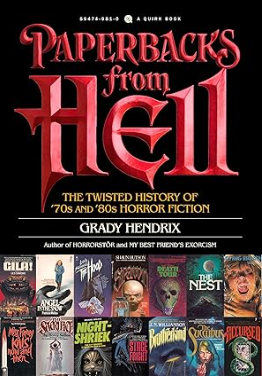
Having had exactly one book traditionally published, I am far from an expert on the world of publishing. Even so, I learned a lot more than I ever expected, and have since become fascinated by the industry as a whole. Also, I am currently working on a supernatural horror novel. So, it makes perfect sense that I would be drawn to Grady Hendrix’s excellent non-fiction book, Paperbacks from Hell, which examines (skewers?) pulp horror literature as it existed in the 1970s and 80s, both as a uber-genre and as an industry. 

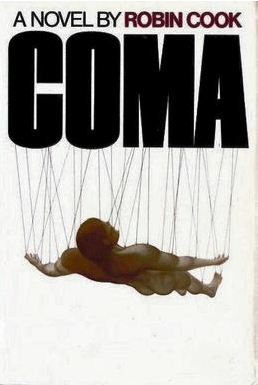
Let me say right up front that this is a very funny book. I found myself laughing out loud many, many times as Hendrix describes the trends and fads that overtook the genre. Take this passage where he introduces the wildly successful pop writer Robin Cook, whose 1977 book Coma is, in Hendrix’s words, the “source of the medical-thriller Nile.” As Hendrix goes on:

It all started with Robin Cook and his novels: Fever, Outbreak, Mutation, Shock, Seizure…terse nouns splashed across paperback racks. And just when you thought you had Cook pegged, he adds an adjective: Fatal Cure, Acceptable Risk, Mortal Fear, Harmful Intent. An ophthalmologist as well as an author, Cook has checked eyes and written best sellers with equal frequency. He’s best known for Coma (1977)…. Its heroine, Susan Wheeler, is one of those beautiful, brilliant medical students who’s constantly earning double takes from male colleagues or looking in the mirror and wondering if she’s a doctor or a woman—and why can’t she be both, dammit? On her first day as a trainee at Boston Memorial, she settles on “woman” and allows herself to flirt with an attractive patient on his way into a routine surgery. They make a date for coffee, but something goes wrong on the table and he goes into…a COMA!

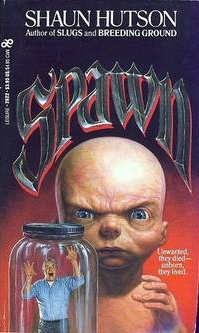
Hendrix cleverly divides each chapter to a single, overarching trend in the pulp horror universe, with titles like HAIL, SATAN (novels of demonic possession and devil-sex), WEIRD SCIENCE (evil doctors and mad scientist-sex), INHUMANIOIDS (deformed monsters and mutant-sex), and so on. I was especially impressed by the way Hendrix explains each publishing fad as a symptom of a larger societal shift. For example, he explains how the white-flight phenomenon of the 1970s in which white middle- and upper-class families abandoned the big cities and moved to quaint, charming little towns in upstate New York or the mid-west or norther California or wherever, results in a surge of small-town horror novels like Harvest Home (wherein evil pagan matriarchs conduct human sacrifices to make the corn grow) and Effigies (wherein Satan is breeding grotesque monsters in the basement of the local church).

Another chapter entitled CREEPY KIDS, which deals with such diverse plot concepts as children who are fathered by Satan, children are who are really small adults pretending to be children, and children who, for whatever reason, just love to kill people. I particularly love this passage:

Some parents will feel helpless. “How can I possibly stop my child from murdering strangers with a hammer because she thinks they are demons from hell?” you might wail (Mama’s Little Girl). Fortunately there are some practical, commonsense steps you can take to lower the body count. Most important, try not to have sex with Satan. Fornicating with the incarnation of all evil usually produces children who are genetically predisposed to use their supernatural powers to cram their grandmothers into television sets, headfirst. “But how do I know if the man I’m dating is the devil?” I hear you ask. Here are some warning signs learned from Seed of Evil: Does he refuse to use contractions when he speaks? Does he deliver pickup lines like, “You live on the edge of darkness”? When nude, is his body the most beautiful male form you have ever seen, but possessed of a penis that’s either monstrously enormous, double-headed, has glowing yellow eyes, or all three? After intercourse, does he laugh malevolently, urinate on your mattress, and then disappear? If you spot any of these behaviors, chances are you went on a date with Satan. Or an alien.

One the many things I learned from reading the book was how the entire publishing world (not just horror) was permanently changed in 1979 by an obscure tax-law case called The Thor Power Tool Co. v Commissioner. In this case, the U.S. Supreme Court ruled that manufacturers could not write-down poor-selling or slow-selling inventory and thus reduce their tax liability. The case was focused on unsold parts for power-tools, but the ruling equally applied to publishing houses, who had hitherto done the same kind of write-down on their slow-selling novels. As Hendrix explains: “Suddenly, the day of the mid-list novel was over. Paperbacks were given six weeks on the racks to find an audience, then it was off to the shredder.” And so, inevitably, came the frantic scramble to find those half-dozen or so “blockbuster” books each season, behind which publishers focused their resources. (A similar “blockbuster” effect ravaged Hollywood in the 1970s, in this case due to the success of summer films like Jaws and Star Wars.) Books got less pulpy and more sparkly, with foil covers and die-cast cutouts like those made famous by the V.C. Andrews novels (which continued to be published, zombie-like, long after Andrews’s death).

Whether you’re a writer or just a pulp-paperback fan, Paperbacks from Hell is a great read. Check it out…

OTD, Richard Burton was Born

A lady I follow on Twitter named @johnstonglenn posted earlier that on this day in 1925, the famous Welsh actor Richard Burton was born. Yes, this would have been the great man’s 100th birthday.

I’ve written about Burton a lot on this blog (see links below), and so I thought I would share this bit of trivia. A fabulously gifted Shakespearean actor, Burton had the second-greatest voice in Western theater (after James Earl Jones, who had the very best). But Burton wasn’t just a great voice. He was a deeply intelligent man who brought enormous power to every part he played. And soul. Lots of it. (He was a bit like Viggo Mortensen in that last regard, actually). If you’ve never seen a Burton film and are looking for a good one to start with, I recommend 1965’s The Spy Who Came in from the Cold. A snippet of it is shown below.

Scene from The Spy Who Came in from the Cold

See also…

R.I.P. Diane Keaton

One indication of Diane Keaton’s greatness is the simple fact that two of the most iconic of the 1970s end with her face. That is, with her face literally filling their final frames, as she looks straight at the viewer. These films are, of course, The Godfather (1972) and Looking for Mr. Goodbar (1977). In the former, her character, Kay, gives a stricken expression as she watches her young husband, Michael Corleone, go over to the Dark Side of the Force to become, at last, the new godfather of his crime family. In the Looking for Mr. Goodbar, her character, Theresa, lies on the floor in her darkened apartment, dying. She has just been fatally stabbed by a psycho guy she picked up at a bar. The guy runs off, and the camera stays fixed on her face as she breathes her last breath, alone.

I’m not sure which ending is more disturbing. In both cases, her character dies a kind of death (spiritual, in The Godfather; literal in Looking for Mr. Goodbar). And this death is brought on, directly or indirectly, by a man’s act of evil. This might seem ironic, given the fact that Keaton, more than other female star, best embodied the spirit of the New Woman, especially the second-wave version that swept the culture in the 60s and 70s. In fact, it’s not ironic at all. In both films, she becomes a kind of casualty-of-war, defiant but ultimately destroyed by a male-centered (if not actually misogynistic) culture. 

No, I am not trying to define Keaton’s long, brilliant career through the single lens of feminism-vs-toxic-masculinity. But you can’t talk about Diane Keaton without considering how important a symbol she was for both boys and girls watching movies when I was growing up. From the moment she appeared on-screen at the titular character in Woody Allen’s masterpiece, Annie Hall, she captured the heart of a generation. Dressed in men’s clothing, she was beautiful, elegant, and breath-takingly feminine. With her goofy demeanor, mixed with her sharp-as-a-whip intellect, she was the gawky, A-student who all the smart, gawky, A-student girls in the audience could look up to (and who all the A-student guys secretly fell in love with.)

As with any movie star of any gender, it is impossible to separate Keaton’s appeal from her physiognomy. She was, of course, beautiful, but in a more muted, subtle way than someone like Jacqueline Bisset, Britt Ekland, Jill St. John, or any other of the “off-the-charts-sexy” actresses of her generation. (On my list of 15 Hollywood Archetypes, Keaton would sit firmly in the “Goddess Next Door” bucket.) To me, the most remarkable thing about Keaton was the way she always seemed to glow. She was literally luminous, in all her films, an attribute that a cynic might write-off as a testament to good genetics (i.e., good skin), or perhaps expert lighting.

Being a bit of mystical, woo-hoo type, I would call it the emanation of her sublime, inner being, filtering out into our mortal plane… 

She carried this luminous quality into old age. Alas, though she was 79, she left us too soon. 

Godspeed, Ms. Keaton!

Synchronicity for Bookworms: Harlan Ellison

Harlan Ellison in the 1970s

The great film critic Roger Ebert once noted that the people we think of as heroes are those we looked up to when we were kids. As adults, we might admire a particularly talented athlete or actor or musician, but they won’t really be “heroes” to us; they’ll just be really cool (but life-sized) people. 

I think that my middle-aged affection for Harlan Ellison might be a slight exception to this adage, however. I was a fan of his when I was growing up (he became famous in the 1970s with his revolutionary, sci-fi short-stories like “I Have No Mouth, and I Must Scream”), but he wasn’t exactly a “hero” of mine. Then, in the 1990s, Ellison began to appear on TV as a talk-show celebrity, especially on the sci-fi channel, where he essentially co-hosted a show called Sci-Fi Buzz, where he was often very funny and always insightful. Also, to my amazement, one of his stories, “The Man Who Rowed Christopher Columbus Ashore,” was included in 1993’s Best American Short Stories collection. I saw an Ellison interview around that time, in which related that the series’ editor called him to give him the good news. At the end of their brief conversation, she asked him if had written any other short stories—an unintentional slight that Ellison said felt like “a dagger to the heart.” 

But this was typical of Ellison’s relationship to the literary world, and to Hollywood. He couldn’t get no respect. Part of this life-long diss was, surely, his own fault. He was famously abrasive and out-spoken, and hated to have his work messed with. When he wrote the screenplay for the what is generally considered the best episode of the original Star Trek series, “City on the Edge of Forever,” he hated Gene Roddenbury’s changes so much that he tried to have his name taken off the credits. (Fortunately, he failed.) In fact, he was so contentious about such matters that he had a special pseudonym, Cordwainer Smith, that he would use when he felt his work had been to mangled by studio executives that he no longer wanted his real name associated with it.

Paradoxically, the more interviews I watched of Ellison in the 1990s and beyond, the more I liked him. He had a razor wit, and he did not suffer fools easily. He could also be mean as hell when he felt attacked. But these were all characteristics I had seen before in some exceptional people I have met over the years, including my great teacher, the writer Harry Crews. I never met Ellison, but I suspect that we would have gotten along just fine. 

Indeed, I came to admire even Elllison’s famously pugilistic nature. He was quick to sue anyone who he felt had stolen his ideas. Most famously, he sued Orion Pictures over 1984’s The Terminator, alleging that director/writer James Cameron had cribbed the concept from a script Ellison wrote for The Outer Limits. Orion settled the suit out of court. (Cameron later called Ellison a “blood-sucking ghoul,” which I still find hilarious.)

Clearly, Ellison knew how to defend himself and his ideas, and to get what he felt was owed to him. Much of this toughness, I imagine, came from Ellison’s early life, growing up as an diminutive Jewish kid in Ohio. Like a lot of smart, little guys, Ellison learned how to punch back, and punch hard. 

After I wrote a blog post about Ellison and Isaac Asimov last year, I found myself thinking about Ellison more and more. So much so, in fact, that a couple of weeks ago I decided to write something about him, although what form that would take. 

Then, in one of those moments of synchronicity that happen to writers when they immerse themselves in a subject, I stumbled upon a fact regarding Ellison that I had never read before, and it came from a totally unrelated source.

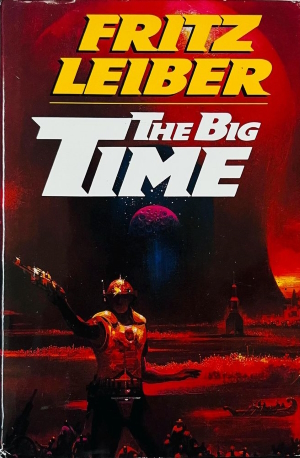
I was looking at some classic sci-fi book covers when I spotted one for Fritz Leiber’s The Big Time. I hadn’t thought of Leiber in decades (he was a favorite of a friend of mine in middle school), so out of pure curiosity I checked out his Wikipedia page. There, I was saddened to learn that Leiber spent the last few years of his life in poverty. As with so many writers, alcohol had taken its toll, and Leiber ended up living in a cheap motel. Apparently, Ellison came to visit him one day and was appalled by the state of his affairs, with Leiber not even able to afford a writing table. Rather, he was composing his latest work on a “manual typewriter propped up over the sink.” 

Fritz Leiber’s Sci-Fi Classic, “The Big Time”

Okay, maybe this wasn’t a good example of full-blown, Jungian synchronicity. I guess it wasn’t that unlikely that I should stumble upon a Ellison anecdote while reading about Leiber. They were both great science fiction writers, after all, and it make sense that they might have known each other. In fact, as I learned, Ellison included some of Leiber’s short stories in the Dangerous Vision anthologies that he (Ellison) edited for decades. Still, I didn’t know of any connection between the men. They were of different generations and circumstances, linked only by their genre and talent.

Unfortunately, the Wikipedia article does not cite the source of this (if anyone knows, please tell me), nor does it say what action, if any, Ellison took to improve Leiber’s circumstances. But I like to think that he did something to help. After all, he was a pugnacious, smart-ass little guy who looked after himself and other little guys. I miss him.

Here is a good interview that Ellison gave to the BBC in the 1970s.

R.I.P. Robert Redford

The great scholar Joseph Campbell once explained that every time we go into a cinema and see a movie star—Tom Cruise, for example—up on the screen, some part of our brains is aware that the real person, the actor Tom Cruise, is alive somewhere else in that same, exact moment. This ability to exist in two places at once, Campbell said, is an aspect of a God, a living divinity. 

Our subconscious perception of actors as gods is one reason we are always surprised by the death of a movie star, especially one who has been around since we, ourselves, were kids. How could they ever die? They seem to occupy a higher plane of reality, immortal, always youthful if not actually young. 

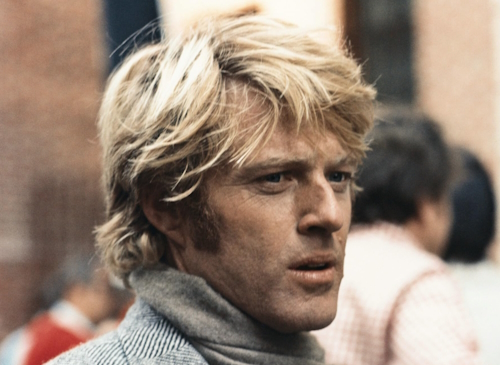
Robert Redford was surely one of the greatest movie stars of my youth, and he starred in two of my favorite films of all time, All the President’s Men and Three Days of the Condor, both of which I have written about on this blog. What made him interesting was that weird dichotomy of blond, athletic, all-American good-looks combined with a reserved, wary intelligence. (On my list of Hollywood Archetypes, he fits squarely in the “Dark Prince” slot.) He was a very smart man, who did a lot of amazing things both on-screen and off-. Among the most notable of these was his founding of the Sundance Film Festival, which has come to rival Cannes as the preferred venue for indie-film directors to premiere their movies. 

The fact that Redford would create an alternative festival for “the little guys” in the film industry was typical. He was, in some ways, the most counter-cultural movie star of the last fifty years—even more so than Easy Rider himself, Peter Fonda—in that he made movies about men fighting some vast, evil establishment. Often, this was the military-industrial complex in either its actual (All the President’s Men) or its fantasy (Three Days of the Condor) form. In his later years, when Redford could no longer play the lead, he took on the role of the villain who represents this evil empire, as in Captain America: The Winter Soldier.

As a kid, I always found something soothing about Robert Redford, even in movies filled with threats and violence. I suspect that, in my mind, he represented the best spirit of my parents’ generation (he was roughly the same age as my father). That is, the young adults of the 1960s and 70s. Post-hippie, but very hip. World-weary, but not broken. Brave, but not foolhardy. Idealistic, but not naïve. 

And, above all, ready to fight the system. 

Godspeed, Mr. Redford…

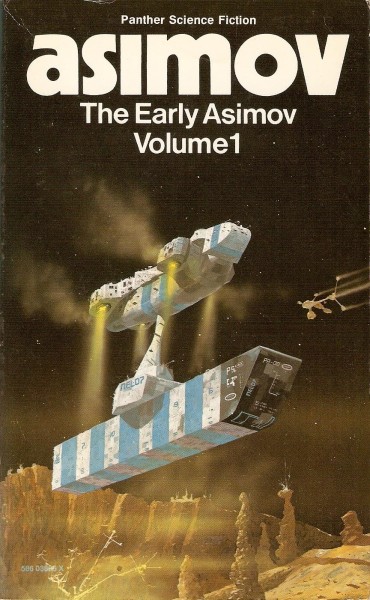
Classic Sci-Fi Book Cover: “The Early Asimov – Volume 1”

Ever since I started this series, I’ve been meaning to write a post about Chris Foss. For a sci-fi nerd growing up in the 1970s and ’80s, it was impossible not to see and be familiar with Foss’s artwork. After all, he illustrated more than 1,000 book covers during his long and celebrated career. His style is so distinct and memorable that one can recognize it on a bookshelf (or a computer screen) from twenty yards away. 

I remember seeing some of his sci-fi book covers back in the 1970s and being struck by their originality and vividness. He specialized in images depicting spaceships or futuristic craft, which he rendered with a strange, industrial-style realism that was new and striking. In particular, his spaceships look like real, constructed things with visible welds and spanners and plates, often painted in bright, almost nautical color schemes. He also likes to depict smoke. Or mist. Or dust. Something to give the otherwise static vacuum of space some drama and sense of motion. 

His work was so good, in fact, that no one seemed to care whether the depicted image had anything to do with the plot of the book itself. Often, it did not. But that didn’t matter. The cover always said two things: science fiction and drama. And that was enough. It was plenty. 

While I was doing a bit of research for this post, I was delighted to learn that Mr. Foss is still alive and still working. You can see more of his artwork on his website, which I encourage everyone to visit.

Today I Learned a Word: “Melisma”

I’ve always been a huge fan of Steve Winwood. Even as a kid, I loved how clean and bright his songs were, without ever being sappy or trite. Rather, they kept an edge somehow. Eric Clapton once said that Winwood was like a young, White, British Ray Charles. I kind of think he was right. 

Not long ago, I stumbled upon one of Winwood’s music videos. It was for “Valerie,” one of his greatest solo hits and one of my favorite songs of all time. The video was on YouTube, of course, and whoever posted it included lyric-captions. Normally I don’t like to follow the captions on a music video, but for some reason I did this time. And as I followed Winwood’s phrasing, I noticed something I had never seen before. Namely, the way he often splits single syllables into multiple notes. Take the line: “Music, hi and sweet.” It’s five syllables, but he sings it as six notes. 

If you are a music major, or anyone who knows a bit about voice training, you are probably rolling your eyes right about now. The technique that Winwood is using is so basic that it’s been around for thousands of years at least. But, being a musical ignoramus, I never thought of it before. It is, I just learned, called melisma and is usually contrasted with syllabic singing, in which notes and syllables match each other one for one. 

Ironically, as I did a bit more searching on the internet, I found a Facebook post by Winwood himself, mentioning melisma. It was in reference to the passing of the great singer Christine McVie of Fleetwood Mac. Winwood commented on how McVie stood out from many of her contemporary singers by virtue of her syllabic singing. And he’s right. McVie’s phrasing was so sharp it was almost like that of a jazz singer. 

And yet, off the top of my head, I can think of several instances of when McVie used melisma to great effect. My favorite example is in “You Make Loving Fun,” when she splits the word “believe” into so many notes I can’t even count them. And each one goes right through me each time I hear it. 

It’s taking me this many years to learn the definition of melisma. Go figure. You can’t teach an old dog new tricks, but you can teach them some new words.

Friday Night Rock-Out – “Verb: That’s What’s Happening”

I thought I would use this Fourth of July 2025 installment of my Friday Night Rock-Out series to celebrate one of the greatest triumphs of enlightened American capitalism: Schoolhouse Rock! The brainchild of ABC executive David McCall, the series ran on Saturday mornings during cartoon-time and was seen, enjoyed, and effortlessly memorized by millions of America kids, myself included. Even kids today will be somewhat familiar with the series—mainly because their Baby-Boomer and Gen-X parents made them watch it on DVD!

My favorite episode is Verb: That’s What Happening, which was performed with great soul by Zachary Sanders, along with a little help from The Pointer Sisters (allegedly). After fifty-odd years, it still hits.

Rock on….