R.I.P. Diane Keaton

One indication of Diane Keaton’s greatness is the simple fact that two of the most iconic of the 1970s end with her face. That is, with her face literally filling their final frames, as she looks straight at the viewer. These films are, of course, The Godfather (1972) and Looking for Mr. Goodbar (1977). In the former, her character, Kay, gives a stricken expression as she watches her young husband, Michael Corleone, go over to the Dark Side of the Force to become, at last, the new godfather of his crime family. In the Looking for Mr. Goodbar, her character, Theresa, lies on the floor in her darkened apartment, dying. She has just been fatally stabbed by a psycho guy she picked up at a bar. The guy runs off, and the camera stays fixed on her face as she breathes her last breath, alone.

I’m not sure which ending is more disturbing. In both cases, her character dies a kind of death (spiritual, in The Godfather; literal in Looking for Mr. Goodbar). And this death is brought on, directly or indirectly, by a man’s act of evil. This might seem ironic, given the fact that Keaton, more than other female star, best embodied the spirit of the New Woman, especially the second-wave version that swept the culture in the 60s and 70s. In fact, it’s not ironic at all. In both films, she becomes a kind of casualty-of-war, defiant but ultimately destroyed by a male-centered (if not actually misogynistic) culture. 

No, I am not trying to define Keaton’s long, brilliant career through the single lens of feminism-vs-toxic-masculinity. But you can’t talk about Diane Keaton without considering how important a symbol she was for both boys and girls watching movies when I was growing up. From the moment she appeared on-screen at the titular character in Woody Allen’s masterpiece, Annie Hall, she captured the heart of a generation. Dressed in men’s clothing, she was beautiful, elegant, and breath-takingly feminine. With her goofy demeanor, mixed with her sharp-as-a-whip intellect, she was the gawky, A-student who all the smart, gawky, A-student girls in the audience could look up to (and who all the A-student guys secretly fell in love with.)

As with any movie star of any gender, it is impossible to separate Keaton’s appeal from her physiognomy. She was, of course, beautiful, but in a more muted, subtle way than someone like Jacqueline Bisset, Britt Ekland, Jill St. John, or any other of the “off-the-charts-sexy” actresses of her generation. (On my list of 15 Hollywood Archetypes, Keaton would sit firmly in the “Goddess Next Door” bucket.) To me, the most remarkable thing about Keaton was the way she always seemed to glow. She was literally luminous, in all her films, an attribute that a cynic might write-off as a testament to good genetics (i.e., good skin), or perhaps expert lighting.

Being a bit of mystical, woo-hoo type, I would call it the emanation of her sublime, inner being, filtering out into our mortal plane… 

She carried this luminous quality into old age. Alas, though she was 79, she left us too soon. 

Godspeed, Ms. Keaton!

Synchronicity for Bookworms: Harlan Ellison

Harlan Ellison in the 1970s

The great film critic Roger Ebert once noted that the people we think of as heroes are those we looked up to when we were kids. As adults, we might admire a particularly talented athlete or actor or musician, but they won’t really be “heroes” to us; they’ll just be really cool (but life-sized) people. 

I think that my middle-aged affection for Harlan Ellison might be a slight exception to this adage, however. I was a fan of his when I was growing up (he became famous in the 1970s with his revolutionary, sci-fi short-stories like “I Have No Mouth, and I Must Scream”), but he wasn’t exactly a “hero” of mine. Then, in the 1990s, Ellison began to appear on TV as a talk-show celebrity, especially on the sci-fi channel, where he essentially co-hosted a show called Sci-Fi Buzz, where he was often very funny and always insightful. Also, to my amazement, one of his stories, “The Man Who Rowed Christopher Columbus Ashore,” was included in 1993’s Best American Short Stories collection. I saw an Ellison interview around that time, in which related that the series’ editor called him to give him the good news. At the end of their brief conversation, she asked him if had written any other short stories—an unintentional slight that Ellison said felt like “a dagger to the heart.” 

But this was typical of Ellison’s relationship to the literary world, and to Hollywood. He couldn’t get no respect. Part of this life-long diss was, surely, his own fault. He was famously abrasive and out-spoken, and hated to have his work messed with. When he wrote the screenplay for the what is generally considered the best episode of the original Star Trek series, “City on the Edge of Forever,” he hated Gene Roddenbury’s changes so much that he tried to have his name taken off the credits. (Fortunately, he failed.) In fact, he was so contentious about such matters that he had a special pseudonym, Cordwainer Smith, that he would use when he felt his work had been to mangled by studio executives that he no longer wanted his real name associated with it.

Paradoxically, the more interviews I watched of Ellison in the 1990s and beyond, the more I liked him. He had a razor wit, and he did not suffer fools easily. He could also be mean as hell when he felt attacked. But these were all characteristics I had seen before in some exceptional people I have met over the years, including my great teacher, the writer Harry Crews. I never met Ellison, but I suspect that we would have gotten along just fine. 

Indeed, I came to admire even Elllison’s famously pugilistic nature. He was quick to sue anyone who he felt had stolen his ideas. Most famously, he sued Orion Pictures over 1984’s The Terminator, alleging that director/writer James Cameron had cribbed the concept from a script Ellison wrote for The Outer Limits. Orion settled the suit out of court. (Cameron later called Ellison a “blood-sucking ghoul,” which I still find hilarious.)

Clearly, Ellison knew how to defend himself and his ideas, and to get what he felt was owed to him. Much of this toughness, I imagine, came from Ellison’s early life, growing up as an diminutive Jewish kid in Ohio. Like a lot of smart, little guys, Ellison learned how to punch back, and punch hard. 

After I wrote a blog post about Ellison and Isaac Asimov last year, I found myself thinking about Ellison more and more. So much so, in fact, that a couple of weeks ago I decided to write something about him, although what form that would take. 

Then, in one of those moments of synchronicity that happen to writers when they immerse themselves in a subject, I stumbled upon a fact regarding Ellison that I had never read before, and it came from a totally unrelated source.

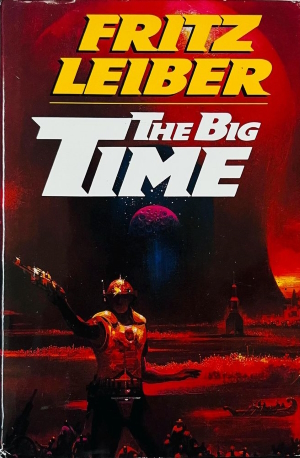
I was looking at some classic sci-fi book covers when I spotted one for Fritz Leiber’s The Big Time. I hadn’t thought of Leiber in decades (he was a favorite of a friend of mine in middle school), so out of pure curiosity I checked out his Wikipedia page. There, I was saddened to learn that Leiber spent the last few years of his life in poverty. As with so many writers, alcohol had taken its toll, and Leiber ended up living in a cheap motel. Apparently, Ellison came to visit him one day and was appalled by the state of his affairs, with Leiber not even able to afford a writing table. Rather, he was composing his latest work on a “manual typewriter propped up over the sink.” 

Fritz Leiber’s Sci-Fi Classic, “The Big Time”

Okay, maybe this wasn’t a good example of full-blown, Jungian synchronicity. I guess it wasn’t that unlikely that I should stumble upon a Ellison anecdote while reading about Leiber. They were both great science fiction writers, after all, and it make sense that they might have known each other. In fact, as I learned, Ellison included some of Leiber’s short stories in the Dangerous Vision anthologies that he (Ellison) edited for decades. Still, I didn’t know of any connection between the men. They were of different generations and circumstances, linked only by their genre and talent.

Unfortunately, the Wikipedia article does not cite the source of this (if anyone knows, please tell me), nor does it say what action, if any, Ellison took to improve Leiber’s circumstances. But I like to think that he did something to help. After all, he was a pugnacious, smart-ass little guy who looked after himself and other little guys. I miss him.

Here is a good interview that Ellison gave to the BBC in the 1970s.

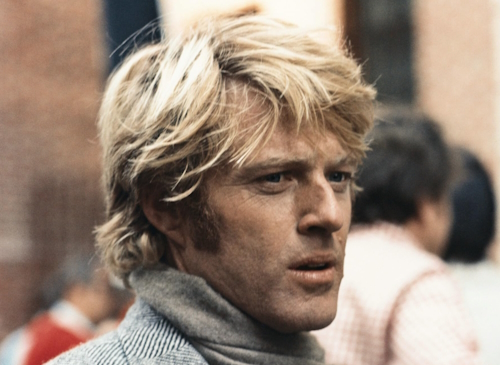
R.I.P. Robert Redford

The great scholar Joseph Campbell once explained that every time we go into a cinema and see a movie star—Tom Cruise, for example—up on the screen, some part of our brains is aware that the real person, the actor Tom Cruise, is alive somewhere else in that same, exact moment. This ability to exist in two places at once, Campbell said, is an aspect of a God, a living divinity. 

Our subconscious perception of actors as gods is one reason we are always surprised by the death of a movie star, especially one who has been around since we, ourselves, were kids. How could they ever die? They seem to occupy a higher plane of reality, immortal, always youthful if not actually young. 

Robert Redford was surely one of the greatest movie stars of my youth, and he starred in two of my favorite films of all time, All the President’s Men and Three Days of the Condor, both of which I have written about on this blog. What made him interesting was that weird dichotomy of blond, athletic, all-American good-looks combined with a reserved, wary intelligence. (On my list of Hollywood Archetypes, he fits squarely in the “Dark Prince” slot.) He was a very smart man, who did a lot of amazing things both on-screen and off-. Among the most notable of these was his founding of the Sundance Film Festival, which has come to rival Cannes as the preferred venue for indie-film directors to premiere their movies. 

The fact that Redford would create an alternative festival for “the little guys” in the film industry was typical. He was, in some ways, the most counter-cultural movie star of the last fifty years—even more so than Easy Rider himself, Peter Fonda—in that he made movies about men fighting some vast, evil establishment. Often, this was the military-industrial complex in either its actual (All the President’s Men) or its fantasy (Three Days of the Condor) form. In his later years, when Redford could no longer play the lead, he took on the role of the villain who represents this evil empire, as in Captain America: The Winter Soldier.

As a kid, I always found something soothing about Robert Redford, even in movies filled with threats and violence. I suspect that, in my mind, he represented the best spirit of my parents’ generation (he was roughly the same age as my father). That is, the young adults of the 1960s and 70s. Post-hippie, but very hip. World-weary, but not broken. Brave, but not foolhardy. Idealistic, but not naïve. 

And, above all, ready to fight the system. 

Godspeed, Mr. Redford…

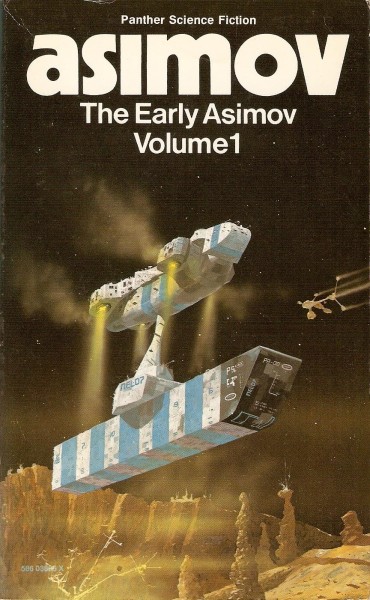
Classic Sci-Fi Book Cover: “The Early Asimov – Volume 1”

Ever since I started this series, I’ve been meaning to write a post about Chris Foss. For a sci-fi nerd growing up in the 1970s and ’80s, it was impossible not to see and be familiar with Foss’s artwork. After all, he illustrated more than 1,000 book covers during his long and celebrated career. His style is so distinct and memorable that one can recognize it on a bookshelf (or a computer screen) from twenty yards away. 

I remember seeing some of his sci-fi book covers back in the 1970s and being struck by their originality and vividness. He specialized in images depicting spaceships or futuristic craft, which he rendered with a strange, industrial-style realism that was new and striking. In particular, his spaceships look like real, constructed things with visible welds and spanners and plates, often painted in bright, almost nautical color schemes. He also likes to depict smoke. Or mist. Or dust. Something to give the otherwise static vacuum of space some drama and sense of motion. 

His work was so good, in fact, that no one seemed to care whether the depicted image had anything to do with the plot of the book itself. Often, it did not. But that didn’t matter. The cover always said two things: science fiction and drama. And that was enough. It was plenty. 

While I was doing a bit of research for this post, I was delighted to learn that Mr. Foss is still alive and still working. You can see more of his artwork on his website, which I encourage everyone to visit.

Today I Learned a Word: “Melisma”

I’ve always been a huge fan of Steve Winwood. Even as a kid, I loved how clean and bright his songs were, without ever being sappy or trite. Rather, they kept an edge somehow. Eric Clapton once said that Winwood was like a young, White, British Ray Charles. I kind of think he was right. 

Not long ago, I stumbled upon one of Winwood’s music videos. It was for “Valerie,” one of his greatest solo hits and one of my favorite songs of all time. The video was on YouTube, of course, and whoever posted it included lyric-captions. Normally I don’t like to follow the captions on a music video, but for some reason I did this time. And as I followed Winwood’s phrasing, I noticed something I had never seen before. Namely, the way he often splits single syllables into multiple notes. Take the line: “Music, hi and sweet.” It’s five syllables, but he sings it as six notes. 

If you are a music major, or anyone who knows a bit about voice training, you are probably rolling your eyes right about now. The technique that Winwood is using is so basic that it’s been around for thousands of years at least. But, being a musical ignoramus, I never thought of it before. It is, I just learned, called melisma and is usually contrasted with syllabic singing, in which notes and syllables match each other one for one. 

Ironically, as I did a bit more searching on the internet, I found a Facebook post by Winwood himself, mentioning melisma. It was in reference to the passing of the great singer Christine McVie of Fleetwood Mac. Winwood commented on how McVie stood out from many of her contemporary singers by virtue of her syllabic singing. And he’s right. McVie’s phrasing was so sharp it was almost like that of a jazz singer. 

And yet, off the top of my head, I can think of several instances of when McVie used melisma to great effect. My favorite example is in “You Make Loving Fun,” when she splits the word “believe” into so many notes I can’t even count them. And each one goes right through me each time I hear it. 

It’s taking me this many years to learn the definition of melisma. Go figure. You can’t teach an old dog new tricks, but you can teach them some new words.

Friday Night Rock-Out – “Verb: That’s What’s Happening”

I thought I would use this Fourth of July 2025 installment of my Friday Night Rock-Out series to celebrate one of the greatest triumphs of enlightened American capitalism: Schoolhouse Rock! The brainchild of ABC executive David McCall, the series ran on Saturday mornings during cartoon-time and was seen, enjoyed, and effortlessly memorized by millions of America kids, myself included. Even kids today will be somewhat familiar with the series—mainly because their Baby-Boomer and Gen-X parents made them watch it on DVD!

My favorite episode is Verb: That’s What Happening, which was performed with great soul by Zachary Sanders, along with a little help from The Pointer Sisters (allegedly). After fifty-odd years, it still hits.

Rock on….

Friday Night Rock-Out: “Listen to Her Heart”

Of the hundreds of kids who graduate from Gainesville High School every year, relatively few (I’m guessing) are aware that they attended the same school as the late, great Tom Petty. (My son Connor definitely was aware because I was constantly reminding him of it, to his annoyance. LOL.) Petty is still Gainesville’s most famous native son, and with good reason. He was one of the greatest rock musicians of his generation. In fact, I think of him as America’s version of David Bowie—brilliant, inventive, always changing and yet always the same.

(Fun fact: one of Gainesville’s other famous sons, Don Felder, taught Petty how to play piano, or guitar, depending on who you ask.)

My favorites of Petty’s songs are the early classics like this one, “Listen to her Heart.” If you’ve ever feared losing a lover to a rival with a lot of money and cocaine (and who hasn’t?), this song is for you.

Rock on…

Friday Night Rock-Out: “Trouble”

Forget Van Halen. Forget Hendrix. Forget Clapton. Lindsey Buckingham is the greatest guitarist in the history of rock music. Don’t believe me? Listen to this song, “Trouble,” from his 1981 solo album Law and Order. If it doesn’t transport you to another plane of existence—yes, forgive the cliche; to an actual soundscape—then you need to get your ears checked.

Buckingham was, of course, the driving force behind Fleetwood Mac’s second incarnation, when they produced one of the greatest rock LPs of all time, Rumours. (When he joined the band, he insisted they also hire his girlfriend, Stevie Nicks, who also had a bit to do with the group’s ultimate success.) As band leader Mick Fleetwood saw at the time, Buckingham is not just an incredible guitarist, he is also a phenomenally talented song-writer, multi-instrumentalist, and singer.

Getting back to his guitar playing, though, let me add that Buckingham uses an usual finger-picking technique—more like a banjo-player—which he employs in a variety of styles and with amazing creativity. That creativity is on full display here. 

Rock on…

Classic Sci-Fi Book Cover: “The War Against the Rull”

This entry in my on-going Classic Sci-Fi Book Covers series is both old and new. That is, it’s a modern touch-up of the cover from the October 1949 edition of Astounding Science Fiction painted by Hubert Rogers. That issue included a work by A.E. van Vogt, but not the one we are interested in here. This modern version is from a 1999 edition of van Vogt’s classic sci-fi novel, The War Against the Rull, which I distinctly remember devouring in two days when I was in eighth-grade.

I like this cover a lot. It’s not just a classic. It’s an archetype. Specifically, the archetype of the heroic (America) scientist, a buff intellectual and polymath whose ilk could be found in countless works of Isaac Asimov, Robert Heinlein, Roger Zelazny, and on an on. In The War Against the Rull, the man is Dr. Trevor Jamieson, a brilliant scientist who is also a fierce warrior and survival-expert. He’s stranded on an alien planet with a huge, six-legged, intelligent creature called an ezwal who wants to kill him. But when both Jamieson and the ezwal encounter a mutual enemy—a race of aggressive, centipede-like aliens called the Rull—they decide to work together to survive.

It’s a great story, like so many from the sci-fi’s Golden Age. I’ve written before about why sci-fi novels from that era are so much more enjoyable (to me, at least) than most of those written in the last ten years or so. I think it has to do with the gritty humanity of such stories. Yeah, Jamieson is essentially a comic-book character (think Doctor Quest and Race Bannon rolled into one), but van Vogt does a great job of making you believe he’s in real trouble. The ezwal, too—he’s a compelling character in his own right. You get involved in the desperate nature of their situation, and you keep reading to see how they will get out of it.

Anyway, check it out if you can…

Original Cover from Astounding
Cover from the 1970 edition that I read as a kid (by artist John Schoenherr)
Another version of the Scientist Hero Archetype (by artist James Bama)

Classic Sci-Fi Book Cover: “This Immortal”

My privious entry in this continuing “Classic Sci-Fi Book Covers” series was also devoted to Roger Zelazny, so please forgive me for double-dipping into the Zelazny well. But I couldn’t resist talking about one of Zelazny’s other great novels, …And Call Me Conrad—published in 1966 as This Immortal. Most people have never heard of it, but it’s an interesting book for several reasons.

For one, it was Zelazny’s first novel, and it has many of his signature obsessions (e.g, ancient mythology mixed with science fiction; a wise-cracking anti-hero who is also an Übermensch; epic fight scenes; etc.). For another, it actually won a Hugo Award, tying in 1966 with a slightly better-known book…Frank Herbert’s Dune. And finally, it’s just a hell of an entertaining adventure tale.

I chose this cover (by fantasy artist Rowena Morrill) because it really captures the sense of the book’s main character, Conrad Nomikos, a world-weary man-of-mystery who might be immortal. (The text suggests that he is at least a century old, and hints that he might be several thousand years older still.) He works as director of a government agency tasked with protecting and preserving the surviving relics of a destroyed earth. A nuclear war referred to by the characters as “The Three Days” has occurred many decades before, leaving most of the planet uninhabitable. The survivors, which include a wide variety of mutants both human and animal, live mainly on islands like Greece, Conrad’s home.

And that’s not even the main subject this wild, wild little book. Conrad is assigned the duty of escorting a group of VIP tourists—including Cort Myshtigo, an alien from the Vega star system whose race has purchased earth as a kind of vast museum—as they tour the planets once great sites (now ruins). Conrad soon realizes that another of the tourists, an Egyptian assassin named Hassan with whom Conrad has befriended in the past, is secretly on a mission to kill the Vegan. Hassan, it seems, has been hired for this task by an obscure, underground political group who want to reclaim earth for humanity. So, Conrad finds himself not only being a tour-guide but also an unpaid protector of Myshtigo—who he hates.

It’s a crazy book, and the cover conveys this craziness well. Though the edition is from 1980, the cover really feels like a 1970s cover, with its vaguely photorealistic painting of a ruggedly handsome dude with great hair (think Roger Staubach in his prime). I also like how Morrill works in the other tropes of the book—its setting among Greek ruins, as well as the presence of some mythological creatures in the background (which, the reader eventually learns, are actually just animals that have been mutated by radioactive fall-out).

It’s a very dated cover, but still a really cool one. Classic, one might say…