(…or, Everything That’s Wrong with Deadpool & Wolverine)
Well, I finally got around to watching Marvel’s latest blockbuster, Deadpool & Wolverine. This was the first Marvel movie I’d watched in a while, and now I remember why. Holy smoke, what a crappy film! As I watched it—doggedly, hoping it would get better, resisting the urge to switch it off—I began to realize that this film is not only bad, it is profoundly bad. That is, bad in a way that’s worth talking about.
Normally, being a nominal “artist” myself, I don’t lay into other people’s work just because I don’t like it. Why bother? But this movie triggered me in such a way that I have to rant about it for a while. Specifically, it pissed me off because it breaks the single most important rule of genre fiction (which applies equally to genre film): Keep it Real.
Wait a moment, you say. Realistic genre fiction? Realistic fantasy fiction? Sounds like an oxymoron, right? Actually, no. For while every Marvel movie, like every James Bond movie and every action movie and every horror movie and even every science fiction movie, is, in a sense a fantasy, the good ones display a kind of realism that’s critical, and vastly more important than any sense of day-to-day realism in the story itself. This is psychological realism. And psychological realism has its root in physiologicalrealism—the realism of the human body.
When most people think of the archetypal techno-thriller writer, they probably think of Tom Clancy. He didn’t invent the genre, but with the publication of his 1984 mega-hit The Hunt for Red October, he took it to a whole new level of mainstream popularity. Henceforth, the pop lit shelves in bookstores and airport gift shops across the countries would be filled with works by Clancy and an army of his imitators.
And why not? The techno-thriller novel combines aspects of several other genres, including “caper” fiction (a group of determined men taking on a seeming impossible mission), science fiction (the “techno” part is often so cutting-edge that it is more like sci-fi), mysteries (there is always a hidden bad guy in the mix), and, of course, thrillers (duh).
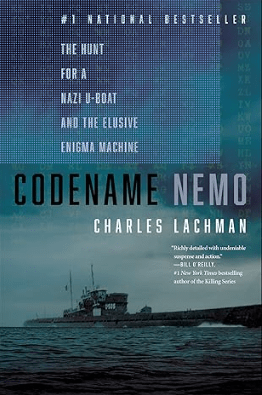
I kept thinking of The Hunt for Red October as I read an excellent history book recently, Codename Nemo: The Hunt for a Nazi U-Boat and the Elusive Enigma Machine by Charles Lachman. It recounts the fantastical story of a visionary naval captain, Daniel Gallery, who comes up with a hare-brained plan to capture a German U-boat. He developed the idea while stationed at a naval base in Iceland, seeing the damage that U-boats could wreak. He also learned how to sink them.
1.) Alternate Realities One of the great things about living in a university town is that you get to hear some great lectures by famous people—for free. Back in the 80s, I attended a lecture on the subject of evolution by the late, great Stephen Jay Gould. He talked about how incredibly subtle mutations in the gene pool can, over time, create titanic changes in the history of earth. He called this the Phenomenon of Contingency. To illustrate his point, he mentioned two movies that deal primarily with the subject of an individual’s impact on the course of history—the way small choices can resonate through the future. The movies he sited were It’s a Wonderful Life and Back To The Future. He might have mentioned a dozen or so works of modern science fiction, or the Hindu concept of the Net of Jewels. Or all of Buddhism, for that matter. But he was right on the money with It’s a Wonderful Life. The movie is about keeping your eye on the Cosmic View, rather on selfish or ego-centric desires. George has forgotten how much good he had done in Bedford Falls because the effects of his actions have been blurred by time. Clarence the Angel reveals (or re-reveals) it to him.
When I was teenager (ahem, some years ago) I had the good fortune to see Robin Williams perform. He was the lead entertainment for that year’s Gator Growl, the annual pep rally thrown by the University of Florida. At the time, Williams was mainly known as the odd but extremely funny star of TV’s Mork & Mindy. Few were aware that he was first and foremost a stand-up comedian, and even fewer knew just how brilliant—not to mention obscene—his style of comedy could be. So, you can imagine the surprise (and shock) that ensued when he walked out on stage and did his first joke, miming the cocking action of a shotgun as well as the sound: KA-CHICK. “Down here in the South,” he said, “if you hear that sound, you’d better be one fast motherfucker!”
The ensuing performance became a local legend. I remember it as being as incredibly manic and astoundingly creative. William’s comedy was like nothing else around at that time. It wasn’t long before he emerged as the premier comedian of his generation. And, since his suicide in 2014, he has become firmly embedded in our national consciousness as the Greatest Comedian of All Time.
This is a justifiable opinion. For my money, though, there was one comic who surpassed even Williams in his intellect, inventiveness, and sheer genius. This was Richard Pryor.
I’ve been meaning to write a post listing some great movies about the press. Normally, I would make this a “top-10” list, but the fact is that I couldn’t think of that many, unless I resorted to some cheating (yes, Citizen Kane involves the muckraking journalism of the early 1900s, but you can’t really call it a movie about the press). So, here’s my list, from great to greatest…
The Paper
Ron Howard’s 1994 film The Paper focuses on one frantic day in the newsroom of a major metropolitan newspaper. The day begins with a high-profile murder, for which two young African-American men are arrested. Michael Keaton, Glenn Close, and Robert Duvall are the editors who are fighting to uncover the truth—before deadline. The Paper is a bit broad compared to the other entries on my list, but it’s still a fine movie with a great story.
In one of those strange, synchronicity moments that sometimes happen, I recently stumbled upon an article in Collider about how the classic John Carpenter film Escape from New York is getting a new 4K release from Shout Factory. This was a heart-warming bit of information, for me, since the film has been one of my favorites since I saw it in the theaters in 1982. It’s nice to think that new generations of film lovers might be given a chance to appreciate its many charms.
The news was also timely, for me, because I had been contemplating writing a post about the things I love most about movies like Escape from New York. That is, B-Movie Action Flicks. As anyone who reads this blog or my old one will realize, I am somewhat obsessed with B-Movie Action Flicks, especially from their golden age back in the 1970s-80s. Part of my obsession is mere nostalgia, of course. I spent many a late Saturday watching such movies on HBO with my equally nerdy, reprobate friends, and they (the films and the friends) helped me get through the agonies of growing up. But the other part of my obsession has to do with the nature of B-Movie Action Flicks. Why are they so much fun?
Well, I finally watched Dune: Part Two (henceforth known as Dune 2) last night. I’m a big fan of the first film (part 1), and I was very eager to see this one (although not eager enough, apparently, to shell-out for theater tickets; oh, well).
Dune 2 is, obviously, an amazing film, even when viewed on a TV screen. A lot of people have commented on how much the movie reminds them of Lawrence of Arabia, and it’s true. Why not? Frank Herbert was, himself, influenced by Lawrence when he wrote the book. But as I watched Dune 2, I kept thinking of another classic film, The Godfather. They’re practically the same movie, when you think about it. Duke Leto is the Godfather, the noble monarch of a great and honorable kingdom. Arrakis is New York City, full of violence, corruption, and sadistic evil. Paul is Michael, the exiled prince, who is at first reluctant to take up his old man’s role but later succumbs to the circumstances that surround him, and to his own desire for revenge. Chani is Kay. Gurney is Clemenza. And on and on.
I mean this comparison, of course, as a compliment. Dune 2 is an archetypal film, as is The Godfather. And, like The Godfather, it’s got some electrifying scenes of action, woven inside a theme of how good can survive in an evil universe without becoming evil itself. (Dune 2, like The Godfather, leaves the question unresolved.)
I did have some pretty major complaints about the movie, especially in the way it handles time. Correct me if I’m wrong, but the entire story takes place during Lady Jessica’s pregnancy with the unborn Alia. Right? So, unless babies in the Dune universe take a lot longer to gestate, that’s less than nine months—which makes no logical sense. (In the book, it’s more like four years.) Even more problematic, for me, is the film’s unrelenting depictions of sadism. The Harkonnens—the greatest lovers of BDSM fashion in the galaxy—are always stabbing or crushing or slicing somebody up, usually someone helpless and innocent. Yeah, I get it; evil is the major theme of the movie. But I couldn’t help but think that director Denis Villeneuve (who is, I believe, a genius) takes it just a little…bit…too…far. I mean, we get four or maybe five scenes that are essentially remakes of The Empire Strikes Back with Darth Vader killing some dim-witted subordinate.
Still, it’s a great movie, exciting and fluid and beautifully acted. I’ll watch it again. If you haven’t seen it (which I seriously doubt), check it out…
Back in the early 1990s when I was a poor graduate student, I used to stay home on Saturday nights and watch my little black-and-white TV. I couldn’t afford cable, of course, but thankfully there was always PBS, so I watched a lot of documentaries and episodes of Great Performances. On one such night, I saw a filmed performance of Peter Brook’s stage play The Mahabharata. The play is, of course, a dramatic adaptation of the great Hindu epic, the tale of a feud between two groups of royal cousins, the Pāṇḍava princes and their arch-nemeses, the Kauravas. As epic tales are wont to do, the feud escalates into a civil war so catastrophic that even the gods are pulled into the conflict (in the same way that the Greek gods Mars, Apollo, and Venus involve themselves in the The Illiad).
Being a filmed staged play, Brook’s TV version is low on special effects (this was before CGI) but packed with minimalistic, highly-stylized interpretations of sweeping battles, multi-armed demons, and flying chariots. Somehow, it all works, and I found myself obsessed with both the film and the story. A few years later I would finally read a popular translation of The Bhagavad Gita, which is really just one portion of the much larger Mahabharata.
The great B-Movie director Roger Corman has died. As a kind of tribute, I’m reposting an essay I wrote some years ago on my old blog. Enjoy!
Ever since I turned forty, I find myself going to see fewer and fewer movies. It’s only natural, I suppose. The less time you have left, the less time you want to spend in a darkened theater, lost in flights of fancy. And so, what little I know of recent film releases comes to me second-hand, either through friends or online reviews or through the film trailers that I see when I do occasionally go to a movie. Even from this limited perspective, I can glean a few obvious facts about movies these days: 1.) they are all rated PG-13 and 2.) they are all about the end-of-the-world and 3.) they all rely heavily on digital effects.
These three qualities go together, of course, for reasons that are based more in economics than anything else. The digital effects are required to attract a modern audience raised on video games and violent TV. And because these CGI effects tend to be horrifically expensive, the movies must be rated PG-13 in order to gather as large are a customer base as possible. Finally, the reliance on end-of-the-world plots come naturally, mainly because the plot-lines that justify these breathtaking explosions, airships, monsters, and laser guns usually involve some kind Biblical-style, science-fiction-themed catastrophe.
Fifteen years ago I read Mark Harris’s excellent non-fiction book Pictures at a Revolution: Five Movies and the Birth of New Hollywood. It recounts five movies that came out in 1968, a kind of annus mirabilis of American film, a pivot point in both cinema and culture when Hollywood reinvented itself for the better.
I was reminded of Mr. Harris’s book last night as I sat in a crowded IMAX theater watching Christopher Nolan’s vaunted new film, Oppenheimer. It is, of course, a terrific movie on almost every level: technically, visually, dramatically, and, yes, historically. Moreover, it marks the second very good movie I’ve seen in the last month (Wes Anderson’s Asteroid City was the other), and both films struck me as indications of turning-point in American movies, similar to the one Harris describes so beautifully. Both Asteroid City and Oppenheimer are gorgeous, inventive, and lyrica films—a dark, nostalgic kind of lyricism in the former, and a dark, horrific kind in the latter. Coming just a few years after the movie industry was declared dead during the COVID pandemic, this new wave of excellent films (I’m guessing Greta Gerwig’s Barbie will continue it) makes me hopeful that a new revolution is afoot.
Regarding Oppenheimer, I sat next to my son, Connor, who is also a film and history buff, and we were both mesmerized by the power of the film, but even more so by its cleverness. For a film based on a non-fiction source (Kai Bird’s fine biography of Oppenheimer, American Prometheus), Oppenheimer the movie feels like a fiction film. Unrelentingly tense and dramatic, it is almost free of exposition. Noland trusts the viewer to figure out what is going on in each scene, whether or not you’re familiar with the actual history.
I am, actually, familiar with it. I read Kai Bird’s book years ago and loved it. So, at one moment in the film when Oppenheimer reads from a sanskrit book and intones the words: “I am become death, the destroyer of worlds,” I knew that he is reading from the Hindu epic The Bhagavad Gita, and that these are the same words that would come to mind later as he witnesses the first nuclear test in the New Mexico desert. Part of Nolan’s genius, however, is to reframe this quote into a dramatic (um…actually erotic) scene, in which the character is having sweaty sex with his lover (the tormented Jean Tatlow, played with intelligence and verve by Florence Pugh). This is history done right. If you’re going to insert a famous quote by a famous man in a famous moment in history, you’re better off sneaking it into a steamy sex scene.
I don’t mean to brag—oh, who am I kidding; I totally mean to brag—but not only have I read Kai Bird’s book, I’ve read The Bhagavad Gita, too. And while I only read an English translation (unlike Oppenheimer), I gleaned enough meaning from it to know that it’s a story about a man who finds himself caught between duty and humanity, action and paralysis. Which strikes me as the central theme of Oppenheimer, too, both the man and the movie. Like Arjuna, the super-warrior hero of the Bhagavad Gita, who doesn’t want to go into battle against his friends, Oppenheimer was naturally reluctant to use his talents to create a bomb. But, from a moral and existential point-of-view, he finds himself trapped in a cosmic dilemma. As he explains to a friend at one point in the film, giving the Allies an atomic weapon would be dangerous, but giving the Nazis one would be apocalyptic.
But did he make the right choice? The question becomes even thornier when focused on the specific issue of how the bomb was first used, against Japan, an enemy that never had an atomic weapons program of its own and which was pretty much on the ropes by 1945. Personally, I have always found the question of whether or not America was right to drop the bomb on Japan to be mildly ridiculous. If we were fighting a war today in which hundreds of thousands of our soldiers had been killed fighting an implacable enemy, and if someone then told us, “We’ve got a bomb that will insert a colony of mutant spiders into country X, and those spiders will eat the face off everyone there, soldiers included,” I’d probably say, “Drop the friggin spiders.” This was essentially the decision Oppenheimer himself reached when advocating for the use of the bomb on Japan (an event he eventually celebrated, as is shown in the film’s most chilling scene).
But the best thing about Nolan’s film is that it never descends to this level of after-the-fact, arm-chair quarterbacking. Indeed, through Oppenheimer’s own hallucinations and fever dreams about a potential World War III, it makes clear that the decisions made in 1945—like the cosmic forces they unleashed—surpass ordinary human judgment, if not human understanding. Was Oppenheimer right to lobby for dropping the bomb? God knows. Perhaps not even Him.






 Ash Clifton, Writer