If you were to ask a music lover to name the most iconic pop band of the 1970s, their answer would probably be The Bee Gees. And they’d be right–mostly. For about three years, The Bee Gees bestrode the world like a collosus, leading the musical and cultural era that was disco.
But, for my money, it was the Electric Light Orchestra that most defined 70s pop. The creation of musical genius Jeff Lynne, E.L.O. was hit machine that cranked out gold records with regularity. Their songs were all over the radio here Gainesville, and their records were coveted.
And expensive. I remember looking at Out of Blue in the record store and was shocked to see that it was priced at $14.99. (This was back when ten bucks would get you a decent dinner in a real restaurant.)
My favorite E.L.O. song is, of course, “Turn to Stone”, which is the perfect fusion of pop and rock. Cinemaphiles will note that it was this song that P.T. Anderson ended his great film Boogie Nights with.
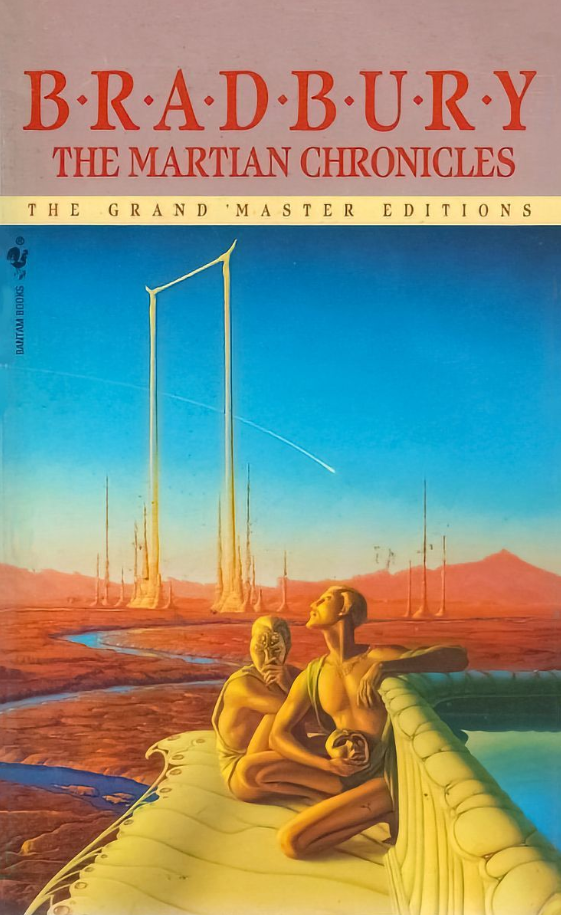
When I was a public school kid back in the 1980s, I used to spend hours at the bookstore, mostly looking at science fiction books. It wasn’t just the stories themselves that interested me, but the cover art. Back then, before the internet gave one an endless supply of great sci-fi concept art of any kind, the only way to get one’s imagination going was to head to the bookstore.
So, it’s probably inevitable that I would regard that time as a golden age of sci-fi cover art. And I do. When I look at sci-fi books today, there is usually no cover art to speak of, but just an exercise in graphic design. The title goes in this font 38 point; the author’s name goes in this font at 28 point; etc.; with some blurry, abstract notion of an alien planet or a futuristic city. Back in the pre-digital days, sci-fi cover art consisted mainly of actual paintings, made by actual painters.
One of the best actual painters was (and is) Michael Whelan. His work has that perfect blend of realism, action, and whimsy that I always looked for in a good sci-fi cover. For five decades, he created some of the best covers ever made, and they earned him a place in the Science Fiction Hall of Fame.
One of my favorites is the one above, his cover for the 1990 Bantam/Spectra edition of Ray Bradbury’s The Martian Chronicles. If you haven’t read it (and you should), it’s an allegory about the loss of ancient wisdom, the horrors of capitalism, and even the conquest of the American West. Haunting the work are the ghosts of the Martians themselves, who once-great civilization is helpless in the face of the invading Earth-men, with their guns and disease and endless greed. I love this cover because it gives you a sense of that lost majesty, but it also makes you curious about the story.
There is a great tradition in American comedy of very smart women playing very dumb women (usually, dumb blonds). It goes back to at least the 1930s with the duo of George Burns and Gracie Allen, and probably much further than that.
So, it’s not terribly surprising that the brilliant actress Teri Garr was best known for playing a stereotypical “dumb blond”. Specifically, she played Inga, Dr. Frankenstein’s (that’s FRAH-ken-steen‘s) lab assistant in Mel Brooks’s classic Young Frankenstein. The film is one of the funniest ever made, and Garr’s performance is one of the funniest things in it. It’s a masterpiece of physical humor, timing, and delivery, not to mention a great, fake German accent.
The doc falls in love with her by the end of the film, and the same can be said for many of the viewers. It’s safe to say that the film wouldn’t have been half as good without her.
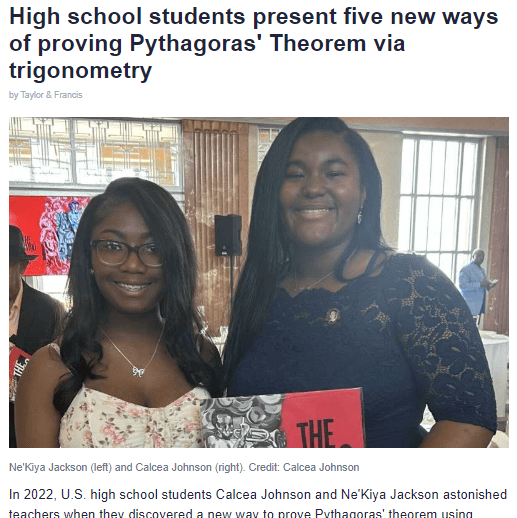
The latest entry in my continuing series celebrating Nerds in the News (STEM nerds, mostly, as opposed to book nerds, of which I am one) goes to these two young, awesome math nerds. Back in 2022, using nothing but trigonometry (which, as it happens, was the only class I failed in high school), they came up with an entire new proof of the Pythagorean Theorem. Even more incredible, these two mathematicians were both teenagers at the time. And they still are!
I am, of course, terrible at math, but I am endlessly fascinated by it. One of my favorite non-fiction books of all time is Simon Singh’s excellent Fermat’s Enigma, which recounts master-mathematician Andrew Wiles’ quest to solve Fermat’s Last Theorem, which eluded math nerds for hundreds of years. (Wiles solved it in 1993.) Coincidentally, that problem also directly concerned the Pythagorean Theorem, and Singh recounts the story like a centuries-old mystery. One interesting point about the tale is that many advances in the hunt for the solution were made by amateur mathematicians, which is exactly what Ms. Johnson and Ms. Jackson are. (This is due to their youth; I have a feeling they will go on to have great careers after…you know, they graduate college).
Congratulations, Ms. Calcea Johnson and Ms. Ne’Kiya Jackson!
Was there ever a band more influential than Siouxie and the Banshees? Bands as diverse as Depeche Mode and Jane’s Addiction have expressed their admiration. And no less an iconic figure than Billy Idol has written about how awestruck he was the first time he saw the Banshees play live.
Not only were they one of the most important bands of the 1980s, they were one of the hardest to pigeonhole. Post-punk. Alt-rock. Alt-pop. Glam-rock. Goth-rock. All these labels have been applied to them.
All I know is that I always loved them, and still do.
Remember that scene from The Matrix in which the crew of the rebel hovercraft the Nebuchadnezzar sits down to a meal of some artificial, lab-concocted glop? Apoc describes it as being “like a bowl of snot,” while Mouse say it actually reminds him of one of his favorite foods as a child, the fictional Tasty Wheat.
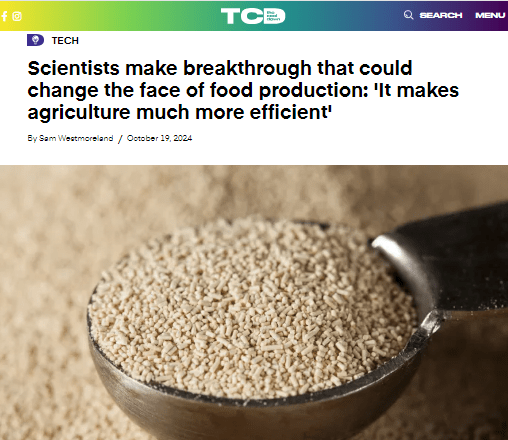
Dozer explains that the glop is said to be created by a single-celled organism and has all the nutrients required to support human life. In real life—and especially on our rapidly warming planet, where droughts are becoming more common and every inch of arable land will soon be needed to grow basic crops—such glop would actually be a very cool thing. It might, in fact, be the difference millions of people suffering famine and those same millions having decent, long lives. Never mind the taste, this glop would be a Godsend.
Well, this week some nerds at the University of Tübingen in Germany announced that they have essentially created some version of the magical glop. The single-celled organism turns out to be a bacterium called Thermoanaerobacter kivui, and the glop created contains both B9 and more protein per volume than beef. And all it needs to grow is C02 (the primary offender in the climate crisis), hydrogen, and some heat. Pretty cool!
I’ve always been fascinated by the idea of creating artificial food. This is probably because I’ve read too many science fiction novels, where such technology is often presented as dystopian (I’m looking at you, Soylent Green) as well as utopian (see the replicators on Star Trek). Being a natural, rational optimist, I tend to believe that artificial food will be a great boon to society. In particular, artificial protein would be a wonderful thing because it would free up so much land that is currently used by livestock (the most inefficient form of food production, not to mention the cruelest in its most common form).
Don’t get me wrong—I like meat. I cook with meat. And I think free-range livestock raised with traditional, holistic practices might actually be a crucial element in the fight against climate change. But if there were a good, renewable alternative to real meat that sucks up C02 in the process, I’m all in. It could, in fact, save the world as we know it.
Hopefully, they will figure out the taste problem.
When I was teenager (ahem, some years ago) I had the good fortune to see Robin Williams perform. He was the lead entertainment for that year’s Gator Growl, the annual pep rally thrown by the University of Florida. At the time, Williams was mainly known as the odd but extremely funny star of TV’s Mork & Mindy. Few were aware that he was first and foremost a stand-up comedian, and even fewer knew just how brilliant—not to mention obscene—his style of comedy could be. So, you can imagine the surprise (and shock) that ensued when he walked out on stage and did his first joke, miming the cocking action of a shotgun as well as the sound: KA-CHICK. “Down here in the South,” he said, “if you hear that sound, you’d better be one fast motherfucker!”
The ensuing performance became a local legend. I remember it as being as incredibly manic and astoundingly creative. William’s comedy was like nothing else around at that time. It wasn’t long before he emerged as the premier comedian of his generation. And, since his suicide in 2014, he has become firmly embedded in our national consciousness as the Greatest Comedian of All Time.
This is a justifiable opinion. For my money, though, there was one comic who surpassed even Williams in his intellect, inventiveness, and sheer genius. This was Richard Pryor.
I’ve been meaning to write a post listing some great movies about the press. Normally, I would make this a “top-10” list, but the fact is that I couldn’t think of that many, unless I resorted to some cheating (yes, Citizen Kane involves the muckraking journalism of the early 1900s, but you can’t really call it a movie about the press). So, here’s my list, from great to greatest…
The Paper
Ron Howard’s 1994 film The Paper focuses on one frantic day in the newsroom of a major metropolitan newspaper. The day begins with a high-profile murder, for which two young African-American men are arrested. Michael Keaton, Glenn Close, and Robert Duvall are the editors who are fighting to uncover the truth—before deadline. The Paper is a bit broad compared to the other entries on my list, but it’s still a fine movie with a great story.
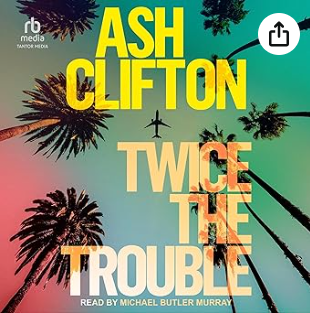
Anyone who is all interested in mystery fiction might avail themselves of this long (three chapters!) sample of the audiobook version of Twice the Trouble. It’s free on Youtube from Google Play. Check it out…!





 Ash Clifton, Writer