There is a cool website called My Book, The Movie where authors can describe their dream movie production of their book. The gentleman who runs the site invited me to post, and here is the result…
Not long ago, I read a very fine biography called Furious Love: Elizabeth Taylor, Richard Burton, and the Marriage of the Century by Nancy Schoenberger. I picked it up not only because I am a huge fan of Richard Burton but also because of my growing interest in Taylor, who was surely one of the most remarkable people of the 20th Century. It was Taylor who, upon hearing that her great friend Montgomery Clift had just been in a car accident a few blocks away, literally ran to the scene. She got there in time to pull one of Clift’s dislodged teeth from his throat just before he choked on it. Pretty amazing.
Clift’s importance in the larger story of Taylor and Burton’s whirlwind romance is minor. He is only mentioned in one or two parts. And yet his unexpected appearance in the book fascinated me, especially when Schoenberger reveals the mutual disdain that Clift and Burton felt for each other. Jealously over Taylor’s affections surely had something to do with this, despite the fact that Clift was gay and by all accounts his relationship with Taylor was platonic. But even deeper than this personal rancor lay an artistic rivalry between the two men regarding their respective abilities as actors.
Clift was one of the first and greatest alumni of “the method” studios taught by Stella Adler and Lee Strasberg, which emphasized acting as a physical interpretation of deep psychological impulses. The actor seems to transform into the character from the “inside out”. (Think Robert De Niro in Raging Bull or…well…any other De Niro movie.)
I’ve long harbored the secret hope that someone, someday would refer to me reverentially as a bad-mother-hush-your-mouth, but I don’t think it’s ever going to happen. Oh, well.
This week’s Friday Night Rock-Out (okay, it’s more a Friday-Night Funk/Soul-Out) is dedicated to the late, great Isaac Hayes. Hayes was a musical genius, as well as being a pretty good actor. (He did fine journeyman work in The Rockford Files and Escape from New York. He was also a great voice-actor on South Park.) He will always be remembered, though, for the theme-song of the 1971 Gordon Parks film about the most phallocentric private investigator in the history of American crime fiction.
Yeah, I’m talkin about Shaft. I hope you can dig it.
The great B-Movie director Roger Corman has died. As a kind of tribute, I’m reposting an essay I wrote some years ago on my old blog. Enjoy!
Ever since I turned forty, I find myself going to see fewer and fewer movies. It’s only natural, I suppose. The less time you have left, the less time you want to spend in a darkened theater, lost in flights of fancy. And so, what little I know of recent film releases comes to me second-hand, either through friends or online reviews or through the film trailers that I see when I do occasionally go to a movie. Even from this limited perspective, I can glean a few obvious facts about movies these days: 1.) they are all rated PG-13 and 2.) they are all about the end-of-the-world and 3.) they all rely heavily on digital effects.
These three qualities go together, of course, for reasons that are based more in economics than anything else. The digital effects are required to attract a modern audience raised on video games and violent TV. And because these CGI effects tend to be horrifically expensive, the movies must be rated PG-13 in order to gather as large are a customer base as possible. Finally, the reliance on end-of-the-world plots come naturally, mainly because the plot-lines that justify these breathtaking explosions, airships, monsters, and laser guns usually involve some kind Biblical-style, science-fiction-themed catastrophe.
When U2’s Achtung Baby came out in 1991, critics joked that it was the album that saved the band from itself. After the enormous success of 1987’s The Joshua Tree, U2 too fell into an abyss of self-indulgence and ego with their follow-up album-and-movie extravaganza Rattle and Hum, which alienated some of their fans. Fortunately, Achtung Baby marked not only a return to form for the band but a whole new direction, one influenced by techno, funk, and other genres.
One of my favorite songs on the album is “Even Better Than the Real Thing.” Most young people today do not realize that the title and chorus on the song is a reference to Coca-Cola’s long-standing slogan: “It’s the real thing.” With his brilliant and demented lyrics, Bono twists the slogan into a critique of modern consumerism. The song is basically a sequel to The Rolling Stones’s “Satisfaction,” but with an even more apocalyptic bent.
It also has a great video, notable at the time for its innovative use of a harness in which Bono was strapped while the camera whirled around him. The final effect is both exhilarating and somewhat nauseating, literal sensory overload, in keeping with the theme of the song itself. Not to mention our modern age.
It’s hard to believe that 32 years have passed since Neal Stephenson’s Snow Crash was published. Not only is it one of the best books of the 1990s, it’s also one of the definitive novels of the cyberpunk genre. In retrospect, one of the most surprising things about Snow Crash is that it’s not really a dystopian novel. It’s more like a satire, a spoof of corporate America’s relentless pursuit of wealth and power in the 21st Century. Its hero (deftly named Hiro) is a Ninja-level hacker by night and a pizza-delivery guy by day. The pizza company he works for is run by the mafia (which has become legal), and if he fails to deliver a pizza in thirty minutes or less, Hiro faces summary execution.
Yeah, it’s that kind of book. It also has some really kick-ass fight scenes.
I love this cover by Bruce Jensen because it’s photorealistic and immediately suggests a narrative, which is perfect for this kind of sci-fi, quasi-adventure novel. More importantly, it captures the crazy melange of elements that Stephenson squeezes into the novel. you’ve got a hero with his samurai sword walking towards a clearly futuristic, cyberpunk city. Paradoxically, he’s passing through an ancient stone doorway that might be a relic from Bronze Age Persia.
It’s an enigmatic cover but also thrilling and stimulating to the imagination. Which is exactly what one expects from a great sci-fi book cover.
The good people at Shepherd.com invited me to post a “5 best” list on their site. I had a lot of fun with it. Thanks to Ben Shepherd for making this happen.
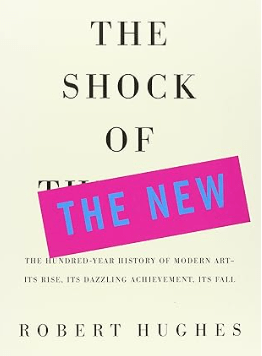
Back in the 1980s, I took a Humanities class during my freshman year of college. The professor was really good, and she supplemented her lectures by showing up a few episodes of Robert Hughes‘s BBC series Shock of the New, which covered the history of Modern Art as seen through Hughes’s own discerning, sardonic lens.
I remember being struck by how witty and intelligent Hughes seemed as he talked about numerous examples of iconic modern art and architecture. He did exactly what a good critic is supposed to do: open your eyes to meaning and resonance in art that you might have missed, and connections you never would have thought of.
I liked the series so much that I’ve watched it a couple of times since on YouTube, and I recently bought the book that Hughes wrote to accompany it. Hughes really was one the smartest and most interesting art critics of his generation, and he could really write. Take this passage, for instance, about Pablo Picasso’s most famous and disturbing work, Guernica,
Seen detached from its social context, if such a way of seeing were either possible or desirable (in Picasso’s view it would not have been, but there are still formalists who disagree), it is a general meditation on suffering, and its symbols are archaic, not historical: the gored and speared horse (the Spanish Republic), the bull (Franco) louring over the bereaved, shrieking woman, the paraphernalia of pre-modernist images like the broken sword, the surviving flower, and the dove. Apart from the late Cubist style, the only specifically modern elements in Guernica are the Mithraic eye of the electric light, and the suggestion that the horse’s body is made of parallel lines of newsprint, like the newspaper in Picasso’s collages a quarter-century earlier. [emphasis mine]
As I read this passage, I thought to myself: wow. Then I thought to myself: Mithraic? WTF is that? So, naturally, I googled it and discovered that Mithraism was a religious cult in 4th Century C.E. Rome that directly opposed Christianity and was popular with Roman soldiers. I don’t know exactly what sense Hughes was employing the word, but I think he was getting at the idolatrous aspect of Fascism—literally, an ideology opposed to Christ and Christian values—as manifested in the mid-Twentieth Century love of technology and machines. Reading Hughes’s moving and trenchant prose, I was reminded of how Picasso, eighty-seven years before Christopher Nolan’s Oppenheimer, Picasso painted the most powerful and grotesque indictment of war, and especially high-tech war, ever conceived. (Sadly, it is as relevant now as it was in 1937.)
If you have a chance, you should watch Shock of the New, or any of Hughes’s other series if you can find them. If nothing else, you’ll probably be smitten by his fascinating and highly idiosyncratic rhetorical style, with his strange (theoretically Australian) accent and tendency to punch words harder than Mike Tyson. My wife and I still joke lovingly about the way he pronounced various famous artists: i.e., Pehblo Pehkesso.
When “Sweet Dreams (Are Made of This)” came out in 1983, I was a junior in high school. Being a bit of a music snob, not to mention a budding wannabe intellectual, I was pretty well versed in the New Wave music of the era, bands like the Talking Heads and Gary Numan and Devo, not to mention the more avant guard stylings of The Police. (Synchronicity came out that year, and if it’s not a New Wave song, I don’t know what is.)
But, like everyone else, I was totally unprepared for “Sweet Dreams”. It wasn’t just the disconcerting, off-kilter, literally ass-backwards beat of the song. It was Annie Lennox’s soaring, operatic delivery of those out-there, nakedly perverse lyrics (“some of them want to abuse you; some of them want to be abused”). Most of all, it was the music video, which came spilling out of TVs everywhere and didn’t stop for about six months.
Looking back on it now in our absurdly trans-phobic era, it’s hard to imagine how utterly trans the video was. Transexual. Transgressive. Trans-everything. The sight of the beautiful Annie Lennox decked out in a (tailored) man’s suit, with her orange hair and vaguely Hitlerian mannerism, was like an A-Bomb going off in the brain of middle America. It might have all been too much, except for one thing: It’s a hell of a good song.
Okay, it’s a been a few days since the solar eclipse, but I’m still gonna go for the low-hanging fruit; this week’s Friday Night Rock-Out is Soundgarden’s “Black Hole Sun.”
When this song came out in 1994, it was the first time I really became aware of Soundgarden as a band (and, more directly, Chris Cornell’s awesomely powerful voice). It didn’t hurt that the song came with a trippy, nightmarish music video that, like the song itself, seemed to capture the country’s mid-90s dread that everything was quite literally flying apart. (Not like now at all.)




 Ash Clifton, Writer