I’m no expert on the subject, but when I think of The History of Science Fiction, I imagine it in three big chunks. First came the “Golden Age” of the 1920s and 1930s, when pulp magazines like Astounding and Amazing Stories became enormously popular. Second was the era during and after World War II, when the so-called “Big Three” superstar authors—Issac Asimov, Robert Heinlein, and Authur C. Clarke—emerged. Then came science fiction’s “New Wave,” when literary writers like Philip K. Dick, Ursula K. Le Guin, Harlan Ellison, Samuel R. Delany, and J. G. Ballard transformed the genre.
Over my reading lifetime, I have mostly explored this third era—the New Wave—mainly because, frankly, it’s the only one where you can find some genuinely great novels. But in middle school and high school, I read some of the post-WWII writers, too, especially Clarke. I read Childhood’s End, 2001: A Space Odyssey, Earthlight, and Rendezvous with Rama. I loved all of them, particularly Childhood’s End, which is probably his best book.
Clarke was, by far, my favorite of the Big Three, even though he was far from a great writer. (Heinlein was probably the best, from a stylistic sense, but I disliked his books for other reasons.) Almost invariably, Clarke’s characters fall into a two-dimensional, generic type—the stalwart (male) hero, the honorable scientist, the devoted wife, the curious child, etc. etc.—but he was such a good story teller that no one cared. Essentially, his books are like extended Astounding magazine short stories, beginning with a fascinating, nerdy premise and weaving a cerebral-yet-exciting adventure tale around it.
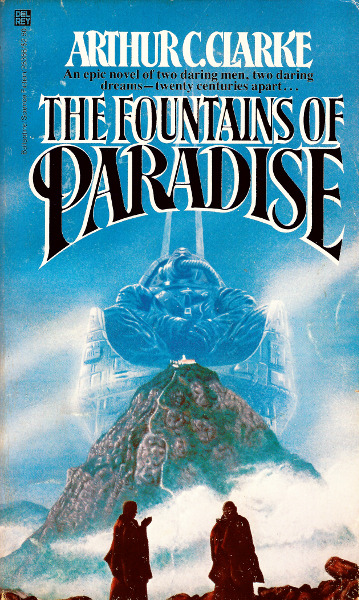
I read one of his later novels, The Fountains of Paradise, when I was in college and enjoyed it immensely. Set in the near-future, it focuses on a stalwart scientist-hero—a civil engineer, in this case, named Vannevar Morgan—who is determined to build the world’s first space elevator, a literal railway to the stars. He needs to build it somewhere on the earth’s equator and chooses a mountain on the fictional island of Taprobane (a thinly veiled Sri Lanka, which was Clarke’s home for the latter half of his life). Naturally, he immediately faces challenges, beginning with the intractable head-monk of a Buddhist monastery that happens to be smack in the middle of the site Morgan has chosen. The rest of the story follows Morgan’s struggle to build the elevator. Technical problems abound, and several mini-crisis intrude on the elevator’s progress.
One element that The Fountains of Paradise stand-out from the rest of his novels is a clever narrative trick he pulls off. The 21st Century story Morgan is interwoven with a 5th Century tale of a local monarch, King Kalidasa, who tried to build a heaven-like palace on the exact same mountain top. The parallels between the two men are obvious but interesting—each is driven, almost to the point of madness, to see his dream come to reality. But while Kalidasa is a ruthless dictator who amputates the hands off his craftsmen after they finish their task (so they can never reproduce the work for another king), Morgan is a deeply moral, modern, scientific visionary whose goal is the betterment of humanity. He also cares about his workers. In the books final act, an accident occurs that requires Morgan to risk his own life to get oxygen to the workers who are stranded high-up on the elevator’s monofilament cable. It’s a great sequence. (I won’t spoil the ending, of course.)
I really like this cover (by veteran illustrator Terry Oakes) from the 1979 Del Rey edition. I like the juxtaposition of the monks in the foreground with the ghost of King Kalidasa hovering over the mountain (albeit in a high-tech reincarnation, wearing a pressure suit) and the space-elevator cable shooting up into the sky. It’s a crazy cover, in some ways, but it captures the clever dichotomy of the book.
Last year, I wrote a post about a fine non-fiction book called Paperbacks from Hell: The Twisted History of ‘70s and ‘80s Horror Fiction. I enjoyed the book primarily for the way the author, Grady Hendrix, mixes his obvious love of old, pulpy horror novels with an enormous amount of mockery and snark. Basically, he makes fun of the trends that ran through horror fiction back in the day, as well their emphasis on over-the-top gore and hilariously silly plots.
As I read the book, though, I noticed Hendrix mention one writer whom he does not mock: Michael McDowell. Rather, Hendrix uncharacteristically bestows a bit of praise on this particular novelist, which made me curious as to why I had never heard of the dude.
As it turns out, most people haven’t heard of McDowell, even though he was a very respected paperback fiction writer (Stephen King called him one of the best) as well as a successful screenwriter (he wrote the screenplays for Beetlejuice and The Nightmare before Christmas, as well as a lot of TV shows). I, especially, should have heard of McDowell considering he was, like me, a Southern writer—from the Gulf Coast of Alabama, not far from where I spent my summers in Pass Christian, Mississippi. He was also a writer who tried to blend a literary sensibility with an appreciation of genre narrative, which is an achievement which I admire.
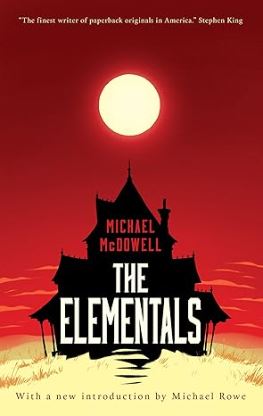
McDowell died in 1999, a latter casualty of the AIDS epidemic in America, just a few years before reliable HIV treatments came into common use. In the years since, his reputation seems to have grown, steadily if slowly, to the point where he is now considered a forgotten master. I was surprised to find an e-book edition of his most famous novel, The Elementals, on my local library’s Overdrive site, and I immediately checked it out and tore into it.
It’s definitely worth the read. Set in Alabama, it tells the story of a two wealthy, intermarried families: the Savages, with matriarch Marian and her adult son, Dauphin; and the McCrays, with matriarch Big Barbara and her adult children, Luker (who has a thirteen-year-old daughter, India) and Leigh (who is married to Dauphin Savage). At the start of the book, Marian has just died and the rest of the blended family is attending her funeral:
In the middle of a desolate Wednesday afternoon in the last sweltering days of May, a handful of mourners were gathered in the church dedicated to St. Jude Thaddeus in Mobile, Alabama. The air conditioning in the small sanctuary sometimes covered the noise of traffic at the intersection outside, but occasionally it did not, and the strident honking of an automobile horn would sound above the organ music like a mutilated stop. The space was dim, damply cool, and stank of refrigerated flowers. Two dozen enormous and very expensive arrangements had been set in converging lines behind the altar. A massive blanket of silver roses lay draped across the light-blue casket, and there were petals scattered over the white satin interior. In the coffin was the body of a woman no more than fifty-five. Her features were squarish and set; the lines that ran from the corners of her mouth to her jaw were deep-plowed. Marian Savage had not been overtaken happily.
Even for a funeral, it’s a very dreary and ominous affair. Yet it gets worse when, at one pre-arranged moment, Dauphin rises and stabs a ritual knife into his dead mother’s chest. Yeah, it’s that kind of book. The fact that McDowell can pull it off and still maintain a high-level of physical and emotional realism—not to mention vivid, sharp writing, as in the passage above—is a testament to his mastery.
The book gets even weirder after the funeral, when the family retreats to their ancestral vacation spot, a tiny barrier island called Beldame, taking with them their Black maid, the long-suffering (and very smart) Odessa. We soon learn that there are three houses on Beldame, yet the family occupies only two of them, leaving the third abandoned. (You can probably guess the reason why, but it has something to do with the house’s intermittent habit of…well…eating people.)
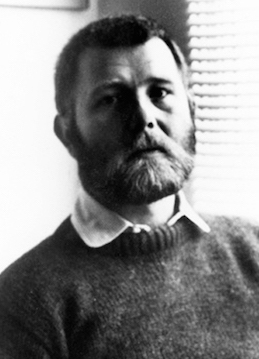
Michael McDowell
As the sand-dunes slowly encroach and bury it, the empty house attracts the curiosity of the young and intrepid India McCray, who ventures inside and sees something impossible yet real. And terrifying.
Of course, The Elementals isn’t just a generic ghost story, nor a generic Southern Gothic novel. The characters are vividly drawn, sympathetic, and believable. Their conversation is fraught with age-old tensions and resentments, yet it’s often very funny in a Curb Your Enthusiasm kind of way. And the characters of India and Odessa are especially well-realized. Linked by their intelligence and, as McDowell implies, some kind of psychic power reminiscent of The Shining, each comes off as a kind of hero in their battle against the evil hiding (rather obviously) in House #3.
The Elementals is a literary horror novel, meaning that it bridges the gap between genre story-telling and development of realistic characters. The book really comes to life (forgive the pun) in the chapters about India as well as of the adult male characters, Luker and Dauphin, both of whom struggle—in true Southern fashion—with the dark legacy of the past and especially surround their own family. Self-indulgent, smothering matriarchs like the recently deceased Marian are, in particular, a source of psychological revulsion. Indeed, they are central to the main theme of the novel, which I will not spoil here.
There is also a good amount of subtle criticism about the racial divide that existed at the time (and now) in the deep south. Odessa, the Black maid, is the only character who does any real work in the book, busy doing the cooking and cleaning for the affluent Whites, just as she has done (we are told) for thirty years. And, of course, Odessa is not only smarter than most of the family members (except, perhaps, for India) she is the only one who knows what the hell is going on in House #3, using her power of second-sight as well as (it is implied) a familial knowledge of voodoo.
Yes, as many reviewers on Reddit have observed, Odessa is an instance of the Magical Negro Trope, of the sort that genre writers, both Southern and not, have abused for a century. This trope is, of course, a literary stereotype, and like any stereotype it can be harmful if taken too far and left unexamined. But if Odessa is a Magical Negro, she is a very world-weary and snarky example, with both courage and brains. I simply loved her character. Sue me.
In fact, I loved the whole book, which feels a bit like a mash-up of Tennessee Williams and Stephen King. Check it out. It deserves some attention. Better late than never.
The great sci-fi writer Clifford D. Simak was known for writing novels and short stories with off-beat main characters. Often, his protagonists were cynical, working-class stiffs (often with a drinking problem) who stuck to their own, private, moral code, often at great cost to themselves. One of Simak’s editors once groused that all of his stories were about “losers.”
“I like losers,” Simak replied.
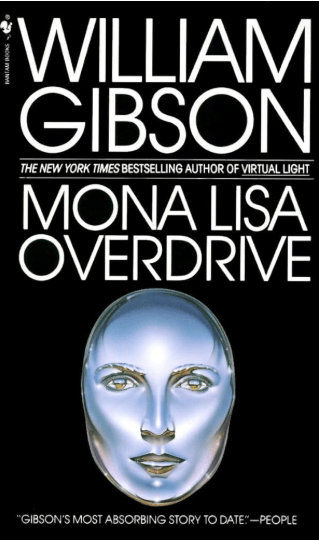
I just read this quote the other day, and I immediately thought of William Gibson’s books—specifically, Mona Lisa Overdrive. I first read MLO back in the early 1990s, just a few years after its publication, and I thought it was great. I never really thought of reading it again, but for some reason—perhaps because I’ve been a bit down, of late—I recently checked-out the book and re-read it. And I’m really glad I did. One of the foundational works of the cyberpunk sub-genre (along with Gibson’s Burning Chrome, Neuromancer, Count Zero, and other books), it still holds up, both as a work of speculative fiction as well as just a damned good, vividly imagined, human story.
A lot of people heap praise on Gibson’s novel—and on the Cyberpunk genre in general—because of their ideas, the thematic questions they ask about how humanity can relate in an age of overwhelming, dehumanizing technology. And what are the brutalizing effects of the ever-increasing disparity between the high-tech haves and the lower-tech have nots? Et cetera et cetera.
Myself, I like Gibson’s characters. Often, they are losers, of the sort Simak wrote about. Little people eking-out an existence on the fringes of society. MLO is no exception. The last of Gibson’s Sprawl trilogy, after Neuromancer and Count Zero, it’s set on a near-ish future Earth where mega-corporations, trillionaires, and criminal cartels have replaced all governments, and most of humanity muddles along in a rat-race of late-stage capitalism. The plot is a complicated skein of four interlocking narratives, each centered on a different character: Mona, a teenaged prostitute; Kumiko, the tween-aged daughter of a Yakuza boss; Angie, a beautiful young star of virtual reality films (“simstims”); and Slick Henry, an artist who sculpts robots and suffers from government-inflicted memory loss. I find it interesting that, of these four characters, two are children (Mona is sixteen), one is addicted to drugs, and one is brain-damaged. Additionally, two of them (Mona and Slick Henry) are poor, while the other two “rich” characters (Angie and Kumiko) are virtual prisoners of their wealth and position, separated from any real friendships or human connection.
Most notably, none of them have real families. Mona is an orphan; Kumiko’s mother died under mysterious circumstances, and her father is an aloof cypher.
In short, all of Gibson’s view-point characters are underdogs, one way or another. The closest he has ever come to a real, kick-ass hero is in one of his best supporting characters, Molly Millions, the cybernetically enhanced mercenary who figures so prominently throughout the Sprawl trilogy (not to mention Gibson’s landmark short-story “Johnny Mneumonic”, which first appeared in Omni Magazine in 1981; yeah, I read it fresh off the newsstand). And even Molly is more of an anti-hero, selling her services to the highest bidder, yet always displaying a basic, inner decency and compassion.
It is Molly, in fact, who becomes the physical catalyst that eventually brings the four narrative threads of the plot together in the MLO’s final chapters. I don’t want to spoil it completely, but the story involves a plot to kidnap Angie (the simstim star, whom Mona strongly resembles; hint, hint) and prevent her from reuniting with her boyfriend, Bobby Newmark, whose body lies comatose in Slick Henry’s art studio while his mind is busy in cyberspace. Kumiko, too, finds herself caught up in this plot, if only tangentially.
Having just re-read the book for the first time in thirty-odd years, I find myself liking it even more now than I did back then. I am awestruck by how deft Gibson’s prose is (he is surely one of America’s most underrated writers), as well as how quickly the story sucks the reader in. Almost every pop-novel out there these days is written from multiple, shifting points-of-view, but very, very few manage to draw their individual characters so vividly, or keep the reader as invested in the plight of each.
And, yeah, Gibson’s ideas are really, really cool. My favorite revelation in the book is when Slick Henry’s friend, Gentry, figures out that the L.F., the device attached to Bobby’s skull, is really an aleph, referencing the 1945 short story by Jorge Luis Borges. (If you read enough cyberpunk novels—or urban fantasy novels, for that matter—you’re going to run into Borges eventually.)
To sum up, Mona Lisa Overdrive is one of my favorite novels, sci-fi or otherwise. Check it out…
I know, I know. This cover is a bit out-there. Not every sci-fi book cover, after all, has a spaceship hovering in a night sky over a plus-size female model in a metal bikini, go-go boots, and mail headdress. (But I kind of wish they did.)
Even so, this cover for Babel-17 by Samuel R. Delany is a bonafide classic by the great Spanish illustrator Vicente Segrelles, who has created a ton of great covers throughout his long and brilliant career. It was done for a series of Delany’s novels that were re-released by Bantam in the 1980s, all of which had great, subtle, off-beat covers.
Now, I’ve read a lot of snark about this cover on various chat-boards. Younger guys, especially, find it hilariously bad (and perhaps a lot of girls, too). I think this is because the woman depicted is not the usual, skinny, spandex-clad sci-fi babe. Personally, that’s one reason I like her. I think she’s mysterious, regal, and (yes) sexy.
More importantly, she captures the essence of the novel’s main character, Rydra Wong, who is not only the captain of a spaceship but also a master linguist. When government operatives seek her help in cracking an enemy, alien code called Babel-17, she discovers that it is not just a code—it’s an entire language. She promptly sets-off on a space-adventure to decipher the language, a quest that leads her into a war zone on the edge of the galaxy.
One of the things I love about Babel-17 is the way Delany, even way back in 1966, managed to push a message of tolerance and multi-culturalism. Wong’s spaceship is crewed by a rag-tag group of mercenaries, some of whom are not only transsexual but transhuman, opting for synthetically altered bodies that make them resemble wild animals or fairy tale creatures, and so on. Moreover, Wong’s desire to find the source of Babel-17—and, thus, better understand the aliens who are attacking humanity—suggests a deeper response to the usual fear and xenophobia that was so endemic in America at the time (and is again now, alas).
Babel-17 a classic sci-novel with a classic cover. Check it out…
If you’re a liberal-arts nerd like me who thinks about culture all the time, you have probably pondered this question: why do people remake movies, but not books?
Yeah, I know. On the surface, this seems like a silly and even naive question. Movies, after all, are a popular medium. They belong primarily in the category of the performing arts, like theater and ballet and classical music. And, as we all understand, no one over ever gives the “final” performance of Hamlet or Don Giovanni or The Jupiter Symphony. Yes, there are certainly “classic” performances of all these works—some of them, made in the past century, have been recorded for the ages—but none is ever the last performance. Each generation must have its own Hamlet, Don Giovanni, etc.
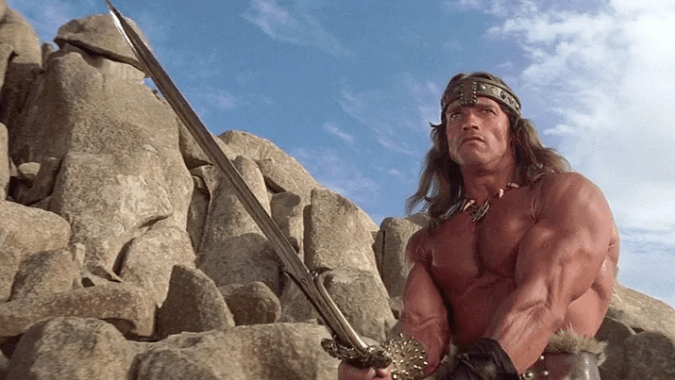
As I was working on a recent post about the great sci-fi and fantasy movies of 1982, I re-read the Wikipedia page on one of those films, Conan the Barbarian. It’s a great movie, despite the fact that it’s really just a raunchy, gory, over-the-top B-movie with an A-movie budget. I loved it when it came out, as did millions of others. It was, in fact, a culturally significant film, in its own way, and the Wiki page reflects this. A lot of passionate, obviously smart people have contributed to the page over the years. (Wikipedia is, imho, the single greatest triumph of the internet, but that’s a subject for another post.)
Of course, the page inevitably includes a rather insightful section called Themes, in which people have enumerated the topics that the film explores—or at least seems concerned with. These include “The Riddle of Steel,” “Death,” “Wagnerian Opera,” “Individualism,” and “Sex.”
I’m sorry, but “Sex” is not a theme of this movie, nor any other. Neither, for that matter, is “Death.” It’s a topic, surely, perhaps even a motif. (Note that I’m using the word “motif” in its strictest, compositional sense, as it is referenced in musicology.) But it’s not a theme.
Yeah, I know. I’m being a bit of an English-major-snob on this one. A word-Nazi. But bear with me, please. If you’re a person who really tries to appreciate literature, either on the page or on film, then the distinction between theme and motif is important. It’s even more important if you’re a fiction writer who struggles to create books that have some meaning and not mere entertainment that is purely disposable. Not that there is anything wrong with fiction that is mere entertainment—entertainment is great—but let’s not kid ourselves that it’s the pinnacle that people should aim for.
The film’s Wiki page comes much closer to the idea of a real theme when it discusses “The Riddle of Steel” (although it completely mischaracterizes and misinterprets the real matter at hand). As anyone who has seen the movie knows, The Riddle of Steel is a connundrum—not so much a riddle as a philosophical question—that Conan believes god will ask him when he dies. The question goes something like this: “Which is stronger? The sword, or the hand that wields it?” Or, put another way, “Technology? Or willpower?” “Brute force, or the power of conviction?”
It’s actually a pretty deep question, especially when one considers that film’s original script writer, Oliver Stone (who later went on to direct a few films, himself) is a veteran of the Vietnam War, which surely represented one of the greatest struggles of all time between technology, on the American side, versus sheer determination and courage on the North Vietnamese side. (Please don’t write to me and tell me that determination and courage were displayed on both sides of that tragic war. I realize this, and I am over-simplifying the conflict for the sake of argument.)
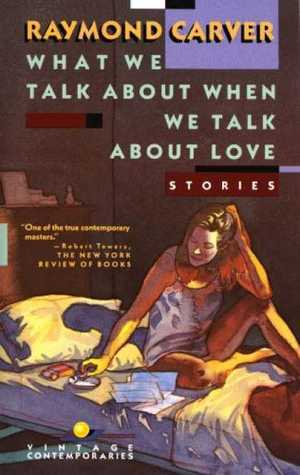
This posing of a philosophical and moral question, which the hero of the film (and, thus, the viewer) struggles to answer is, to my mind, the real definition of a theme. Perhaps the supreme example of this questioning is Raymond Carver’s classic short story, “What We Talk About When We Talk About Love,” in which three couples—all in late middle-age, all alchohic, and all jaded—discuss the definition of “love” over drinks. It’s a great story, not just because it captures the individual voice and attitude of each character, but also because all of the characters seem to be genuinely struggling with something—a matter of real import that, each one senses, will reveal something about their own lives. As one might expect, each character has their own story to tell about the subject, beginning with this one from a woman named Terri.
Terri said the man she lived with before she lived with Mel loved her so much he tried to kill her. Then Terry said, “He beat me up one night. He dragged me around the living room by my ankles. He kept saying, “I love you, I love you, you bitch.” He went on dragging me around the living room. My head kept knocking on things.” Terri looked around the table. “What do you do with love like that.”
She was a bone-thin woman with a pretty face, dark eyes, and brown hair that hung down her back. She like necklaces made of turquoise, and long pendant earrings.
“My god, don’t be silly. That’s not love and you know it,” Mel said. “I don’t know what you’d call it, but I sure know you wouldn’t call it love.”
The story continues around the table, with each character telling their own story about the general subject of “love.”
In Carver’s supremely able hands, each of these stories is shocking, yet rings true. Completely, brutally true. Some of them are also funny as hell, in a gallows-humor sort of way. One of the greatest things about the story, though, is the way it never gives us a definitive answer to the question it asks. To the contrary, the story raises even more questions—deeper meta-questions that the characters, themselves, are unaware of but which we, as readers, are. Is there a single definition for love? Is that question even meaningful? Does love even exist, really, in the cosmic sense? Does it matter?
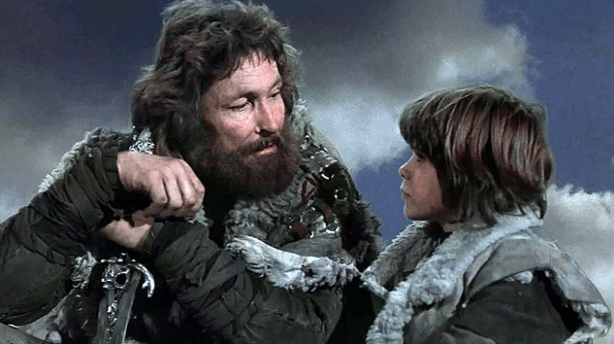
In the same way, Conan the Barbarian presents its hero with several possible answers to its central thematic question. The first is given by Conan’s father (played by the great character actor William Smith) in the opening scene, where he tells the young Conan that the one thing he can ever depend on. “Not men. Not women. Not beasts. This,” he says, gesturing to a sword he has just forged. Of course, he is not talking about that particular sword, or even swords in general. He is, we sense, talking about all the intangible things for which the sword is a symbol—discipline, training, courage. The martial ideal.
Later in the film, the villainous Thulsa Doom presents Conan with another answer. In that famous (and surprisingly shocking, even now) scene when he beckons one of his followers to literally jump off a cliff, he suggests that control over the human mind—through dogma, religion, and all the other tools of tyrants—is far more powerful than strength of arms, either literal or metaphorical.
So, which of these answers does Conan accept. Neither! In fact, his tale seems to suggest a third answer, one which is never articulated—never explicitly told—to either Conan or the viewer, but is rather born out by the action of the narrative. The answer, simply, is love. It’s Conan’s love for his murdered parents that sustains him through the ordeal of slavery and drives his desire for revenge. He also loves his friend, Subotai, and he comes to love Valeria even though she is, initially, a rival. Later, it’s Valeria’s love of Conan (along with some help from Subotai) that saves his life after they rescue him from the Tree of Woe. And it’s Conan’s grief over the death of Valeria that causes him to go on his final (foolhardy) confrontation with Thulsa Doom, where he uses his father’s broken sword (note the symbolism, there; steel really isn’t that strong, after all) to behead the man.
I think it is important to note that even in a “silly” genre movie like Conan the Barbarian, good writing can add a level of thematic resonance to any work of fiction. That is, it can turn a potentially crappy movie into a good movie, and a good movie into a great movie. It’s this complexity that separates the vast majority of films (and books, for that matter) from the few we remember years later—that tiny minority that we deem “classics” after the fact.
Another thing to consider is how Conan the Barbarian, like Carver’s short story, doesn’t fully answer its own thematic question. At least, not completely. The ending is ambiguous. Yes, Conan kills the bad guy, and (we are told) ends up a king himself, but he “sits on his throne with a troubled brow.” In others, the verdict is still out on what the real answer to The Riddle of Steel is, after all.This kind of ambiguity is, of course, a hallmark of all good fiction. We, as viewers and readers, don’t get a definitive answer—mainly because the kinds of questions that good fiction asks are, ultimately, unanswerable in any objective sense. They are always about choices. Priorities. Does honor matter more, or friendship? Revenge, or love?
The great film critic Roger Ebert once noted that the people we think of as heroes are those we looked up to when we were kids. As adults, we might admire a particularly talented athlete or actor or musician, but they won’t really be “heroes” to us; they’ll just be really cool (but life-sized) people.
I think that my middle-aged affection for Harlan Ellison might be a slight exception to this adage, however. I was a fan of his when I was growing up (he became famous in the 1970s with his revolutionary, sci-fi short-stories like “I Have No Mouth, and I Must Scream”), but he wasn’t exactly a “hero” of mine. Then, in the 1990s, Ellison began to appear on TV as a talk-show celebrity, especially on the sci-fi channel, where he essentially co-hosted a show called Sci-Fi Buzz, where he was often very funny and always insightful. Also, to my amazement, one of his stories, “The Man Who Rowed Christopher Columbus Ashore,” was included in 1993’s Best American Short Stories collection. I saw an Ellison interview around that time, in which related that the series’ editor called him to give him the good news. At the end of their brief conversation, she asked him if had written any other short stories—an unintentional slight that Ellison said felt like “a dagger to the heart.”
But this was typical of Ellison’s relationship to the literary world, and to Hollywood. He couldn’t get no respect. Part of this life-long diss was, surely, his own fault. He was famously abrasive and out-spoken, and hated to have his work messed with. When he wrote the screenplay for the what is generally considered the best episode of the original Star Trek series, “City on the Edge of Forever,” he hated Gene Roddenbury’s changes so much that he tried to have his name taken off the credits. (Fortunately, he failed.) In fact, he was so contentious about such matters that he had a special pseudonym, Cordwainer Smith, that he would use when he felt his work had been to mangled by studio executives that he no longer wanted his real name associated with it.
Paradoxically, the more interviews I watched of Ellison in the 1990s and beyond, the more I liked him. He had a razor wit, and he did not suffer fools easily. He could also be mean as hell when he felt attacked. But these were all characteristics I had seen before in some exceptional people I have met over the years, including my great teacher, the writer Harry Crews. I never met Ellison, but I suspect that we would have gotten along just fine.
Indeed, I came to admire even Elllison’s famously pugilistic nature. He was quick to sue anyone who he felt had stolen his ideas. Most famously, he sued Orion Pictures over 1984’s The Terminator, alleging that director/writer James Cameron had cribbed the concept from a script Ellison wrote for The Outer Limits. Orion settled the suit out of court. (Cameron later called Ellison a “blood-sucking ghoul,” which I still find hilarious.)
Clearly, Ellison knew how to defend himself and his ideas, and to get what he felt was owed to him. Much of this toughness, I imagine, came from Ellison’s early life, growing up as an diminutive Jewish kid in Ohio. Like a lot of smart, little guys, Ellison learned how to punch back, and punch hard.
After I wrote a blog post about Ellison and Isaac Asimov last year, I found myself thinking about Ellison more and more. So much so, in fact, that a couple of weeks ago I decided to write something about him, although what form that would take.
Then, in one of those moments of synchronicity that happen to writers when they immerse themselves in a subject, I stumbled upon a fact regarding Ellison that I had never read before, and it came from a totally unrelated source.
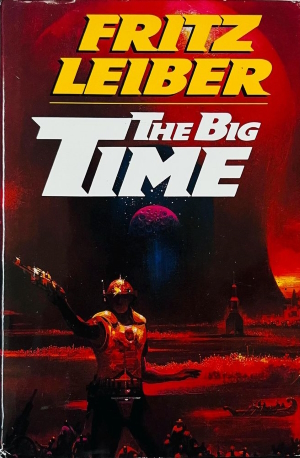
I was looking at some classic sci-fi book covers when I spotted one for Fritz Leiber’s The Big Time. I hadn’t thought of Leiber in decades (he was a favorite of a friend of mine in middle school), so out of pure curiosity I checked out his Wikipedia page. There, I was saddened to learn that Leiber spent the last few years of his life in poverty. As with so many writers, alcohol had taken its toll, and Leiber ended up living in a cheap motel. Apparently, Ellison came to visit him one day and was appalled by the state of his affairs, with Leiber not even able to afford a writing table. Rather, he was composing his latest work on a “manual typewriter propped up over the sink.”
Fritz Leiber’s Sci-Fi Classic, “The Big Time”
Okay, maybe this wasn’t a good example of full-blown, Jungian synchronicity. I guess it wasn’t that unlikely that I should stumble upon a Ellison anecdote while reading about Leiber. They were both great science fiction writers, after all, and it make sense that they might have known each other. In fact, as I learned, Ellison included some of Leiber’s short stories in the Dangerous Vision anthologies that he (Ellison) edited for decades. Still, I didn’t know of any connection between the men. They were of different generations and circumstances, linked only by their genre and talent.
Unfortunately, the Wikipedia article does not cite the source of this (if anyone knows, please tell me), nor does it say what action, if any, Ellison took to improve Leiber’s circumstances. But I like to think that he did something to help. After all, he was a pugnacious, smart-ass little guy who looked after himself and other little guys. I miss him.
Harry Harrison’s Deathworld trilogy kept me sane during one long-ago summer when I was bored and lonely. As I recall, my father gave it to me, having bought it in an airport bookshop after a long trip. (Yes, he was a good dad.)
Harrison is most famous for his Stainless Steel Rat series, but I liked these books better. As in all of Harrison’s work, the Deathworld stories center around a trickster anti-hero—in this case, Jason dinAlt, a smart, conniving rogue who is also telepathic. (He uses his E.S.P. to cheat at cards and thus travels from casino-to-casino, and planet-to-planet, having adventures but never a real job.)
Looking back on it, I would bet that this cover by illustrator David Egge, depicting dinAlt in futuristic battle gear, had a lot to do with further popularizing the military science fiction sub-genre, of which Robert Heinlein’s Starship Troopers is the best-known example. (Current examples are too numerous to name.) In fact, the Deathworld books are not military sci-fi. The characters dress like soldiers because they live on a very dangerous planet named Pyrrus (as in pyrrhic; get it?) where every living thing from plants to animals is lethal to humans. Indeed, the entire ecosystem of Pyrrus seems determined to kill all the human colonists, for reasons that dinAlt will try to discover using his telepathic powers as well as his finely honed survival skills.
The Deathworld books are just fun, well-plotted, fast-paced adventure stories, reminiscent of science fiction’s Golden Age—albeit with a bit more wit attached to them than the average sci-fi fair. Moreover, Harrison should be lauded for the series’ strong ecological message (well hidden, at first, but definitely in there), which was usual at the time, especially in “guy’s” books.
As I’ve stated before, one mark of a truly fine mystery novel—for me at least—is if I feel the need to go back and reread it. This isn’t just a matter of me waiting long enough to forget whodunnit (a period of time that grows shorter the older I get), it’s also an indication that something about the novel stuck with me, and made me want to revisit its imagined world.
So, it’s perhaps not surprising that I find myself rereading many of Edith Pargeter’s (writing as Ellis Peters) Brother Cadfael novels. Currently, I’m on The Rose Rent, which is about as fine an episode in the series as any. It has all the components of a truly great mystery novel—namely, a compelling and complicated sleuth; an entrancing and alien setting; original and interesting secondary characters; and a multi-layered plot.
And a voice. Of course, a great narrative voice. Take the opening paragraph of the novel:
By reason of the prolonged cold, which lingered far into April, and had scarcely mellowed when the month of May began, everything came laggard and reluctant that spring of 1142. The birds kept close about the roofs, finding warmer places to roost. The bees slept late, depleted their stores, and had to be fed, but neither was there any early burst of blossom for them to make fruitful. In the gardens there was no point in planting seed that would rot or be eaten in soil too chilly to engender life.
I love the elegance and almost romantic feel to this passage, which is characteristic of all Pargeter’s writing. You feel like you’re in competent hands, which is crucial considering that you’ve been transported to England in the Twelfth Century. (Specifically, to Shrewsbury, the town where Cadfael lives as the resident herbalist of the local Benedictine monastery.) I love the sense of desolation in this opening. We can almost feel the lingering winter, which has gone on too long and threatens the well-being of the town, including the ordinary folk, the monks, and even the nobles. It also suggests the coming tragedy of the murder around which the story will be revolve—that of a young, love-stricken monk who is killed trying to protect the woman with whom he has become infatuated.
Yes, it’s a desolate opening. But with Pargeter, you never really feel hopeless. Sure, it’s the Dark Ages, but her stories are populated with good, strong, shrewd people who always find a way to make the best of things. Take this paragraph, which comes a bit later and introduces Brother Cadfael himself:
Brother Cadfael, preoccupied with his own narrower concerns, continued to survey the vegetable patch outside the wall of his herb-garden, digging an experimental toe into soil grown darker and kinder after a mild morning shower. “By rights,” he said thoughtfully, “carrots should have been in more than a month ago, and the first radishes will be fibrous and shrunken as old leather, but we might get something with more juices in it from now on. Lucky the fruit-blossom held back until the bees began to wake up, but even so it will be a thin crop this year. Everything’s four weeks behind, but the seasons have a way of catching up, somehow. Wareham, you were saying? What of Wareham?”
#
He is speaking, of course, to his best friend, Hugh Berenger, the Sheriff of Shrewsbury. Berenger is a much younger man, but like Cadfael he is world-weary, experienced, and tough. Indeed, many of the best novels in the series depict bad guys who underestimate Berenger, with his mild demeanor and slight build, as weak. He is, in fact, an intelligent man and a cunning fighter. Berenger has just brought news of the most recent battle of the on-going English civil war (the Anarchy) which serves as the backdrop for all the novels. Berenger, we know, has befriended Cadfael in part because they have both been soldiers—in Cadfael’s case, a veteran of the First Crusade, which caused him to live in the Middle East for many years, where he lived with a Muslim widow and fathered a child with her.
A great part of the appeal of these novels is this tension between two sides of Cadfael’s character. He is the very opposite of an oblate—a person who has come into the monastery as a child. Rather, Cadfael has converted later in life, after have seen many terrible and wondrous things and had many worldly experiences. As such, he brings a shrewd, wise perspective to his role as a monk, healer, and protector of the innocent—a shrewdness that is matched by the “hatchet-faced” Abbot Rudolfus, who often conspires with Cadfael to bend the rules in favor of a remorseful miscreant or helpless person.
And, of course, there is just Pargeter’s unerring talent for winning, memorable description. For instance, take this passage, in which a self-serving (and possibly villainous) young character, Vivian, is introduced.
[Vivian] was a very personable young man indeed, tall and athletic, with corn-yellow hair that curled becomingly, and dancing pebble-brown eyes in which a full light found surprising golden glints. He was invariably elegant in his gear and wear, and knew very well how pleasant a picture he made in most women’s eyes. And if he had made no headway yet with the Widow Perle, neither had anyone else, and there was still hope.
The woman on whom Vivian has set his sights is Judith Perle, a young widow who has leased her old house to the monastery for the meager “rent” of a single rose per year, plucked from the bush that grows outside the doorway. Judith is, of course, very rich woman, and must of the plot revolves around a murder who is intent of separating her from that wealth—even if this means killing her in the process.
The Rose Rent is a great mystery novel. Check it out…
Okay, let’s get this out of the way: Something Wicked this Way Comes is not a science fiction novel. It’s dark fantasy, and, in my opinion, a precursor to many famous books in that genre from the likes of Stephen King, Anne Rice, Erin Morgenstern, and others.
However, Ray Bradbury’s books were always sold in the science fiction aisle when I was a kid. And I read all his books thinking they were science fiction. (I didn’t read fantasy back then.) So, I’m shoe-horning him into my classic sci-fi book covers thread.
Having said all that, let me add that this is one of my favorite novels, not to mention Bradbury’s best. It’s the tale of two 13-year-old boys, Will and Jim, who have grown up next door to each other in 1930s Illinois. Will and Jim are almost exactly the same age, with Will being born one minute before midnight on October 30th and Jim being born one minute after midnight on October 31st. Yes, one boy is born a minute before Halloween begins and the other born a minute after. (Guess which one is the “bad” kid?)
It might seem like clunky symbolism, but in Bradbury’s prolix hands, it works. The duality between the introverted, good-natured Will and the adventurous, mischievous Jim—that is, between light and dark sides of our being—is repeated throughout the novel. Both boys are forced to confront their darker impulses when a demonic carnival arrives on the edge of town in the middle of the night. Will and Jim soon discover that the carnival is a vehicle for a bunch of malevolent, vampire-like beings who want nothing more to lure innocent people onto the midway and tempt them into evil.
The only person who believes the boys when they tell what they’ve seen is Will’s father, an older man who doubts his own strength and courage. Together, they challenge the men who run the carnival, Mr. Cougar and Mr. Dark (another light/dark duality) for the soul of the town.
I really like this cover—created by veteran illustrator David Grove—because it captures the nostalgia, magic, and dark wonder that are the great strengths of the novel. Specifically, it refers to a moment in the story when Mr. Dark wanders through the town looking for Will and Jim. He has the images of the boy tattooed on his palms, and he shows them to passersby to see if anyone recognizes them. It’s an extremely creepy scene in an amazing book. (It’s also the first moment when Will’s father shows his courage and guile in besting Mr. Dark.)
My appreciation for the cover is in no way diminished by the fact that it appears to be a poster tie-in with the film adaptation produced by Disney in 1983, depicting the likenesses of some of the actors (most notably, the great Jonathan Pryce, who performance as Mr. Dark is worth the price of admission all by itself).
Also, not long after Mr. Grove passed away, Tor.com published a tribute to him and his career. You can see it here…