Ten Things I Love About B-Movie Action Flicks

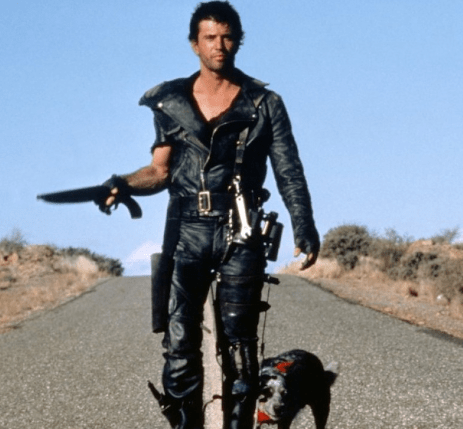
In one of those strange, synchronicity moments that sometimes happen, I recently stumbled upon an article in Collider about how the classic John Carpenter film Escape from New York is getting a new 4K release from Shout Factory.  This was a heart-warming bit of information, for me, since the film has been one of my favorites since I saw it in the theaters in 1982. It’s nice to think that new generations of film lovers might be given a chance to appreciate its many charms.

The news was also timely, for me, because I had been contemplating writing a post about the things I love most about movies like Escape from New York. That is, B-Movie Action Flicks. As anyone who reads this blog or my old one will realize, I am somewhat obsessed with B-Movie Action Flicks, especially from their golden age back in the 1970s-80s. Part of my obsession is mere nostalgia, of course. I spent many a late Saturday watching such movies on HBO with my equally nerdy, reprobate friends, and they (the films and the friends) helped me get through the agonies of growing up. But the other part of my obsession has to do with the nature of B-Movie Action Flicks. Why are they so much fun? 

Continue reading “Ten Things I Love About B-Movie Action Flicks”

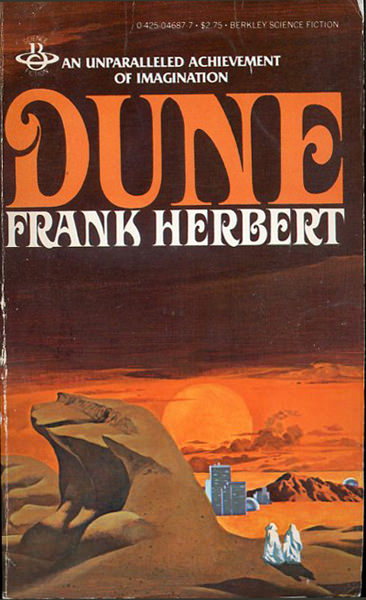
Classic Sci-Fi Book Cover: “Dune” (1977 Berkley Edition)

Frank Herbert’s Dune is arguably the most successful science fiction book ever published, kicking off a series that (thanks to his son and other writers) continues to this day. Actually more a work of epic science fantasy than hard sci-fi, it was amazingly inventive and original, and it surely would have been a huge hit regardless of how it was packaged. However, I personally believe that its success was greatly increased by the brilliant marketing work done by Berkley Books in the 1970s. Specifically, their brilliant use of a font called Davison Art Nouveau that, with its swirly, vaguely Arabian vibe, perfectly captures the spirit of the books. The font was also used on all the sequels, creating a visual unity for Berkley’s Dune brand.

Even more striking, to me, was the sublime cover art by the legendary Vincent Di Fate. This is the edition of Dune that I read in high school, which means I’ve been looking at for four decades, and I never once suspected that it was done by Di Fate. Di Fate was, after all, a sci-fi artist primarily known for his space opera-style covers. He was already famous for these back in the 1970s, so much so that I my parents gave me a book of his cover art for Christmas one year. (Yeah, I was that nerd.) But his cover for Dune seems totally atypical for him.

Nonetheless, it’s a great cover. Putting a dune on the cover of Dune might seem like a no-brainer, but Di Fate’s choice here really gives the reader a sense of the book’s setting—the mysterious, pitiless desert planet of Arrakis. And if there was ever a novel where the setting becomes a character in and of itself, it’s Arrakis. The ghostly white figures depicted are obviously Fremen, the fierce native people of the story (never mind the fact that the Fremen in the book where black still-suits and not white robes). The fact that they seem to be crossing out of the desert and into the town is significant, too, because so much of novel involves the intersection of wilderness and civilization (the desert people being more “civilized,” in some ways, than those of the town).

Shakespeare vs. The Method

hamletolivier
Brando

Not long ago, I read a very fine biography called Furious Love: Elizabeth Taylor, Richard Burton, and the Marriage of the Century by Nancy Schoenberger. I picked it up not only because I am a huge fan of Richard Burton but also because of my growing interest in Taylor, who was surely one of the most remarkable people of the 20th Century. It was Taylor who, upon hearing that her great friend Montgomery Clift had just been in a car accident a few blocks away, literally ran to the scene. She got there in time to pull one of Clift’s dislodged teeth from his throat just before he choked on it. Pretty amazing.

clift

Clift’s importance in the larger story of Taylor and Burton’s whirlwind romance is minor. He is only mentioned in one or two parts. And yet his unexpected appearance in the book fascinated me, especially when Schoenberger reveals the mutual disdain that Clift and Burton felt for each other. Jealously over Taylor’s affections surely had something to do with this, despite the fact that Clift was gay and by all accounts his relationship with Taylor was platonic. But even deeper than this personal rancor lay an artistic rivalry between the two men regarding their respective abilities as actors.  

Clift was one of the first and greatest alumni of “the method” studios taught by Stella Adler and Lee Strasberg, which emphasized acting as a physical interpretation of deep psychological impulses. The actor seems to transform into the character from the “inside out”. (Think Robert De Niro in Raging Bull or…well…any other De Niro movie.)

Continue reading “Shakespeare vs. The Method”

Perfect Films: “The Dead Zone”

DeadZone1

Author’s Note: One of my favorite films, The Dead Zone, is free to stream on Amazon Prime right now. I thought I would take the opportunity to repost my tribute to the film, which I originally published on my old blog, Bakhtin’s Cigarettes.

When I was a student at the University of Florida in the late 1980s, I took writing classes under the great novelist Harry Crews. Harry was almost as famous for being a wild man as he was for being a writer, but by the time I knew him he had quit drinking and was leading a simple, almost monastic life of writing and teaching. Like many recovering alcoholics, he had lost many of his old friends, and he was also divorced, so he was alone a lot.

Continue reading “Perfect Films: “The Dead Zone””