I know, I know. This cover is a bit out-there. Not every sci-fi book cover, after all, has a spaceship hovering in a night sky over a plus-size female model in a metal bikini, go-go boots, and mail headdress. (But I kind of wish they did.)
Even so, this cover for Babel-17 by Samuel R. Delany is a bonafide classic by the great Spanish illustrator Vicente Segrelles, who has created a ton of great covers throughout his long and brilliant career. It was done for a series of Delany’s novels that were re-released by Bantam in the 1980s, all of which had great, subtle, off-beat covers.
Now, I’ve read a lot of snark about this cover on various chat-boards. Younger guys, especially, find it hilariously bad (and perhaps a lot of girls, too). I think this is because the woman depicted is not the usual, skinny, spandex-clad sci-fi babe. Personally, that’s one reason I like her. I think she’s mysterious, regal, and (yes) sexy.
More importantly, she captures the essence of the novel’s main character, Rydra Wong, who is not only the captain of a spaceship but also a master linguist. When government operatives seek her help in cracking an enemy, alien code called Babel-17, she discovers that it is not just a code—it’s an entire language. She promptly sets-off on a space-adventure to decipher the language, a quest that leads her into a war zone on the edge of the galaxy.
One of the things I love about Babel-17 is the way Delany, even way back in 1966, managed to push a message of tolerance and multi-culturalism. Wong’s spaceship is crewed by a rag-tag group of mercenaries, some of whom are not only transsexual but transhuman, opting for synthetically altered bodies that make them resemble wild animals or fairy tale creatures, and so on. Moreover, Wong’s desire to find the source of Babel-17—and, thus, better understand the aliens who are attacking humanity—suggests a deeper response to the usual fear and xenophobia that was so endemic in America at the time (and is again now, alas).
Babel-17 a classic sci-novel with a classic cover. Check it out…
The great film critic Roger Ebert once noted that the people we think of as heroes are those we looked up to when we were kids. As adults, we might admire a particularly talented athlete or actor or musician, but they won’t really be “heroes” to us; they’ll just be really cool (but life-sized) people.
I think that my middle-aged affection for Harlan Ellison might be a slight exception to this adage, however. I was a fan of his when I was growing up (he became famous in the 1970s with his revolutionary, sci-fi short-stories like “I Have No Mouth, and I Must Scream”), but he wasn’t exactly a “hero” of mine. Then, in the 1990s, Ellison began to appear on TV as a talk-show celebrity, especially on the sci-fi channel, where he essentially co-hosted a show called Sci-Fi Buzz, where he was often very funny and always insightful. Also, to my amazement, one of his stories, “The Man Who Rowed Christopher Columbus Ashore,” was included in 1993’s Best American Short Stories collection. I saw an Ellison interview around that time, in which related that the series’ editor called him to give him the good news. At the end of their brief conversation, she asked him if had written any other short stories—an unintentional slight that Ellison said felt like “a dagger to the heart.”
But this was typical of Ellison’s relationship to the literary world, and to Hollywood. He couldn’t get no respect. Part of this life-long diss was, surely, his own fault. He was famously abrasive and out-spoken, and hated to have his work messed with. When he wrote the screenplay for the what is generally considered the best episode of the original Star Trek series, “City on the Edge of Forever,” he hated Gene Roddenbury’s changes so much that he tried to have his name taken off the credits. (Fortunately, he failed.) In fact, he was so contentious about such matters that he had a special pseudonym, Cordwainer Smith, that he would use when he felt his work had been to mangled by studio executives that he no longer wanted his real name associated with it.
Paradoxically, the more interviews I watched of Ellison in the 1990s and beyond, the more I liked him. He had a razor wit, and he did not suffer fools easily. He could also be mean as hell when he felt attacked. But these were all characteristics I had seen before in some exceptional people I have met over the years, including my great teacher, the writer Harry Crews. I never met Ellison, but I suspect that we would have gotten along just fine.
Indeed, I came to admire even Elllison’s famously pugilistic nature. He was quick to sue anyone who he felt had stolen his ideas. Most famously, he sued Orion Pictures over 1984’s The Terminator, alleging that director/writer James Cameron had cribbed the concept from a script Ellison wrote for The Outer Limits. Orion settled the suit out of court. (Cameron later called Ellison a “blood-sucking ghoul,” which I still find hilarious.)
Clearly, Ellison knew how to defend himself and his ideas, and to get what he felt was owed to him. Much of this toughness, I imagine, came from Ellison’s early life, growing up as an diminutive Jewish kid in Ohio. Like a lot of smart, little guys, Ellison learned how to punch back, and punch hard.
After I wrote a blog post about Ellison and Isaac Asimov last year, I found myself thinking about Ellison more and more. So much so, in fact, that a couple of weeks ago I decided to write something about him, although what form that would take.
Then, in one of those moments of synchronicity that happen to writers when they immerse themselves in a subject, I stumbled upon a fact regarding Ellison that I had never read before, and it came from a totally unrelated source.
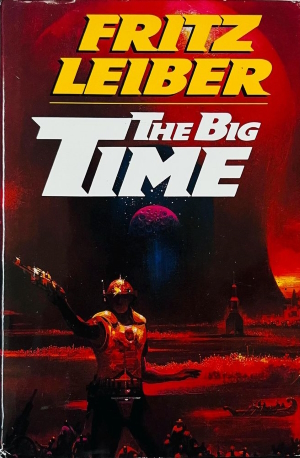
I was looking at some classic sci-fi book covers when I spotted one for Fritz Leiber’s The Big Time. I hadn’t thought of Leiber in decades (he was a favorite of a friend of mine in middle school), so out of pure curiosity I checked out his Wikipedia page. There, I was saddened to learn that Leiber spent the last few years of his life in poverty. As with so many writers, alcohol had taken its toll, and Leiber ended up living in a cheap motel. Apparently, Ellison came to visit him one day and was appalled by the state of his affairs, with Leiber not even able to afford a writing table. Rather, he was composing his latest work on a “manual typewriter propped up over the sink.”
Fritz Leiber’s Sci-Fi Classic, “The Big Time”
Okay, maybe this wasn’t a good example of full-blown, Jungian synchronicity. I guess it wasn’t that unlikely that I should stumble upon a Ellison anecdote while reading about Leiber. They were both great science fiction writers, after all, and it make sense that they might have known each other. In fact, as I learned, Ellison included some of Leiber’s short stories in the Dangerous Vision anthologies that he (Ellison) edited for decades. Still, I didn’t know of any connection between the men. They were of different generations and circumstances, linked only by their genre and talent.
Unfortunately, the Wikipedia article does not cite the source of this (if anyone knows, please tell me), nor does it say what action, if any, Ellison took to improve Leiber’s circumstances. But I like to think that he did something to help. After all, he was a pugnacious, smart-ass little guy who looked after himself and other little guys. I miss him.
Harry Harrison’s Deathworld trilogy kept me sane during one long-ago summer when I was bored and lonely. As I recall, my father gave it to me, having bought it in an airport bookshop after a long trip. (Yes, he was a good dad.)
Harrison is most famous for his Stainless Steel Rat series, but I liked these books better. As in all of Harrison’s work, the Deathworld stories center around a trickster anti-hero—in this case, Jason dinAlt, a smart, conniving rogue who is also telepathic. (He uses his E.S.P. to cheat at cards and thus travels from casino-to-casino, and planet-to-planet, having adventures but never a real job.)
Looking back on it, I would bet that this cover by illustrator David Egge, depicting dinAlt in futuristic battle gear, had a lot to do with further popularizing the military science fiction sub-genre, of which Robert Heinlein’s Starship Troopers is the best-known example. (Current examples are too numerous to name.) In fact, the Deathworld books are not military sci-fi. The characters dress like soldiers because they live on a very dangerous planet named Pyrrus (as in pyrrhic; get it?) where every living thing from plants to animals is lethal to humans. Indeed, the entire ecosystem of Pyrrus seems determined to kill all the human colonists, for reasons that dinAlt will try to discover using his telepathic powers as well as his finely honed survival skills.
The Deathworld books are just fun, well-plotted, fast-paced adventure stories, reminiscent of science fiction’s Golden Age—albeit with a bit more wit attached to them than the average sci-fi fair. Moreover, Harrison should be lauded for the series’ strong ecological message (well hidden, at first, but definitely in there), which was usual at the time, especially in “guy’s” books.
Okay, let’s get this out of the way: Something Wicked this Way Comes is not a science fiction novel. It’s dark fantasy, and, in my opinion, a precursor to many famous books in that genre from the likes of Stephen King, Anne Rice, Erin Morgenstern, and others.
However, Ray Bradbury’s books were always sold in the science fiction aisle when I was a kid. And I read all his books thinking they were science fiction. (I didn’t read fantasy back then.) So, I’m shoe-horning him into my classic sci-fi book covers thread.
Having said all that, let me add that this is one of my favorite novels, not to mention Bradbury’s best. It’s the tale of two 13-year-old boys, Will and Jim, who have grown up next door to each other in 1930s Illinois. Will and Jim are almost exactly the same age, with Will being born one minute before midnight on October 30th and Jim being born one minute after midnight on October 31st. Yes, one boy is born a minute before Halloween begins and the other born a minute after. (Guess which one is the “bad” kid?)
It might seem like clunky symbolism, but in Bradbury’s prolix hands, it works. The duality between the introverted, good-natured Will and the adventurous, mischievous Jim—that is, between light and dark sides of our being—is repeated throughout the novel. Both boys are forced to confront their darker impulses when a demonic carnival arrives on the edge of town in the middle of the night. Will and Jim soon discover that the carnival is a vehicle for a bunch of malevolent, vampire-like beings who want nothing more to lure innocent people onto the midway and tempt them into evil.
The only person who believes the boys when they tell what they’ve seen is Will’s father, an older man who doubts his own strength and courage. Together, they challenge the men who run the carnival, Mr. Cougar and Mr. Dark (another light/dark duality) for the soul of the town.
I really like this cover—created by veteran illustrator David Grove—because it captures the nostalgia, magic, and dark wonder that are the great strengths of the novel. Specifically, it refers to a moment in the story when Mr. Dark wanders through the town looking for Will and Jim. He has the images of the boy tattooed on his palms, and he shows them to passersby to see if anyone recognizes them. It’s an extremely creepy scene in an amazing book. (It’s also the first moment when Will’s father shows his courage and guile in besting Mr. Dark.)
My appreciation for the cover is in no way diminished by the fact that it appears to be a poster tie-in with the film adaptation produced by Disney in 1983, depicting the likenesses of some of the actors (most notably, the great Jonathan Pryce, who performance as Mr. Dark is worth the price of admission all by itself).
Also, not long after Mr. Grove passed away, Tor.com published a tribute to him and his career. You can see it here…
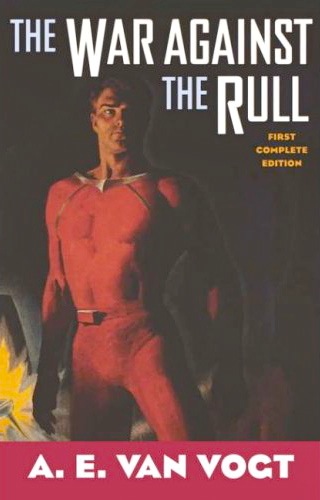
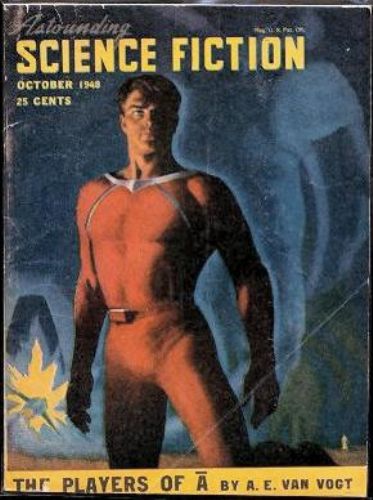
This entry in my on-going Classic Sci-Fi Book Covers series is both old and new. That is, it’s a modern touch-up of the cover from the October 1949 edition of Astounding Science Fiction painted by Hubert Rogers. That issue included a work by A.E. van Vogt, but not the one we are interested in here. This modern version is from a 1999 edition of van Vogt’s classic sci-fi novel, The War Against the Rull, which I distinctly remember devouring in two days when I was in eighth-grade.
I like this cover a lot. It’s not just a classic. It’s an archetype. Specifically, the archetype of the heroic (America) scientist, a buff intellectual and polymath whose ilk could be found in countless works of Isaac Asimov, Robert Heinlein, Roger Zelazny, and on an on. In The War Against the Rull, the man is Dr. Trevor Jamieson, a brilliant scientist who is also a fierce warrior and survival-expert. He’s stranded on an alien planet with a huge, six-legged, intelligent creature called an ezwal who wants to kill him. But when both Jamieson and the ezwal encounter a mutual enemy—a race of aggressive, centipede-like aliens called the Rull—they decide to work together to survive.
It’s a great story, like so many from the sci-fi’s Golden Age. I’ve written before about why sci-fi novels from that era are so much more enjoyable (to me, at least) than most of those written in the last ten years or so. I think it has to do with the gritty humanity of such stories. Yeah, Jamieson is essentially a comic-book character (think Doctor Quest and Race Bannon rolled into one), but van Vogt does a great job of making you believe he’s in real trouble. The ezwal, too—he’s a compelling character in his own right. You get involved in the desperate nature of their situation, and you keep reading to see how they will get out of it.
Anyway, check it out if you can…
Original Cover from AstoundingCover from the 1970 edition that I read as a kid (by artist John Schoenherr)Another version of the Scientist Hero Archetype (by artist James Bama)
My privious entry in this continuing “Classic Sci-Fi Book Covers” series was also devoted to Roger Zelazny, so please forgive me for double-dipping into the Zelazny well. But I couldn’t resist talking about one of Zelazny’s other great novels, …And Call Me Conrad—published in 1966 as This Immortal. Most people have never heard of it, but it’s an interesting book for several reasons.
For one, it was Zelazny’s first novel, and it has many of his signature obsessions (e.g, ancient mythology mixed with science fiction; a wise-cracking anti-hero who is also an Übermensch; epic fight scenes; etc.). For another, it actually won a Hugo Award, tying in 1966 with a slightly better-known book…Frank Herbert’s Dune. And finally, it’s just a hell of an entertaining adventure tale.
I chose this cover (by fantasy artist Rowena Morrill) because it really captures the sense of the book’s main character, Conrad Nomikos, a world-weary man-of-mystery who might be immortal. (The text suggests that he is at least a century old, and hints that he might be several thousand years older still.) He works as director of a government agency tasked with protecting and preserving the surviving relics of a destroyed earth. A nuclear war referred to by the characters as “The Three Days” has occurred many decades before, leaving most of the planet uninhabitable. The survivors, which include a wide variety of mutants both human and animal, live mainly on islands like Greece, Conrad’s home.
And that’s not even the main subject this wild, wild little book. Conrad is assigned the duty of escorting a group of VIP tourists—including Cort Myshtigo, an alien from the Vega star system whose race has purchased earth as a kind of vast museum—as they tour the planets once great sites (now ruins). Conrad soon realizes that another of the tourists, an Egyptian assassin named Hassan with whom Conrad has befriended in the past, is secretly on a mission to kill the Vegan. Hassan, it seems, has been hired for this task by an obscure, underground political group who want to reclaim earth for humanity. So, Conrad finds himself not only being a tour-guide but also an unpaid protector of Myshtigo—who he hates.
It’s a crazy book, and the cover conveys this craziness well. Though the edition is from 1980, the cover really feels like a 1970s cover, with its vaguely photorealistic painting of a ruggedly handsome dude with great hair (think Roger Staubach in his prime). I also like how Morrill works in the other tropes of the book—its setting among Greek ruins, as well as the presence of some mythological creatures in the background (which, the reader eventually learns, are actually just animals that have been mutated by radioactive fall-out).
It’s a very dated cover, but still a really cool one. Classic, one might say…
One of my favorite movies of the last twenty years is Ridley Scott’s The Martian. It’s a science-fiction/adventure movie about an astronaut (Matt Damon) who becomes stranded on Mars after his comrades leave him for dead. Marooned on a barren, hostile world, he has to use his brains and ingenuity to survive until his friends come back to rescue him. By the end of the movie, he has survived dust storms, explosions, freezing temperatures, and starvation.
How does he overcome all these challenges?
Science.
The story is familiar, of course. It has many antecedents, including with the original stranded-on-an-island novel, Robinson Crusoe, and also (more directly) to a great B-movie Robinson Crusoe on Mars. In that classic 1964 cheese-fest, the hero survives by finding a Martian cave full of air where plants still grow, water still flows, and there’s a steady source of light (which is never explained). He even befriends an alien who is also trapped on the planet.
The first DVD I bought was Blade Runner. The second was Forbidden Planet. This latter film is a science fiction classic from Hollywood’s second golden age, 1956 (the same year that John Ford’s landmark film The Searchers was released). Perhaps the definitive pulp sci-fi movie, it’s got everything you might expect: stalwart heroes, spaceships, lasers, aliens, a teen-aged hottie, a mad scientist, and even a talking robot.
And monsters, of course. Monsters from the Id.
Ever since I first saw Forbidden Planet on TV when I was kid, I’ve loved it. Here are ten reasons why…
1.) Altair IV
Forbidden Planet is, to my knowledge, the first Hollywood movie to depict human beings landing a spaceship on a planet of another star. This was a fairly landmark achievement in the history of science fiction cinema, made even better by the film’s two art directors, Cedric Gibbons and Arthur Lonergan. In their vision, Altair becomes a green- and blue-tinged desert, not unlike that of John Ford’s American Southwest. Considering this was done with matte paintings and other pre-CGI effects, it’s amazing how good the landscapes are, so desolate and full of foreboding. It’s a prefiguration of all the wild worlds of Star Wars, Star Trek, and so on, yet to come.
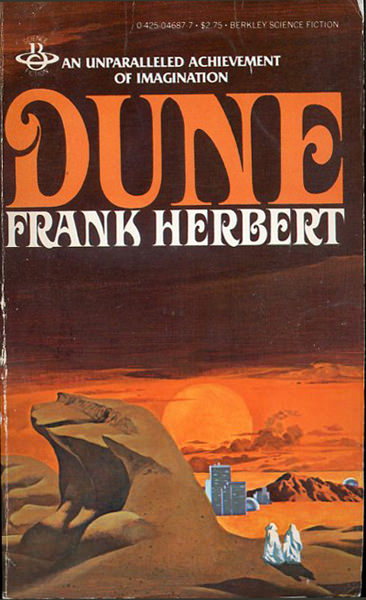
Frank Herbert’s Dune is arguably the most successful science fiction book ever published, kicking off a series that (thanks to his son and other writers) continues to this day. Actually more a work of epic science fantasy than hard sci-fi, it was amazingly inventive and original, and it surely would have been a huge hit regardless of how it was packaged. However, I personally believe that its success was greatly increased by the brilliant marketing work done by Berkley Books in the 1970s. Specifically, their brilliant use of a font called Davison Art Nouveau that, with its swirly, vaguely Arabian vibe, perfectly captures the spirit of the books. The font was also used on all the sequels, creating a visual unity for Berkley’s Dune brand.
Even more striking, to me, was the sublime cover art by the legendary Vincent Di Fate. This is the edition of Dune that I read in high school, which means I’ve been looking at for four decades, and I never once suspected that it was done by Di Fate. Di Fate was, after all, a sci-fi artist primarily known for his space opera-style covers. He was already famous for these back in the 1970s, so much so that I my parents gave me a book of his cover art for Christmas one year. (Yeah, I was that nerd.) But his cover for Dune seems totally atypical for him.
Nonetheless, it’s a great cover. Putting a dune on the cover of Dune might seem like a no-brainer, but Di Fate’s choice here really gives the reader a sense of the book’s setting—the mysterious, pitiless desert planet of Arrakis. And if there was ever a novel where the setting becomes a character in and of itself, it’s Arrakis. The ghostly white figures depicted are obviously Fremen, the fierce native people of the story (never mind the fact that the Fremen in the book where black still-suits and not white robes). The fact that they seem to be crossing out of the desert and into the town is significant, too, because so much of novel involves the intersection of wilderness and civilization (the desert people being more “civilized,” in some ways, than those of the town).
When I was an English major at the University of Florida, one of the best classes I took was a Survey of Science Fiction Literature course. It covered a lot of famous American and British SF, some of which I had already read as a teenager and some of which were new to me.
Looking back on it now, it occurs to me that two of the writers we read in the class were not only totally different from each other, they also presented two completely opposite visions of what we now call artificial intelligence. These writers were Isaac Asimov and Harlan Ellison.
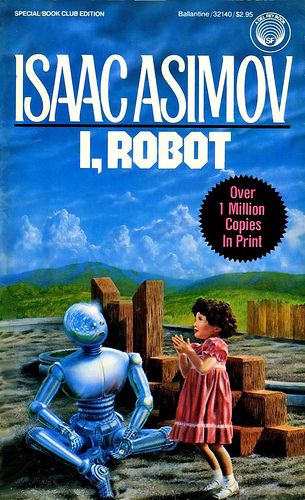
For Asimov, we read his early, seminal work, I, Robot. This is the short story collection that included his first formulation of the Three Laws of Robotics, which have been alluded to (i.e, ripped off) in countless other science fiction stories, including Star Trek. The book came out before the term AI became common parlance. Yet, in Asimov’s imagined future, the world is rife with robots that are essentially AIs with mechanical bodies. All of them have positronic brains (yeah, Star Trek ripped off this conceit, too) with the Three Laws hard-wired in. The result is that all robots function as humanity’s tireless, benevolent servants. (Some would say, slaves.)
Actually, they are much more than that. They can think, reason, and make choices. In fact, they have to make choices. The moral dilemmas created by the Three Laws as the robots interact with chaotic (and often evil) human beings is the source of drama in most of the stories.
Despite the mystery and drama of the stories, though, Asimov’s vision is a very optimistic, almost Buck-Rogers-esque idea of the future—not quite a utopia but close to it. There is no poverty, no hunger, no war. It’s only upon close reading of the stories in I, Robot that the exact nature of the master/servant relationship between humans and robots appears fraught—probably more so than Asimov consciously intended. This is especially true in a few of the stories, where it’s revealed that future governments are secretly run by the highest order of HAL 9000 style robots, whose plans might be beyond human comprehension.
Later in the Science Fiction class, we read Harlan Ellison’s short story “I Have No Mouth and I Must Scream,” which is quite possibly the darkest and most disturbing short story I have ever read, sci-fi or otherwise. And, of course, it involves an AI.
The story is mostly set underground, about one hundred years after a nuclear war wiped out all of humanity except for five people. The war was started by a mutinous Pentagon computer (yeah, just like Skynet) called AM that becomes self-aware and decides it hates human beings more than anything. After killing everyone on the planet, it preserves the five people as its playthings, running them through an endless number of elaborate, sadistic games. Unfortunately for them, AM has somehow obtained God-like technological power over physics, able to shape and project matter wherever it wishes, and also to keep the humans alive and immortal in their banged-up, miserable state. So, in effect, the protagonists spend an eternity in a kind of Holodeck-like hellscape, trying to figure out how to either escape or kill themselves.
Yeah, it’s heavy.
This enormous gulf between Asimov’s and Ellison’s visions of the future—an AI paradise versus an almost literal AI hell—is, in part, symptomatic of various generational and cultural shifts between the two men. I, Robot was published in 1950, on the tail-end of the Golden Age of Science Fiction, the time when the prosperity of America in the post-war years seemed destined to go on forever, fueled by newer and greater technological innovations (AI among them). In contrast, Ellison’s short story was published in 1967, at the height of a counter-cultural revolution that extended into science fiction literature —the New Wave that introduced some of my favorite sci-fi writers of all time, such as Samuel R. Delany, Ursula K. Le Guin, Roger Zelazny, and Ellison himself.
Thus, the difference between Asimov and Ellison’s work is essentially the difference between the lingering triumph of World War II and the horrors of VietNam. Between the optimism of the Atomic Age and the nihilism of the Cold War. In some ways, it’s also the difference between fantasy and realism, and between genre fiction and literary fiction. As dark as Ellison’s short story is, it’s also a much better work of fiction than Asimov’s. More convincing, too, alas. Told from the point-of-view of AM’s youngest victim, Ted, the story is filled with vivid, sharp writing and devastating passages, like this one:
Nimdok (which was the name the machine had forced him to use, because AM amused itself with strange sounds) was hallucinating that there were canned goods in the ice caverns. Gorrister and I were very dubious. “It’s another shuck,” I told them. “Like the goddam frozen elephant AM sold us. Benny almost went out of his mind over that one. We’ll hike all that way and it’ll be putrified or some damn thing. I say forget it. Stay here, it’ll have to come up with something pretty soon or we’ll die.”
Benny shrugged. Three days it had been since we’d last eaten. Worms. Thick, ropey.
You don’t have to be a literary critic to see that Asimov and Ellison are worlds apart, not just on the subject of Artificial Intelligence but on literally everything. Asimov was a scientist, a rationalist, and his optimistic views on the future of humanity were deeply rooted in the legacy of the Enlightenment. Ellison is more of a Gothic Romantic, full of existential angst and cosmic horror. His story is essentially an updated version of Mary Shelley’s Frankenstein, with the supercomputer in the role of the monster, determined to torment its creator.
Of course, the Frankenstein story is, itself, a reworking of an even older one—the Faustian myth. According to German legend, Faust is an intellectual who sells his soul to the devil in exchange for knowledge, and ends up going to hell. If the story seems familiar, it’s probably because the legend has been the psychological basis for countless tales of perverted science for centuries. Scientists, the story goes, want to attain the power of God, and thus end up being destroyed by their own hubris (often in the form of some infernal creation like Frankenstein’s monster or, more recently, SkyNet).
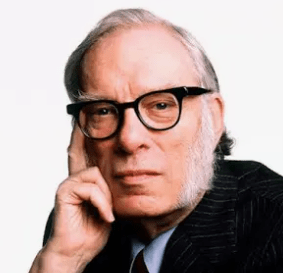
Isaac Asimov
Perhaps the biggest irony here (at least for me, personally) is that while I have great admiration for Ellison’s story, and I believe it is a much greater artistic work that anything ever penned by Asimov, Asimov’s vision is probably more accurate of what we can actually expect from the AI revolution. For all the hype about AIs destroying art and music and literature and taking away our jobs, I think AI will be a net positive for humanity. Perhaps a big net positive. It’s already making contributions in the fields of materials science, medicine, and even fusion energy. Yeah, it’s probably going to take away some people’s jobs, but those were probably crap jobs anyway. (If you train an AI to do it as well as a human, it’s probably not worth doing.)
As for the whole AM/Skynet thing, I don’t worry about it because I don’t believe computers will ever become conscious. In fact, the very idea of a machine becoming conscious seems like a category error, the kind of conceit that will seem laughable a hundred years from now as those old drawings of “men of the future” with feathered wings strapped to their arms.
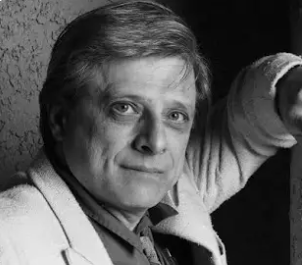
Harlan Ellison
This doesn’t mean, of course, that we won’t, someday, create an artificial life form that might replace us. But it won’t be a computer. It will be…something else.








 Ash Clifton, Writer