There is a scene in Steven Soderbergh’s 1999 noir thriller The Limey when the main character, Wilson, a career-criminal and generally scary guy, is questioning a woman in her house about a man named Valentine. Wilson (played with enormous power by Terance Stamp), is looking for the man who killed his daughter, and Valentine is his prime suspect. The woman, naively, offers to give Wilson Valentine’s phone number, at which point Wilson smiles wickedly and says, mostly to himself, “I’ve got his number.”
It’s a great, almost chilling moment. What we, the viewers, know (and the woman doesn’t) is that Wilson has already killed five men to get Valentine’s “number”, every sense of the term. And Stamp’s delivery of this line speaks volumes about Wilson’s character—his steely-eyed determination, his courage, and his constant, barely controlled rage.
It’s a great moment in a great movie, which marked one of several come-backs in Stamp’s long career. His filmography is so great and varied that one must divide not in stages but in ages. First, there was Stamp the movie star, an epically handsome, Angry-Young-Man who got the lead in several fine, gritty films in the 1960s, including William Wyler’s The Collector and Ken Loach’s Poor Cow. But he never really clicked as a leading-man, either in England or in Hollywood, and his next big break didn’t come until 1980’s Superman II, in which he reprised his role as the evil General Zod (a.k.a. the chief of the three baddies whom Superman’s dad banishes to the Phantom Zone in Superman.)
To this day, Stamp is best remembered for this one, silly role, Zod—at least, in America. But film nerds such as myself admired his work in many other small, supporting roles throughout the 80s. My favorite was his scene-stealing cameo in 1987 Wall Street, playing a redoubtable corporate raider who has reformed his ways and stands in opposition to the evil Gordon Gekko.
Then, in the 1990’s, Stamp had his next, and greatest, comeback with his role as transexual woman in The Adventures of Priscilla, Queen of the Desert, which remains one of my favorite films of all time. Stamp was nominated for a BAFTA for that one, and he should have been nominated for an Oscar, too. But no matter. The role is a classic, and it re-introduced him to American audiences.
This led to Stamp’s last leading role in a major motion picture. This was, of course, The Limey, and it is perhaps his greatest performance, in part because he was able to leverage his own, real-life history as 1960s hipster in the role of Wilson, who was a master thief in 1960s England. Indeed, Soderbergh sampled black-and-white footage of Stamp from Ken Loach’s Poor Cow to use in flashbacks of Wilson’s earlier life—a daring artistic choice which, although done with permission from Loach himself, remains controversial to this day. However one might feel about this cinematic cribbing, though, Soderbergh made one hell of a good movie—a genuine classic—in which Stamp finally got a chance to shine in the lead, one last time.
Terance Stamp passed away on Sunday, at the age of 87. Not bad, for such a hell-raiser. I’ll miss him.
Having once been an art student (well, a creative-writing student; close enough), I know from experience that the quickest way to start an argument among a bunch of art majors is to ask them what the definition of “real” art is. Similarly, the best way to start an argument among a bunch of cinephiles is to ask them what “real” cinema is.
That is essentially what the great director Martin Scorsese did in 2019 when he suggested that Marvel superhero movies (in their zenith, at the time) were “not cinema”. He stated:
Honestly, the closest I can think of them, as well made as they are, with actors doing the best they can under the circumstances, is theme parks. It isn’t the cinema of human beings trying to convey emotional, psychological experiences to another human being.
Scorsese thus not only managed to make himself sound like a bit of a snob—not to mention a grumpy old man—but to also start an internet flame-war that continues to this day.
Ultimately, though, the whole affair was a tempest-in-a-teapot. Of course the Marvel films are “real” cinema. That is, they are fabulously well-crafted motion pictures that, at their best, have an emotional and even a physical impact on their viewers. They also (again, at their best) make important philosophical and political points.
However, they are a different kind of cinema than what Scorsese works in. In other words, what we’re really talking about her is the difference between literary cinema and popular (that is, genre-based) cinema.
This is the same distinction one must make between literary fiction and genre fiction. The purest and simplest definition of genre fiction is that, for the most part, the reader knows what they’re gonna get. A mystery is going to have a murderer and a sleuth. A horror story is going to have a monster and hero/heroine fighting it. A rom-com is going to have two people who should get together romantically but just can’t, for some reason, until the very end. And a superhero movie is going to have, well, a superhero with some kind of superpowers who is fighting some equally superlative evil.
The devil, of course, is in the details. We consume genre cinema for the same reason we consume genre literature—because we want to see how they pull it off. “They” in the case of cinema, being the director and the writer and the actors. How do they change-up the old formula, make it interesting and somehow new?
That is how genres evolve and adapt to new time periods and new zeitgeists. Daniel Craig’s interpretation of James Bond was different from Sean Connery’s or Roger Moore’s—it was more brutal, more bloodthirsty, and yet somehow more vulnerable, too. Just like us, the American film-viewing public.
In the same way, Marvel superhero movies are different from superhero movies of the 1970s (think Superman) or the 1980s. The characters are more believable, as well as being more complex and even vulnerable. I am, again, thinking of the very best Marvel movies: the first Ironman starring Robert Downey Jr. and Captain America: The Winter Soldier. This latter film, which came out in 2014 (yes, it’s been that long), is probably the best film of the entire series. And, yes, it is “real” cinema.
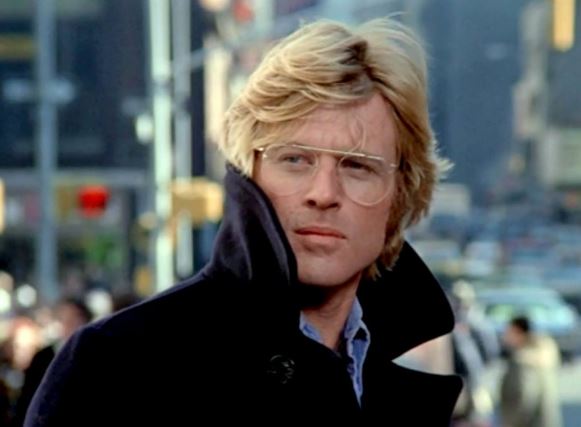
Robert Redford in “Three Days of the Condor”
In fact, as very few people have realized, The Winter Soldier is almost a remake of a 1975 film that most film snobs would agree is “real” cinema: Three Days of the Condor.
The only obvious similarity is that both films feature Robert Redford. In Condor, Redford plays a brilliant but very bookish CIA analyst named Turner who works in a New York City branch office. One day, he comes back from lunch to find everyone in the office dead, murdered by professional assassins. Turner goes on the run. Unsure of who he can trust, he kidnaps an unsuspecting, beautiful woman (Faye Dunnaway) and hides in her apartment. From there, he gradually figures out that the assassins who killed his work-mates were sent by a rogue faction inside the CIA itself. Apparently, Turner’s branch had stumbled upon a secret plot by the faction to invade the Middle East and capture all the oil fields (how very far-fetched, right?). Turner eventually confronts the leader of the faction, as well the head assassin, a Zen-Master-like Frenchman named Joubert (played with brilliant, icy effectiveness by Max von Sydow).
On the surface, Condor might seem like a very different film from The Winter Soldier. But the closer you look, the more The Winter Soldier seems almost like a remix of the earlier film. That is, it has all the same elements. The good-guy-betrayed-by-his-government figure is Steve Rogers (a.k.a. Captain America) who, like Turner in Condor, discovers a vast conspiracy within U.S. intelligence (S.H.I.E.L.D, in this case, rather than the CIA). Like Turner, Rogers finds himself on the run with a beautiful woman (Natasha Romanoff/Black Widow). He confronts the leader of the conspiracy (played by none other than Robert Redford himself). And of course he confronts the lead assassin, Barnes, who (like Joubert in Condor) turns out to be far more complicated than he appears.
Even some of the individual scenes in The Winter Soldier are eerily reminiscent of those in Condor. Take the now famous elevator sequence, which is not only the best in the film but one of the best in the entire MCU series. On his way out of the high-tech and vaguely fascistic H.Q. of S.H.I.E.L.D., Rogers steps into an elevator and rides down. As the elevator stops at successive floors, more and more men step on, each menacing but seemingly disinterested. The scene works so well because everyone can relate to it, to that sense of unease we all fell when forced into close proximity with strangers. We begin to wonder: what if some of these people were evil. They could hurt us—maybe even kill us—before we could react. And yet, despite this unease, we do nothing because we have no real evidence of evil intent. We’re playing a social role. And that’s just what Rogers—a good-natured man if ever there was one, willing to give anyone the benefit of the doubt—does.
Robert Redford in “The Winter Soldier”
I love the moment when Rogers notices sweat streaming down the face of one of the men next to him. He knows—as we, the viewers, know—that this is really, really bad. But there is nothing he can do about it…yet. It’s still in the future. Alfred Hitchcock couldn’t have done it any better. Nor, for that matter, could Sidney Pollack, who has an almost identical scene in Condor, in which the hapless Turner finds himself in an elevator with Joubert, the master assassin. Each man knows that the other man knows who he really is, but neither can take any action…yet.
Ever since I read Mark Crispin Miller’s landmark essay “Hollywood: The Ad” many years ago, I’ve been fascinated the way in which the tropes and elements of an early “classic” movie can end up rearranged and transformed in a later pop film. Miller gives the example of 2001: A Space Odyssey (1968) and Star Wars (1977). If you look closely, many of the components of the former get transmogrified in the latter. The apes of 2001 become the loyal Wookie Chewbacca. The cold, robotic voice of HAL the computer becomes that of C3PO the droid. The white, sterile interiors of the spaceship Discovery become the stark, sterile halls of the Death Star. And so on and so forth.
Martin Scorsese
That’s just what has happened here, with Condor and The Winter Solider. They’re practically the same movie, but shaken up by time and changing purposes. That is, The Winter Soldier is every inch a pop film, with the full intention of stimulating the audience with all the action and explosions and kung-fu fights that we’ve come to expect from a Hollywood blockbuster. But, on some level, the kernel of Condor is still there. The Winter Soldier is also a story about evil, rapacious men seizing control of government, and also the creeping power of America’s military-industrial complex. It’s also about the dehumanization the soldiers like Rogers and Barnes undergo as pawns in the hands of callous leaders and ruthless institutions.
In short, despite all its roller-coaster-ride thrills and spectacle, The Winter Solider is a “real” movie.
American cinema and theater has lost another great character actor this week, Harris Yulin. With his lumpy face and gruff demeanor, Yulin was an everyman—one of those actors that you recognize from countless roles but whose name you never knew.
He was one of the most respected stage, film, and TV actors in the country. And yet, ironically, most viewers today will know his work from two unlikely sources: the TV show Frasier on which he played an affable crime boss and Star Trek: Deep Space Nine, for which Yulin appeared in one famous episode, Duet. It was this particular gig (yes, a frickin episode of Star Trek) that gave Yulin one of his few chances to really show-off his acting chops to a mass audience. I still think he should have gotten an Emmy nomination for it, but oh, well.
In all his performances, Yulin was one of those actors who exude a kind of intelligence, presence and grace that make them stand out a mile on the screen or stage.
The world is a little less interesting today without him in it.
I have a confession to make: I dream about shopping malls. Specifically, one shopping mall, the Oaks Mall here in Gainesville.
The “Collapsed Time” Effect of Vaporwave
After my parents’ divorce, I saw my mother mostly on the weekends, and one of our routine activities was to go to the mall. We would have lunch, see a movie, and wander around. Later, when I got into my teens, I spent a lot more time at the mall with my friends. We hit all the usual spots—the arcade, both bookstores (Waldenbooks and B. Dalton’s), the record store, Spencer’s Gifts, the toy store. And we did anything else we felt like.
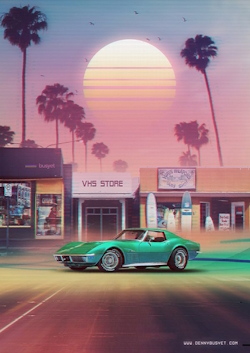
Trappings of the 1980s, along with “Broken Sun” motif
We weren’t alone, of course. After the collapse of downtown America, the mall was the last remaining public square. In suburban America, particularly, it was also the only fun thing to do on a Saturday afternoon. Or a Saturday night, for that matter. When I entered high school and started going on dates, we often went to a movie at the mall. One of my most vivid memories is of how strange and eerie the mall felt after the movie let out at 11:00 or so, and we would walk through the empty, dark hall with all the shops closed and metal gates drawn down. It was one of my first experiences of liminal space, and it sticks with me even today.
In fact, it haunts my dreams. Literally. For when I dream of the Oaks Mall now, I often find myself lost among its corridors near closing time, the wings still busy with shoppers but with the crowd starting to thin out, little by little. Stranger still, my dream-mall is huge—the size of Manhattan Island, practically. A gigantic labyrinth of brand-name stores, all of which are in the early stages of shutting down for the night. (My subconscious, I think, is warning me that the mall is shutting down forever.) These dreams often end in a sense of panic as I realize I am on the wrong side of the mall from my friends, or my car, or whatever, and I will never be able to reach them/it in time before…what? Closing? It’s not clear, but whatever it is, it’s kind of scary.
Despite the disquieting nature of these dreams—or perhaps because of it—I find myself endlessly fascinated by what has come to be known as the Vaporwave aesthetic. Vaporwave is primarily a visual genre, marked by artistic images of 1980s culture. That is, computer graphics, shopping malls, the Miami skyline (alaMiami Vice), fast food restaurants, music videos, video stores, and old-style video games.
And neon. Lots and lots of neon.
Empty Mall / Liminal Space Vibe Typical of Vaporwave
The overriding effect is that of a hyper-real fantasy that feels like a time-portal back to the 1980s. I love these images because they somehow evoke the memory of that long ago time, at least for me. More accurately, they evoke the feeling I wanted to have at the timebutcould never quite capture. The feeling of an endless, prosperous, fun, high-tech future.
I think that this is the real power of nostalgia. A wise man once defined nostalgia as a fondness for a Time that never existed. I don’t think that’s quite right. Nostalgia is a fondness not for a lost time but for a lost hope—the hope one felt and in a familiar place and a long-ago time. A hope that, though never realized, still lingers in the heart.
That sense of lost opportunity is, I think, reflected in the very name of the genre itself, vaporwave, which is very similar to vaporware, a term coined in the 1980s to mean great-looking software that was promised by advertisers and corporations but which never actually materialized. It simply evaporated.
The same thing happened to our collective dreams back in the 1980s. My friends and I all hoped that we could look forward to a glorious future, one better than that of our parents’ and teachers’ generation. A future that would be made bright by the many technological revolutions (the digital revolution, especially) that were impacting every aspect of our culture: movies, TV, music, art, games, fashion, and even books. The haunting images of vaporwave reflect that lost dream—rather than the sterile reality—of the 1980s and ’90s.
Many vaporwave images seem to have a psychedelic “collapsed time” feel to them, as did many of the music videos and computer-generated short films of that era. The hippie generation had the psychedelic flower as their symbol. We had the computer-generated sun—the so-called “broken sun”—which seems to have been pulled directly from of a film poster or a television commercial from 1982.
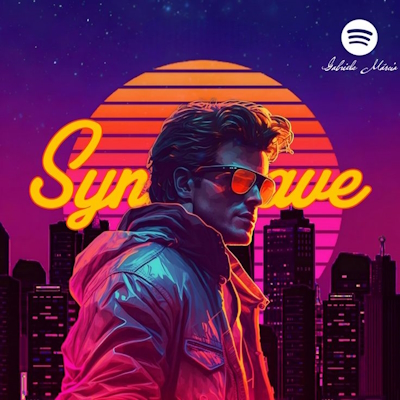
As attracted as I am to vaporwave, I am equally drawn to its parallel music genre, synthwave. Like vaporwave, synthwave is characterized by the early computer-era vibe, as symbolized in synthesized music. Not actual synthesized music from the 1980s, of course, but rather music that sounds a lot like it, yet is somehow drained of all melodrama and false tension that characterized synth-music back then. Synthwave has a kind of purity to it. A simple beauty that surpasses the actual music of that time.
In other words, synthwave is to actual 1980s music what Andy Warhol was to actual advertisements of the 1950s. His silk screen images of Campbell’s soup cans looked almost exactly like actual soup cans, but larger, stylized, more vivid. They made the world really see Campbell’s soup cans—the sublime nature of everything, even a mass-produced soup can—for the first time. Warhol’s genius lay in his ability to show us the beauty and promise of something that was once central and even commonplace in our lives, even as it mocked (lovingly) that very same thing.
That’s what vaporwave does, too. Through the alchemy of art, it somehow humanizes the relentless, corporate-controlled media barrage of the 1980s. For me, and millions of others like me, it is literally the stuff that dreams are made of.
Or were made of, that is. Back in the day.
Lo-Poly, Computer-Generated Background with Broken Sun
Blatent Consumerism of the 1980s, both celebrated and mocked
Once again, it has taken me far too long to write a short tribute to a fine person who has passed away—Val Kilmer, who died of pneumonia on April 1. This time, it was more than just my workload that explains the delay. I had a bit of trouble discovering what I wanted to say about Kilmer, who was a great actor but also a bit of a cipher. A few years ago, I read his memoir, I’m Your Huckleberry, and I enjoyed it. I was struck, however, by how little Valmer says about his filmmaking experiences. For instance, he barely mentions the production of Tombstone, the film in which Kilmer had his most celebrated film performance—playing the famous gunfighter Doc Holliday—and from which the book’s title is taken. He says even less about the making of Michael Mann’s Heat, in which Kilmer portrays a talented but slightly crazy master-burglar with pitch-perfect ferocity.
This lack of detail was especially disappointing, to me, in part because Heat has my favorite action-sequence of all time—the shoot-out in Century City. More than any other actor in the scene, it’s Kilmer who makes it work, with his fluid transition from cool and controlled bank-robber to machine-gun wielding warrior. I read an autobiography written by a Navy Seal who wrote that he and his comrades once watched Heat together and were impressed by Kilmer’s magazine-changing speed in the film. High praise, indeed.
This reticence on Kilmer’s part to discuss his film-making career—the very aspect of his life that made him famous across the world—suggests to me that Kilmer was deeply ambivalent about being a movie star. I suspect that, like the great Welsh actor Richard Burton, Kilmer was simply too intelligent to think that movie-making was a worthy and serious endeavor. I also suspect that, like Burton, Kilmer was much happier as a stage actor. (His one-man show of Mark Twain was universally praised.)
Unfortunately, his ambivalence somehow bled into his performances whenever he played a leading man, as he did in several major films, none of which was terribly successful. He never seemed to really have his heart in it. But that self-doubt evaporated when he played supporting roles, and these are what he will be remembered for: Iceman in the Top Gun films; Doc Holliday in Tombstone; Chris in Heat. In each of the movies, Kilmer seemed to bring his entire soul to the performance, and he was every inch the movie star.
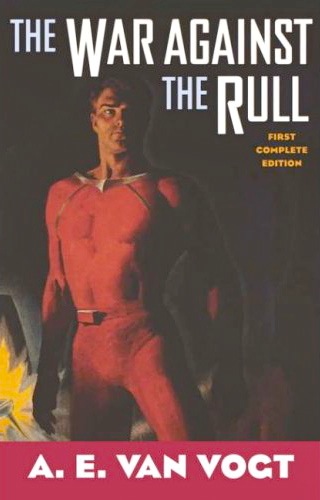
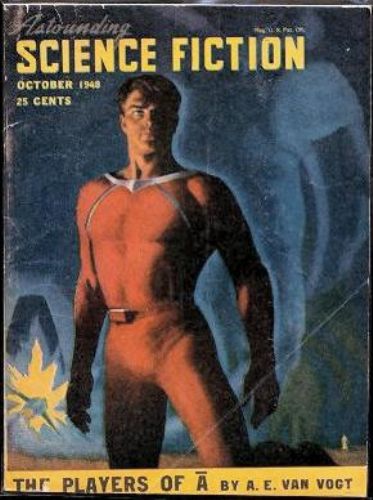
This entry in my on-going Classic Sci-Fi Book Covers series is both old and new. That is, it’s a modern touch-up of the cover from the October 1949 edition of Astounding Science Fiction painted by Hubert Rogers. That issue included a work by A.E. van Vogt, but not the one we are interested in here. This modern version is from a 1999 edition of van Vogt’s classic sci-fi novel, The War Against the Rull, which I distinctly remember devouring in two days when I was in eighth-grade.
I like this cover a lot. It’s not just a classic. It’s an archetype. Specifically, the archetype of the heroic (America) scientist, a buff intellectual and polymath whose ilk could be found in countless works of Isaac Asimov, Robert Heinlein, Roger Zelazny, and on an on. In The War Against the Rull, the man is Dr. Trevor Jamieson, a brilliant scientist who is also a fierce warrior and survival-expert. He’s stranded on an alien planet with a huge, six-legged, intelligent creature called an ezwal who wants to kill him. But when both Jamieson and the ezwal encounter a mutual enemy—a race of aggressive, centipede-like aliens called the Rull—they decide to work together to survive.
It’s a great story, like so many from the sci-fi’s Golden Age. I’ve written before about why sci-fi novels from that era are so much more enjoyable (to me, at least) than most of those written in the last ten years or so. I think it has to do with the gritty humanity of such stories. Yeah, Jamieson is essentially a comic-book character (think Doctor Quest and Race Bannon rolled into one), but van Vogt does a great job of making you believe he’s in real trouble. The ezwal, too—he’s a compelling character in his own right. You get involved in the desperate nature of their situation, and you keep reading to see how they will get out of it.
Anyway, check it out if you can…
Original Cover from AstoundingCover from the 1970 edition that I read as a kid (by artist John Schoenherr)Another version of the Scientist Hero Archetype (by artist James Bama)
In any given decade, one or two musicians discovers exactly the right sound, look, and vibe to capture the spirit of the times. Such “triple-threat” artists are rare. Elvis Presley was one. David Bowie was another.
For many in my generation of kids growing up in the early 1980s, there were two such figures. One was Madonna. The other was Billy Idol. Unless you were a teenager in that dark, troubled time, you can’t imagine what a huge impact Idol had on youth culture. Let’s start with his look, an ingenious mix of pre-Goth romanticism (complete with black leather and rosary beads) and science-fiction cyberpunk (he had the same peroxide blond hair and chiseled features as Rutger Hauer’s Nazi replicant in Blade Runner).
Idol looked like…well…an idol. A pop idol, that is. But it was his sound that really mattered. Just as Elvis took the energy and soul of R&B and turned into something that middle-class, white American kids could enjoy, Idol took the punk sound of 1970s London and turned it into kick-ass American hard rock. His early hits like “White Wedding” and “Mony, Mony” stuck out a mile on FM radio (not to mention MTV, where they stuck out two miles). Not only were his songs vicious and fast, they had an actual beat; you could dance to them. And we did.
In short, Idol did what the Sex Pistols never could: he brought punk to mainstream America.
Some years ago, my son Connor and I were watching the movie Dunkirk on DVD. It’s a very good movie, telling the story of that fateful week from multiple points-of-view. Of course, the most compelling thread of the narrative is that of the lone RAF pilot (played by Tom Hardy) doing his heroic best to protect the stranded British troops.
These scenes inevitably led to a geek-worthy discussion between Connor and me about the relative merits of the RAF’s Spitfire versus the Luftwaffe’s Messerschmitt 109. Believe it or not, such discussions are becoming more common between fathers and sons (and mothers and daughters, for all I know), mainly because of online games like War Thunder, whose popularity has breathed new life into the study of military history by the Millennial generation.
Anyway…. At some point during the discussion, I offhandedly commented that I had once flown in Adolf Hitler’s airplane.
My parents divorced when I was a little kid. My mom was struggling with mental illness (undiagnosed, at the time) and so I went to live with my father and his new wife, my step-mother Eileen. I saw my mom mostly on the weekends, and we would invariably go to the movies. I probably saw over fifty movies in the theater per year, all with my mom.
I seldom went to the movies with my father, and even more seldomly when it was just the two of us. The last time I remember was in 1992. Eileen was out-of-town with my brother and sister, so Dad and I went to see Clint Eastwood’s Unforgiven. It’s a great movie, and both my father and I loved it. We especially admired Gene Hackman’s performance as the villainous sheriff Little Bill Daggett, who, as Hackman himself revealed, is a kind of precursor to the modern right-wing movement.
My dad and I went out to dinner after the movie, and we shared our favorite moments from the film. It’s one of my fondest memories. I thought of it this morning when I read that Hackman had died. And I thought of something else, too. It occurred to me that the last movie I saw alone with my mother was also a Gene Hackman film, 1985’s Twice in a Lifetime. It’s about as different a film from Unforgiven as one can possibly imagine, with Hackman playing a completely different kind of character. And yet, it was still Hackman. Still low-key. Still forceful. Still brilliant.
What are the odds that the two last movies I saw with each of my parents alone were both Hackman films? Pretty good, actually. He was in a lot of movies. In fact, you could argue that he was the most versatile, compelling, and attractive character actor in Hollywood history. He played villains and heroes, and everything in between, across genres from action to mystery to sci-fi. In Twice in a Lifetime, he played an unassuming everyman who, on the tail-end of middle-age, leaves his wife to make a new start. He was also Lex Luthor in Superman. And Pop-eye Doyle in The French Connection. And the blind guy in Young Frankenstein.
Being a writer of mysteries, I’m particularly fond of Authur Penn’s 1975 film Night Moves, in which Hackman played a world-weary P.I. searching for a missing girl. It’s one of trademark, understated performances, and yet it crackles with energy. That was his gift.
One of my favorite movies of the last twenty years is Ridley Scott’s The Martian. It’s a science-fiction/adventure movie about an astronaut (Matt Damon) who becomes stranded on Mars after his comrades leave him for dead. Marooned on a barren, hostile world, he has to use his brains and ingenuity to survive until his friends come back to rescue him. By the end of the movie, he has survived dust storms, explosions, freezing temperatures, and starvation.
How does he overcome all these challenges?
Science.
The story is familiar, of course. It has many antecedents, including with the original stranded-on-an-island novel, Robinson Crusoe, and also (more directly) to a great B-movie Robinson Crusoe on Mars. In that classic 1964 cheese-fest, the hero survives by finding a Martian cave full of air where plants still grow, water still flows, and there’s a steady source of light (which is never explained). He even befriends an alien who is also trapped on the planet.











 Ash Clifton, Writer